Peptides A–Z
One profile per peptide. Each opens with what it is, whether the FDA has approved it, and how much human evidence exists, then the dosage, side effects and legality spokes under it. We do not sell, rank vendors, or link to anything labeled for research use.
Every peptide, A–Z
- AOD-9604Not FDA approved
Modified hGH 177-191 fragment (16 amino acids). PCAC voted 0 to 12 against it in December 2024; no compounding route.
- BPC-157Not FDA approved
Gastric pentadecapeptide. Rodent healing data, plus five small human studies. PCAC recommended it July 2026; no final rule. Interim HHS policy (Oct 2026) covers injected, oral and topical forms, with conditions.
- CJC-1295 / IpamorelinNot FDA approved
GHRH analogue plus GH secretagogue. PCAC voted against both in late 2024; neither is on the bulks list.
- EpitalonNot FDA approved
Synthetic tetrapeptide; Russian studies only. PCAC recommended it July 2026; no final rule. Interim HHS policy (Oct 2026) covers injected forms in intermittent courses, with conditions.
- GHK-CuNot FDA approved
Copper peptide. Topical cosmetics are not drugs. Injectable GHK-Cu has no compounding route; non-injectable forms are back in 503A category 1 (May 14, 2026 list), with FDA intending to consult PCAC by Feb 2027.
- IpamorelinNot FDA approved
Growth hormone secretagogue. PCAC voted against it in October 2024 (0 yes, 12 no, 1 abstain on each form); not on the bulks list.
- KPVNot FDA approved
Alpha-MSH fragment; anti-inflammatory in animal models. PCAC recommended it July 2026; no final rule. Interim HHS policy (Oct 2026) covers topical and oral forms only, with conditions. Injected KPV is not covered.
- MK-677 (ibutamoren)Not FDA approved
An oral ghrelin mimetic, not a peptide; listed because it is sold alongside them. Not approved for anything; in 503A category 2 as of May 2026.
- MOTS-cNot FDA approved
Mitochondrial-derived peptide. PCAC recommended it July 2026; no final rule. Interim HHS policy (Oct 2026) covers injected forms, with conditions.
- NAD+Compounded (Rx)
Not a peptide. NAD and NADH are in 503A category 1 and compounded under FDA interim policy; the disodium salt form is in category 3.
- PT-141 (bremelanotide)FDA approved
Vyleesi, approved 2019 for hypoactive sexual desire disorder in premenopausal women.
- SelankNot FDA approved
Anxiolytic peptide studied mainly in Russia. Not approved in the US; no compounding route.
- SemaxNot FDA approved
Seven-amino-acid nasal peptide. PCAC recommended it July 2026; no final rule. Interim HHS policy (Oct 2026) covers intranasal use only, with conditions. Injected semax is not covered.
- SermorelinCompounded (Rx)
GHRH 1-29. Geref withdrawn 2009 (not for safety). Compounded with a prescription; in 503B category 1 as a component of an approved drug.
- SS-31 (elamipretide)FDA approved
Forzinity, accelerated approval Sept 19, 2025 for muscle strength in Barth syndrome (patients 30 kg and up). Research-sold elamipretide is not the approved product.
- TB-500 (thymosin beta-4 fragment)Not FDA approved
PCAC recommended it July 2026; no final rule. Interim HHS policy (Oct 2026) covers injected forms, with conditions.
- TesamorelinFDA approved
Egrifta SV and Egrifta WR, approved for excess abdominal fat in adults with HIV. Regulated as a biologic since 2020, so not compoundable.
- Thymosin alpha-1Not FDA approved
Immune-signaling peptide (thymalfasin). Not FDA-approved in the US, and not covered by the October 2026 HHS policy.
Status as of Nov 2, 2026. "Interim HHS policy" means HHS says it does not intend to take enforcement action against compounding that meets ten conditions; it is not FDA approval. The FDA status tracker has the full record.
Profiles
- AOD-9604 overviewAOD-9604Not FDA approved
A synthetic hexadecapeptide (Tyr plus human growth hormone residues 177-191) developed for obesity; marketed online as 'fat-burning' injections.
- BPC-157 overviewBPC-157Not FDA approved
A synthetic 15-amino-acid fragment of a protein found in human gastric juice, studied for tissue healing in animals.
- CJC-1295 / Ipamorelin overviewCJC-1295 / IpamorelinNot FDA approved
Two different peptides often sold together: CJC-1295, a modified growth hormone-releasing hormone, and ipamorelin, a ghrelin-receptor agonist.
- Epitalon overviewEpitalonNot FDA approved
A synthetic tetrapeptide (alanine, glutamic acid, aspartic acid, glycine) developed in Russia as a 'synthetic analog' of epithalamin, a pineal gland extract.
- GHK-Cu overviewGHK-CuNot FDA approved
A naturally occurring tripeptide (glycine, histidine, lysine) bound to a copper ion, used in skin-care products as copper tripeptide-1.
- Ipamorelin overviewIpamorelinNot FDA approved
A synthetic five-amino-acid peptide that activates the ghrelin receptor and triggers a pulse of growth hormone.
- MK-677 (ibutamoren) overviewMK-677 (ibutamoren)Not FDA approved
An oral, non-peptide small molecule that activates the ghrelin receptor and raises growth hormone and IGF-1. Also called ibutamoren mesylate and, in current trials, LUM-201.
- MOTS-c overviewMOTS-cNot FDA approved
A 16-amino-acid peptide encoded in mitochondrial DNA, studied for metabolism and exercise capacity in mice.
- NAD+ overviewNAD+Compounded (Rx)
A coenzyme made of two nucleotides joined by phosphate groups, central to energy metabolism; sold in clinics as IV infusions, injections and nasal sprays.
- PT-141 overviewPT-141FDA approved
A synthetic ring-shaped seven-amino-acid peptide that activates melanocortin receptors, sold as Vyleesi.
- Selank overviewSelankNot FDA approved
A synthetic heptapeptide (Thr-Lys-Pro-Arg-Pro-Gly-Pro) developed in Russia as an anxiolytic, sold there as Selank 0.15% nasal drops.
- Semax overviewSemaxNot FDA approved
A synthetic heptapeptide (Met-Glu-His-Phe-Pro-Gly-Pro) based on a fragment of the hormone ACTH, sold in Russia as 0.1% and 1% nasal drops.
- Sermorelin overviewSermorelinCompounded (Rx)
A synthetic 29-amino-acid fragment of human growth hormone-releasing hormone that prompts the pituitary to release growth hormone.
- SS-31 (elamipretide) overviewSS-31 (elamipretide)FDA approved
A mitochondria-targeted tetrapeptide (D-Arg-Dmt-Lys-Phe-NH2) that binds cardiolipin; the active ingredient in Forzinity.
- TB-500 overviewTB-500Not FDA approved
A synthetic, acetylated seven-amino-acid fragment (amino acids 17 to 23, LKKTETQ) of thymosin beta-4, first used in veterinary and doping settings.
- Tesamorelin overviewTesamorelinFDA approved
A synthetic analog of growth hormone-releasing factor (GHRH), injected under the skin once a day to raise the body's own growth hormone.
- Thymosin alpha 1 overviewThymosin alpha 1Not FDA approved
A synthetic 28-amino-acid peptide first isolated from cattle thymus extract, marketed outside the US as thymalfasin (Zadaxin) to modify immune responses.
- KPV overviewKPVNot FDA approved
A three-amino-acid peptide (Lys-Pro-Val), the C-terminal end of alpha-melanocyte-stimulating hormone, studied for anti-inflammatory effects in cells and animals.
How to read a profile
The top panel tells you three things before anything else: what the peptide is, its FDA status and its evidence level. "Animal studies only" means exactly that. The dosage spoke for such a peptide reports what rodent studies used and why that does not translate to humans, rather than inventing a protocol. Approved drugs get their label schedule. Where a peptide has only limited human data, the page reports what those studies used and says that no human dose has been established.
What counts as a peptide?
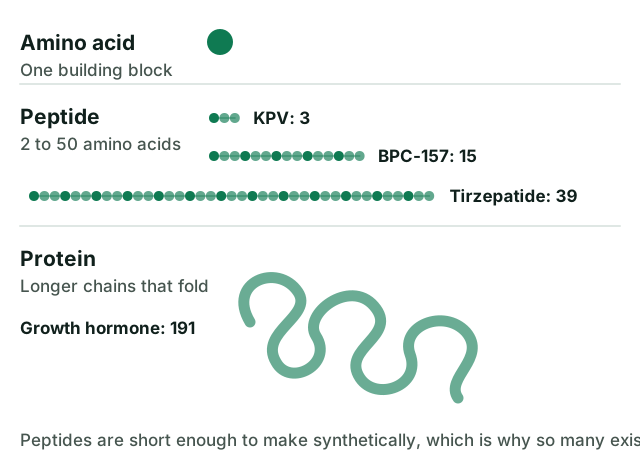
Peptides are short chains of 2 to 50 amino acids, which covers a three-amino-acid fragment like KPV and a drug like tirzepatide alike. Size tells you nothing about safety or evidence, so the status badge matters more than the chemistry. A few entries here are not peptides at all, including NAD+ and MK-677, and they appear because they are sold alongside peptides.
What did the October 2026 HHS policy change?
It changed how HHS says it will enforce the law for six peptides, and it changed nothing about what is known about them. As of November 2, 2026, HHS says it does not intend to take enforcement action against a state-licensed pharmacy, federal facility or licensed physician compounding BPC-157, TB-500, MOTS-c, epitalon, KPV or semax when ten conditions are met, until a final rule decides each one. Those conditions include a prescription for a named patient and a single active ingredient per product.
None of the six is FDA-approved or on the 503A bulks list, and no rule has been proposed. FDA has not reviewed any compounded product for safety, effectiveness or quality. The notice says the policy creates no rights and is not binding, HHS may revisit it if a safety or quality problem appears, states can be stricter, and comments are open until November 13, 2026. It covers 503A compounding only, so outsourcing facilities are outside it. Each profile keeps its evidence level as it was. The HHS policy news item lists the limits peptide by peptide.
How do you compare two peptides?
The compare tool puts any two profiles side by side, with FDA status, evidence level and the spokes for each. For a question that starts from an outcome rather than a name, peptides by goal is the better door. Where a real head-to-head question exists, there is a page for it, such as sermorelin vs tesamorelin.
Why there is no "where to buy"
Because we describe peptides and do not help anyone obtain them. Products sold "for research use only" are not legal to use on people, and HHS says its policy is meant to discourage them. They are not tested for identity, purity or sterility for injection, and a label on the vial proves nothing about what is inside. If you have a prescription, the pharmacy is the source and your prescriber is the person to ask. The status tracker explains the categories and the practical test.