Short answer
NAD+ injections and IV drips have not been shown to deliver the energy or anti-aging benefits clinics advertise. NAD+ is a coenzyme, not a peptide, and no NAD+ drug is FDA-approved; pharmacies compound it under an FDA interim policy. Drips can cause nausea, cramping and chest discomfort, especially when run fast.
- What it is
- A coenzyme made of two nucleotides joined by phosphate groups, central to energy metabolism; sold in clinics as IV infusions, injections and nasal sprays.
- FDA status
- Compounded (Rx)
Not FDA-approved. Nicotinamide adenine dinucleotide (NAD) and NADH are in 503A category 1 (under evaluation) on the May 14, 2026 list, so FDA does not intend to act against compounding them if the interim policy's conditions are met. A disodium salt form is in category 3, which the policy does not cover.
- Evidence level
Early human studies
Small or uncontrolled human studies only.
NAD+ drips and shots have not been shown to give people more energy, sharper thinking or slower aging, which is what most clinics sell them for. NAD+ is not even a peptide. It is a coenzyme, a helper molecule every cell uses to turn food into energy, and it sits in our peptide index only because the same clinics offer it. No NAD+ drug is FDA-approved. What it does have, unlike most peptides here, is a compounding route: FDA lists it in 503A category 1 while it evaluates it.
| Question | Short answer as of November 2, 2026 |
|---|---|
| Is it a peptide? | No. It contains no amino acids |
| FDA-approved? | No. No approved NAD+ drug exists |
| How it is sold | Compounded IV drips, injections under the skin or into muscle, nasal sprays; also research-labeled powder |
| Outcome trials for wellness | None for injected or infused NAD+, per a 2026 systematic review |
| Most reported drip side effects | Nausea, cramping, flushing, chest discomfort, worse at faster rates |
| Covered by the October 2026 HHS peptide policy? | No. That policy names six peptides; NAD+ has its own, older category 1 route |
What NAD+ is, and why it is not a peptide
NAD+ stands for nicotinamide adenine dinucleotide. It is two nucleotides joined through their phosphate groups: one carries nicotinamide, a form of vitamin B3, and the other carries adenine. A peptide, by contrast, is a short chain of amino acids. In cells, NAD+ shuttles electrons in the reactions that make energy, flipping between NAD+ and its reduced form, NADH. It is also used up by enzymes involved in DNA repair and cell signaling, which is the basis of the anti-aging interest.
The body makes NAD+ from dietary niacin, nicotinamide and tryptophan. Oral “precursors” such as nicotinamide riboside (NR) and nicotinamide mononucleotide (NMN) are sold as supplements on the idea that they raise NAD+ levels. A 2026 narrative review of IV NAD+ noted that recent large human data indicate “whole-blood NAD+ concentrations do not decline with healthy aging,” which undercuts the simplest version of the marketing: that everyone’s NAD+ runs low with age and needs topping up.
NAD+ benefits: what the evidence shows
The real benefit of NAD+ is that you cannot live without it, and your cells make their own. The open question is whether adding more from outside helps a healthy person, and for drips and shots no trial has shown that it does.
| Claimed benefit | What the human evidence shows |
|---|---|
| More energy, less fatigue | No placebo-controlled outcome trial of injected or infused NAD+ |
| Slower aging, longevity | No outcome trial. A 2026 review called IV longevity therapy “an experimental intervention” |
| Raising NAD+ levels | Oral NR at 2,000 mg a day for 28 days raised whole-blood NAD+ about 3-fold, as the 2026 narrative review describes; the review warns blood levels do not show organ levels |
| Better blood sugar control | Two oral NR trials found no significant improvement in insulin sensitivity despite higher NAD+ metabolites, per the same review |
| Heart failure | One trial of 180 patients in China used 10 mg IV a day for 7 days; pumping fraction was higher at 1 month, admissions did not differ significantly |
| Addiction recovery, cognition, athletic performance | No published placebo-controlled trial of injected or infused NAD+ found |
Two things make the drip claims especially hard to support. First, NAD+ in the blood does not stay NAD+ for long. Enzymes on cell surfaces, most notably CD38, cut it into nicotinamide and ADP-ribose, and the 2026 narrative review says “it remains uncertain how much intact NAD+ enters cells.” A rise in blood levels does not show that muscle or brain got more. Second, the oral precursors have more human data than the drips do. They raise NAD+ markers and are generally well tolerated, yet the 2026 systematic review found their functional results mixed or null.
NAD+ IV drip vs injection
The two routes deliver very different amounts in very different ways, and neither has outcome data for wellness.
| IV drip | Injection under the skin or into muscle | |
|---|---|---|
| Amount in published studies | 500 to 1,000 mg; 750 mg in the 2019 pilot | 100 mg once daily for 3 days in one small trial |
| How long it takes | 97 minutes on average in one clinic review; 6 hours in the 2019 pilot | Seconds |
| Human studies | A few small pilot, retrospective and single-center studies | One randomized pilot of 45 adults split across nine arms, posted as a preprint and funded by a company that sells an NR product |
| Main side effects | Cramping, nausea, vomiting, flushing, chest pressure during the infusion | Pain, redness and itching at the site; flushing reported with some shots |
| Outcome evidence | None for wellness | None |
What the injection data show
The only controlled human data on NAD+ shots come from a 2026 preprint, which has not yet been peer reviewed. In one trial, 45 adults received placebo, NR or NAD+, each by vein, under the skin or into muscle, 100 mg a day for 3 days. Only 4 to 6 people were in each NAD+ group. Under the skin, NR and NAD+ “performed comparably,” and the authors reported no severe or unexpected adverse events attributable to either. The trials were funded by ChromaDex, which makes NR and holds patents on its use, and the authors describe their findings as a preliminary safety signal. That is a tolerability check in a few dozen people over days. It says nothing about benefit, and nothing about the weekly injections some clinics sell for months.
NAD+ infusion reactions
Drips are where most of the reported side effects happen, and the speed of the drip matters. The 2026 narrative review lists nausea, cramping, flushing and chest discomfort, “particularly at faster infusion rates.”
The clearest real-world picture comes from a 2026 review of records at a wellness clinic. Six clients had 500 mg of NAD+ in 500 mL of saline on four consecutive days, controlling their own drip rate. All six reported moderate to severe abdominal cramping, diarrhea, nausea, vomiting, faster heart rate, throat pain, congestion and chest pressure, and they slowed their drips because of it. The symptoms ended when each infusion finished, and no adverse events were documented. Eight clients given NR instead finished in about 37 minutes, with milder effects. All the authors worked for the clinic, and six people is a very small group. The 2019 pilot, which ran 750 mg over 6 hours, roughly 2 mg a minute, reported no adverse events at that slow rate.
Some reactions have nothing to do with NAD+ itself:
- Contamination. In January 2026 FDA warned a 503B outsourcing facility after three patients went to the emergency room with low blood pressure, uncontrollable shaking, shivering and body aches after NAD+ from the same vial. An unopened vial from that lot held 3,360 EU/mL of bacterial endotoxin, a toxin that causes fever and shock. The firm had recalled its sterile products in July 2025.
- The line itself. Any drip can cause bruising, vein irritation or infection at the needle site.
- Long term. Unknown. Reviews note that long-term safety data are lacking.
Low blood pressure, shaking and chills after a drip, as in FDA’s contamination case, are not the usual NAD+ discomfort and need urgent medical care.
FDA status in detail
| Question | Answer as of November 2, 2026 |
|---|---|
| Is there an FDA-approved NAD+ drug? | No |
| Which forms are in 503A category 1? | Nicotinamide adenine dinucleotide (NAD) and nicotinamide adenine dinucleotide disodium reduced (NADH) |
| Is any form in category 3? | Yes: beta-nicotinamide adenine dinucleotide disodium salt trihydrate, “nominated without adequate support,” which the interim policy does not cover |
| What does category 1 mean? | FDA “does not intend to take action” against a state-licensed pharmacy, federal facility or licensed physician compounding with it, if the policy’s conditions are met |
| Is it on the 503A bulks list? | No. Category 1 is a holding position while FDA evaluates it |
| Can a 503B outsourcing facility use it? | FDA’s January 2026 warning letter said NAD+ is not on the 503B bulks list, so products a 503B facility compounds from it do not qualify for that exemption |
FDA’s January 2025 interim policy sets four conditions for compounding with a category 1 substance: the substance must appear in category 1; every manufacturer of the bulk ingredient must be registered with FDA; the ingredient must come with a valid certificate of analysis; and the compounded drug must meet every other condition of section 503A, which includes a prescription for an individual patient. FDA can move a substance out of category 1 if it identifies safety risks. The exact salt form matters: a pharmacy using the category 3 form is outside the policy.
The HHS enforcement policy announced on October 28, 2026 is a separate thing. As of November 2, 2026, it covers six peptides (BPC-157, TB-500, MOTS-c, KPV, epitalon and semax) under ten conditions, approves none of them, and does not include NAD+. Nothing about NAD+’s route changed that week.
None of this makes compounded NAD+ an approved drug. FDA says it “does not verify the safety, effectiveness or quality of compounded drugs before they are marketed.” In August 2026 FDA reported at least 30 patients with sepsis-like reactions after IV glutathione compounded from a supplement-grade ingredient, a reminder that ingredient grade matters for anything infused.
What the human studies show
| Study | Who | What was given | What was found |
|---|---|---|---|
| Grant et al. 2019, Front Aging Neurosci | 11 men (8 NAD+, 3 saline) | 750 mg NAD+ by IV over 6 hours (about 2 mg a minute) | NAD+ vanished from the blood for at least the first 2 hours before levels rose; no adverse events at this slow rate; a pharmacokinetic study, not an outcomes trial |
| Yu et al. 2025, Am J Cardiovasc Drugs | 180 adults with heart failure from ischemic cardiomyopathy, one center in China | 10 mg NAD+ IV daily for 7 days, or placebo, with standard heart failure treatment | Heart pumping fraction (LVEF) at 1 month 45.4% vs 42.4% on placebo; trends, not significant differences, in hospital admissions |
| Reyna et al. 2026, Front Aging | 6 NAD+ and 8 NR clients, one clinic, retrospective | 500 mg IV daily for 4 days | Every NAD+ client had moderate to severe infusion symptoms; drips averaged 97 minutes against 37 for NR |
| Gallagher and Emmanuel 2026, systematic review | 33 human and 80 rodent studies, 2010 to 2025 | NAD+ and its precursors by any route | Oral NR and NMN raise NAD-related levels and are generally well tolerated, with mixed or null functional results; “no eligible outcomes trials evaluated intravenous or intramuscular NAD+ itself for anti-aging or wellness indications” |
| Alangari et al. 2026, narrative review | Human data on IV NAD+ and IV precursors, 2018 to 2026 | IV NAD+ and NMN | Evidence “consists primarily of small uncontrolled studies, observational investigations, and isolated case reports” and is “insufficient to support routine clinical or wellness use” |
The doses differ enormously: the heart failure trial used 10 mg a day, while drips in the other studies used 500 to 1,000 mg, so the trial says nothing about drip-clinic protocols. A 2026 dermatology review of IV “longevity therapy,” including NAD+, concluded it “should be regarded as an experimental intervention.” For nasal sprays, we found no human studies at all.
WADA status
NAD+ is not a named substance on the 2026 WADA Prohibited List. The way it is often given can be a problem: prohibited method M2.2 bans “intravenous infusions and/or injections of more than a total of 100 mL per 12-hour period” except those received legitimately in hospital treatment, surgery or clinical investigations. A 500 mL wellness drip breaches that limit whatever is in the bag.
Research-labeled NAD+ powder
NAD+ is also sold online as powder marked “for research use only.” That label, under 21 CFR 312.160, covers shipment for laboratory animal or test-tube work, and these products are not legal to use on people. They are not the compounded product described above: there is no prescription, no pharmacy, no verified sterility and no registered-manufacturer requirement. The guide to reading a COA explains why a seller’s certificate does not fill that gap.
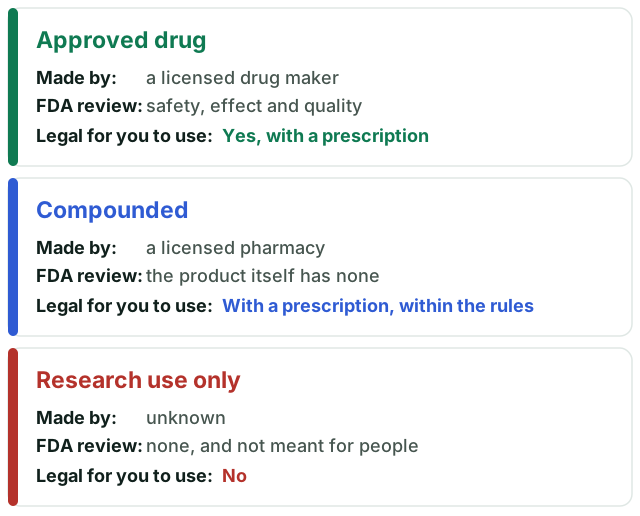
NAD+ has no approved column, so only the last two kinds exist for it.
Questions to ask before an NAD+ drip or shot
- Who made it? A state-licensed 503A pharmacy compounding for you, on a prescription with your name, is the route FDA’s category 1 policy describes.
- Which form? NAD or NADH is in category 1; the disodium salt trihydrate is in category 3 and outside the policy.
- What grade was the ingredient? FDA’s glutathione and NAD+ actions both involved sterile injectables gone wrong. Ask whether the bulk ingredient came with a certificate of analysis from an FDA-registered maker.
- How much, and how fast? Ask the dose in milligrams, the bag volume and the planned infusion time, since faster drips bring more symptoms.
- What happens if I feel unwell? Someone should be able to slow or stop the drip and recognize a reaction that needs emergency care.
- What result should I expect? Since no trial shows a wellness benefit, a clinic promising one is promising more than the evidence holds.
The peptide therapy guide covers checking a clinic and pharmacy more broadly.
Who should be cautious, and what to watch for
- Anyone expecting proven benefit. No published trial supports the wellness claims for injected or infused NAD+.
- People with heart or kidney disease, or who are pregnant. These groups have not been studied in wellness use.
- Symptoms during a drip. Chest discomfort, severe cramping or shortness of breath are reasons to stop and get medical attention.
- Product and pharmacy. A legitimate compounded product has a prescription, a licensed pharmacy’s label, the patient’s name and a beyond-use date. The guide to peptide safety covers compounding risks, and the FDA status tracker carries NAD+ in its own row.
Compare
Peptide news, sorted. Plus the printable dose chart.
Sorted, every Tuesday: the week's peptide and GLP-1 news in five minutes: FDA moves, new studies explained, and price changes. Subscribe and the one-page dose and injection-site chart arrives first.
Questions people ask
Is NAD+ a peptide?
Is NAD+ injection FDA-approved?
What are the benefits of NAD+?
Is an NAD+ injection better than an IV drip?
What are the side effects of an NAD+ drip?
Is NAD+ banned in sport?
Sources
Primary sources first: FDA labels and documents, peer-reviewed trials, registries.
- 1FDA. Bulk drug substances nominated for use in compounding under section 503A, category list (updated May 14, 2026)fda.gov
- 2FDA. Interim policy on compounding using bulk drug substances under section 503A of the FD&C Act, guidance for industry, January 2025fda.gov
- 3FDA. Bulk drug substances used in compounding under section 503A of the FD&C Act (content current as of May 14, 2026)fda.gov
- 4FDA. Compounding and the FDA: questions and answers (content current as of September 16, 2025)fda.gov
- 5Grant R et al. A pilot study investigating changes in the human plasma and urine NAD+ metabolome during a 6 hour intravenous infusion of NAD+. Front Aging Neurosci 2019;11:257doi.org
- 6Gallagher C, Emmanuel OO. NAD+ supplementation for anti-aging and wellness: a PRISMA-guided systematic review of preclinical and clinical evidence. Ageing Res Rev 2026;116:103057doi.org
- 7Alangari A et al. Narrative review of intravenous NAD+ and NAD+ precursors in wellness and translational medicine. Front Aging 2026;7:1887175doi.org
- 8Reyna K et al. Intravenous infusion of NAD+ versus nicotinamide riboside (NR): a retrospective tolerability pilot study in a real-world setting. Front Aging 2026;7:1652582pmc.ncbi.nlm.nih.gov
- 9Preliminary safety analysis of two pilot clinical trials involving injections of Niagen (nicotinamide riboside chloride). medRxiv preprint, April 2026, not peer reviewedmedrxiv.org
- 10Yu X et al. Effect of nicotinamide adenine dinucleotide on heart failure caused by ischemic cardiomyopathy: a randomized, placebo-controlled trial. Am J Cardiovasc Drugs, published online September 2025doi.org
- 11Godic A, Townsend J. Intravenous longevity therapy: a critical review of evidence, mechanisms, and clinical utility. Acta Dermatovenerol Alp Pannonica Adriat 2026;35(1):39-43pubmed.ncbi.nlm.nih.gov
- 12FDA. Warning letter to GenoGenix LLC, a 503B outsourcing facility, #718739, January 20, 2026fda.gov
- 13FDA. FDA reminds compounders not to use dietary supplement grade glutathione in injectables, August 27, 2026fda.gov
- 14HHS. Enforcement Discretion Policy Regarding 503A Compounding Using Certain Peptide Bulk Drug Substances, with Appendices A and B, October 2026hhs.gov
- 15WADA 2026 Prohibited List, official text as reprinted in the Dutch Treaty Series (Trb. 2026, 25)zoek.officielebekendmakingen.nl
- 1621 CFR 312.160, drugs for investigational use in laboratory research animals or in vitro testslaw.cornell.edu
PeptideSorted Editorial Team
Editorial review
The PeptideSorted editors check every guide against its cited sources before publication: each number against its FDA label, trial or registry, the FDA status against current FDA and HHS documents, and the wording against our describe-never-prescribe rule. Licensed clinicians who join the review panel are listed by name on the editorial team page.
This page was checked against its cited sources by the PeptideSorted editorial team. Licensed clinicians on our review panel are listed on the editorial team page. Every health page cites primary sources and shows its review date. Read the editorial policy and how medical review works, or report an error via corrections. Educational only; not medical advice.