
Short answer
Peptide therapy is a clinic term for prescribing peptides, usually by injection, for weight, aging, recovery or sexual health, and it is not one treatment. Some products are FDA-approved drugs and some are compounded. Many others are unapproved, and as of November 2, 2026 only six of those are tolerated under an interim HHS policy, with strict conditions.
- What it is
- A clinic or telehealth service that prescribes peptide injections, nasal sprays or creams, often as a cash-pay program.
- FDA status
- Not a drug
- Evidence level
n/a
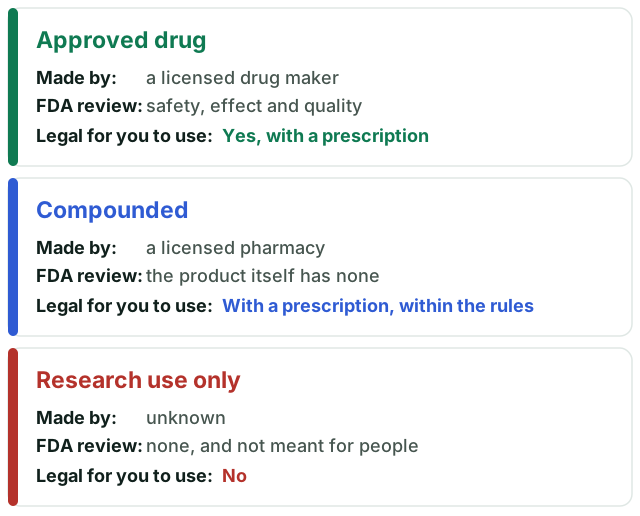
“Peptide therapy” is a clinic term, not a medical one. It means a prescriber, often at a wellness clinic, med spa or telehealth service, prescribing peptides for goals such as weight loss, aging, injury recovery, sleep or sexual function, usually as injections under the skin. Under that one label sit very different things: FDA-approved drugs, compounded drugs, and unapproved peptides. If the word itself is new, our peptide basics start with what peptides are, and the FDA status tracker gives the status of each one.
| What the clinic offers | Example peptides | FDA status | What that means for you |
|---|---|---|---|
| An FDA-approved drug, for its labeled use | Semaglutide (Wegovy), tirzepatide (Zepbound), tesamorelin (Egrifta), bremelanotide (Vyleesi) | Approved | The drug has a label, an approved dose and trial safety data |
| An approved drug, off-label | Any approved peptide used outside its label, such as tesamorelin in someone without HIV-associated lipodystrophy | Approved molecule, unapproved use | Legal for a prescriber to choose, but FDA has not found it safe and effective for that use |
| A compounded copy of an approved drug | Compounded semaglutide or tirzepatide | Not approved; legal only in narrow circumstances | A pharmacy product with no FDA review; see the compounded tirzepatide guide |
| A compounded peptide with no approved product | Sermorelin | Not approved; compounded with a prescription | No current label or approved dose; FDA position on its compounding basis unverified |
| An unapproved peptide under the interim HHS policy | BPC-157, TB-500, MOTS-c, epitalon, KPV, semax | Not approved; tolerated with ten conditions as of November 2, 2026 | No label or approved dose. Limited to specific forms and routes, single-ingredient products and 503A pharmacies |
| An unapproved peptide outside that policy | CJC-1295, ipamorelin, AOD-9604, selank, thymosin alpha-1, any blend | Not approved; not on the bulks list | No lawful compounding basis that we can find, whatever the vial says |
NAD+, often sold in the same programs, is not a peptide. It is a coenzyme in FDA’s 503A category 1, which means pharmacies may compound it under an interim policy while FDA evaluates it.
How does peptide therapy work?
There is no single mechanism, because each peptide is a different drug with its own target. GLP-1 drugs act on appetite and blood sugar. Tesamorelin signals the pituitary to release growth hormone. Bremelanotide acts on receptors in the brain. The therapy part is the service around the drug: an intake form or visit, a prescription, a shipment, and usually a monthly fee. Most products are injected under the skin at home, and some come as nasal sprays or creams. The injection sites guide covers the technique, and the labels differ on where a drug can go.
What is peptide therapy used for?
Clinics market it for weight loss, muscle, recovery, sleep, skin, hair, sexual function and aging. Only some of those goals have an approved peptide behind them. Weight loss does. Muscle, skin, sleep and injury healing do not, and the goals overview sets out what the human evidence shows for each. A clinic can offer an approved drug for its labeled use, an approved drug off-label, or an unapproved product, and those are very different propositions wearing the same name.
What is FDA-approved and what is not
Only the drugs, never the program, carry FDA approval. Each approved peptide is approved for something specific, and the label says what:
- Semaglutide and tirzepatide are approved for type 2 diabetes and chronic weight management, with more uses added over time. These are the best-studied drugs in any peptide program.
- Tesamorelin (Egrifta WR) is approved “for the reduction of excess abdominal fat in HIV-infected adult patients with lipodystrophy.” The label adds that it is “not indicated for weight loss management.”
- Bremelanotide (Vyleesi) is approved for acquired, generalized hypoactive sexual desire disorder in premenopausal women.
A prescriber may use an approved drug off-label. FDA says healthcare providers “generally may prescribe the drug for an unapproved use” when they judge it medically appropriate, but that FDA “has not determined that the drug is safe and effective for the unapproved use.” That is a real distinction worth asking about.
Compounded drugs are a separate category. FDA’s wording is that “compounded drugs are not FDA-approved,” and that it “does not verify the safety, effectiveness or quality of compounded drugs before they are marketed.” A compounded peptide is legal when a state-licensed pharmacy makes it for a named patient from a substance it is allowed to use, or when an FDA-registered outsourcing facility makes it under manufacturing rules.
What changed for clinics in October 2026?
Six of the peptides that make clinic programs distinctive now sit in a new and narrow position. BPC-157, TB-500, KPV, MOTS-c, epitalon and semax were recommended for the compounding list by an FDA advisory committee in July 2026, against FDA staff advice. On October 30, 2026 HHS, through the Secretary’s office rather than FDA, published an interim policy on them. As of November 2, 2026, HHS says it does not intend to take enforcement action against a state-licensed pharmacy, federal facility or licensed physician compounding one of the six when ten conditions are met, until a final rule decides each one.
The limits decide what this means in a real clinic:
- None of the six is FDA-approved. None is on the 503A bulks list, and no rule has been proposed. HHS’s notice calls the policy a draft in places, says it “does not establish any rights for any person,” and takes comments until November 13, 2026.
- Form and route are fixed. Injected KPV and injected semax are not covered, for example. The tracker has the full table.
- Blends are out. The policy requires a single active ingredient, so products such as the Wolverine stack fall outside it even when every ingredient is on the list.
- Outsourcing facilities are out. The policy covers 503A compounding only.
- Oral products need extra proof. The compounder has to keep documentation that the formulation reaches adequate oral bioavailability in humans.
- States can be stricter. State boards of pharmacy license these pharmacies and keep their own rules, and states may not follow the federal approach.
- The evidence has not moved. This is a decision about enforcement. It says nothing about whether a peptide works or is safe.
CJC-1295, ipamorelin, AOD-9604 and selank are not in the policy, so a program built on them gets no cover from it.
How to evaluate a peptide clinic
The questions below separate a medical service from a storefront. None of them is about price or results; they are about whether the product and the prescription are real.
1. Is there a licensed prescriber who actually evaluates you?
A prescription needs a prescriber licensed in your state, usually a physician, nurse practitioner or physician assistant. State licensing boards publish license lookups by name. A real evaluation covers your history, other medicines and conditions that rule a drug out, such as the thyroid cancer history that bars GLP-1 drugs. A checkout page that picks a peptide and a dose for you is not an evaluation. In September 2026, FDA questioned a compounder whose prescriptions were generated through preselected options on telehealth platforms.
2. Who dispenses it?
The drug should come from one of these places, and the label should say which:
| Dispenser | Who licenses or registers it | Who oversees it | What to look for |
|---|---|---|---|
| 503A compounding pharmacy | The state board of pharmacy | Mainly the state board; FDA inspects for cause | Pharmacy name and address, your name, the drug and strength, a beyond-use date |
| 503B outsourcing facility | Registered with FDA | FDA, on a risk-based inspection schedule; must follow manufacturing rules (CGMP) | The facility on FDA’s registered outsourcing facilities list |
| A retail or mail-order pharmacy dispensing an approved drug | The state board of pharmacy | State board; the product itself is FDA-approved | The brand or generic name and an FDA label |
A state-licensed pharmacy can be checked on the state board of pharmacy’s website. A 503B facility can be checked on FDA’s registered outsourcing facilities list, which FDA says is generally updated weekly. FDA notes that registration means only that the facility submitted the required information, not that it passed inspection.
3. Is anything labeled “research use only”?
If a clinic hands over, ships or tells you to order a vial marked “research use only” or “not for human consumption,” it is not a pharmacy product and not legal for human use. Federal rules allow such products to be shipped only for laboratory or animal research. FDA warning letters to peptide sellers, including five sent on August 24, 2026, found that a research label does not change what a product is when the seller supplies dosing guidance and reconstitution calculators. The HHS policy gives these products nothing, and says its purpose includes discouraging their use.
4. Does the product match what the policy describes?
If a clinic offers one of the six peptides and points to the HHS policy, the details can be checked against it. The label should read “This is a compounded drug product. Not for resale.” The product should contain one active ingredient, in a form and route the policy lists, made for you on a patient-specific prescription. The only device packaged with it should be an FDA-cleared syringe, and the guide to reading a COA explains the testing behind the ingredient. Meeting these conditions does not make the product approved. Missing them means the policy does not apply at all.
5. Does the marketing describe the products honestly?
FDA sent 30 warning letters to telehealth companies on March 3, 2026 over compounded GLP-1 marketing. The claims it objected to included calling a compounded product “FDA-approved,” describing it as “generic Zepbound,” and wording that implied the product was the approved drug. Any program that calls a compounded or unapproved peptide “FDA approved” is misdescribing it, and that includes presenting the HHS policy as an approval.
6. Do they say what the evidence is?
For an approved drug, the answer is the label and its trials. For most other clinic peptides, the honest answer is animal studies or small early human studies. FDA’s own review of BPC-157 said the agency “lacks sufficient information to know whether the drug would cause harm when administered to humans.” A clinic that describes these peptides as proven is overstating the evidence. Each peptide profile on this site states the evidence level up front.
Red flags
- No prescriber evaluation, or a prescriber you cannot identify by name and license.
- Vials with no patient name, no pharmacy name, or a research-use label.
- A drug called “FDA approved” when it is compounded or unapproved.
- A blend of several peptides presented as covered by the HHS policy.
- Semaglutide sodium or semaglutide acetate on the label. FDA says these salt forms are different active ingredients from the approved drugs and it knows of no lawful basis for compounding with them.
- Retatrutide or cagrilintide offered as a compounded product. FDA says they “cannot be used in compounding under federal law.”
- Instructions to mix a powder with water you are told to source yourself. A pharmacy-dispensed powder comes with the diluent or names the one to use; the reconstitution guide explains why that matters.
What does peptide therapy cost, and does insurance cover it?
Clinic peptide programs rarely publish prices in a form that can be checked and dated, so PeptideSorted does not print them. For the approved drugs, prices are public: the tirzepatide cost page and cheapest GLP-1 without insurance list dated prices with their sources.
Insurance does not cover a program as such. Plans decide coverage drug by drug and diagnosis by diagnosis, so the useful question to your plan names the specific drug and the reason for it. Ask before paying a clinic, and ask the clinic for an itemized breakdown of what the fee includes.
What to watch for
The drug risks are the same whoever prescribes them: the label’s warnings apply to an approved drug in a clinic exactly as they do at a hospital. What a clinic setting adds is the risk of the product. Compounded GLP-1s have generated more than 1,700 FDA adverse event reports, some tied to dosing errors with vials and syringes, and unapproved peptides have no human safety data at all. The are peptides safe guide sets out what is known for each kind.
Compare
- LearnAre peptides safe?Approved peptide drugs have measured risks.
- LearnFDA status trackerWhich peptides are FDA-approved, which HHS tolerates under conditions, and which are not legal to use.
- GLP-1sFDA approvedCompounded tirzepatideCompounded tirzepatide is legal only in narrow cases since the shortage ended.
Peptide news, sorted. Plus the printable dose chart.
Sorted, every Tuesday: the week's peptide and GLP-1 news in five minutes: FDA moves, new studies explained, and price changes. Subscribe and the one-page dose and injection-site chart arrives first.
Questions people ask
Is peptide therapy FDA approved?
Is peptide therapy legal?
Did the FDA allow BPC-157 for clinics in 2026?
Does peptide therapy work?
How much does peptide therapy cost, and does insurance cover it?
How do I know if a peptide clinic is legitimate?
Sources
Primary sources first: FDA labels and documents, peer-reviewed trials, registries.
- 1FDA. Compounding and the FDA: questions and answers (content current as of September 16, 2025)fda.gov
- 2FDA. Information for outsourcing facilitiesfda.gov
- 3FDA. Understanding unapproved use of approved drugs off labelfda.gov
- 4FDA. Bulk drug substances nominated for use in compounding under section 503A, category list (updated May 14, 2026)fda.gov
- 5FDA. Certain bulk drug substances for use in compounding may present significant safety risksfda.gov
- 6FDA. July 23-24, 2026 meeting of the Pharmacy Compounding Advisory Committeefda.gov
- 7HHS. Enforcement Discretion Policy Regarding 503A Compounding Using Certain Peptide Bulk Drug Substances, with Appendices A and B, October 2026hhs.gov
- 8Federal Register. Notice of availability, FR Doc. 2026-22192, Docket HHS-OASH-2026-0496, RIN 0910-ZD94, published October 30, 2026public-inspection.federalregister.gov
- 9AJMC. 5 things to know about HHS's interim peptide compounding policy, October 29, 2026ajmc.com
- 10Foley & Lardner. GLP-1 compliance: FDA targets telehealth marketing in 30 new warning letters, March 2026foley.com
- 11FDA. FDA's concerns with unapproved GLP-1 drugs used for weight loss (content current as of October 1, 2026)fda.gov
- 12Egrifta WR (tesamorelin) prescribing information, revised March 2025, via FDAaccessdata.fda.gov
- 13Vyleesi (bremelanotide) prescribing information, 2019, via FDAaccessdata.fda.gov
- 1421 CFR 312.160, drugs for investigational use in laboratory research animals or in vitro testslaw.cornell.edu
- 15FDA warning letter to an online peptide seller, August 24, 2026 (one of five issued that day)fda.gov
More in Learn
- Are peptides safe?Approved peptide drugs have measured risks. Compounded ones skip FDA review. Research-use vials have no safety review. What is known about each kind.Read
- Bacteriostatic waterSterile water with 0.9% benzyl alcohol, so one vial can be used for up to 28 days. How it differs from sterile water, storage, and who must avoid it.Read
- FDA status trackerWhich peptides are FDA-approved, which HHS tolerates under conditions, and which are not legal to use. One row per peptide, with sources and check dates.Read
- How to read a COAWhat each line on a peptide COA means: HPLC purity, mass spec identity, net content, endotoxin and sterility, plus red flags and what a COA cannot prove.Read
- How to reconstituteHow a prescribed freeze-dried vial is mixed with bacteriostatic water, the mg/mL and units math worked through, storage, and mistakes that waste a vial.Read
- Injection sitesMost peptide drugs go under the skin of the abdomen or thigh, and some labels add the upper arm. Which sites each label names, plus rotation and technique.Read
PeptideSorted Editorial Team
Editorial review
The PeptideSorted editors check every guide against its cited sources before publication: each number against its FDA label, trial or registry, the FDA status against current FDA and HHS documents, and the wording against our describe-never-prescribe rule. Licensed clinicians who join the review panel are listed by name on the editorial team page.
This page was checked against its cited sources by the PeptideSorted editorial team. Licensed clinicians on our review panel are listed on the editorial team page. Every health page cites primary sources and shows its review date. Read the editorial policy and how medical review works, or report an error via corrections. Educational only; not medical advice.