
Short answer
Some peptides have passed FDA review, and others have never been properly tested in people. Approved drugs have measured, labeled risks. Compounded versions skip FDA review, and FDA has logged more than 1,700 adverse event reports for compounded semaglutide and tirzepatide. Research-use-only peptides have no safety review, and lab tests found wrong doses, toxic metals and endotoxin.
- What it is
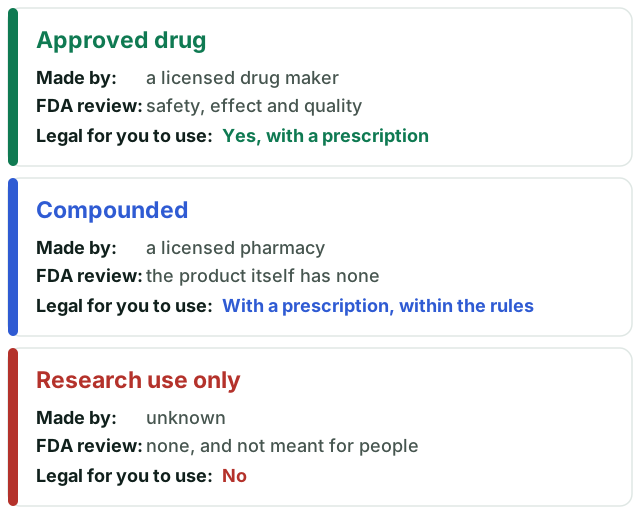
- A safety comparison of the three ways peptides reach people: approved drugs, compounded drugs, and products labeled for research use only.
- FDA status
- Not a drug
- Evidence level
n/a
Whether a peptide is safe depends almost entirely on which of three routes it came by. FDA-approved peptide drugs have their risks measured in large trials and printed on the label. Compounded peptides are made by pharmacies without FDA review of the product. Products sold “for research use only” have no safety review of any kind. Start with what peptides are if the groups are new to you, or the wider peptide basics. The FDA status tracker says which group each peptide falls into.
| Kind | Who checked it before it reached you | What is known about safety | Documented problems |
|---|---|---|---|
| FDA-approved peptide drug | FDA, on trial data; the maker, under manufacturing rules | Risks measured in randomized trials and listed on the label | The label’s own warnings, such as the thyroid tumor boxed warning on GLP-1 drugs |
| Compounded peptide | A state-licensed pharmacy; FDA does not review the product | Same molecule as an approved drug, or a substance with no approved version at all; the finished product is not reviewed | More than 1,700 FDA adverse event reports for compounded semaglutide and tirzepatide; 10-fold dosing errors; an endotoxin outbreak from a supplement-grade ingredient |
| Research use only | No one | No human safety data for most of these molecules | Wrong doses, low purity, arsenic and lead, endotoxin in every sample in one study, a surge in emergency visits |
Are FDA-approved peptides safe?
They are safe enough that FDA judged the benefits to outweigh the risks for a specific use, which is a different thing from risk-free. Approval means the risks were measured in controlled trials, weighed against the benefit, and written down. The label, also called the prescribing information, is where they live. It lists contraindications (people who must not take the drug), warnings and precautions, and the adverse reactions seen in trials with their rates.
A boxed warning is the strongest warning FDA requires, printed in a black box at the top of the label. Among peptide drugs, the best known is on the GLP-1 class.
| Drug | Boxed warning | Other key label warnings |
|---|---|---|
| Semaglutide (Wegovy, Ozempic) | Yes: risk of thyroid C-cell tumors, seen in rodents; contraindicated with a personal or family history of medullary thyroid carcinoma or MEN 2 | Acute pancreatitis, gallbladder disease, kidney injury, low blood sugar with insulin or sulfonylureas |
| Tirzepatide (Zepbound, Mounjaro) | Yes: same thyroid C-cell tumor warning and contraindication | Same family of warnings; see the tirzepatide side effects page |
| Bremelanotide (Vyleesi) | No | Blood pressure rises after each dose, up to 6 mmHg systolic, so it is contraindicated with uncontrolled hypertension or known heart disease; nausea in 40% of trial patients; darkened skin patches in 1% |
| Tesamorelin (Egrifta WR) | No | Contraindicated in pregnancy and active cancer; raises IGF-1; fluid retention; glucose intolerance |
| Teriparatide (Forteo) | Removed in 2020 | The osteosarcoma boxed warning, based on high-dose rat studies, was dropped after studies linking pharmacy claims to cancer registries found no increase in people |
| Elamipretide (Forzinity) | No | Approved September 19, 2025 under accelerated approval for Barth syndrome, so FDA requires a confirmatory trial and can withdraw approval if it fails; injection site reactions were the most common adverse reaction; hypersensitivity warning |
The thyroid warning shows how labels work. In rats and mice, GLP-1 drugs caused thyroid C-cell tumors. Whether that happens in people is not known, so the label does two things: it bars the drug for people with a personal or family history of medullary thyroid carcinoma (MTC) or multiple endocrine neoplasia type 2 (MEN 2), an inherited cancer syndrome, and it tells prescribers to counsel every patient about neck lumps, trouble swallowing and persistent hoarseness.
Bremelanotide shows the other end. Its label has no boxed warning, but nausea was the most common reaction in the phase 3 trials: 40% of patients had it, 13% needed anti-nausea medicine, and 8% dropped out because of it.
Are compounded peptides safe?
They carry more risk than the approved drug because nobody outside the pharmacy checks the finished product. FDA puts it plainly: “Compounded drugs are not FDA-approved. This means that FDA does not verify the safety, effectiveness or quality of compounded drugs before they are marketed.” A compounded semaglutide or tirzepatide contains the same molecule as the approved drug, so the label’s drug risks still apply. What compounding adds are the risks of the product itself.
Adverse event reports
As of May 31, 2026, FDA had received 990 adverse event reports involving compounded semaglutide and more than 730 involving compounded tirzepatide, and says these are “likely” underreported, because state-licensed pharmacies that are not outsourcing facilities do not have to report them. Some reports involved hospitalization. A report is not proof the drug caused the event, but the numbers are why FDA keeps a standing page on the problem.
Dosing errors
Approved GLP-1 pens deliver a fixed dose with a click. Compounded versions usually come as a multi-dose vial, drawn up with an insulin syringe measured in units, while the prescription is written in milligrams. That is three units of measure for one dose. FDA has received reports of patients measuring the wrong dose and of clinicians miscalculating it. A poison control center case series described two patients who injected ten times their intended dose of compounded semaglutide; all three patients in the series had days of nausea, vomiting and abdominal pain, and one patient reported dosing “in milliliters and units rather than in milligrams.” The mg to units converter shows how the conversion works; the pharmacy label and the prescriber set the dose.
Ingredient quality
A licensed pharmacy is only as good as its ingredients. In August 2026, FDA reported at least 30 patients with fever, chills, shock and sepsis-like symptoms after intravenous glutathione compounded from a dietary-supplement-grade ingredient. The symptoms were consistent with endotoxin, a toxic fragment of bacterial cell walls, and some patients were hospitalized. Glutathione is a tripeptide rather than one of the peptide drugs this site profiles, but the lesson carries to any compounded injectable: FDA said supplement-grade ingredients are “not an appropriate ingredient to make injectable drugs” and that testing alone does not ensure quality.
Did the October 2026 HHS policy make six peptides safe?
No. As of November 2, 2026, an interim HHS policy says HHS does not intend to take enforcement action against a state-licensed pharmacy, federal facility or licensed physician compounding BPC-157, TB-500, MOTS-c, epitalon, KPV or semax, when ten conditions are met, until a final rule decides each one. That is a decision about enforcement. It is not evidence that any of the six works or is safe, and none of them is FDA-approved.
Some of the conditions do address product quality. The bulk ingredient has to come from an FDA-registered maker with a certificate of analysis, each product may hold only one active ingredient, and serious adverse events have to be reported to FDA MedWatch. HHS may revisit the policy if a safety signal or quality problem appears. What the conditions cannot supply is the missing human data. FDA’s drug center recommended against listing all six, and the wording on its safety page, quoted below for BPC-157, has not changed.
Are research-use-only peptides safe?
This is where the safety question has no reassuring answer. Under 21 CFR 312.160, a “research use only” drug may be shipped only for tests in laboratory animals or in vitro, labeled not for use in humans. It is not legal to use on people, and FDA warning letters, including five sent to online peptide sellers on August 24, 2026, have found that the disclaimer does not change what a product is when the seller’s website offers dosing guidance and reconstitution calculators. HHS’s own policy describes “research-use-only peptides supplied by foreign manufacturers that pose a safety risk to US patients.”
No human safety data
For most of these molecules, the safety question has never been studied in people. FDA’s review of BPC-157 for compounding found the agency “lacks sufficient information to know whether the drug would cause harm when administered to humans.” Similar language covers several other popular peptides on the same FDA page. The peptides A to Z states the evidence level for each one.
What lab tests of these products found
Independent tests have repeatedly found that what is in the vial is not what is on the label.
| Study | What was tested | What was found |
|---|---|---|
| Ashraf et al., J Med Internet Res 2024 | Semaglutide vials ordered from illegal online pharmacies | Every vial delivered held 29% to 39% more semaglutide than labeled. Endotoxin was found in all samples. Measured purity was 7.7% to 14.4% against a 99% claim on the label. Three ordered pens never arrived. |
| Janvier et al., Talanta 2018 | The ten falsified peptide drugs most often seen on the Belgian market, from three illegal internet pharmacies | High variation in dose per vial, purity as low as 5% for some peptides, arsenic at up to ten times the parenteral safety limit, and lead in one sample |
| Janvier et al., Drug Test Anal 2018 | Two illegal injectable peptide products | Both contained haemolytic Bacillus cereus, a bacterium that can cause serious infection |
Endotoxin matters because it is not removed by the bacteriostatic water added to a vial, and it survives when the bacteria themselves are dead. A product can pass a sterility test and still carry enough endotoxin to cause fever and shock. The guide to reading a COA explains the tests that are supposed to catch this and why a seller’s certificate is not a substitute for them.
Emergency visits
The clearest population data so far comes from Australia. New South Wales Health searched emergency department triage notes for mentions of unapproved peptides and found 1,180 presentations between July 1, 2025 and September 30, 2026, rising from 5 in July 2025 to 217 in September 2026. Most mentioned retatrutide, an investigational drug that is not approved in Australia or the United States.
The most common diagnoses were gastrointestinal (abdominal pain, nausea, vomiting), cardiovascular (including chest pain), and allergic reactions including anaphylaxis. 18% of the visits led to hospital admission, and a quarter of patients were 16 to 24. NSW Health also reported kidney damage and liver injury through its Poisons Information Centre. Its report notes that keyword searches likely miss cases, so the true number is probably higher.
What is immunogenicity, and why does FDA keep mentioning it?
Immunogenicity is a product’s tendency to provoke an immune response, in which the body treats the drug as a foreign invader. It comes up again and again on FDA’s page of bulk substances with safety concerns. FDA uses nearly the same sentence for BPC-157, TB-500, semax, epitalon, selank, ipamorelin, CJC-1295, thymosin alpha-1 and others: the compounded drug “may pose risk for immunogenicity for certain routes of administration,” often because of aggregation (molecules clumping together) or peptide-related impurities (fragments and near-copies left over from manufacturing).
This is a risk that a purity number on a label does not settle. It depends on the molecule, how it was made, how it was stored and how it enters the body. FDA also flags that for several of these peptides it has little or no human data to judge the size of the problem, and it rates the risk as “significant” for some, including AOD-9604, MOTS-c and thymosin alpha-1.
Do peptides cause cancer?
There is no single answer, and for most unapproved peptides the question has not been studied in people. What exists is specific to each drug:
| Peptide | What is known | Source of concern |
|---|---|---|
| GLP-1 drugs | Thyroid C-cell tumors in rodents; unknown in people; boxed warning | Animal studies |
| Teriparatide | Boxed warning for osteosarcoma removed in 2020 after studies linking pharmacy claims to cancer registries found no increase in people | High-dose rat studies, later human data |
| Tesamorelin | Contraindicated in active cancer; raises IGF-1 | FDA label |
| LL-37 (cathelicidin) | FDA notes that nonclinical research suggests it “can be protumorigenic in some tissues” | Nonclinical research |
| Melanotan II | FDA notes published case reports of serious adverse events including melanoma | Case reports |
Case reports and animal findings do not prove a cause. They are also the most anyone has for many of these molecules, which is a different thing from reassurance.
How to judge any safety claim about a peptide
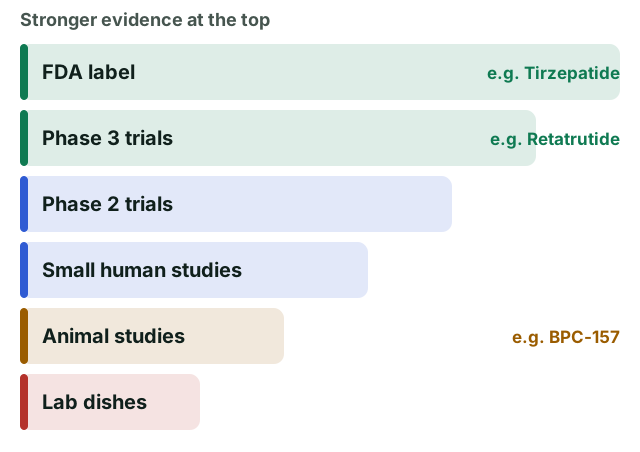
Ask which rung of the evidence ladder the claim stands on. “Natural” is no help, because the body makes peptides such as insulin and they can still do serious harm at the wrong dose. “No side effects reported” is no help either if nobody was watching. A study in rodents can be a good reason to run a human trial, and it tells you very little about what an injection will do to you.
What to watch for
- Approved drug: read the label’s contraindications before the first dose. For GLP-1 drugs, the label lists severe abdominal pain that does not go away (possible pancreatitis) and a lump or swelling in the neck as reasons to contact a prescriber.
- Compounded drug: confirm the dose in milligrams and in syringe units with the pharmacist before the first injection, and check the pharmacy label for a patient name, strength and beyond-use date. The compounded tirzepatide guide covers the label.
- Research product: there is no safe version. NSW Health’s advice to anyone already using one is to speak with a health professional before taking another dose, and to tell any treating clinician about it, especially before surgery.
Any suspected reaction to a drug in the United States can be reported to FDA MedWatch at 1-800-FDA-1088. Severe symptoms such as trouble breathing, fainting or chest pain are an emergency.
Compare
- LearnFDA status trackerWhich peptides are FDA-approved, which HHS tolerates under conditions, and which are not legal to use.
- LearnHow to read a COAWhat each line on a peptide COA means: HPLC purity, mass spec identity, net content, endotoxin and sterility, plus red flags and what a COA cannot prove.
- GLP-1sFDA approvedCompounded tirzepatideCompounded tirzepatide is legal only in narrow cases since the shortage ended.
Recent news on this
Peptide news, sorted. Plus the printable dose chart.
Sorted, every Tuesday: the week's peptide and GLP-1 news in five minutes: FDA moves, new studies explained, and price changes. Subscribe and the one-page dose and injection-site chart arrives first.
Questions people ask
Are peptides safe to inject?
What are the side effects of peptides?
Is BPC-157 safe?
Are compounded peptides safer than research peptides?
Are peptides bad for you?
Does a certificate of analysis make a research peptide safe?
Sources
Primary sources first: FDA labels and documents, peer-reviewed trials, registries.
- 1Wegovy (semaglutide) injection prescribing information, Novo Nordisk, DailyMeddailymed.nlm.nih.gov
- 2Zepbound (tirzepatide) prescribing information, Eli Lilly, via FDAaccessdata.fda.gov
- 3Vyleesi (bremelanotide) prescribing information, 2019, via FDAaccessdata.fda.gov
- 4Egrifta WR (tesamorelin) prescribing information, revised March 2025, via FDAaccessdata.fda.gov
- 5FDA. Forzinity (elamipretide) accelerated approval letter, NDA 215244, September 19, 2025accessdata.fda.gov
- 6Forzinity (elamipretide) prescribing information, 2025, via FDAaccessdata.fda.gov
- 7Krege JH et al. Teriparatide and osteosarcoma risk: history, science, elimination of boxed warning, and other label updates. JBMR Plus 2022pmc.ncbi.nlm.nih.gov
- 8FDA. Compounding and the FDA: questions and answers (content current as of September 16, 2025)fda.gov
- 9FDA. FDA's concerns with unapproved GLP-1 drugs used for weight loss (content current as of October 1, 2026)fda.gov
- 10Lambson JE, Flegal SC, Johnson AR. Administration errors of compounded semaglutide reported to a poison control center: case series. J Am Pharm Assoc 2023;63(5):1643-1645doi.org
- 11FDA. FDA reminds compounders not to use dietary supplement grade glutathione in injectables, August 27, 2026fda.gov
- 12Ashraf AR et al. Multifactor quality and safety analysis of semaglutide products sold by online sellers without a prescription. J Med Internet Res 2024;26:e65440doi.org
- 13Janvier S et al. Impurity profiling of the most frequently encountered falsified polypeptide drugs on the Belgian market. Talanta 2018;188:795-807doi.org
- 14Janvier S et al. Are injectable illegal polypeptide drugs safe? Case report demonstrating the presence of haemolytic Bacillus cereus in 2 illegal peptide drugs. Drug Test Anal 2018;10(4):791-795doi.org
- 15NSW Health. Emergency department presentations mentioning unapproved peptide use, NSW, July 2025 to September 2026 (published October 17, 2026)health.nsw.gov.au
- 16NSW Health. NSW Health warns of surge in hospital presentations linked to peptide use, October 19, 2026health.nsw.gov.au
- 17FDA. Certain bulk drug substances for use in compounding may present significant safety risksfda.gov
- 18FDA warning letter to an online peptide seller, August 24, 2026 (one of five issued that day)fda.gov
- 1921 CFR 312.160, drugs for investigational use in laboratory research animals or in vitro testslaw.cornell.edu
- 20HHS. Enforcement Discretion Policy Regarding 503A Compounding Using Certain Peptide Bulk Drug Substances, with Appendices A and B, October 2026hhs.gov
- 21Federal Register. Notice of availability, FR Doc. 2026-22192, Docket HHS-OASH-2026-0496, RIN 0910-ZD94, published October 30, 2026public-inspection.federalregister.gov
More in Learn
- Bacteriostatic waterSterile water with 0.9% benzyl alcohol, so one vial can be used for up to 28 days. How it differs from sterile water, storage, and who must avoid it.Read
- FDA status trackerWhich peptides are FDA-approved, which HHS tolerates under conditions, and which are not legal to use. One row per peptide, with sources and check dates.Read
- How to read a COAWhat each line on a peptide COA means: HPLC purity, mass spec identity, net content, endotoxin and sterility, plus red flags and what a COA cannot prove.Read
- How to reconstituteHow a prescribed freeze-dried vial is mixed with bacteriostatic water, the mg/mL and units math worked through, storage, and mistakes that waste a vial.Read
- Injection sitesMost peptide drugs go under the skin of the abdomen or thigh, and some labels add the upper arm. Which sites each label names, plus rotation and technique.Read
- Peptide therapyPeptide therapy is a clinic term, not a medical one. It mixes FDA-approved, compounded and unapproved peptides. How to tell which you are being offered.Read
PeptideSorted Editorial Team
Editorial review
The PeptideSorted editors check every guide against its cited sources before publication: each number against its FDA label, trial or registry, the FDA status against current FDA and HHS documents, and the wording against our describe-never-prescribe rule. Licensed clinicians who join the review panel are listed by name on the editorial team page.
This page was checked against its cited sources by the PeptideSorted editorial team. Licensed clinicians on our review panel are listed on the editorial team page. Every health page cites primary sources and shows its review date. Read the editorial policy and how medical review works, or report an error via corrections. Educational only; not medical advice.