New to peptides? Start here.
Five pages, read in order, about 20 minutes. By the end you can tell an approved drug from a research chemical, read a dose table, and do the syringe math yourself.
Step 1: Find out what a peptide is, and which kind you are looking at
Insulin, semaglutide and tirzepatide are peptides. So is BPC-157. What separates them is whether anyone has tested the product in people and whether the FDA has reviewed it.
What are peptides About 4 min
Step 2: Check its status before you read anything else about it
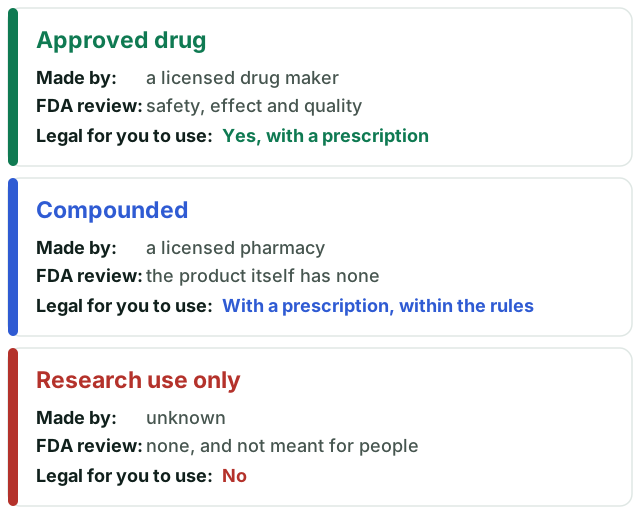
Approved, compoundable with a prescription, investigational in trials, or not approved at all. "Research use only" on a label means it is not legal to use on a person.
FDA status tracker About 3 min
Step 3: If it is a GLP-1, read the label schedule and the side effects
Tirzepatide and semaglutide have a defined dose ladder, a boxed warning and real cost numbers. Everything on those pages comes from the FDA label or the trials.
GLP-1 section About 6 min
Step 4: Learn the syringe math once
A vial in mg, water in mL, and a dose. The calculator shows the units and draws the syringe, and one worked example is usually enough to make the logic stick.
Reconstitution calculator About 2 min
Step 5: Then the hands-on part
Bacteriostatic water, swirl not shake, label the vial, rotate injection sites, dispose of sharps properly.
How to reconstitute About 5 min
The four statuses you will see on every profile
- FDA approved
- Reviewed and approved by the FDA for at least one use. Has a label with a dose schedule and a known side-effect profile.
- Compounded (Rx)
- Not approved as a finished product, but a licensed pharmacy may compound it for a specific patient with a prescription.
- Investigational
- In registered human trials. Access runs through a trial or, rarely, a maker's early-access program. Retatrutide is the best-known example.
- Not FDA approved
- No FDA approval. Most have no compounding route. Six are under an interim HHS enforcement policy with conditions, explained below.
Why status comes first
"Peptide" sounds like one thing, and that is where most confusion starts. The same word covers a prescription drug with a boxed warning and years of trials, a product a pharmacy mixed for one patient, and a powder sold online with a research-only sticker. Once you know which of those you are looking at, most other questions answer themselves.
Which page should you read first?
The five steps above suit most people, but if you arrived with one specific question, go straight to it.
- You are holding a vial and a syringe. Use the peptide calculator, then read the reconstitution guide and the injection sites guide.
- You want to lose weight. Peptides for weight loss starts from the evidence, and the GLP-1 section has the doses, side effects and prices.
- You heard a name like BPC-157 or sermorelin. The Peptides A–Z opens each profile with its FDA status and evidence level.
- You are weighing two options. The compare tool sets any two profiles side by side.
- You have a goal and no name. Peptides by goal says which options have human evidence.
- A word stopped you. The glossary defines about 80 of them.
What about the six peptides in the news?
As of November 2, 2026, HHS says it does not intend to take enforcement action against pharmacies and physicians compounding BPC-157, TB-500, MOTS-c, epitalon, KPV and semax when ten conditions are met, until a final rule decides each one. None of the six is FDA-approved or on the 503A bulks list, FDA has not reviewed any compounded product, and the policy creates no rights. HHS may revisit it, states can be stricter, outsourcing facilities are not covered, and comments are open until November 13. The evidence for each peptide is unchanged. The news item on the policy has the limits.
What this site will not do
We describe doses from FDA labels and trials, and your prescriber sets yours. Peptides without a label get what the studies used and a plain statement that no human dose has been established. We do not sell anything, rank vendors or link to research-use products. If you are ever unsure about something you have already taken, your prescriber or a pharmacist is the right first call.
Peptide news, sorted. Plus the printable dose chart.
Sorted, every Tuesday: the week's peptide and GLP-1 news in five minutes: FDA moves, new studies explained, and price changes. Subscribe and the one-page dose and injection-site chart arrives first.