
Short answer
The peptides with strong evidence for weight loss are semaglutide (Wegovy) and tirzepatide (Zepbound), both FDA-approved, with average losses of 14.9% to 20.9% in their main trials. Retatrutide and CagriSema are investigational. Peptides sold online for fat loss, such as AOD-9604 and MOTS-c, are not approved and have no trial showing weight loss in people.
Two peptides have the evidence people are hoping for: semaglutide (Wegovy) and tirzepatide (Zepbound), both FDA-approved, both backed by large phase 3 trials. A newer group, led by retatrutide and CagriSema, has strong trial data but no approval. The peptides that fill social media feeds and online shops, such as AOD-9604 and MOTS-c, are in a third group: not approved, with no trial showing weight loss in people. Those three groups are very different things, even though all get called “peptides.” The GLP-1 section covers the approved drugs in depth, and the peptides A-Z covers the rest. This is an overview by evidence, not a ranking.
The three groups at a glance
| Approved GLP-1 drugs | Investigational drugs | Unapproved peptides sold for weight loss | |
|---|---|---|---|
| Examples | Semaglutide (Wegovy), tirzepatide (Zepbound), liraglutide (Saxenda) | Retatrutide, CagriSema, cagrilintide | AOD-9604, MOTS-c |
| FDA status | Approved for weight management | Not approved | Not approved |
| Best human evidence | Large phase 3 trials and an FDA label | Phase 3 trials | AOD-9604: failed trial. MOTS-c: no published human trial |
| Average weight loss in trials | About 15% to 21% in the main trials | About 20% to 25% for CagriSema and retatrutide | No proven effect |
| Access | Prescription from a licensed prescriber | Clinical trials; a narrow compassionate use program for retatrutide | No approved product exists |
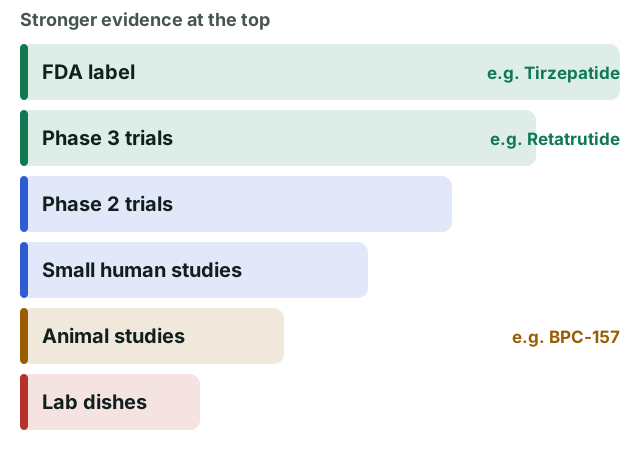
Each group sits on a different rung of the evidence ladder. A human trial tells you far more than a mouse study, and an FDA label tells you more than either, because it comes with an agency review of safety data and a list of who should not take the drug.
Which peptides are FDA-approved for weight loss?
Semaglutide (Wegovy), tirzepatide (Zepbound) and liraglutide (Saxenda) are the peptides approved for chronic weight management in the broad population with obesity. People hoping to get “a peptide for weight loss” usually mean one of these, whether they know it or not. Each is used with a reduced-calorie diet and more physical activity.
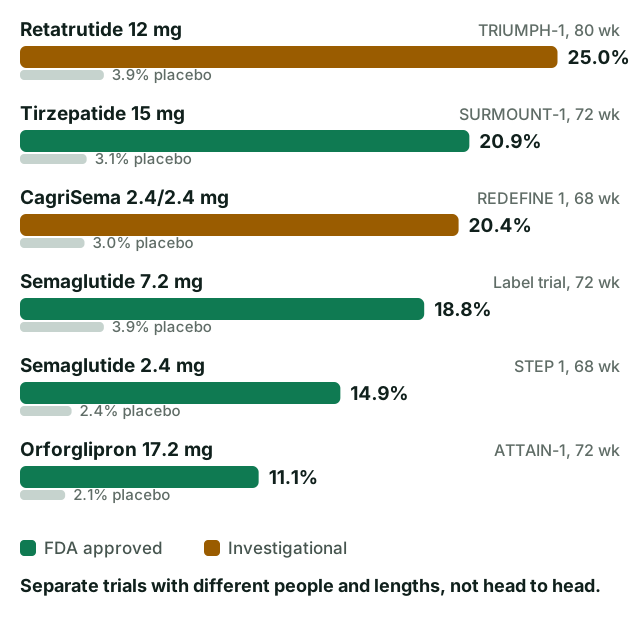
Here is what the labels and main trials report. The drugs are listed by brand name, not by how good they are.
| Drug | Form | Main trial | Average weight change | Placebo |
|---|---|---|---|---|
| Wegovy 2.4 mg (semaglutide) | Weekly injection | STEP 1, 68 weeks | -14.9% | -2.4% |
| Wegovy HD 7.2 mg (semaglutide) | Weekly injection | STEP UP, 72 weeks | -18.8% | -3.9% |
| Wegovy pill 25 mg (semaglutide) | Daily tablet | OASIS 4, 64 weeks | -13.6% | -2.4% |
| Zepbound 15 mg (tirzepatide) | Weekly injection | SURMOUNT-1, 72 weeks | -20.9% | -3.1% |
| Foundayo 17.2 mg (orforglipron, not a peptide) | Daily tablet | ATTAIN-1, 72 weeks | -11.1% | -2.1% |
Saxenda (liraglutide) is a daily injection, also approved for teens 12 and older. Wegovy’s label covers teens too, and it adds a use beyond weight: lowering the risk of heart attack, stroke and cardiovascular death in adults with heart disease and obesity or overweight. That came from SELECT, a trial of 17,604 adults. Foundayo earns a place in this table although it is not a peptide, because it works on the same receptor and people weigh it against the others.
Other FDA-approved weight drugs are not peptides at all: orlistat, phentermine-topiramate and naltrexone-bupropion. A daily injection, setmelanotide (Imcivree), is limited to specific rare genetic causes of obesity confirmed by testing. Older drugs such as phentermine alone are approved only for a few weeks.
How do these drugs cause weight loss?
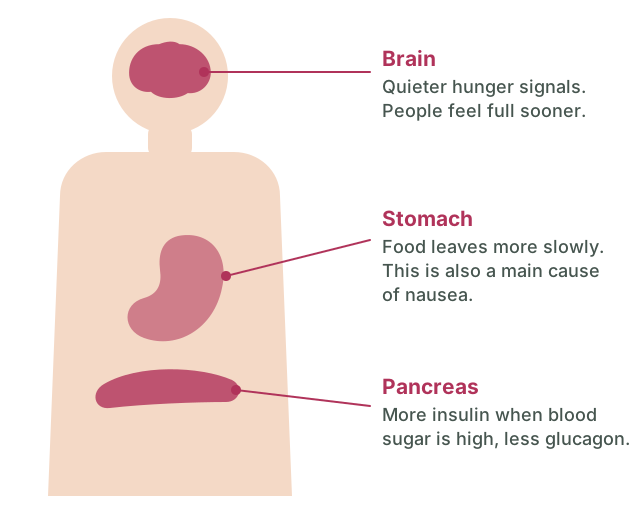
They copy hormones your gut releases after eating. GLP-1 (glucagon-like peptide-1) tells the brain you are full, slows the stomach, and helps the pancreas release insulin when blood sugar is high. Tirzepatide also acts on a second hormone receptor, GIP. The result is a smaller appetite, and that is why the weight change takes months.
Who qualifies, and what can you expect?
The National Institute of Diabetes and Digestive and Kidney Diseases describes the usual threshold as an adult with a BMI of 30 or more, or 27 or more with a weight-related problem such as high blood pressure or type 2 diabetes. Those trial averages took 64 to 72 weeks, and individual results vary widely around them. Doses rise slowly over months, which is why early weight loss is modest; the tirzepatide dosage chart and semaglutide dosage chart show the label ladders. NIDDK says that if you have not lost at least 5% of your starting weight after 12 weeks on the full dose, your clinician will probably suggest stopping or changing course. Even a 5% to 10% loss can improve blood sugar, blood pressure and triglycerides.
What are the risks of the approved drugs?
Stomach side effects are the most common problem. On the Zepbound label, nausea affected 25% to 29% of people versus 8% on placebo. On Wegovy 2.4 mg it was 44% versus 16%. Most of it happened during dose increases and eased with time.
The serious warnings matter more:
- Boxed warning. Wegovy and Zepbound both carry a boxed warning about thyroid C-cell tumors, seen in rodents. Human relevance is unknown. Neither may be used by anyone with a personal or family history of medullary thyroid carcinoma or with Multiple Endocrine Neoplasia syndrome type 2.
- Other label warnings. Pancreatitis, gallbladder disease, kidney injury from dehydration, low blood sugar with insulin or a sulfonylurea, serious allergic reactions, diabetic eye complications and food entering the lungs under anesthesia.
- Pregnancy. NIDDK says weight-loss medications should not be taken during pregnancy or when planning one, and are not recommended while breastfeeding.
- Not to be combined. The Wegovy and Zepbound labels both say not to use them with another GLP-1 drug.
Severe stomach pain that will not go away, sometimes reaching the back, is the classic sign of pancreatitis, and the labels say to stop and call right away. Swelling of the face or throat, or trouble breathing, needs emergency care. The tirzepatide side effects guide and semaglutide side effects guide have the full tables.
What happens when you stop?
Most people regain weight. In the STEP 1 extension, people who had lost 17.3% on semaglutide regained 11.6 percentage points within a year of stopping. In SURMOUNT-4, everyone took tirzepatide for 36 weeks. Those then switched to placebo regained 14.0% over a year, while those who continued lost another 5.5%. NIDDK describes obesity as a chronic disease, and the trials behave that way: the effect lasts about as long as the treatment does.
What are investigational peptides for weight loss?
These are real drug candidates with serious trial data, but no approved product and no approved dose.
| Drug | Maker | How it differs | Main trial result | Where it stands, November 2, 2026 |
|---|---|---|---|---|
| Retatrutide | Eli Lilly | Acts on GIP, GLP-1 and glucagon | TRIUMPH-1, 12 mg, 80 weeks: -25.0%; placebo -3.9% | Not approved. Lilly plans to file in Q1 2027 |
| CagriSema | Novo Nordisk | Cagrilintide (amylin) plus semaglutide | REDEFINE 1, 68 weeks: -20.4%; placebo -3.0% | Under FDA review. Novo expects a decision in Q4 2026; none found yet |
| Cagrilintide alone | Novo Nordisk | Amylin analogue | REDEFINE 1, 68 weeks: -11.5%; placebo -3.0% | Phase 3 trials running |
“Investigational” means something specific. These drugs cannot be bought or prescribed normally, and they are given inside clinical trials. Lilly also runs a narrow compassionate use program for retatrutide, which physicians apply to, for adults with refractory obesity and two or more serious complications who cannot join a trial. Anything sold online is not that program. The FDA says retatrutide and cagrilintide “cannot be used in compounding under federal law.” The October 2026 HHS peptide policy described below does not change any of that; investigational drugs are unaffected.
The FDA has warned companies selling retatrutide, survodutide and mazdutide falsely labeled “for research purposes.” A vial with one of these names on it is not the drug tested in the trials. If you are interested, the honest route is ClinicalTrials.gov, where you can search a drug’s name with the status filter set to “Recruiting.”
Do AOD-9604 and MOTS-c work for weight loss?
No human trial has shown that either one causes weight loss.
| AOD-9604 | MOTS-c | |
|---|---|---|
| What it is | A 16-amino-acid fragment of human growth hormone, modified | A 16-amino-acid peptide encoded in mitochondrial DNA |
| FDA status | Not approved | Not approved |
| Best human evidence | Phase 2b trial, oral, 502 randomized adults: no significant difference in weight loss at 12 weeks versus placebo | None published. FDA “has not identified, any clinical studies or human exposure data” for it |
| Other evidence | Obese mice | Mice on a high-fat diet gained less weight on daily injections |
| FDA’s view | “A lack of evidence to support the effectiveness” for obesity by any route | Safety risks in humans “are unknown” |
| Advisory committee | Voted 0 to 12 against adding it to the compounding list, December 2024 | Recommended it July 23, 2026, against FDA staff advice |
| Sport | Banned by WADA | Banned by WADA |
AOD-9604 is the more instructive story, because it was actually tested. It was developed as an obesity pill, the trials did not support it, and the developer abandoned it in 2007. It now sells as a “fat-burning” injection, a route no human study has tested.
MOTS-c is earlier still. The human data closest to it come from CB4211, a different, modified molecule, where a 4-week study in 20 people with obesity and fatty liver showed only a downward trend in weight. A phase 2a trial of MOTS-c itself (NCT07505745) began enrolling in 2026 and has no results.
What the October 2026 HHS policy means for MOTS-c
As of November 2, 2026, an interim HHS policy says HHS does not intend to take enforcement action against a state-licensed pharmacy, federal facility or licensed physician compounding MOTS-c acetate for injection under the skin or into muscle, if ten conditions are met, until a final rule decides whether MOTS-c goes on the 503A bulks list. Those conditions include a single active ingredient, a valid patient-specific prescription and sourcing from an FDA-registered facility.
That is a choice not to enforce, and it stops well short of approval. MOTS-c is not FDA-approved and not on the bulks list, no rule has been proposed, and FDA has not reviewed any compounded product for safety, effectiveness or quality. The notice says the policy “does not establish any rights for any person and is not binding on HHS or the public.” It covers 503A compounding only, states can be stricter, HHS may revisit it, and comments are open until November 13, 2026. The evidence has not changed: a policy about enforcement is not evidence that a peptide works or is safe.
AOD-9604 is not on the HHS list, so the policy does not cover it. CJC-1295 and ipamorelin are not on the list either. Tesamorelin (Egrifta) is a real approved drug, but only for excess belly fat in people with HIV-related lipodystrophy, and its label says it is not for weight loss.
Where compounded semaglutide and tirzepatide fit
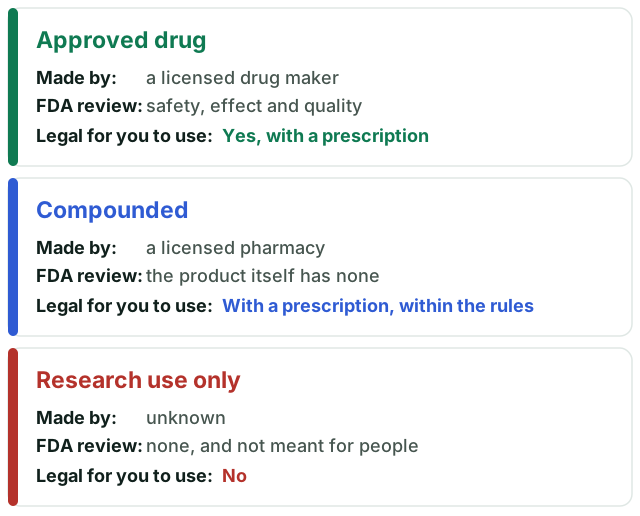
Compounded versions sit awkwardly between these groups. They use the names of approved drugs, but the compounded product itself is not FDA-approved or reviewed for safety, effectiveness or quality. The FDA says compounded drugs should be used only when a patient’s medical needs cannot be met by an approved drug. The official shortages of both drugs have ended. By May 31, 2026 the FDA had received 990 adverse event reports for compounded semaglutide and more than 730 for compounded tirzepatide, and it has warned about dosing errors, some requiring hospitalization. The compounded semaglutide guide and compounded tirzepatide guide cover the rules.
The third kind of product is the one to steer clear of. Products sold “for research use only” are not legal to use on people, whatever peptide is named on the vial, and HHS says its interim policy is meant to discourage their use. The FDA urges consumers not to purchase these products, which it describes as “of unknown quality.”
What to do instead of buying a vial online
If weight is affecting your health, the useful next steps are ordinary ones.
- Check whether you qualify. BMI of 30 or more, or 27 or more with a weight-related condition, is the usual starting point.
- See a licensed prescriber, in person or through telehealth, and bring a list of everything you take, including supplements.
- Ask about cost early. Coverage varies by plan, and manufacturers run self-pay programs. The cheapest GLP-1 without insurance guide compares them.
- Use a lifestyle program alongside any drug. NIDDK says medications work best combined with one, and they do not replace healthy eating and activity.
- Ask about surgery if your BMI is high. A clinician can refer you to a bariatric surgeon when medication is not enough.
- Look at trials if you want to help test something new.
Questions worth bringing to the appointment:
- Which approved drug fits my health history, and why?
- What should I expect by 12 weeks on the full dose, and when would we change course?
- How long would I stay on it, and what is the plan if I stop?
- Do any of my medicines interact, or does my family history rule anything out?
The goals overview sets weight loss beside the other outcomes people ask about, and the FDA status tracker records each approval and rule as it happens.
Compare
Peptide news, sorted. Plus the printable dose chart.
Sorted, every Tuesday: the week's peptide and GLP-1 news in five minutes: FDA moves, new studies explained, and price changes. Subscribe and the one-page dose and injection-site chart arrives first.
Questions people ask
What is the best peptide for weight loss?
Are peptides for weight loss safe?
Does AOD-9604 work for weight loss?
Does MOTS-c help with weight loss?
Do you regain weight after stopping these drugs?
Do I need a prescription for weight-loss peptides?
Sources
Primary sources first: FDA labels and documents, peer-reviewed trials, registries.
- 1Zepbound (tirzepatide) prescribing information, Eli Lilly, revised 8/2026, via DailyMeddailymed.nlm.nih.gov
- 2Wegovy (semaglutide) injection and tablets prescribing information, Novo Nordisk, revised 6/2026, via DailyMeddailymed.nlm.nih.gov
- 3Foundayo (orforglipron) tablets prescribing information, Eli Lilly, revised 7/2026uspl.lilly.com
- 4NIDDK. Prescription medications to treat overweight and obesityniddk.nih.gov
- 5Jastreboff AM et al. Tirzepatide once weekly for the treatment of obesity (SURMOUNT-1). N Engl J Med 2022pubmed.ncbi.nlm.nih.gov
- 6Wilding JPH et al. Once-weekly semaglutide in adults with overweight or obesity (STEP 1). N Engl J Med 2021pubmed.ncbi.nlm.nih.gov
- 7Wharton S et al. Once-weekly semaglutide 7.2 mg in adults with obesity (STEP UP). Lancet Diabetes Endocrinol 2025pubmed.ncbi.nlm.nih.gov
- 8Lincoff AM et al. Semaglutide and cardiovascular outcomes in obesity without diabetes (SELECT). N Engl J Med 2023pubmed.ncbi.nlm.nih.gov
- 9Wharton S et al. Orforglipron, an oral small-molecule GLP-1 receptor agonist for obesity treatment (ATTAIN-1). N Engl J Med 2025;393:1796-1806pubmed.ncbi.nlm.nih.gov
- 10Wilding JPH et al. Weight regain and cardiometabolic effects after withdrawal of semaglutide: the STEP 1 trial extension. Diabetes Obes Metab 2022;24:1553-1564pmc.ncbi.nlm.nih.gov
- 11Aronne LJ et al. Continued treatment with tirzepatide for maintenance of weight reduction in adults with obesity (SURMOUNT-4). JAMA 2024;331:38-48pubmed.ncbi.nlm.nih.gov
- 12Jastreboff AM et al. Retatrutide, a triple hormone receptor agonist, for treatment of obesity (TRIUMPH-1). N Engl J Med, published online September 29, 2026pubmed.ncbi.nlm.nih.gov
- 13Eli Lilly press release. TRIUMPH-2 detailed results and plan to submit a BLA in Q1 2027, September 29, 2026investor.lilly.com
- 14ClinicalTrials.gov NCT07629401. Pre-approval expanded access of retatrutide (LY3437943)clinicaltrials.gov
- 15AJMC. Lilly expands retatrutide access amid doctor pushback, August 5, 2026ajmc.com
- 16Garvey WT et al. Coadministered cagrilintide and semaglutide in adults with overweight or obesity (REDEFINE 1). N Engl J Med 2025;393:635-647pubmed.ncbi.nlm.nih.gov
- 17Novo Nordisk. Capital Markets Day, obesity presentation, September 21, 2026 (CagriSema FDA decision expected in the fourth quarter of 2026)novonordisk.com
- 18Novo Nordisk company announcement (topline, not peer reviewed). REDEFINE 1 headline results, December 20, 2024 (via Drugs.com)drugs.com
- 19FDA. FDA's concerns with unapproved GLP-1 drugs used for weight loss, content current as of October 1, 2026fda.gov
- 20FDA declaratory order: Resolution of shortages of semaglutide injection products (Ozempic and Wegovy), Feb 21 2025fda.gov
- 21FDA declaratory order: Resolution of shortages of tirzepatide injection products (Mounjaro and Zepbound), Dec 19 2024fda.gov
- 22FDA. Briefing document: evaluation of AOD-9604-related bulk drug substances, Pharmacy Compounding Advisory Committee, December 4, 2024fda.gov
- 23FDA. Final summary minutes of the Pharmacy Compounding Advisory Committee meeting, December 4, 2024fda.gov
- 24FDA. Briefing document for MOTS-c-related bulk drug substances, Pharmacy Compounding Advisory Committee, July 23-24, 2026fda.gov
- 25FDA. July 23-24, 2026 meeting of the Pharmacy Compounding Advisory Committeefda.gov
- 26Lee C et al. The mitochondrial-derived peptide MOTS-c promotes metabolic homeostasis and reduces obesity and insulin resistance. Cell Metab 2015pubmed.ncbi.nlm.nih.gov
- 27CohBar, Inc. Investor presentation with phase 1a/1b CB4211 topline results, August 10, 2021 (SEC filing, exhibit 99.3)sec.gov
- 28ClinicalTrials.gov NCT07505745. Phase 2a trial of MOTS-c in adults with prediabetes and overweight or obesity (MOTS-MET)clinicaltrials.gov
- 29HHS. Enforcement Discretion Policy Regarding 503A Compounding Using Certain Peptide Bulk Drug Substances, with Appendices A and B, October 2026hhs.gov
- 30Federal Register. Notice of availability, FR Doc. 2026-22192, Docket HHS-OASH-2026-0496, RIN 0910-ZD94, published October 30, 2026public-inspection.federalregister.gov
- 31Egrifta WR (tesamorelin) prescribing information, revised March 2025, via FDAaccessdata.fda.gov
- 32WADA. The Prohibited List (current)wada-ama.org
More in Goals
- Glow blendGlow is an injectable blend of GHK-Cu, BPC-157 and TB-500, never tested in people and outside the HHS policy. See what each ingredient really shows.Read
- Hair growthNo peptide is FDA-approved for hair loss. See what the small peptide studies measured, who paid for them, and how minoxidil and finasteride compare.Read
- Klow blendKlow is Glow plus KPV: four unapproved peptides in one vial, never tested in people and outside the HHS policy for three reasons. See what KPV adds.Read
- Muscle growthNo peptide is FDA-approved to build muscle. What tesamorelin, sermorelin, CJC-1295, ipamorelin and MK-677 did to lean mass and strength in human trials.Read
- SkinA few skin peptides beat a control in small, mostly company-run trials. None is FDA-approved. See the evidence by type and what has stronger proof.Read
- SleepNo peptide is FDA-approved for sleep. DSIP's 1980s trials were mixed, epitalon and selank have no sleep trials, and proven insomnia treatments exist.Read
PeptideSorted Editorial Team
Editorial review
The PeptideSorted editors check every guide against its cited sources before publication: each number against its FDA label, trial or registry, the FDA status against current FDA and HHS documents, and the wording against our describe-never-prescribe rule. Licensed clinicians who join the review panel are listed by name on the editorial team page.
This page was checked against its cited sources by the PeptideSorted editorial team. Licensed clinicians on our review panel are listed on the editorial team page. Every health page cites primary sources and shows its review date. Read the editorial policy and how medical review works, or report an error via corrections. Educational only; not medical advice.