
Short answer
Cagrilintide is not FDA-approved, alone or in combination, as of November 2, 2026. It is an investigational once-weekly amylin analogue from Novo Nordisk. Paired with semaglutide as CagriSema, it produced 20.4% average weight loss at 68 weeks versus 3.0% on placebo in REDEFINE 1. Novo expects an FDA decision on CagriSema in the fourth quarter of 2026.
- What it is
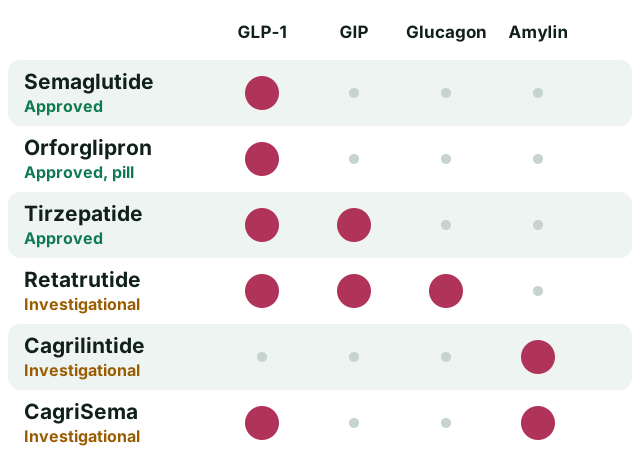
- A long-acting, once-weekly injectable copy of amylin, a pancreatic hormone that promotes fullness, developed by Novo Nordisk mainly as half of the fixed-dose combination CagriSema (cagrilintide plus semaglutide).
- FDA status
- Investigational
Not approved. Novo Nordisk submitted a New Drug Application for CagriSema 2.4 mg/2.4 mg for weight management on December 18, 2025, and said on September 21, 2026 that a decision is expected in Q4 2026. No FDA decision found as of November 2, 2026.
- Evidence level
Phase 3 trials
Large randomized human trials have been completed.
Cagrilintide is not FDA-approved, on its own or combined. It is a lab-made, long-acting version of amylin, a hormone the pancreas releases that helps signal fullness. Novo Nordisk, the maker of Ozempic and Wegovy, has developed it mainly as one half of CagriSema, a once-weekly injection that pairs cagrilintide with semaglutide. CagriSema has been under FDA review since December 2025, and Novo expects a decision before the end of 2026. We checked on November 2 and found none. It sits at the edge of the GLP-1 drug family: the amylin half is new, and the semaglutide half is already on the market as Wegovy.
Is cagrilintide FDA approved?
No. Novo’s own words from its filing announcement: “CagriSema is not approved in the US or EU.”
| Question | Answer as of November 2, 2026 | Source |
|---|---|---|
| Is cagrilintide approved? | No, on its own or combined | Novo, Dec 18, 2025; absent from FDA’s 2026 novel approvals list |
| Has Novo applied? | Yes, for CagriSema 2.4 mg/2.4 mg, to reduce excess body weight and maintain weight reduction in adults with obesity, or overweight with at least one weight-related condition | Novo press release, Dec 18, 2025 |
| What was the filing based on? | REDEFINE 1 and REDEFINE 2 | Novo press release, Dec 18, 2025 |
| When is a decision expected? | Q4 2026, according to Novo; no public FDA action date | Novo, Sept 21, 2026 |
| Has the FDA decided? | No decision found as of November 2, 2026 | FDA status tracker |
| Can it be prescribed now? | No | Not approved |
| Can a pharmacy compound it? | No. FDA says retatrutide and cagrilintide “cannot be used in compounding under federal law” | FDA, content current Oct 1, 2026 |
If the FDA approves CagriSema, Novo says it would be “the first injectable GLP-1 receptor agonist and amylin analogue combination treatment.” Approval of CagriSema would not make cagrilintide on its own an approved drug. This could change any day, so check the date on anything you read.
What is cagrilintide, and how does it work?
Cagrilintide is an amylin analogue: an engineered copy of a natural hormone. The Lancet authors of the cagrilintide phase 2 trial describe the original simply: “natural amylin is a pancreatic hormone that induces satiety,” the feeling of having eaten enough. Cagrilintide is built to last much longer than the natural hormone. In the phase 1b trial, its half-life was 159 to 195 hours, about a week, which is what makes once-weekly injection possible.
Semaglutide works through a different receptor, GLP-1. The idea behind CagriSema is that the two hormones act on appetite through complementary pathways, so combining them could produce more weight loss than either alone. REDEFINE 1 tested exactly that by including each drug alone as well as the combination.
Who would CagriSema be for?
Novo has asked the FDA to approve CagriSema for adults with obesity, or overweight with at least one weight-related condition, as an aid to losing weight and keeping it off. That matches the wording on approved weight-loss drugs. Whether the FDA agrees, and on what terms, will be in the label if one is issued. REDEFINE 2 tested the drug in people with type 2 diabetes, but a diabetes indication is not part of the filing Novo described.
How much weight do people lose on CagriSema?
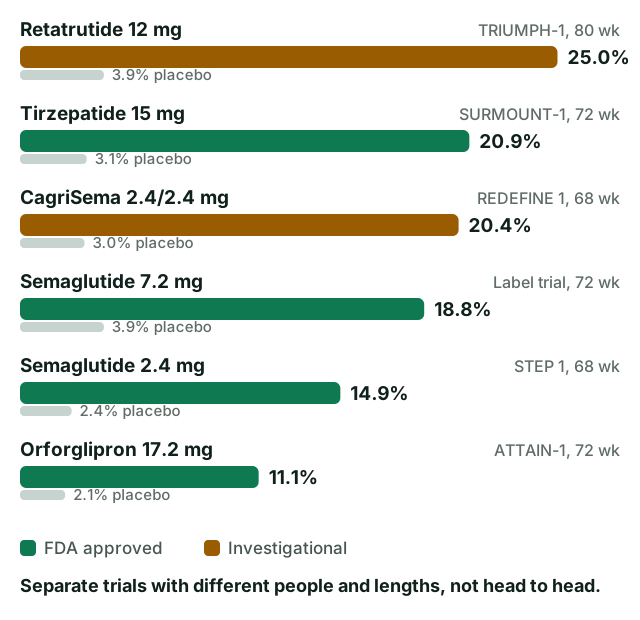
In REDEFINE 1, the main trial, adults without diabetes lost an average of 20.4% of their body weight at 68 weeks, against 3.0% on placebo.
| Trial | Who | Length | CagriSema 2.4/2.4 mg | Placebo | Status of the data |
|---|---|---|---|---|---|
| REDEFINE 1 | 3,417 adults with obesity or overweight, no diabetes | 68 weeks | -20.4% | -3.0% | Published, NEJM, June 2025 |
| REDEFINE 2 | 1,206 adults with obesity or overweight and type 2 diabetes | 68 weeks | -13.7% | -3.4% | Published, NEJM, June 2025 |
These are treatment-policy estimates, which count everyone randomized whether or not they kept taking the drug. When Novo modeled the effect if everyone had stayed on treatment, REDEFINE 1 gave 22.7% for CagriSema, 16.1% for semaglutide alone, 11.8% for cagrilintide alone and 2.3% for placebo. On the treatment-policy measure, semaglutide alone produced 14.9%. The combination beat both of its parts.
Two other REDEFINE 1 details matter. First, 40.4% of people on CagriSema lost 25% or more of their body weight, against 16.2% on semaglutide alone (Novo topline). Second, the protocol let investigators adjust the dose, and at 68 weeks only 57.3% of the CagriSema group were on the highest dose, against 70.2% on semaglutide alone and 82.5% on cagrilintide alone. In REDEFINE 2, 73.5% of people with type 2 diabetes on CagriSema reached an A1c of 6.5% or lower, against 15.9% on placebo.
Is cagrilintide alone better than semaglutide?
No, not in the one trial that ran both. In REDEFINE 1, cagrilintide alone produced 11.5% against 14.9% for semaglutide 2.4 mg alone.
| Trial | Who and how long | Dose | Average weight change | Comparison |
|---|---|---|---|---|
| Phase 2 (Lau et al., Lancet 2021) | 706 adults with obesity or overweight, 26 weeks | 0.3 to 4.5 mg weekly | -6.0% to -10.8% | Placebo -3.0%; liraglutide 3.0 mg daily -9.0% |
| REDEFINE 1, cagrilintide-only arm | 302 adults, 68 weeks | 2.4 mg weekly | -11.5% (treatment policy); -11.8% (if all stayed on treatment) | Placebo -3.0% |
The phase 2 figures use the trial product estimand, which assumes everyone kept taking the drug; the authors reported similar results with the treatment policy estimand. At 4.5 mg, cagrilintide beat daily liraglutide (Saxenda) by 1.8 percentage points. The REDEFINE 1 cagrilintide-only figures come from Novo’s December 2024 topline announcement.
Head to head with tirzepatide
| Trial | Who | Length | CagriSema | Tirzepatide | Result |
|---|---|---|---|---|---|
| REDEFINE 4 | 809 adults with obesity, open-label | 84 weeks | 2.4/2.4 mg: -20.2% | 15 mg: -23.6% | Did not show non-inferiority on weight loss |
| REIMAGINE 4 | Adults with type 2 diabetes on metformin, with or without an SGLT2 inhibitor, open-label | 68 weeks | 2.4/2.4 mg: -15.2%, A1c -1.9 points | 15 mg: -15.8%, A1c -2.2 points | Non-inferior on weight, not on A1c |
| REIMAGINE 5 | Adults with type 2 diabetes | 60 weeks | 1.0/1.0 mg: -12.4%, A1c -1.71 points | 5 mg: -9.1%, A1c -1.67 points | Superior on weight, non-inferior on A1c |
All three are Novo topline results and not yet peer reviewed. REDEFINE 4 uses the treatment-regimen estimand; REIMAGINE 4 and 5 use the estimate if everyone stayed on treatment. Open-label means participants and investigators knew which drug was given. REIMAGINE 5 compared a low CagriSema dose with tirzepatide’s second-lowest dose, so it says nothing about the top doses. For how tirzepatide performs against another next-generation drug, see tirzepatide vs retatrutide.
In September 2026, Novo also reported REDEFINE 9, in which CagriSema 1.0 mg/1.0 mg produced 21.0% weight loss at 68 weeks versus 2.0% on placebo in adults with obesity or overweight (topline, efficacy estimand). That is a separate trial from REDEFINE 1 and its population and design differ, so the two numbers should not be compared directly.
What doses did the trials use?
There is no approved dose, and none has been established outside a trial. In REDEFINE 1, CagriSema, cagrilintide alone and semaglutide alone were each reached through a 16-week dose-escalation period and then continued for 52 weeks of maintenance, according to the ClinicalTrials.gov entry. In the earlier phase 1b trial, cagrilintide and semaglutide were raised together in 4-week steps over 16 weeks. The dose filed with the FDA is 2.4 mg cagrilintide plus 2.4 mg semaglutide once weekly. Lower combinations, 1.0 mg/1.0 mg and 1.7 mg/1.7 mg, have been tested in later trials.
What are the side effects of cagrilintide and CagriSema?
Most side effects involve the stomach and gut, and most were mild to moderate and faded over time.
| Side effect | REDEFINE 1: CagriSema | REDEFINE 1: placebo | REDEFINE 2: CagriSema | REDEFINE 2: placebo |
|---|---|---|---|---|
| Any gastrointestinal event | 79.6% | 39.9% | 72.5% | 34.4% |
| Nausea | 55% | 12.6% | not reported in summary | not reported in summary |
| Constipation | 30.7% | 11.6% | not reported in summary | not reported in summary |
| Vomiting | 26.1% | 4.1% | not reported in summary | not reported in summary |
| Stopped because of side effects | 5.9% | 3.5% | 8.4% | 3% |
Sources: NEJM 2025 abstracts (gastrointestinal totals) and Novo’s December 18, 2025 filing announcement (nausea, constipation, vomiting, discontinuation).
Cagrilintide on its own followed a similar pattern at a lower level. In the 26-week phase 2 trial, gastrointestinal side effects affected 41% to 63% of people across the cagrilintide doses versus 32% on placebo, mainly nausea (20% to 47% versus 18%), and injection-site reactions were among the most frequent events. Across all groups in that trial, including placebo and liraglutide, 4% of participants stopped treatment because of side effects.
For comparison, the tirzepatide side effects page reports nausea of 25% to 29% in the Zepbound weight-loss trials, but across different trials those numbers are only a rough guide.
Until the FDA acts there are no official contraindications for CagriSema. Semaglutide, its other half, already carries a boxed warning: it causes thyroid C-cell tumors in rodents, the human relevance is unknown, and the Wegovy label rules it out for anyone with a personal or family history of medullary thyroid carcinoma or with Multiple Endocrine Neoplasia syndrome type 2. The trials enrolled adults with obesity, or overweight with a weight-related condition, so effects in other groups, including pregnancy, are unknown. An approved label would set the warnings and the people who should not use it.
What is next for cagrilintide?
CagriSema is the near-term story, and several larger questions are still being tested.
- Cagrilintide alone. Phase 3 trials are running in people with obesity or overweight (NCT07220642, about 300 people) and in those who also have type 2 diabetes (NCT07220759, about 330). The registry lists primary completion in May 2027. Novo’s September 2026 investor presentation expects a launch in 2028.
- Higher doses. A phase 3 trial (NCT07564414, about 2,500 people) is testing two different doses of CagriSema and semaglutide, with primary completion listed for February 2028. Novo expects a higher-dose readout in the first half of 2028.
- Heart outcomes. A large trial in people with established heart disease (NCT05669755, about 7,100 people) has primary completion listed for September 2027.
How much will CagriSema cost, and can you get it now?
It has no US price because it is not on the market, and we found no announced price. Until the FDA acts, the only legal way to receive cagrilintide or CagriSema is in a clinical trial. Novo’s trials are listed on ClinicalTrials.gov; searching for “CagriSema” or “cagrilintide” with the status filter set to “Recruiting” shows which are enrolling. If you need treatment now, the GLP-1 section covers the approved options.
Products sold online as research cagrilintide are unapproved drugs. Under 21 CFR 312.160 they may be shipped only for tests in laboratory animals or in vitro, labeled “Not for use in humans,” and using them on a person is not legal. Nobody verifies what is in them.
Questions to ask a prescriber
- Is an approved drug a better fit for me today than waiting for a decision that has no public date?
- If I am on semaglutide already and CagriSema is approved, would there be any reason to change?
- Given that tirzepatide 15 mg beat CagriSema in REDEFINE 4, how would you weigh the two for me?
- Do any recruiting trials near me fit, and what would I have to stop first?
Compare
- GLP-1sTirzepatide vs retatrutideTirzepatide is approved; retatrutide is not.
- GLP-1sFDA approvedTirzepatideTirzepatide is the weekly GIP/GLP-1 injection in Zepbound and Mounjaro.
- LearnFDA status trackerWhich peptides are FDA-approved, which HHS tolerates under conditions, and which are not legal to use.
Recent news on this
Peptide news, sorted. Plus the printable dose chart.
Sorted, every Tuesday: the week's peptide and GLP-1 news in five minutes: FDA moves, new studies explained, and price changes. Subscribe and the one-page dose and injection-site chart arrives first.
Questions people ask
Is cagrilintide FDA approved?
What is the difference between cagrilintide and CagriSema?
Is cagrilintide a GLP-1 drug?
How much weight do people lose on CagriSema?
Is CagriSema better than tirzepatide?
When will CagriSema be available?
Sources
Primary sources first: FDA labels and documents, peer-reviewed trials, registries.
- 1Novo Nordisk. Capital Markets Day, obesity presentation, September 21, 2026 (CagriSema FDA decision expected in the fourth quarter of 2026; cagrilintide phase 3 ongoing)novonordisk.com
- 2Novo Nordisk. Form 6-K, company announcement No 13/2026, filed with the US SEC, February 2026 (CagriSema submitted December 2025; FDA decision anticipated by late 2026)sec.gov
- 3Garvey WT et al. Coadministered cagrilintide and semaglutide in adults with overweight or obesity (REDEFINE 1). N Engl J Med 2025;393:635-647pubmed.ncbi.nlm.nih.gov
- 4Davies MJ et al. Cagrilintide-semaglutide in adults with overweight or obesity and type 2 diabetes (REDEFINE 2). N Engl J Med 2025;393:648-659pubmed.ncbi.nlm.nih.gov
- 5Lau DCW et al. Once-weekly cagrilintide for weight management: a dose-finding phase 2 trial. Lancet 2021;398:2160-2172pubmed.ncbi.nlm.nih.gov
- 6Enebo LB et al. Cagrilintide with semaglutide 2.4 mg: a phase 1b trial. Lancet 2021;397:1736-1748pubmed.ncbi.nlm.nih.gov
- 7Novo Nordisk press release. Novo Nordisk files for FDA approval of CagriSema, December 18, 2025novonordisk.com
- 8Novo Nordisk company announcement (topline, not peer reviewed). REDEFINE 1 headline results, December 20, 2024 (via Drugs.com)drugs.com
- 9Novo Nordisk company announcement (topline). REDEFINE 4 head-to-head with tirzepatide, February 23, 2026 (via Drugs.com)drugs.com
- 10Novo Nordisk company announcement (topline). REIMAGINE 5 and REDEFINE 9 results; FDA decision expected Q4 2026, September 21, 2026 (via Drugs.com)drugs.com
- 11Novo Nordisk Form 6-K, interim report for the first six months of 2026 (REIMAGINE 4 results), August 4, 2026sec.gov
- 12ClinicalTrials.gov NCT05567796. REDEFINE 1: CagriSema in people with excess body weight (arm and escalation descriptions)clinicaltrials.gov
- 13ClinicalTrials.gov NCT07220642. Efficacy and safety of cagrilintide for weight management in participants with overweight or obesityclinicaltrials.gov
- 14ClinicalTrials.gov NCT07220759. Efficacy and safety of cagrilintide for weight management in participants with overweight or obesity and type 2 diabetesclinicaltrials.gov
- 15ClinicalTrials.gov NCT07564414. Two different doses of CagriSema and semaglutide in participants with obesity with or without type 2 diabetesclinicaltrials.gov
- 16ClinicalTrials.gov NCT05669755. Cardiovascular safety and efficacy of CagriSema in participants with established cardiovascular diseaseclinicaltrials.gov
- 17FDA. Novel Drug Approvals for 2026, content current as of October 20, 2026fda.gov
- 18FDA. FDA's concerns with unapproved GLP-1 drugs used for weight loss, content current as of October 1, 2026fda.gov
- 19Wegovy (semaglutide) prescribing information, Novo Nordisk, revised 6/2026, via DailyMed (semaglutide boxed warning)dailymed.nlm.nih.gov
- 2021 CFR 312.160, drugs for investigational use in laboratory research animals or in vitro testslaw.cornell.edu
PeptideSorted Editorial Team
Editorial review
The PeptideSorted editors check every guide against its cited sources before publication: each number against its FDA label, trial or registry, the FDA status against current FDA and HHS documents, and the wording against our describe-never-prescribe rule. Licensed clinicians who join the review panel are listed by name on the editorial team page.
This page was checked against its cited sources by the PeptideSorted editorial team. Licensed clinicians on our review panel are listed on the editorial team page. Every health page cites primary sources and shows its review date. Read the editorial policy and how medical review works, or report an error via corrections. Educational only; not medical advice.