Short answer
Microdosing a GLP-1 means taking less than the label's starting dose or spacing doses further apart, and no clinical trial has tested it as a strategy. The closest evidence suggests smaller doses bring smaller weight loss and fewer stomach side effects. It is off-label, and measuring tiny doses raises the risk of dosing errors.
- What it is
- An informal, off-label practice of using GLP-1 drugs such as semaglutide or tirzepatide at doses below, or intervals longer than, those in the FDA label.
- FDA status
- FDA approved
Semaglutide (Wegovy, Ozempic) and tirzepatide (Zepbound, Mounjaro) are FDA-approved at the doses and schedules in their labels. Microdosing is not a labeled regimen, and no FDA-approved product is sold for it.
- Evidence level
Phase 2 trials
Mid-size human trials; doses are still being studied.
Microdosing a GLP-1 means taking less than the labeled dose, and no trial has shown it works as a plan. It is a social media term, not a clinical one, and it appears in no FDA label. A 2026 commentary in Expert Opinion on Pharmacotherapy describes it as typically “25-50% of manufacturer-recommended starting doses or extended dosing intervals,” and notes that “high-quality evidence is essentially absent.” The short version: lower doses seem to do something, but much less than full doses, and the measuring is where people get hurt.
What the labels and trials actually used
| Drug | Labeled starting dose | Labeled maintenance doses | Lowest dose tested in a trial, and result |
|---|---|---|---|
| Tirzepatide (Zepbound) | 2.5 mg weekly for 4 weeks; “not approved as a maintenance dosage” | 5, 10 or 15 mg weekly (10 or 15 mg for sleep apnea) | 1 mg weekly in a 26-week phase 2 trial in type 2 diabetes: 0.9 kg average weight loss vs 0.4 kg on placebo and 11.3 kg on 15 mg |
| Tirzepatide (Zepbound), obesity trial | Same | Same | 5 mg weekly in SURMOUNT-1: 15.0% average weight loss at 72 weeks vs 19.5% (10 mg), 20.9% (15 mg) and 3.1% (placebo) |
| Semaglutide (Wegovy injection) | 0.25 mg weekly for 4 weeks, then up every 4 weeks | 1.7 or 2.4 mg weekly (up to 7.2 mg) | 0.05 mg daily in a 52-week phase 2 trial: 6.0% average weight loss vs 2.3% on placebo and 13.8% on 0.4 mg daily |
The pattern across all three trials is a dose-response curve: lower doses produced some weight loss compared with placebo, and less than higher doses. Side effects followed the same curve. In the tirzepatide phase 2 trial, stomach side effects occurred in 23.1% of people on 1 mg, 32.7% on 5 mg, 51.0% on 10 mg and 66.0% on 15 mg, against 9.8% on placebo. None of these trials tested staying on a sub-starting dose long term, or stretching the interval between doses, which is what microdosing usually means online.
mL and mg to units
100 units = 1 mLWhat do people hope microdosing will do?
Most people who try it want one of four things. Two published 2026 reviews list the stated reasons as fewer stomach side effects, lower cost, and stretching supply during the drug shortages. The review in the Journal of the American Association of Nurse Practitioners adds “vanity weight,” meaning small cosmetic weight goals, and flags pen manipulation, compounded vials and medication sharing as the main safety problems.
In practice, the same reviews describe three methods:
- Smaller doses. A fraction of the starting dose, drawn from a compounded vial or dialed on a multi-dose pen.
- Longer intervals. A labeled dose taken less often than once a week.
- “Click counting.” Dialing part of a dose on a multi-dose pen by counting the clicks of the dose knob.
What does the human evidence show?
The best real-world data so far points to modest weight loss. A study published in August 2026 searched health records from 29 million patients for people who stayed on the lowest dose: at least three prescriptions over at least 6 months. Only 814 of 490,072 people on semaglutide and 1,016 of 322,442 on tirzepatide fit, which suggests how unusual it is. After matching 534 people in each group:
| Result | Semaglutide 0.25 mg | Tirzepatide 2.5 mg |
|---|---|---|
| Average weight change at 12 months | -2.2% | -5.5% |
| Constipation by 24 months | 22.4% | 32.6% |
| Acute kidney injury by 24 months | 0.4% | 2.7% |
Those numbers need care. The study was observational, so people who stay on a low dose may differ from people who do not. A prescription shows what was ordered, and the authors say these prescriptions are proxies that do not establish intentional microdosing. The authors work for nference, a data company that collaborates with drugmakers, and they state that no drug company funded or influenced the study.
Stepping down after weight loss is a different situation with better evidence. In the randomized SURMOUNT-MAINTAIN trial, adults who lost weight on tirzepatide were moved to 5 mg, stayed on their highest tolerated dose, or switched to placebo. At week 112 they were 16.6%, 21.9% and 9.9% below their starting weight. So a lower labeled dose held more than placebo and less than the full dose. That trial tested 5 mg, a labeled maintenance dose, so it says nothing about doses below the label.
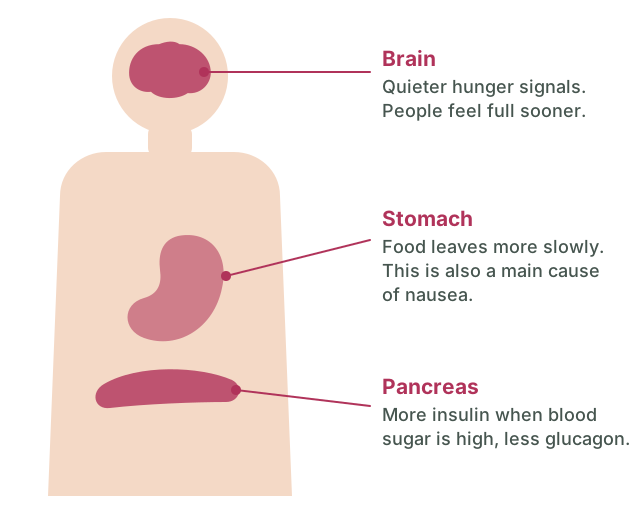
It helps to know what the drug is doing at any dose. GLP-1 drugs act on appetite signals, stomach emptying and insulin release, and the labels climb in steps to reduce stomach side effects.
What do the labels say about going lower?
The labels already describe the lowest doses and how a prescriber adjusts them, and neither describes microdosing.
- Zepbound starts at 2.5 mg once weekly for 4 weeks, then 5 mg, with further 2.5 mg steps no sooner than every 4 weeks. The label says 2.5 mg “is for treatment initiation and is not approved as a maintenance dosage,” and tells prescribers to “consider treatment response and tolerability when selecting the maintenance dosage. If patients do not tolerate a maintenance dosage, consider a lower maintenance dosage.” The lowest labeled maintenance dose is 5 mg.
- Wegovy injection starts at 0.25 mg once weekly for 4 weeks and steps up every 4 weeks. The maintenance dose for weight reduction is 1.7 mg or 2.4 mg. If a dose is not tolerated during the climb, the label says to consider delaying the next step by 4 weeks.
- Timing. The Zepbound label says a missed dose can be taken within 4 days, otherwise it is skipped, and that the injection day can be moved as long as doses are at least 3 days apart. It does not describe planned intervals longer than a week.
So a slower climb, or staying on a lower labeled maintenance dose, is something the label lets a prescriber choose. Taking less than the starting dose indefinitely is not described anywhere in it. The tirzepatide dosage chart and semaglutide dosage chart show the full labeled schedules.
Does microdosing save money?
Often it does not. Novo’s self-pay price is the same $349 a month for every Wegovy pen from 0.25 mg to 2.4 mg, so a lower pen dose costs the same as the full one. Zepbound 2.5 mg is $299 against $399 for 5 mg, but the label does not approve 2.5 mg for maintenance. Splitting one product across more weeks is where the savings would come from, and that is the part the devices are not built for. The cheapest GLP-1 without insurance guide shows the labeled routes to a lower price.
The units math risk
Microdosing almost always means measuring a small amount by hand, and small amounts are where errors are largest.
With a multi-dose pen. The Zepbound KwikPen Instructions for Use say to turn the dose knob “all the way until it stops,” state “Do not count clicks as you select the dose,” and say “Do not transfer ZEPBOUND from your Pen into a syringe.” The pen is designed to give four fixed weekly doses, after which it will not dial a full dose. Partial dialing is outside what the device was tested to do.
With a compounded vial. Doses are measured in units on a U-100 insulin syringe, where 100 units equals 1 mL. Units = dose in mg divided by concentration in mg/mL, times 100.
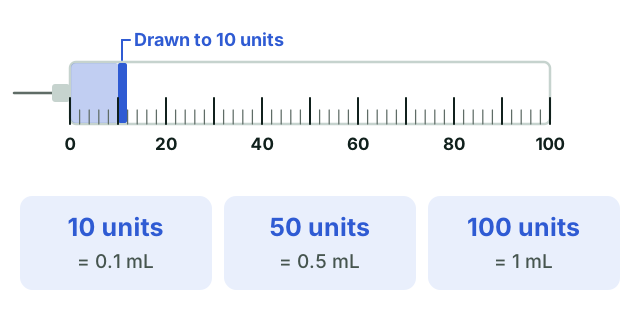
The smaller the dose, the smaller the volume, and the bigger the share of the dose a single misread unit represents:
| Dose | At 2.5 mg/mL | At 10 mg/mL | At 20 mg/mL | Share of the dose in 1 unit at 20 mg/mL |
|---|---|---|---|---|
| 0.25 mg | 10 units | 2.5 units | 1.25 units | 80% |
| 0.5 mg | 20 units | 5 units | 2.5 units | 40% |
| 1 mg | 40 units | 10 units | 5 units | 20% |
| 2.5 mg | 100 units | 25 units | 12.5 units | 8% |
The concentrations are examples. Compounded vials vary by pharmacy, so the label on your vial is the only number that counts. The converter above, or the mg/mL to units converter, does the arithmetic.
The FDA says it has received adverse event reports, some requiring hospitalization, tied to dosing errors with compounded injectable semaglutide, where patients measured the wrong amount and in some cases clinicians miscalculated. Since early 2025, compounded semaglutide and tirzepatide are also lawful only for a documented patient-specific need; the compounded tirzepatide guide and compounded semaglutide guide explain the rules. Products sold “for research use only” are not legal for human use at any dose.
Who should not, and what to watch for
A lower dose does not change who should not take the drug. Semaglutide and tirzepatide labels rule out anyone with a personal or family history of medullary thyroid carcinoma or Multiple Endocrine Neoplasia syndrome type 2, and anyone with a prior serious allergic reaction to the drug. Pancreatitis, gallbladder problems and dehydration from vomiting or diarrhea are listed warnings with no low-dose exception. The semaglutide side effects guide and tirzepatide side effects guide list the symptoms that need a call. Starter doses also bring side effects of their own, as the constipation figures above show.
What to do instead of microdosing
If the reason is side effects or cost, there are labeled ways to raise it with a prescriber:
- If side effects are the problem: ask about delaying the next step, staying at the current step longer, or a lower labeled maintenance dose.
- If you want a smaller goal: ask whether a GLP-1 is the right tool, and what a lower labeled maintenance dose would likely do. The weight loss overview covers the options.
- If cost is the problem: compare the price at your actual maintenance dose before changing the dose.
- Before changing anything: ask how the dose will be measured accurately, and what happens on restarting after a gap. The Zepbound label treats a gap of more than 4 days as a missed dose, and the Wegovy label says to restart the climb at a lower dose after 2 or more missed doses in a row.
The dose itself is the prescriber’s decision. The trials and labels above can only tell you what has been studied.
Compare
- GLP-1sFDA approvedDosage chartThe label takes tirzepatide from 2.5 mg to as high as 15 mg weekly in 4-week steps.
- GLP-1sFDA approvedDosage chartWegovy starts at 0.25 mg weekly and reaches 2.4 mg at week 17.
- GLP-1sFDA approvedCompounded semaglutideCompounded semaglutide is legal only in narrow cases since the shortage ended in 2025.
Peptide news, sorted. Plus the printable dose chart.
Sorted, every Tuesday: the week's peptide and GLP-1 news in five minutes: FDA moves, new studies explained, and price changes. Subscribe and the one-page dose and injection-site chart arrives first.
Questions people ask
Does microdosing a GLP-1 work?
How much weight do people lose on a starter dose?
Can I microdose with a Zepbound KwikPen by counting clicks?
What is the lowest dose of Zepbound or Wegovy?
Why do people microdose?
Is microdosing with a compounded vial safe?
Sources
Primary sources first: FDA labels and documents, peer-reviewed trials, registries.
- 1Beck H, Clements JN. Considerations and challenges in microdosing of GLP-1-based receptor agonists. Expert Opin Pharmacother 2026 (Oct 5)pubmed.ncbi.nlm.nih.gov
- 2Trainer N. The "microdosing" dilemma: balancing patient anecdotes with clinical safety amid GLP-1 compounding restrictions. J Am Assoc Nurse Pract 2026 (May 26)pubmed.ncbi.nlm.nih.gov
- 3Murugadoss K et al. Comparison of cardiometabolic benefits and tolerability in patients on sustained low doses of semaglutide or tirzepatide. Biol Methods Protoc 2026;11:bpag048pubmed.ncbi.nlm.nih.gov
- 4Horn DB et al. Tirzepatide for maintenance of bodyweight reduction (SURMOUNT-MAINTAIN). Lancet 2026, summarized by the American College of Cardiology, May 18 2026acc.org
- 5Zepbound (tirzepatide) prescribing information and Instructions for Use (pen, vial, KwikPen), Eli Lilly, revised 8/2026uspl.lilly.com
- 6Wegovy (semaglutide) injection and tablets prescribing information, Novo Nordisk, revised 6/2026novo-pi.com
- 7O'Neil PM et al. Semaglutide versus liraglutide and placebo for weight loss: dose-ranging phase 2 trial. Lancet 2018;392:637-49pubmed.ncbi.nlm.nih.gov
- 8Frias JP et al. Efficacy and safety of LY3298176 (tirzepatide) in type 2 diabetes: phase 2 trial. Lancet 2018;392:2180-93pubmed.ncbi.nlm.nih.gov
- 9Jastreboff AM et al. Tirzepatide once weekly for the treatment of obesity (SURMOUNT-1). N Engl J Med 2022;387:205-16pubmed.ncbi.nlm.nih.gov
- 10FDA. FDA's concerns with unapproved GLP-1 drugs used for weight loss, current as of Oct 1 2026fda.gov
- 11NovoCare. Price your Wegovy, self-pay prices, checked Nov 2 2026novocare.com
- 12Eli Lilly. LillyDirect: Zepbound self-pay prices by dose (CMAT-05333 08/2026), checked Nov 2 2026lilly.com
More in GLP-1s
- CagrilintideCagrilintide is an unapproved amylin drug. Paired with semaglutide as CagriSema, it is under FDA review. No decision yet. See results and side effects.Read
- Cheapest without insuranceThe cheapest GLP-1 without insurance starts at $149 a month, but that buys a starter dose. Compare Wegovy, Zepbound and Foundayo at the dose you keep.Read
- OrforglipronFoundayo (orforglipron) is a daily GLP-1 pill approved in April 2026. Label doses, 11.1% average weight loss, side effects, food rules and self-pay prices.Read
- RetatrutideRetatrutide is not FDA-approved, and Lilly plans to file in Q1 2027. See what six phase 3 trials showed, the side effects, and why access is so limited.Read
- DosingRetatrutide has no approved dose. See the weekly steps Lilly's trials used, from 2 mg to 12 mg, why each lasts 4 weeks, and what they can't tell you.Read
- Side effectsNausea, diarrhea and constipation lead the list. See dose-by-dose rates from the phase 3 trials, the skin-burning signal, heart data and when to get help.Read
PeptideSorted Editorial Team
Editorial review
The PeptideSorted editors check every guide against its cited sources before publication: each number against its FDA label, trial or registry, the FDA status against current FDA and HHS documents, and the wording against our describe-never-prescribe rule. Licensed clinicians who join the review panel are listed by name on the editorial team page.
This page was checked against its cited sources by the PeptideSorted editorial team. Licensed clinicians on our review panel are listed on the editorial team page. Every health page cites primary sources and shows its review date. Read the editorial policy and how medical review works, or report an error via corrections. Educational only; not medical advice.