Short answer
Compounded tirzepatide is a pharmacy-made injection that is not FDA-approved, and since the shortage ended it is lawful only in narrow cases, such as when a prescriber documents a clinical difference for one patient. Routine copies of Zepbound or Mounjaro are not allowed. The FDA does not review these products, and vial dosing errors are a known risk.
- What it is
- A pharmacy-compounded preparation labeled as tirzepatide, usually a multi-dose vial at a concentration the pharmacy sets, that is not an FDA-approved product.
- FDA status
- FDA approved
Tirzepatide itself is approved as Mounjaro (May 2022; cardiovascular risk indication Aug 28 2026) and Zepbound (Nov 2023, OSA Dec 2024). Compounded copies are not approved. The FDA declared the shortage resolved Dec 19 2024; its grace periods ended Mar 5 2025 (503A) and Mar 19 2025 (503B).
- Evidence level
FDA label
Dosing comes from the FDA-approved prescribing information.
Compounded tirzepatide is a pharmacy-made injection labeled with the same active ingredient as Zepbound and Mounjaro, usually sold as a multi-dose vial instead of a pen. It was widely available while the brand was on the FDA’s shortage list. That ended in early 2025, and what is left is a narrow patient-specific exception. In 2026 the FDA and a federal appeals court moved further against routine copies.
Where compounded tirzepatide stands now
| Date | Event |
|---|---|
| December 15, 2022 | Tirzepatide injection added to the FDA drug shortage list |
| October 2, 2024 | FDA determines the shortage is resolved; the decision is challenged in court and sent back for review |
| December 19, 2024 | FDA issues a declaratory order confirming the shortage is resolved |
| March 5, 2025 | FDA’s enforcement discretion for 503A pharmacies ends after a federal court refuses to block the decision |
| March 19, 2025 | Grace period ends for 503B outsourcing facilities |
| April 30, 2026 | FDA proposes excluding tirzepatide from the list of bulk ingredients outsourcing facilities may use; comments ran to June 29, 2026 |
| August 27, 2026 | The Fifth Circuit appeals court affirms the judgment for the FDA in the tirzepatide shortage case |
| September 18, 2026 | FDA warning letter tells a compounding pharmacy that its tirzepatide products appeared to be essentially copies |
| October 8, 2026 | FDA classifies a recall of compounded tirzepatide vials over lack of assurance of sterility |
We found no final FDA decision on the April proposal as of November 2, 2026.
Is compounded tirzepatide legal?
Sometimes, within narrow limits that depend on who is compounding. The law lets compounders make copies of an approved drug freely only while that drug is in shortage, and the FDA’s April 2026 policy page confirms tirzepatide is on neither the shortage list nor the 503B bulks list.
Two kinds of compounders exist under federal law:
- 503A pharmacies are state-licensed pharmacies and physicians compounding for identified patients on individual prescriptions. They are overseen mainly by state boards of pharmacy.
- 503B outsourcing facilities register with the FDA, follow federal manufacturing standards and can make batches without a prescription for each one. In most cases they cannot compound from bulk ingredients unless the substance is on the bulks list or the drug is in shortage.
For a 503A pharmacy, a compounded product can avoid being a copy when it has a change that makes a significant difference for an individual patient, “as determined by the prescribing practitioner.” Pharmacy Times gives a documented allergy to an inactive ingredient, or a needed strength that is not sold, as examples. The FDA also says, as a general policy, that it does not intend to act against a compounder that “fills four or fewer prescriptions” of a copy in a calendar month.
Routine production does not qualify. In its September 2026 warning letter, the FDA objected to orders that had no prescriber determination at all, and to statements “repeated verbatim across many records.” It also raised concerns about pre-selected menu options for choosing a reason. That matters for any telehealth program offering the same checkbox reason to everyone. If you are told you need compounded tirzepatide, a fair question is what your specific clinical reason is, and whether it is written in your record.
The FDA’s safety warnings
The FDA says compounded drugs are not FDA-approved, and that it does not review them for safety, effectiveness or quality before they are sold. Its page on unapproved GLP-1 drugs, current as of October 1, 2026, raises these concerns:
- Dosing errors. Patients drew up the wrong amount and some clinicians miscalculated doses, in reports the FDA ties to compounded injectable semaglutide. Some cases required hospitalization. The agency also cites adverse events that may be linked to compounded semaglutide or tirzepatide prescribed beyond the label, including faster increases.
- Adverse event counts. As of May 31, 2026, the FDA had more than 730 reports tied to compounded tirzepatide and 990 tied to compounded semaglutide. It says these are likely underreported, since state-licensed pharmacies that are not outsourcing facilities do not have to report them.
- Multi-dose vials. The FDA recommends discarding a vial within 28 days of first use, even if medicine remains and even if the compounder says it lasts longer, and using a new sterile needle and syringe each time.
- Shipping. It has complaints of products arriving warm or with too few ice packs, and recommends not using any injectable GLP-1 that arrives warm.
- Fake labels. Some compounded semaglutide and tirzepatide carried the names of pharmacies that do not exist, or of real pharmacies that did not make them.
- Salt forms. Semaglutide sodium and acetate are “different active ingredients than are used in the approved drugs,” and the FDA knows of no lawful basis for using them. The page does not name tirzepatide salts, but the Zepbound and Mounjaro labels list the active ingredient as tirzepatide.
Sterility is a real-world issue too. A recall classified on October 8, 2026 covered compounded tirzepatide 18 mg/mL, 4 mL vials distributed nationwide, in 22 lots, because sterility could not be assured. The FDA rated it Class II. Mounjaro and Zepbound were not part of it.
Tirzepatide sold “for research purposes” or “not for human consumption” is neither compounded nor legal to use on people. The FDA says such products were falsely labeled, sold to consumers with dosing instructions, and are of unknown quality.
What to check on a compounded vial label
A pen does the measuring for you. A vial puts that on you, so read the label before you touch a syringe.
- Concentration, in mg/mL. This sets your dose in units. FDA records show vials at 17 and 18 mg/mL, among others, and two vials can differ. A label showing only a total, such as “30 mg,” with no volume does not tell you the concentration.
- Beyond-use date. Compounded products carry a beyond-use date. Even so, the FDA’s 28-day advice after first use applies.
- Pharmacy name, address and state license. Check these against your state board of pharmacy. Spelling errors or a wrong address are FDA red flags.
- Active ingredient as written. The approved labels say tirzepatide. A salt form is a reason to call the pharmacy.
- Added ingredients. Vitamin B12, niacinamide and others appear in some formulations. Whatever is listed should match what the prescriber ordered.
- Storage instructions and a lot number, so a problem can be traced and a recall can be checked.
If any of these are missing, or the package arrived warm, call the dispensing pharmacy before use.
Units per dose at example concentrations
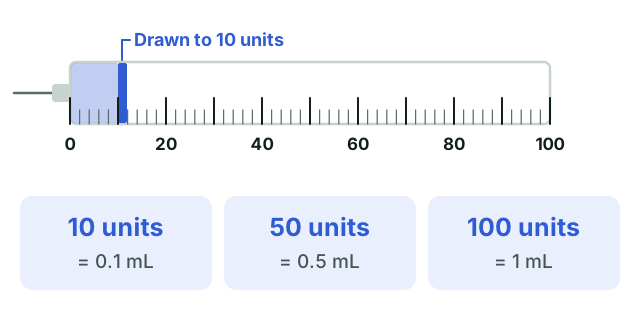
An insulin syringe is marked in units, where 100 units equals 1 mL. To convert a dose, divide the mg by the concentration in mg/mL, then multiply by 100. The doses below are the six steps on the tirzepatide dosage chart; your prescriber sets which one applies. The concentrations are examples, so use the number on your own vial.
| Label dose | 10 mg/mL | 17 mg/mL | 20 mg/mL | 30 mg/mL |
|---|---|---|---|---|
| 2.5 mg | 25 units | 14.7 units | 12.5 units | 8.3 units |
| 5 mg | 50 units | 29.4 units | 25 units | 16.7 units |
| 7.5 mg | 75 units | 44.1 units | 37.5 units | 25 units |
| 10 mg | 100 units | 58.8 units | 50 units | 33.3 units |
| 12.5 mg | 125 units | 73.5 units | 62.5 units | 41.7 units |
| 15 mg | 150 units | 88.2 units | 75 units | 50 units |
At 10 mg/mL, a 12.5 mg or 15 mg dose is more than a 1 mL syringe holds. At 30 mg/mL, one misread unit is a large share of a 2.5 mg dose. The calculator below does the arithmetic for any concentration, and the mg/mL to units converter handles other drugs.
Tirzepatide units calculator
Compounded vialsHow it compares with the brand
| Zepbound or Mounjaro | Compounded tirzepatide | |
|---|---|---|
| Active ingredient | Tirzepatide, confirmed through FDA review | Labeled as tirzepatide; not checked by the FDA before sale |
| FDA review of the finished product | Yes | No |
| Trial evidence for the exact product | SURMOUNT and SURPASS programs | None |
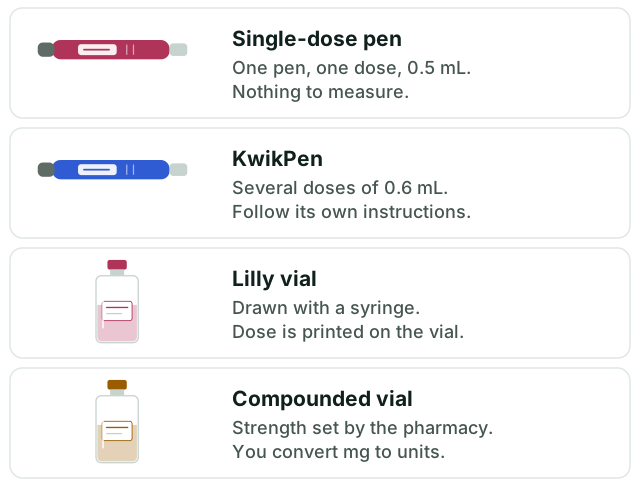
| Device | Single-dose pen, KwikPen or vial, with a fixed dose | Usually a multi-dose vial; you draw each dose |
| Concentration | Fixed per strength and device | Set by the pharmacy; varies |
| Other ingredients | Fixed, reviewed inactive ingredients | May include B12, niacinamide or others |
| Legal basis since March 2025 | Approved drug | Narrow, patient-specific exceptions |
| Cash price | $299 to $449 a month through LillyDirect | Set by each pharmacy or program; often excludes membership and visit fees |
Lilly’s prices have narrowed the argument for compounding on cost. The tirzepatide cost guide lays out every route.
What about oral or sublingual tirzepatide?
No FDA-approved oral tirzepatide exists. Pills and drops are being compounded, but they have not been through clinical trials or FDA evaluation, so it is unclear how well they work or what a standard dose would be.
Who should not use it, and what to watch for
Every warning on the brand label applies to any product containing tirzepatide. That means no use with a personal or family history of medullary thyroid carcinoma or Multiple Endocrine Neoplasia syndrome type 2, and none after a serious allergic reaction to tirzepatide or an ingredient. The tirzepatide side effects guide covers the warnings in full.
Two risks are specific to vials. The first is the dosing error the FDA keeps reporting: a 20 mg/mL vial drawn to 50 units delivers 10 mg, four times the starting dose. The second is contamination, since a multi-dose vial is entered again and again. Redness, swelling or pain at the injection site is worth reporting to your prescriber, and any problem with a compounded product can be reported to FDA MedWatch at 1-800-FDA-1088. The injection sites guide covers technique; the prescriber covers the dose.
Compare
- GLP-1sFDA approvedCostTirzepatide runs from $25 with coverage to $449 cash and $1,086 at list price.
- GLP-1sFDA approvedDosage chartThe label takes tirzepatide from 2.5 mg to as high as 15 mg weekly in 4-week steps.
- GLP-1sFDA approvedCompounded semaglutideCompounded semaglutide is legal only in narrow cases since the shortage ended in 2025.
Getting tirzepatide legitimately
Affiliate disclosure: some links below pay us a referral fee. It never changes the price you pay or the order we list providers.
Through your own doctor
Any licensed prescriber can write a prescription for an FDA-approved GLP-1 if you meet the label criteria. Insurance coverage for weight management varies; ask the office to run a benefits check first.
Through a telehealth provider
Look for a real consultation with a licensed clinician, a named pharmacy, and a clear statement of whether you are getting the brand product or a compounded version. Avoid any site that ships without a consult.
Provider comparison coming once we have verified pricing and pharmacy sourcing for each program. Until then, the two routes above are the only ones we recommend.
Recent news on this
Peptide news, sorted. Plus the printable dose chart.
Sorted, every Tuesday: the week's peptide and GLP-1 news in five minutes: FDA moves, new studies explained, and price changes. Subscribe and the one-page dose and injection-site chart arrives first.
Questions people ask
Is compounded tirzepatide still legal?
Is compounded tirzepatide the same as Zepbound?
How many units is 5 mg of tirzepatide?
How long can you use a vial of compounded tirzepatide?
What is tirzepatide sodium or tirzepatide acetate?
Why does compounded tirzepatide sometimes contain B12 or niacinamide?
Sources
Primary sources first: FDA labels and documents, peer-reviewed trials, registries.
- 1FDA declaratory order: Resolution of shortages of tirzepatide injection products (Mounjaro and Zepbound), Dec 19 2024fda.gov
- 2FDA. FDA clarifies policies for compounders as national GLP-1 supply begins to stabilize, current as of Apr 1 2026fda.gov
- 3FDA. FDA's concerns with unapproved GLP-1 drugs used for weight loss, current as of Oct 1 2026fda.gov
- 4FDA. Compounding and the FDA: questions and answers, current as of Sep 16 2025fda.gov
- 5FDA guidance for industry: Compounded drug products that are essentially copies of approved drug products under section 503B, Jan 2018fda.gov
- 6FDA press announcement: FDA proposes to exclude semaglutide, tirzepatide and liraglutide on 503B bulks list, Apr 30 2026fda.gov
- 7FDA press announcement: FDA intends to take action against non-FDA-approved GLP-1 drugs, Feb 6 2026fda.gov
- 8FDA warning letter to a 503A compounding pharmacy on essentially copies of tirzepatide and semaglutide, WL 738238, Sep 18 2026fda.gov
- 9FDA Enforcement Report: recall event 99952, compounded tirzepatide injection 18 mg/mL, lack of assurance of sterility, classified Oct 8 2026accessdata.fda.gov
- 10US Court of Appeals for the Fifth Circuit. Outsourcing Facilities Association v. FDA, No. 25-10600 (unpublished), Aug 27 2026ca5.uscourts.gov
- 11Halpern L. FDA moves to permanently close the door on compounded GLP-1s. Pharmacy Times, May 1 2026pharmacytimes.com
- 12Zepbound (tirzepatide) prescribing information, Eli Lilly, revised 8/2026, via DailyMeddailymed.nlm.nih.gov
- 13Eli Lilly press release: FDA approves Lilly's Mounjaro (tirzepatide) to reduce cardiovascular risk in adults with type 2 diabetes, Aug 28 2026investor.lilly.com
- 14Eli Lilly. LillyDirect: Zepbound self-pay pricing (CMAT-05333 08/2026), checked Nov 2 2026lilly.com
- 15Eli Lilly press release: Lilly lowers the price of Zepbound single-dose vials, Dec 1 2025investor.lilly.com
- 16GoodRx Health. Zepbound vs. compounded tirzepatide: a complete guide (Billingsley A, PharmD; reviewed Aungst C, PharmD)goodrx.com
More on Tirzepatide
- OverviewTirzepatideTirzepatide is the weekly GIP/GLP-1 injection in Zepbound and Mounjaro. See who it suits, average weight loss, side effects, real prices and what to ask.
- Cheapest onlineThe lowest legitimate online price for tirzepatide is Lilly's own: $299 to $449 a month with a prescription. See prices by dose and the red flags to avoid.Read
- CostTirzepatide runs from $25 with coverage to $449 cash and $1,086 at list price. See every route, Medicare's $50 option and how to pay less.Read
- Dosage chartThe label takes tirzepatide from 2.5 mg to as high as 15 mg weekly in 4-week steps. See the full chart, missed-dose rules and a mg-to-units calculator.Read
- Injection sitesZepbound and Mounjaro go in the stomach, thigh or back of the upper arm, with similar exposure at each. See how to rotate and how each device works.Read
- Side effectsNausea hits 25% to 29% of people on Zepbound, mostly during dose increases. See every label rate by dose, what eases symptoms and which ones need a call.Read
PeptideSorted Editorial Team
Editorial review
The PeptideSorted editors check every guide against its cited sources before publication: each number against its FDA label, trial or registry, the FDA status against current FDA and HHS documents, and the wording against our describe-never-prescribe rule. Licensed clinicians who join the review panel are listed by name on the editorial team page.
This page was checked against its cited sources by the PeptideSorted editorial team. Licensed clinicians on our review panel are listed on the editorial team page. Every health page cites primary sources and shows its review date. Read the editorial policy and how medical review works, or report an error via corrections. Educational only; not medical advice.