Short answer
Compounded semaglutide is legal only in narrow cases: a pharmacy may make it for a named patient when a prescriber documents a significant clinical difference from the approved drug. The shortage that allowed routine copies ended in February 2025. It is not FDA-approved, and the FDA has reported overdoses from unit mix-ups.
- What it is
- A pharmacy-compounded preparation of semaglutide, usually a multi-dose vial labeled in mg/mL, that is not an FDA-approved product.
- FDA status
- FDA approved
Semaglutide is approved as Ozempic, Rybelsus and Wegovy. Compounded copies are not approved; the FDA declared the shortage resolved Feb 21 2025, with copy compounding to end by Apr 22 2025 (503A) and May 22 2025 (503B).
- Evidence level
FDA label
Dosing comes from the FDA-approved prescribing information.
Compounded semaglutide is the same molecule as semaglutide in Wegovy and Ozempic, made by a pharmacy instead of by Novo Nordisk and sold in a multi-dose vial instead of a pen. Today it is legal only in a narrow patient-specific exception. For almost three years it was widely available because the brand was on the FDA’s shortage list. That window closed in spring 2025, and the FDA spent 2026 tightening enforcement. If you already have a vial, the arithmetic further down matters more than anything else here.
Is compounded semaglutide legal?
Only for an individual patient with a documented clinical need, and not as a routine copy of the approved drug. The FDA’s position, in short:
| Who makes it | Allowed today? | The condition |
|---|---|---|
| 503A pharmacy (state-licensed, patient-specific prescriptions) | Narrowly | Prescriber documents a significant difference for an identified patient, such as an allergy to an ingredient in the approved product |
| 503B outsourcing facility (FDA-registered, batch production) | Effectively no | Semaglutide is on neither the 503B bulks list nor the shortage list |
| Any seller of “research” vials | No | Not compounded medicine and not for human use |
Neither kind of compounder makes an FDA-approved drug. The FDA says compounded drugs are not reviewed for safety, effectiveness or quality before they are marketed, and that they “should only be used in patients whose medical needs cannot be met by an FDA-approved drug.”
What a 503A pharmacy may still do
A 503A pharmacy may not compound “essentially copies” of a commercially available drug “regularly or in inordinate amounts.” The FDA’s April 2026 update spells out the test. A compounded product is essentially a copy when it has the same active ingredient in the same, similar or easily substitutable strength, and the approved product can be used by the same route. The exception is when a prescriber documents a “significant difference” for an identified patient. The FDA does not intend to act on the copies rule against a pharmacy that fills four or fewer such prescriptions in a calendar month.
Adding an ingredient does not automatically create a difference. The FDA’s example: semaglutide combined with vitamin B12 (cyanocobalamin) may still be essentially a copy if both are injected and the amounts are “within 10% of the strengths” of the approved products.
What a 503B facility may do
Almost nothing, for now. An outsourcing facility may compound from a bulk substance only if the substance is on the 503B bulks list or the drug is on the shortage list. The FDA states: “Tirzepatide and semaglutide do not currently appear on the 503B bulks list or on FDA’s drug shortage list.”
How the shortage ended
| Date | Event |
|---|---|
| March 2022 | Wegovy added to the FDA drug shortage list |
| August 2022 | Ozempic added to the shortage list |
| July 26, 2024 | FDA warns of overdoses from dosing errors with compounded semaglutide |
| February 21, 2025 | FDA issues a declaratory order: the semaglutide shortage is resolved |
| April 22, 2025 | Deadline for 503A pharmacies and physicians to stop compounding copies (60 days) |
| April 24, 2025 | A federal court in Texas denies an outsourcing-facility trade group’s request for a preliminary injunction against the decision |
| May 22, 2025 | Deadline for 503B outsourcing facilities to stop (90 days) |
The February 2025 order found Novo’s supply “meeting or exceeding demand.” It also acknowledged that “a substantial amount of semaglutide compounding is occurring.” The grace periods existed so that patients on compounded product could move to the approved one.
FDA enforcement through 2026
The agency’s posture has hardened steadily since the deadlines passed.
| Date | Action |
|---|---|
| September 2025 | FDA begins a crackdown on misleading direct-to-consumer drug ads, including telehealth ads for compounded GLP-1s |
| February 6, 2026 | FDA announces its intent “to take decisive steps to restrict GLP-1 active pharmaceutical ingredients” used in mass-marketed compounded drugs, and warns that violations “may result in legal action without further notice,” including “seizure and injunction.” It named a large telehealth company in the statement. |
| March 3, 2026 | FDA sends warning letters to 30 telehealth companies over compounded GLP-1 marketing, mainly claims that the products are the same as approved drugs |
| April 1, 2026 | FDA updates its compounding guidance with the “essentially a copy” test and the B12 example described above |
| April 30, 2026 | FDA proposes to keep semaglutide, tirzepatide and liraglutide off the 503B bulks list, finding no clinical need. Comments closed July 30, 2026 after a 30-day extension |
| September 18, 2026 | FDA warning letter to a large Texas 503A pharmacy says its semaglutide and B12 vials (5 mg/mL semaglutide) “appear to be essentially copies,” and that the differences claimed were “pretextual” given the volume made |
As of November 2, 2026, we found no final FDA decision on the 503B bulks list proposal. The FDA’s page on unapproved GLP-1s, updated October 1, 2026, also lists a green-list import alert (66-80) that blocks GLP-1 ingredients with potential quality concerns.
What the telehealth letters target is marketing. The FDA has said companies may not call compounded products generic, the same as the approved drug, made with the same active ingredient, or clinically proven.
What are the risks of compounded semaglutide?
Dosing errors are the best documented risk, and the list also includes sterility, fraud and missing trial data. The FDA says it had received 990 adverse event reports tied to compounded semaglutide as of May 31, 2026. It adds that the true count is likely higher, because state-licensed pharmacies that are not outsourcing facilities do not have to report.
- Overdose from unit mix-ups. See the next section.
- Doses beyond the label. The FDA has received reports tied to patients prescribed compounded semaglutide in larger doses, more often, or stepped up faster than the approved label allows.
- Sterility. A multi-dose vial is punctured again and again. The FDA’s advice is a new sterile needle and syringe for every dose, and discarding the vial within 28 days of first use.
- Fraud. The FDA says it is aware of fraudulent compounded products: “In some cases, the compounding pharmacies identified on the labels of the products do not exist.” Other labels name a licensed pharmacy that did not make the product.
- The wrong ingredient. See salt forms, below.
- No trial evidence. The STEP and SELECT results come from the approved products, and the compounded version borrows them.
Products sold online “for research purposes” or as “not for human consumption” are a separate category, and they are not legal to use on people. The FDA has warned sellers of these products, says their quality is unknown, and urges consumers not to purchase them.
Dosing errors: why the units matter
In July 2024 the FDA alerted prescribers, compounders and patients to overdoses with compounded semaglutide. Most reports involved patients who gave themselves “five to 20 times more than the intended dose.” Some needed hospital care. Reported symptoms included nausea, vomiting, abdominal pain, fainting, headache, migraine, dehydration, acute pancreatitis and gallstones.
The FDA tied the errors to confusion between milliliters, milligrams and “units,” and to vials that come in more than one concentration. Its examples:
- A patient told to draw 5 units (0.05 mL) on a U-100 syringe drew 50 units instead, ten times the dose.
- A prescriber meant 0.25 mg, which was 5 units, and wrote 25 units, five times the dose.
- Another prescriber wrote 20 units instead of 2, a tenfold error.
Compared with the pen, the risk is built in. A Wegovy single-dose pen delivers one fixed dose. A vial makes you measure every dose yourself.
How compounded vials are labeled
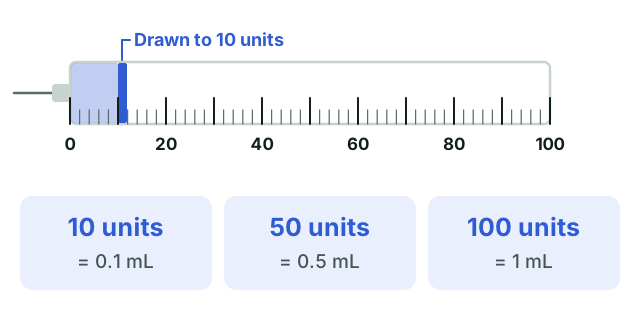
Three numbers on three different scales are where the errors start. The vial is labeled in milligrams per milliliter. Your prescription is in milligrams. The syringe is marked in units, where 100 units equal 1 mL. A label that lists only a total (“10 mg”) without the volume does not tell you the concentration.
What to check on the vial label
- Active ingredient, as written. “Semaglutide” is the approved molecule; “semaglutide sodium” or “semaglutide acetate” is not.
- Concentration in mg/mL, and any additive with its own concentration (for example “5/0.5 mg/mL” for semaglutide with B12).
- Beyond-use date. Whatever the label says, the FDA advises discarding a multi-dose vial within 28 days of first use, even if medication remains.
- Pharmacy name, address and license, so the source can be checked. The FDA has seen labels naming pharmacies that do not exist.
- Storage instructions and a lot number. The FDA advises against using an injectable GLP-1 that arrives warm or poorly refrigerated.
If any of these are missing, call the dispensing pharmacy before use.
Salt forms: a different ingredient
The approved products contain semaglutide base. The FDA says it is aware of compounders using salt forms, semaglutide sodium and semaglutide acetate. It says it has no information showing these match the approved active ingredient, and that it is “not aware of any lawful basis for their use in compounding.” A vial labeled with either salt is not the molecule that was studied in the STEP trials.
How many units is a dose of compounded semaglutide?
Divide the dose in mg by the concentration in mg/mL, then multiply by 100. At 5 mg/mL, 0.25 mg is 5 units. The doses below are the steps on the Wegovy label; the semaglutide dosage chart has every schedule, and the prescriber sets which step applies.
| Label dose | Units at 2.5 mg/mL | Units at 5 mg/mL |
|---|---|---|
| 0.25 mg | 10 units | 5 units |
| 0.5 mg | 20 units | 10 units |
| 1 mg | 40 units | 20 units |
| 1.7 mg | 68 units | 34 units |
| 2.4 mg | 96 units | 48 units |
At 5 mg/mL, the starting dose is 5 units, a small mark on a 100-unit syringe. The FDA recommends that prescribers and compounders supply a syringe sized for the dose and show patients how to measure it. The calculator below does the arithmetic for any concentration; the mg/mL to units converter handles other drugs.
mL and mg to units
100 units = 1 mLHow it compares with the brand
| Wegovy or Ozempic | Compounded semaglutide | |
|---|---|---|
| Active molecule | Semaglutide | Semaglutide when done correctly; salt forms have appeared |
| FDA review of the finished product | Yes | No |
| Trial evidence for the exact product | STEP and SELECT trials for Wegovy; the diabetes trials behind Ozempic | None; evidence is borrowed from the brand |
| Device | Fixed-dose pen or tablet | Multi-dose vial; you draw each dose |
| Concentration | Fixed per pen | Set by the pharmacy; varies |
| Legal basis after May 2025 | Approved drug | Only with a prescriber-documented, patient-specific clinical difference (503A) |
| Self-pay price, Nov 2026 | Wegovy pen $349 a month ($199 for the first two months for new patients through Dec 31, 2026); Wegovy pill from $149 | Set by each pharmacy or program |
Price was the original reason to go compounded, and that gap has narrowed. Novo’s self-pay Wegovy pill starts at $149 a month and the pen is $349. The cheapest GLP-1 without insurance guide lays out every route.
Who should not use it, and what to watch for
Every contraindication on the brand label applies to the compounded version, because it is the same molecule: no use with a personal or family history of medullary thyroid carcinoma or Multiple Endocrine Neoplasia syndrome type 2, and none after a serious allergic reaction to semaglutide. The red-flag symptoms are the same too, and the semaglutide side effects guide lists them. If you may have injected too much, the Wegovy label’s advice applies: an overdose can cause severe nausea, severe vomiting and severe low blood sugar, and Poison Help is at 1-800-222-1222. At 5 mg/mL, drawing 50 units instead of 5 delivers 2.5 mg, ten times the starting dose. For technique, the injection sites guide covers where the shot goes.
Compare
- GLP-1sFDA approvedDosage chartWegovy starts at 0.25 mg weekly and reaches 2.4 mg at week 17.
- GLP-1sFDA approvedCompounded tirzepatideCompounded tirzepatide is legal only in narrow cases since the shortage ended.
- LearnFDA status trackerWhich peptides are FDA-approved, which HHS tolerates under conditions, and which are not legal to use.
Getting semaglutide legitimately
Affiliate disclosure: some links below pay us a referral fee. It never changes the price you pay or the order we list providers.
Through your own doctor
Any licensed prescriber can write a prescription for an FDA-approved GLP-1 if you meet the label criteria. Insurance coverage for weight management varies; ask the office to run a benefits check first.
Through a telehealth provider
Look for a real consultation with a licensed clinician, a named pharmacy, and a clear statement of whether you are getting the brand product or a compounded version. Avoid any site that ships without a consult.
Provider comparison coming once we have verified pricing and pharmacy sourcing for each program. Until then, the two routes above are the only ones we recommend.
Recent news on this
Peptide news, sorted. Plus the printable dose chart.
Sorted, every Tuesday: the week's peptide and GLP-1 news in five minutes: FDA moves, new studies explained, and price changes. Subscribe and the one-page dose and injection-site chart arrives first.
Questions people ask
Is compounded semaglutide still legal in 2026?
Is compounded semaglutide the same as Wegovy or Ozempic?
What is semaglutide sodium or semaglutide acetate?
How many units is 0.25 mg of compounded semaglutide?
Does adding vitamin B12 make compounded semaglutide legal?
How long does a compounded semaglutide vial last once opened?
Sources
Primary sources first: FDA labels and documents, peer-reviewed trials, registries.
- 1FDA declaratory order: Resolution of shortages of semaglutide injection products (Ozempic and Wegovy), Feb 21 2025fda.gov
- 2FDA. FDA clarifies policies for compounders as national GLP-1 supply begins to stabilize, current as of Apr 1 2026fda.gov
- 3FDA. FDA's concerns with unapproved GLP-1 drugs used for weight loss, current as of Oct 1 2026fda.gov
- 4FDA. FDA alerts health care providers, compounders and patients of dosing errors associated with compounded injectable semaglutide products, Jul 26 2024fda.gov
- 5FDA press statement: FDA intends to take action against non-FDA-approved GLP-1 drugs, Feb 6 2026fda.gov
- 6FDA press release: FDA warns 30 telehealth companies against illegal marketing of compounded GLP-1s, Mar 3 2026fda.gov
- 7FDA press release: FDA proposes to exclude semaglutide, tirzepatide and liraglutide from the 503B bulks list, Apr 30 2026fda.gov
- 8Federal Register. List of bulk drug substances for which there is a clinical need under section 503B, May 1 2026 (91 FR 23431)federalregister.gov
- 9Federal Register. Comment period extended to Jul 30 2026, published Jun 26 2026federalregister.gov
- 10FDA warning letter 738238 to a Texas 503A compounding pharmacy, Sep 18 2026fda.gov
- 11FDA. Import Alert 66-80: detention without physical examination of GLP-1 active pharmaceutical ingredients, published Oct 9 2026accessdata.fda.gov
- 12Wegovy (semaglutide) injection and tablets prescribing information, Novo Nordisk, revised 6/2026, via DailyMeddailymed.nlm.nih.gov
- 13NovoCare. Price your Wegovy, self-pay prices, checked Nov 2 2026novocare.com
More on Semaglutide
- OverviewSemaglutideSemaglutide is the drug in Wegovy and Ozempic. Adults lost about 15% of body weight in trials. See how it works, the risks and current cash prices.
- Dosage chartWegovy starts at 0.25 mg weekly and reaches 2.4 mg at week 17. See every label schedule, pen strength, missed-dose rule and unit conversion in one place.Read
- Side effectsNausea hits 44% of people on Wegovy 2.4 mg. See every label rate, how long side effects last, what helps, and the symptoms that need a call right away.Read
PeptideSorted Editorial Team
Editorial review
The PeptideSorted editors check every guide against its cited sources before publication: each number against its FDA label, trial or registry, the FDA status against current FDA and HHS documents, and the wording against our describe-never-prescribe rule. Licensed clinicians who join the review panel are listed by name on the editorial team page.
This page was checked against its cited sources by the PeptideSorted editorial team. Licensed clinicians on our review panel are listed on the editorial team page. Every health page cites primary sources and shows its review date. Read the editorial policy and how medical review works, or report an error via corrections. Educational only; not medical advice.