Short answer
Retatrutide is not FDA-approved for any use and cannot be legally sold as of November 2, 2026. It is an investigational weekly injection from Eli Lilly. In TRIUMPH-1, people on 12 mg lost 25.0% of body weight versus 3.9% on placebo. Lilly plans to file in Q1 2027. Until then, access is limited to trials and narrow compassionate use.
- What it is
- An investigational once-weekly injectable from Eli Lilly (code name LY3437943) that activates the GIP, GLP-1 and glucagon receptors, studied for obesity, type 2 diabetes, knee osteoarthritis pain and sleep apnea.
- FDA status
- Investigational
Not approved for any use. Six phase 3 trials have reported positive results since December 2025. Lilly said on September 29, 2026 that it plans to submit a Biologics License Application in Q1 2027. It cannot be bought or prescribed normally. Outside clinical trials, the only lawful access is Lilly's narrow expanded access (compassionate use) program, which physicians apply to on behalf of a small group of patients.
- Evidence level
Phase 3 trials
Large randomized human trials have been completed.
Retatrutide is not FDA-approved, no pharmacy can dispense it, and Lilly has not yet applied. It is an experimental weekly injection for obesity and type 2 diabetes, a possible next step in the GLP-1 drug family. Six phase 3 trials have reported positive results, and Lilly plans to file with the FDA in the first quarter of 2027. If you saw vials online or simply want it now, here is the plain position: it cannot be bought or prescribed normally, and outside clinical trials there is only a narrow compassionate use program for a small group of very sick patients. Anything sold online is not that program, and it is illegal to sell. Go deeper on the doses the trials used, retatrutide side effects, and tirzepatide vs retatrutide.
Is retatrutide FDA approved?
No. Lilly’s own wording, from October 28, 2026, is that retatrutide “has not been approved by FDA or any regulatory organization anywhere in the world.”
| Question | Answer as of November 2, 2026 | Source |
|---|---|---|
| Is it FDA-approved? | No, for any use | Lilly, October 28, 2026 |
| Has Lilly applied? | Not yet. Lilly plans to submit a Biologics License Application in Q1 2027 | Lilly, September 29, 2026 |
| Can a doctor prescribe it? | Not normally. Lilly runs a narrow expanded access (compassionate use) program that physicians apply to, for patients who cannot join a trial | Lilly, August 2026; ClinicalTrials.gov NCT07629401 |
| Can a pharmacy compound it? | No. FDA says retatrutide “cannot be used in compounding under federal law” | FDA, content current October 1, 2026 |
| Does the October 2026 HHS peptide policy cover it? | No. That interim policy names six other peptides. Investigational drugs like retatrutide are unaffected | HHS, October 2026 |
The current status of every peptide and GLP-1 is on the FDA status tracker.
When will retatrutide be available?
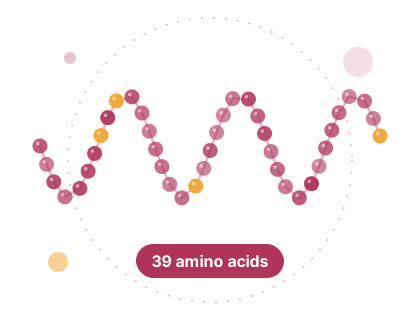
Nobody can give a date. Filing starts the FDA’s review, and Lilly has not announced a launch date, a brand name or a price. One more legal thread could shape what happens after approval. In March 2024 the FDA classified retatrutide as a drug rather than a biological product, because its chain has no more than 40 alpha amino acids. A federal court in Indiana upheld that count on September 30, 2025, but set aside the FDA’s finding on whether retatrutide is “analogous” to a protein and sent that question back to the agency. Lilly appealed, and the Seventh Circuit heard the case on September 24, 2026. We found no ruling as of November 2. The result matters for exclusivity, which runs 12 years for biologics and 5 for drugs, and for future compounding. Today it changes nothing: retatrutide cannot be compounded however the court rules.
How retatrutide works, in plain English
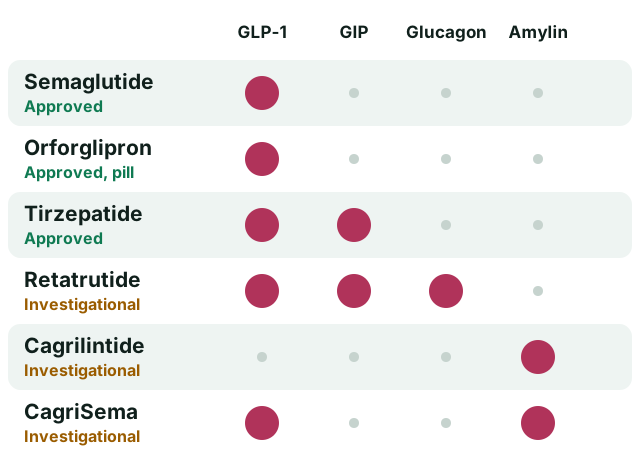
After a meal, the gut releases hormones that tell the pancreas to release insulin and tell the brain you are full. Two of these are GIP (glucose-dependent insulinotropic polypeptide) and GLP-1 (glucagon-like peptide-1). Semaglutide switches on the GLP-1 receptor. Tirzepatide switches on both GIP and GLP-1.
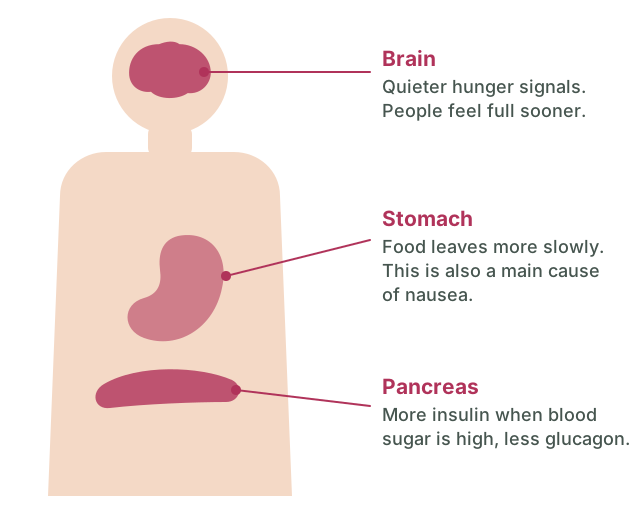
Retatrutide is a single peptide that switches on those two and a third: the receptor for glucagon, a pancreatic hormone best known for raising blood sugar between meals. The phase 2 authors explain the idea: adding glucagon activity “may further reduce energy intake, increase energy expenditure, or both.” In plain terms, the hope is that people eat less and also burn somewhat more. Glucagon and GLP-1 can also speed the heart slightly, which is why heart rate is watched closely in the trials. In trials it is injected under the skin once a week.
Who is retatrutide for?
Today it is for people enrolled in a study, plus a very small expanded access group. Lilly is testing it in obesity and overweight with a weight-related problem, type 2 diabetes, knee osteoarthritis pain, moderate-to-severe sleep apnea, chronic low back pain, heart and kidney outcomes, and fatty liver disease.
Lilly also confirmed on August 3, 2026 that it runs an expanded access (compassionate use) program and is “actively reviewing requests from health care providers.” Its reach is narrow. A physician applies, not a patient, and it is meant for adults who cannot enroll in a clinical trial and have refractory obesity with two or more serious complications. News reports differed on the remaining test: STAT described all standard treatments having been discussed, while Reuters described obesity that persists despite tolerating the highest approved dose of an obesity drug. The ClinicalTrials.gov entry lists both, and sets a BMI of 35 or more.
This is an exception for people with few options left, so it is no way around the wait for most readers. Some obesity specialists told reporters they want more safety data before using it, and others said Lilly’s replies had been slow or vague. For most people with obesity, as one specialist told Medscape, the right answer remains the approved therapies.
How much weight do people lose on retatrutide?
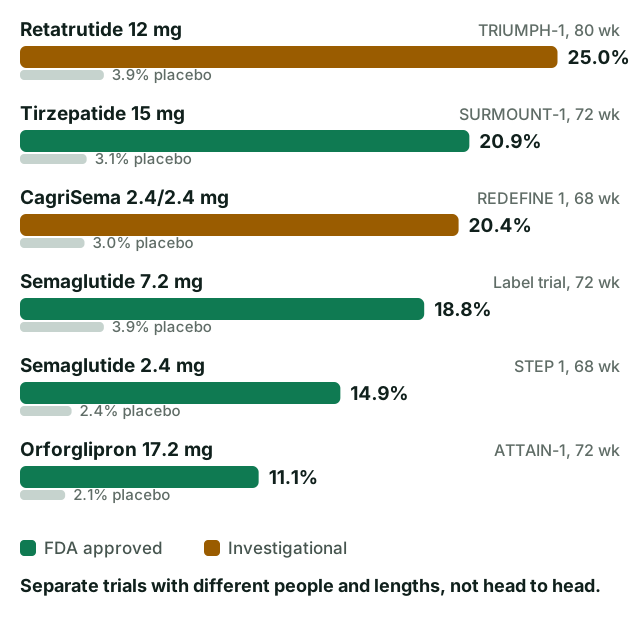
In the largest trial, average weight loss at 80 weeks ran from 17.6% on 4 mg to 25.0% on 12 mg, against 3.9% on placebo.
| Trial | Who was in it | Length | Doses | Average weight change | Placebo | Status of the data |
|---|---|---|---|---|---|---|
| TRIUMPH-1 | 2,339 adults with obesity or overweight, no diabetes | 80 weeks | 4, 9, 12 mg | -17.6%, -23.7%, -25.0% | -3.9% | Published, NEJM, Sept 29, 2026 |
| TRIUMPH-2 | 1,152 adults with obesity or overweight and type 2 diabetes | 80 weeks | 4, 9, 12 mg | -11.9%, -16.8%, -18.8% | -5.1% | Published, Lancet, Sept 29, 2026 |
| TRIUMPH-3 | 1,949 adults with BMI 35 or more and established heart disease | 80 weeks | 9, 12 mg | -21.6%, -22.6% | -3.2% | Lilly topline only (July 23, 2026) |
| TRIUMPH-4 | 445 adults with obesity or overweight and knee osteoarthritis | 68 weeks | 9, 12 mg | -20.0%, -23.7% | -4.6% | Lilly topline only (Dec 11, 2025) |
The TRIUMPH-1, TRIUMPH-2 and TRIUMPH-4 figures use the treatment-regimen estimand, which counts everyone randomized whether or not they kept taking the drug. That is the more conservative way to report. TRIUMPH-3’s figures are the efficacy estimand, the only one Lilly released for it, which estimates the effect had everyone stayed on treatment, so they run higher. Lilly’s press releases lead with the efficacy estimand; for TRIUMPH-1 that gave 19.0%, 25.9% and 28.3%. Both are real numbers that answer different questions, and the 28.3% you may have seen in headlines is the second kind.
Those are averages after a long time on the highest dose a person reached. Weight came off gradually. In the phase 2 trial, the 12 mg group was down 17.5% at 24 weeks and 24.2% at 48 weeks. A TRIUMPH-1 extension of 532 people with a starting BMI of 35 or more who had tolerated their dose reached an average 30.3% at 104 weeks on 12 mg (Lilly topline, efficacy estimand). These were selected participants, not everyone who started.
The 2023 phase 2 trials
The first large human data came from a 48-week phase 2 trial in the New England Journal of Medicine (Jastreboff et al.). It enrolled 338 adults with obesity or overweight and no diabetes. Average weight change at 48 weeks was -8.7% on 1 mg, -17.1% on 4 mg, -22.8% on 8 mg and -24.2% on 12 mg, against -2.1% on placebo. At 12 mg, every participant lost at least 5% of body weight and 83% lost at least 15%.
A companion 36-week phase 2 trial in 281 adults with type 2 diabetes, published in The Lancet the same month, found A1c reductions of up to 2.02 percentage points on 12 mg at 24 weeks and weight loss of up to 16.94% at 36 weeks. Its authors wrote that these data “informed dose selection for the phase 3 programme,” which is why phase 3 uses 4, 9 and 12 mg rather than 8 mg.
What does retatrutide do for type 2 diabetes, knees and sleep apnea?
Beyond weight, the phase 3 results cover blood sugar, joint pain and breathing during sleep.
| Trial | Who | Length | Compared with | A1c change | Weight change |
|---|---|---|---|---|---|
| TRANSCEND-T2D-1 | 537 adults with type 2 diabetes on diet and exercise alone | 40 weeks | Placebo | -1.7, -2.0, -1.9 points on 4, 9, 12 mg; placebo -0.8 | -11.5%, -15.5%, -16.8%; placebo -2.5% |
| TRANSCEND-T2D-2 | 1,298 adults with type 2 diabetes on metformin, with or without an SGLT2 inhibitor, open-label | 80 weeks | Ozempic 2 mg | -2.2 points on 9 and 12 mg; Ozempic -1.8 | -19.5%, -20.9%; Ozempic -9.4% |
Both rows are Lilly topline figures using the efficacy estimand, and TRANSCEND-T2D-2 is not yet peer reviewed. Open-label means participants knew which drug they were on. It is the first phase 3 trial comparing retatrutide directly with another incretin medicine. The 12 mg dose was superior on A1c with formal statistical control; the 9 mg result met noninferiority, and its superiority was only nominal.
- Knee pain. In TRIUMPH-4, the WOMAC pain score (a 0 to 10 osteoarthritis questionnaire) fell by 4.5 and 4.4 points on 9 and 12 mg against 2.4 points on placebo, from a baseline of 6.0 (Lilly topline). TRIUMPH-1’s knee osteoarthritis subgroup also met its pain endpoint (NEJM).
- Sleep apnea. In two sleep apnea sub-studies published in NEJM in October 2026, the apnea-hypopnea index (breathing interruptions per hour of sleep) fell by 34.3 and 31.7 events per hour on 9 and 12 mg, against 9.9 on placebo, from a baseline near 59, in people without diabetes.
- Blood sugar with obesity. In TRIUMPH-2, A1c fell by 1.4 to 1.6 percentage points from a baseline of 7.7%, against 0.2 on placebo (Lilly, efficacy estimand).
- Heart events. TRIUMPH-3 saw fewer major cardiovascular events than expected in both arms. Lilly reported a hazard ratio of 0.82 for a five-part composite, with a confidence interval that crosses 1, so the trial cannot say whether retatrutide lowers or raises heart risk. A dedicated outcomes trial is running.
What dose of retatrutide did the trials use?
Every phase 3 trial started at 2 mg once a week and stepped up every four weeks through 4, 6 and 9 mg, stopping at the assigned target of 4, 9 or 12 mg. The 12 mg group reached its dose after 16 weeks. There is no approved dose, because there is no label, and no human dose has been established for use outside a trial. The retatrutide dosing page lays out each trial’s ladder, and the retatrutide calculator shows the arithmetic behind milligrams and syringe units for readers trying to understand it.
What are the side effects of retatrutide?
The pattern matches every drug in this class, only stronger at the top dose. In TRIUMPH-1, nausea affected 28.6%, 38.4% and 42.4% of people on 4, 9 and 12 mg versus 14.8% on placebo, and vomiting 10.6% to 25.3% versus 4.8%. Between 4.1% and 11.3% stopped because of side effects, versus 4.9% on placebo. Dysesthesia, a burning or altered skin sensation, is the signal that gets the most attention: 5.1% to 12.5% versus 0.9% in TRIUMPH-1, and up to 20.9% on 12 mg in TRIUMPH-4. The full tables, heart rate data, red flags and when to call are on the retatrutide side effects page.
How much will retatrutide cost?
It has no price, because it is not on the market. Lilly has not announced a brand name or a price. ClinicalTrials.gov lists Lilly’s retatrutide studies; searching the registry for “retatrutide” with the status filter set to “Recruiting” shows which trials are enrolling and where. Eligibility is set by each protocol, and placebo groups are common, so enrolling does not guarantee receiving the drug. If you need treatment now, the approved options and what they cost are in the cheapest GLP-1 without insurance guide.
Is retatrutide sold online real, and is it legal?
No legal version of retatrutide is sold to consumers. Lilly’s position is blunt: “Anyone purporting to sell retatrutide to consumers is breaking the law.” Products labeled “research use only” are not legal to use on people. Under 21 CFR 312.160, an unapproved drug may be shipped only for laboratory animal or test-tube research, labeled “not for use in humans,” and the FDA’s March 31, 2026 warning letter to one seller said that despite such labeling, “evidence obtained from your website establishes that your products are intended to be drugs for human use.” The FDA has also warned telehealth companies, ingredient distributors and outsourcing facilities over retatrutide.
Sellers sometimes use other labels; that warning letter notes one company listed retatrutide as “GLP-1-R Peptide,” and Lilly’s code name is LY3437943. None of those products is the drug tested in Lilly’s trials, and none has verified identity, purity or dose. The FDA calls them “of unknown quality.” In August 2026 Lilly said it had filed six lawsuits against US sellers, including compounding pharmacies, medical spas and online sellers, and had reported more than 14,000 listings and posts.
How retatrutide compares with other drugs
So far there is one head-to-head phase 3 result, the Ozempic comparison in type 2 diabetes above. Lilly is also running TRIUMPH-5 (NCT06662383), an 80-week double-blind trial of retatrutide against tirzepatide in about 800 adults with obesity. The registry lists its primary completion as November 2026, and we found no results as of November 2. Until it reports, any comparison with tirzepatide rests on separate trials with different populations and lengths. The tirzepatide vs retatrutide page lays them side by side with that caveat.
Who the trials excluded
Because there is no label, there are no official contraindications and no boxed warning. The phase 2 obesity trial’s registry entry excluded people with type 1 diabetes, a history of pancreatitis or symptomatic gallbladder disease, a personal or family history of medullary thyroid carcinoma or Multiple Endocrine Neoplasia syndrome type 2, recent heart attack, stroke or heart failure hospitalization, uncontrolled high blood pressure, significant kidney impairment, and pregnancy. TRIUMPH-5’s entry repeats the thyroid and pancreatitis exclusions and also rules out weight-loss drugs within 90 days before screening. Those exclusions mean the drug’s safety in those groups is unknown.
Questions to ask a prescriber
- Which approved drug fits my health history, and what would it realistically do for me?
- Is there a retatrutide trial near me, and would I qualify? Would I have to stop my current medicine first?
- If my current treatment has stopped working, what are the next approved options?
- If I wait for retatrutide, what does that delay cost my health, given that it has no approval date?
- I have already used a product bought online. What should you know, and what should we check?
Compare
Recent news on this
Peptide news, sorted. Plus the printable dose chart.
Sorted, every Tuesday: the week's peptide and GLP-1 news in five minutes: FDA moves, new studies explained, and price changes. Subscribe and the one-page dose and injection-site chart arrives first.
Questions people ask
Is retatrutide FDA approved in 2026?
When will retatrutide be available?
How much weight did people lose on retatrutide?
Can I get retatrutide from a doctor or a compounding pharmacy?
How is retatrutide different from tirzepatide?
What is the most unusual side effect of retatrutide?
Sources
Primary sources first: FDA labels and documents, peer-reviewed trials, registries.
- 1Jastreboff AM et al. Retatrutide, a triple hormone receptor agonist, for treatment of obesity (TRIUMPH-1). N Engl J Med, published online September 29, 2026pubmed.ncbi.nlm.nih.gov
- 2Bellido V et al. Retatrutide in adults with obesity and type 2 diabetes (TRIUMPH-2): a phase 3 trial. Lancet 2026;408:1455-1472pubmed.ncbi.nlm.nih.gov
- 3Grunstein RR et al. Retatrutide once weekly for treatment of obstructive sleep apnea. N Engl J Med, published online October 21, 2026pubmed.ncbi.nlm.nih.gov
- 4Jastreboff AM et al. Triple-hormone-receptor agonist retatrutide for obesity: a phase 2 trial. N Engl J Med 2023;389:514-526pubmed.ncbi.nlm.nih.gov
- 5Rosenstock J et al. Retatrutide for people with type 2 diabetes: a phase 2 trial. Lancet 2023;402:529-544pubmed.ncbi.nlm.nih.gov
- 6Eli Lilly press release (topline, not peer reviewed). TRIUMPH-4 knee osteoarthritis results, December 11, 2025investor.lilly.com
- 7Eli Lilly press release (topline). TRANSCEND-T2D-1 results, March 19, 2026investor.lilly.com
- 8Eli Lilly press release (topline). TRIUMPH-1 obesity results, May 21, 2026investor.lilly.com
- 9Eli Lilly press release. TRIUMPH-1 basket results presented at ADA, June 6, 2026investor.lilly.com
- 10Eli Lilly press release (topline). TRIUMPH-2 and TRIUMPH-3 results and BLA plans, July 23, 2026 (via BioSpace)biospace.com
- 11Eli Lilly press release. Lilly calls on online platforms, payment companies and regulators to shut down the illegal retatrutide black market, August 12, 2026investor.lilly.com
- 12Eli Lilly press release. TRIUMPH-2 detailed results and plan to submit a BLA in Q1 2027, September 29, 2026investor.lilly.com
- 13Eli Lilly press release (topline). TRANSCEND-T2D-2 head-to-head results against Ozempic 2 mg, October 28, 2026investor.lilly.com
- 14ClinicalTrials.gov NCT06662383. TRIUMPH-5: retatrutide compared with tirzepatide in adults with obesityclinicaltrials.gov
- 15ClinicalTrials.gov NCT07629401. Pre-approval expanded access of retatrutide (LY3437943)clinicaltrials.gov
- 16AJMC. Lilly expands retatrutide access amid doctor pushback, August 5, 2026ajmc.com
- 17Medscape. Retatrutide expanded access draws mixed clinician views, August 5, 2026medscape.com
- 18ClinicalTrials.gov NCT04881760. Phase 2 study of LY3437943 (retatrutide) in obesity or overweight: eligibility criteriaclinicaltrials.gov
- 19FDA. FDA's concerns with unapproved GLP-1 drugs used for weight loss, content current as of October 1, 2026fda.gov
- 20FDA warning letter to Gram Peptides (retatrutide sold as research use only), March 31, 2026fda.gov
- 2121 CFR 312.160, drugs for investigational use in laboratory research animals or in vitro testslaw.cornell.edu
- 22HHS. Enforcement Discretion Policy Regarding 503A Compounding Using Certain Peptide Bulk Drug Substances, with Appendices A and B, October 2026hhs.gov
- 23Eli Lilly and Co. v. Kennedy, No. 1:24-cv-01503 (S.D. Ind. Sept. 30, 2025), order on summary judgmentgovinfo.gov
- 24BioPharm International. Amino acid count determines retatrutide's biologic or drug classification, October 2, 2026biopharminternational.com
- 25Reason. Can a new weight loss treatment escape the legal and regulatory thicket? September 10, 2026reason.com
Go deeper on Retatrutide
- DosingRetatrutide has no approved dose. See the weekly steps Lilly's trials used, from 2 mg to 12 mg, why each lasts 4 weeks, and what they can't tell you.Read
- Side effectsNausea, diarrhea and constipation lead the list. See dose-by-dose rates from the phase 3 trials, the skin-burning signal, heart data and when to get help.Read
PeptideSorted Editorial Team
Editorial review
The PeptideSorted editors check every guide against its cited sources before publication: each number against its FDA label, trial or registry, the FDA status against current FDA and HHS documents, and the wording against our describe-never-prescribe rule. Licensed clinicians who join the review panel are listed by name on the editorial team page.
This page was checked against its cited sources by the PeptideSorted editorial team. Licensed clinicians on our review panel are listed on the editorial team page. Every health page cites primary sources and shows its review date. Read the editorial policy and how medical review works, or report an error via corrections. Educational only; not medical advice.