
Short answer
Retatrutide has no approved dose because it is not an approved drug. Lilly's phase 3 trials started everyone at 2 mg once a week and raised the dose every four weeks through 4, 6 and 9 mg, stopping at a target of 4, 9 or 12 mg. Those schedules are trial protocols, not a dosing guide.
- What it is
- An investigational once-weekly GIP, GLP-1 and glucagon receptor agonist from Eli Lilly, studied in phase 3 trials for obesity and related conditions.
- FDA status
- Investigational
Not approved for any use and has no label or approved dose. Lilly plans to submit a Biologics License Application in Q1 2027. It cannot be bought or prescribed normally. Outside clinical trials, the only lawful access is Lilly's narrow compassionate use program, which physicians apply to.
- Evidence level
Phase 3 trials
Large randomized human trials have been completed.
Retatrutide has no approved dose, and no human dose has been established for use outside a trial. It is an investigational drug, so the only doses that exist are the ones written into Lilly’s trial protocols, given under medical supervision with scheduled visits and lab work. What follows describes those protocols for readers who want to understand what the trials did. It is not a dosing guide. For the drug itself, its FDA status and what the trials found, start with the retatrutide hub.
The phase 3 schedule: TRIUMPH-1 to TRIUMPH-4
Lilly describes one escalation pattern across the phase 3 program: “participants randomized to retatrutide initiated treatment with 2 mg once weekly and increased the dose every four weeks until reaching their target dose.” The program uses five dose strengths: 2, 4, 6, 9 and 12 mg.
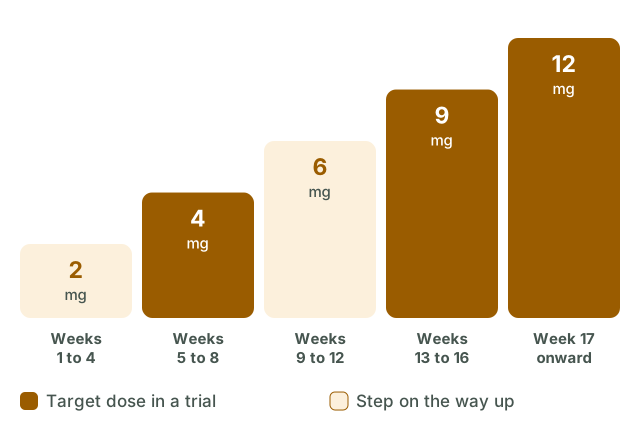
| Weeks of treatment | Target 4 mg | Target 9 mg | Target 12 mg |
|---|---|---|---|
| Weeks 1 to 4 | 2 mg | 2 mg | 2 mg |
| Weeks 5 to 8 | 4 mg (target reached) | 4 mg | 4 mg |
| Weeks 9 to 12 | 4 mg | 6 mg | 6 mg |
| Weeks 13 to 16 | 4 mg | 9 mg (target reached) | 9 mg |
| Week 17 onward | 4 mg | 9 mg | 12 mg (target reached) |
The steps come from Lilly’s published trial descriptions; the week ranges follow from four weeks per step. All doses are once weekly, injected under the skin. The ClinicalTrials.gov entries for these trials list the arms only as “Dose 1”, “Dose 2” and “Dose 3”; the milligram amounts come from Lilly’s announcements and the published papers.
Retatrutide dosage calculator
InvestigationalThat calculator converts a milligram amount into syringe units for a given vial and water volume. Its dropdown lists the phase 2 doses (1, 4, 8 and 12 mg); the phase 3 steps of 2, 6 and 9 mg can be entered with “Other.” The trials report doses in milligrams, not syringe units, so the calculator explains arithmetic and says nothing about what the trials did. The sum itself is simple. On a U-100 syringe, units equal milligrams divided by mg per mL, times 100, and 100 units is always 1 mL. Units measure liquid, so the same number of units can hold very different amounts of drug. The mg/mL to units converter covers the general math. Without a verified concentration, which an unregulated vial cannot give you, the answer means nothing.
What happened at each dose in TRIUMPH-1?
Higher doses brought more weight loss, and past 9 mg they mostly brought more people stopping.
| Target dose | Reached after | Average weight change at 80 weeks | Nausea | Stopped because of side effects |
|---|---|---|---|---|
| Placebo | n/a | -3.9% | 14.8% | 4.9% |
| 4 mg | One step, at week 5 | -17.6% | 28.6% | 4.1% |
| 9 mg | Three steps, at week 13 | -23.7% | 38.4% | 6.9% |
| 12 mg | Four steps, at week 17 | -25.0% | 42.4% | 11.3% |
Weight figures are the treatment-regimen estimand from NEJM; side-effect figures are from Lilly’s May 21, 2026 release. Lilly highlighted that the 4 mg dose was reached with a single step up from 2 mg, and fewer people stopped on it than on placebo. TRIUMPH-1 also had a 24-week extension for 532 people with a starting BMI of 35 or more, in which every group was moved, still blinded, toward a “maximum tolerated dose” of 9 or 12 mg. The full picture by trial is on the retatrutide side effects page.
Which trial used which doses?
| Trial | Population | Length | Target doses (after escalation) | Randomized |
|---|---|---|---|---|
| TRIUMPH-1 (NCT05929066) | Obesity or overweight, no diabetes | 80 weeks | 4, 9, 12 mg or placebo | 2,339 |
| TRIUMPH-2 (NCT05929079) | Obesity or overweight with type 2 diabetes | 80 weeks | 4, 9, 12 mg or placebo | 1,152 |
| TRIUMPH-3 (NCT05882045) | BMI 35 or more with established cardiovascular disease | 80 weeks | 9, 12 mg or placebo | 1,949 |
| TRIUMPH-4 (NCT05931367) | Obesity or overweight with knee osteoarthritis | 68 weeks | 9, 12 mg or placebo | 445 |
| TRANSCEND-T2D-1 | Type 2 diabetes on diet and exercise alone | 40 weeks | 4, 9, 12 mg or placebo | 537 |
| TRANSCEND-T2D-2 (NCT06260722) | Type 2 diabetes on metformin, with or without an SGLT2 inhibitor | 80 weeks | 9, 12 mg or Ozempic 2 mg | 1,298 |
TRANSCEND-T2D-2 used the same start: 2 mg, raised every four weeks to the target.
The phase 2 schedules (2023)
The phase 2 obesity trial (Jastreboff et al., NEJM 2023) ran 48 weeks in 338 adults without diabetes. It tested different starting doses on purpose, to see how the start affected side effects. Doses rose every four weeks, with escalation lasting up to 12 weeks.
| Group | Steps, as listed on ClinicalTrials.gov | Starting dose | Final weekly dose |
|---|---|---|---|
| 1 mg | 1 mg throughout | 1 mg | 1 mg |
| 4 mg, gentle start | 2 mg, then 4 mg | 2 mg | 4 mg |
| 4 mg, direct start | 4 mg throughout | 4 mg | 4 mg |
| 8 mg, gentle start | 2 mg, then 4 mg, then 8 mg | 2 mg | 8 mg |
| 8 mg, faster start | 4 mg, then 8 mg | 4 mg | 8 mg |
| 12 mg | 2 mg, then 4 mg, then 8 mg, then 12 mg | 2 mg | 12 mg |
| Placebo | Placebo injection | n/a | n/a |
The starting dose made a visible difference. Nausea was reported by 18% of the 4 mg group that started at 2 mg versus 36% of the 4 mg group that started at 4 mg, and by 17% versus 60% in the two 8 mg groups. Vomiting followed the same pattern in the 8 mg groups, 6% versus 26%. The authors concluded that gastrointestinal events “were partially mitigated by the use of a lower starting dose (2 mg vs. 4 mg)” and that “further refinement of the dose-escalation scheme for phase 3 trials may improve the side-effect profile.” That is the bridge to the phase 3 ladder above, which always starts at 2 mg and adds a 6 mg step.
The phase 2 trial also built in a floor. Eight participants on retatrutide had protocol-driven dose reductions because their BMI fell to 22 or lower. No participant fell to a BMI of 19 or lower.
The phase 2 diabetes trial
A separate 36-week phase 2 trial in 281 adults with type 2 diabetes (Rosenstock et al., Lancet 2023) used a similar design: 0.5 mg; 4 mg reached by escalation from 2 mg or started directly; 8 mg started at 2 mg (“slow”) or 4 mg (“fast”); and 12 mg started at 2 mg. It compared these with placebo and with dulaglutide 1.5 mg, an approved GLP-1 drug. The authors wrote that the data “informed dose selection for the phase 3 programme.”
Timing and missed doses
The trials gave retatrutide once a week. Beyond that, the public record stops. Retatrutide has no label, and we could not find a published rule on time of day, injection site, food or missed doses from Lilly’s trials. If you are in a trial, those instructions come from your study team. The rules on an approved label, such as the 4-day window in the tirzepatide dosage chart, apply to that drug and should not be borrowed.
Common misreadings of the trial schedules
- Reading a table as a schedule to follow. Trial participants were screened against long exclusion lists, seen at scheduled visits, and had their dose held or reduced by investigators when side effects or weight loss called for it. Nobody outside a trial has that.
- Assuming a vial holds the trial drug. Trial supplies come from the sponsor under an FDA investigational application. A vial bought online is not that drug, whatever its label says.
- Assuming more is better for everyone. In TRIUMPH-1, the step from 9 to 12 mg added little average weight loss (23.7% to 25.0%) but raised the share stopping for side effects from 6.9% to 11.3%.
- Mixing up the two programs. Phase 2 used 8 mg. Phase 3 uses 6 and 9 mg instead. An “8 mg” number comes from the older trial.
- Treating units as the dose. The trials never used units. A number of units means nothing without a verified concentration.
- Assuming the label will match. If retatrutide is approved, the FDA label will set the doses and steps, and they may differ from the trial protocols.
Research retatrutide is not the trial drug
Retatrutide is not an approved drug, and the FDA says it “cannot be used in compounding under federal law,” so every vial sold online is an unapproved new drug. Under 21 CFR 312.160, such products may be shipped only for laboratory animal or test-tube research, labeled “Not for use in humans.” Products labeled “research use only” are not legal to use on people: the FDA’s March 31, 2026 warning letter to one seller said that despite that labeling, “evidence obtained from your website establishes that your products are intended to be drugs for human use.” Lilly’s own statement is that retatrutide “cannot be legally sold or marketed for human use.”
The risk goes beyond the law. A 2026 case report in BMJ Case Reports describes a woman in her mid-20s admitted to hospital with five days of nausea, repeated vomiting and diarrhea that did not respond to standard anti-nausea drugs, after four weekly, dose-escalated injections of an unverified product said to contain retatrutide, given in a wellness setting by someone with no medical qualification. Her symptoms resolved within a week.
Trial dosing happens inside registered clinical trials. Lilly also runs a narrow compassionate use program, applied for by physicians, for adults with refractory obesity and serious complications who cannot enroll in a trial. We found no public dose schedule for it, and anything sold online is not that program. The retatrutide hub explains where access stands and how to search ClinicalTrials.gov.
Compare
Recent news on this
Peptide news, sorted. Plus the printable dose chart.
Sorted, every Tuesday: the week's peptide and GLP-1 news in five minutes: FDA moves, new studies explained, and price changes. Subscribe and the one-page dose and injection-site chart arrives first.
Questions people ask
What is the starting dose of retatrutide in the trials?
What is the maximum dose of retatrutide?
How many units is 2 mg of retatrutide?
What happens if you miss a dose of retatrutide?
Why do the trials raise the dose every four weeks?
Sources
Primary sources first: FDA labels and documents, peer-reviewed trials, registries.
- 1Eli Lilly press release (topline). TRIUMPH-1 obesity results, including dose-escalation design, May 21, 2026investor.lilly.com
- 2Eli Lilly press release (topline). TRIUMPH-4 results and description of the five TRIUMPH doses, December 11, 2025investor.lilly.com
- 3Eli Lilly press release (topline). TRIUMPH-2 and TRIUMPH-3 results and design, July 23, 2026 (via BioSpace)biospace.com
- 4Eli Lilly press release. TRIUMPH-2 detailed results and dose steps, September 29, 2026investor.lilly.com
- 5Eli Lilly press release (topline). TRANSCEND-T2D-1 design and results, March 19, 2026investor.lilly.com
- 6Eli Lilly press release (topline). TRANSCEND-T2D-2 design and results, October 28, 2026investor.lilly.com
- 7Jastreboff AM et al. Retatrutide, a triple hormone receptor agonist, for treatment of obesity (TRIUMPH-1). N Engl J Med, published online September 29, 2026pubmed.ncbi.nlm.nih.gov
- 8Bellido V et al. Retatrutide in adults with obesity and type 2 diabetes (TRIUMPH-2). Lancet 2026;408:1455-1472pubmed.ncbi.nlm.nih.gov
- 9Jastreboff AM et al. Triple-hormone-receptor agonist retatrutide for obesity: a phase 2 trial. N Engl J Med 2023;389:514-526nejm.org
- 10ClinicalTrials.gov NCT04881760. Phase 2 study of LY3437943 in obesity or overweight: arm descriptionsclinicaltrials.gov
- 11Rosenstock J et al. Retatrutide for people with type 2 diabetes: a phase 2 trial. Lancet 2023;402:529-544pubmed.ncbi.nlm.nih.gov
- 12ClinicalTrials.gov NCT05929066 (TRIUMPH-1), NCT05929079 (TRIUMPH-2), NCT05882045 (TRIUMPH-3), NCT05931367 (TRIUMPH-4)clinicaltrials.gov
- 13ClinicalTrials.gov NCT07629401. Pre-approval expanded access of retatrutide (LY3437943)clinicaltrials.gov
- 14AJMC. Lilly expands retatrutide access amid doctor pushback, August 5, 2026ajmc.com
- 15Buzzi et al. Refractory nausea associated with peptide injections reported to contain retatrutide. BMJ Case Rep 2026pubmed.ncbi.nlm.nih.gov
- 16FDA. FDA's concerns with unapproved GLP-1 drugs used for weight loss, content current as of October 1, 2026fda.gov
- 17FDA warning letter to Gram Peptides (retatrutide sold as research use only), March 31, 2026fda.gov
- 1821 CFR 312.160, drugs for investigational use in laboratory research animals or in vitro testslaw.cornell.edu
More on Retatrutide
- OverviewRetatrutideRetatrutide is not FDA-approved, and Lilly plans to file in Q1 2027. See what six phase 3 trials showed, the side effects, and why access is so limited.
- Side effectsNausea, diarrhea and constipation lead the list. See dose-by-dose rates from the phase 3 trials, the skin-burning signal, heart data and when to get help.Read
PeptideSorted Editorial Team
Editorial review
The PeptideSorted editors check every guide against its cited sources before publication: each number against its FDA label, trial or registry, the FDA status against current FDA and HHS documents, and the wording against our describe-never-prescribe rule. Licensed clinicians who join the review panel are listed by name on the editorial team page.
This page was checked against its cited sources by the PeptideSorted editorial team. Licensed clinicians on our review panel are listed on the editorial team page. Every health page cites primary sources and shows its review date. Read the editorial policy and how medical review works, or report an error via corrections. Educational only; not medical advice.