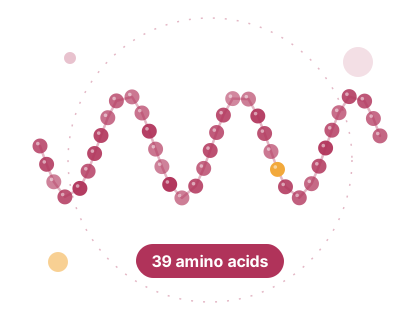
Short answer
Tirzepatide is a once-weekly injection from Eli Lilly that activates two gut-hormone receptors, GIP and GLP-1, sold as Zepbound for weight management and sleep apnea and as Mounjaro for type 2 diabetes. In the SURMOUNT-1 trial, people on 15 mg lost an average of 20.9% of body weight at 72 weeks, versus 3.1% on placebo.
- What it is
- A once-weekly injectable GIP and GLP-1 receptor agonist made by Eli Lilly, sold as Mounjaro (type 2 diabetes) and Zepbound (chronic weight management, obstructive sleep apnea).
- FDA status
- FDA approved
Mounjaro approved May 2022 for type 2 diabetes, with children 10 and older added to the label in December 2025, and on August 28, 2026 to lower the risk of major cardiovascular events in adults with type 2 diabetes at high risk. Zepbound, which does not have that indication, was approved November 2023 for chronic weight management and December 2024 for moderate-to-severe obstructive sleep apnea in adults with obesity.
- Evidence level
FDA label
Dosing comes from the FDA-approved prescribing information.
Tirzepatide is the active ingredient in two Eli Lilly brands: Zepbound, for weight management and obstructive sleep apnea, and Mounjaro, for type 2 diabetes. You inject it under the skin once a week. It belongs to the GLP-1 family of drugs but has a second target, the GIP receptor. The details people ask about most have their own pages: the dosage chart, side effects, cost, where to inject and compounded tirzepatide.
What tirzepatide is approved for
| Date | Brand | Approved for | Source |
|---|---|---|---|
| May 2022 | Mounjaro | Improving blood sugar in adults with type 2 diabetes, with diet and exercise | FDA (NDA 215866) |
| November 8, 2023 | Zepbound | Chronic weight management in adults with obesity (BMI 30 or more) or overweight (BMI 27 or more) with a weight-related condition | FDA press release |
| December 20, 2024 | Zepbound | Moderate-to-severe obstructive sleep apnea in adults with obesity | FDA press release |
| December 2025 | Mounjaro | Improving blood sugar in children 10 and older with type 2 diabetes | Mounjaro label |
| August 28, 2026 | Mounjaro | Lowering the risk of major cardiovascular events (cardiovascular death, non-fatal heart attack, non-fatal stroke) in adults with type 2 diabetes at high risk | Lilly announcement; Mounjaro label |
Mounjaro and Zepbound are the only FDA-approved tirzepatide products. Both labels cover six strengths, 2.5 mg to 15 mg. Single-dose pens and vials hold each dose in 0.5 mL, and the newer KwikPen and multi-dose vial deliver each dose in 0.6 mL.
How does tirzepatide work?
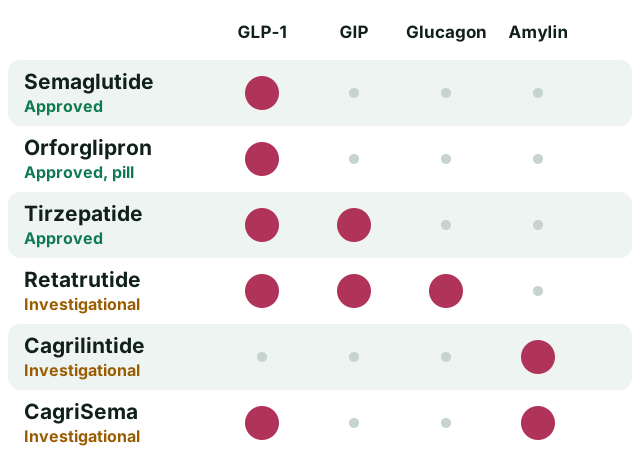
Tirzepatide copies two hormones your gut releases after you eat. Those hormones are GIP (glucose-dependent insulinotropic polypeptide) and GLP-1 (glucagon-like peptide-1), and they tell the pancreas to release insulin and help signal that you have eaten enough. Tirzepatide is one molecule built to switch on the receptors for both. Older drugs in this class, such as semaglutide, act on GLP-1 only.
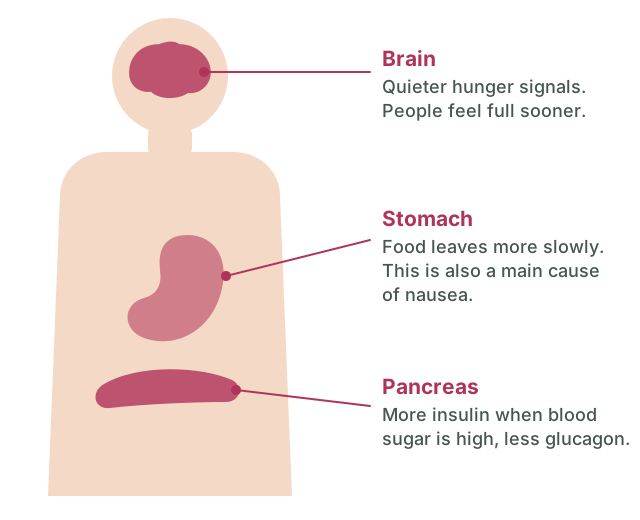
The label describes the effects plainly. Tirzepatide lowers calorie intake, probably by acting on appetite. It stimulates insulin release when blood sugar is high and lowers glucagon, a hormone that raises blood sugar. It also slows stomach emptying, an effect that is largest after the first dose and fades over time. That slowing is part of why you feel full sooner, and part of why nausea is such a common complaint.
Who is tirzepatide for?
Zepbound is for adults with obesity, adults with overweight and at least one weight-related condition, and adults with obesity and moderate-to-severe sleep apnea. It is meant to go alongside a reduced-calorie diet and more physical activity. The label says its safety and effectiveness have not been established in children.
Mounjaro is for adults and children 10 and older with type 2 diabetes, and for reducing heart-related risk in high-risk adults with type 2 diabetes. It is not approved for weight loss on its own.
The Zepbound label advises against combining it with another tirzepatide product or any GLP-1 drug. It recommends no dose change for kidney or liver impairment, and it reports no overall difference in safety or effectiveness for people 65 and older in the weight trials. Kidney function is still monitored if vomiting or diarrhea could lead to dehydration.
How much weight do people lose, and how fast?
The best answer comes from SURMOUNT-1, which enrolled 2,539 adults with obesity or overweight and no diabetes and followed them for 72 weeks.
| Group | Average weight change at 72 weeks | Lost 5% or more | Lost 20% or more |
|---|---|---|---|
| Tirzepatide 5 mg | 15.0% | 85% | 30% |
| Tirzepatide 10 mg | 19.5% | 89% | 50% |
| Tirzepatide 15 mg | 20.9% | 91% | 57% |
| Placebo | 3.1% | 35% | 3% |
Three things put those numbers in context:
- It takes a long time. Doses climbed over as much as 20 weeks, and people then spent at least 52 weeks at their full dose. A 20% result is a 72-week result.
- Everyone had lifestyle support. The trials paired the drug with counseling on eating about 500 fewer calories a day and getting at least 150 minutes of activity a week. The placebo group’s 3.1% reflects that.
- Diabetes changes the math. In a separate 72-week trial of people with type 2 diabetes, average loss was 12.8% on 10 mg and 14.7% on 15 mg, against 3.2% on placebo.
The gap between 10 mg and 15 mg is small compared with the gap between either dose and placebo, and these are averages with a wide spread on both sides.
Does everyone lose weight?
No. At 72 weeks, about 15% of people on 5 mg and 9% on 15 mg had not reached even a 5% loss. Between 14% and 16% stopped the drug during the trial, compared with 26% on placebo. The label tells prescribers to weigh both response and tolerability when choosing a maintenance dose.
Does it take off fat or muscle?
Both, with more fat than lean mass. The label says tirzepatide “lowers body weight with greater fat mass loss than lean mass loss.” It gives no figure for how much muscle goes.
What happens if you stop?
Weight tends to come back. In the Zepbound withdrawal trial, 670 people lost an average of 20.9% over 36 weeks on the drug, then were split into two groups. By week 88, those moved to placebo had regained 14.0% from their week-36 weight, while those who stayed on tirzepatide had lost another 5.5%.
What else does tirzepatide treat?
Type 2 diabetes
Mounjaro’s approval rested on five SURPASS trials. In SURPASS-2, which compared tirzepatide head to head with semaglutide 1 mg in people on metformin, A1c fell by 2.01, 2.24 and 2.30 percentage points on 5, 10 and 15 mg over 40 weeks, against 1.86 points on semaglutide. In SURPASS-1, tirzepatide alone lowered A1c by 1.7 to 1.8 points against 0.1 for placebo.
Heart risk in type 2 diabetes
The August 28, 2026 approval came from SURPASS-CVOT, which compared Mounjaro with Trulicity (dulaglutide), an older GLP-1 drug with its own heart-risk indication, in 13,299 people with type 2 diabetes and established cardiovascular disease. There was no placebo group. Over a median of about four years, a cardiovascular death, heart attack or stroke occurred in 12.1% on Mounjaro and 13.0% on dulaglutide, an 8% lower rate (hazard ratio 0.92, 95.3% CI 0.83 to 1.01). The label calls that non-inferior, meaning at least as good, and says superiority was not established. This indication belongs to Mounjaro only, so Zepbound’s label does not carry it.
Sleep apnea
The December 2024 approval rested on two 52-week trials in 469 adults with obesity and moderate-to-severe obstructive sleep apnea. Breathing interruptions fell by 25.3 and 29.3 events an hour on tirzepatide, against 5.3 and 5.5 on placebo. Remission or mild, symptom-free disease was reached by 42.2% and 50.2%, against 15.9% and 14.3%. The trials did not test when, or whether, someone can stop using a CPAP machine.
How do you take tirzepatide?
It goes under the skin of the stomach, the thigh or the back of the upper arm once a week, at any time of day, with or without food. Another person should give upper-arm injections. Technique differs between the pen, KwikPen and vial, so the label calls for training on your specific device, and again if it changes. Single-dose pens and vials normally live in the fridge and can stay at up to 86°F for up to 21 days in total. The guide to where to inject Zepbound compares each device and explains how to rotate sites.
Tirzepatide dosing, briefly
The Zepbound label starts at 2.5 mg once a week for 4 weeks, then moves to 5 mg. After that, the dose can rise in 2.5 mg steps with at least 4 weeks on each, to a maximum of 15 mg for adults. The 2.5 mg step is for getting started and is not approved as a maintenance dose. The named maintenance doses are 5, 10 or 15 mg for weight management and 10 or 15 mg for sleep apnea. Mounjaro also starts at 2.5 mg, and its dose rises only if more blood sugar control is needed.
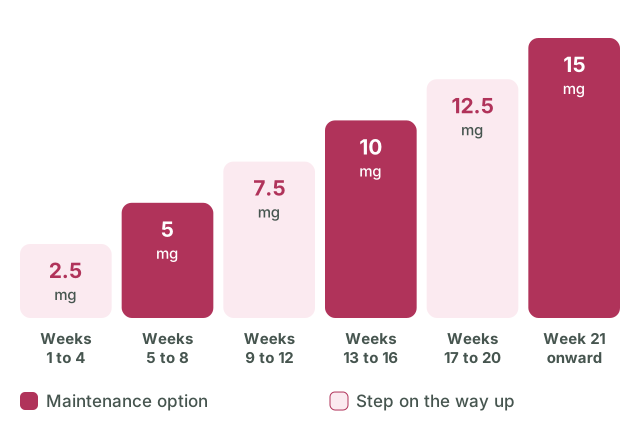
A missed dose can be taken within 4 days. After that it is skipped. The tirzepatide dosage chart has the full schedule and pen concentrations, and the tirzepatide units calculator turns a milligram dose into syringe units for anyone drawing from a vial. Your prescriber sets the dose and the pace.
Side effects, briefly
The common side effects are stomach-related. In the pooled weight-management trials on the Zepbound label, nausea affected 25% to 29% of people on tirzepatide versus 8% on placebo, and diarrhea 19% to 23% versus 8%. Most nausea, vomiting and diarrhea happened during dose increases and faded over time. Between 4.8% and 6.7% of people stopped the drug because of side effects, versus 3.4% on placebo.
The serious warnings are pancreatitis, gallbladder disease, dehydration leading to kidney injury, severe stomach reactions, low blood sugar when combined with insulin or a sulfonylurea, diabetic eye complications, severe allergic reactions and food entering the lungs under anesthesia. The tirzepatide side effects guide has the full table, what helps, and when to call.
What does tirzepatide cost?
Most people pay far less than list price, and which number applies depends on your coverage.
| Route | Monthly cost (checked Nov 2, 2026) |
|---|---|
| List price | Up to $1,086.37 for Zepbound, $1,112.16 for Mounjaro |
| LillyDirect self-pay, Zepbound vial or KwikPen | $299 (2.5 mg), $399 (5 mg), $449 (7.5 to 15 mg) with refills within 45 days |
| Commercial insurance that covers Zepbound, with savings card | As little as $25, through Dec 31, 2026 |
| Medicare GLP-1 Bridge, Zepbound KwikPen for weight management | $50 for eligible Part D members, through 2027 |
The tirzepatide cost guide walks through each route, and the cheapest legitimate options online are laid out by dose.
How does tirzepatide compare with semaglutide?
Tirzepatide produced more weight loss in the one head-to-head obesity trial. SURMOUNT-5 randomly assigned adults with obesity and no diabetes to the highest tolerated dose of each drug for 72 weeks.
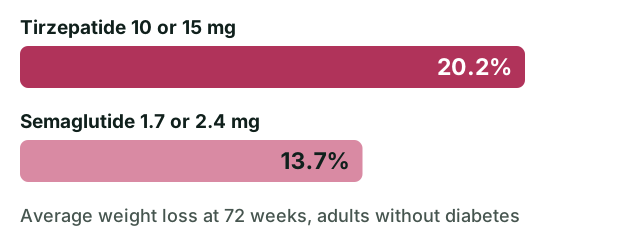
That result does not make tirzepatide the right drug for everyone. Coverage, side effects and your other conditions all count. The semaglutide vs tirzepatide comparison goes through the differences.
Brand versus compounded, briefly
During the shortage that began in December 2022, compounding pharmacies could make copies of tirzepatide. The FDA confirmed the shortage was resolved on December 19, 2024, and its grace periods ended on March 5, 2025 for 503A pharmacies and March 19, 2025 for 503B outsourcing facilities. Compounded versions are not reviewed by the FDA and usually come in multi-dose vials, so you have to convert milligrams to syringe units yourself. Products sold “for research purposes” are a separate matter: the FDA calls that labeling false when they are sold to consumers, and they are not legal to use on people. The compounded tirzepatide guide covers the rules and the safety warnings.
The boxed warning
Both labels carry a boxed warning about thyroid C-cell tumors. In rats, tirzepatide caused these tumors in a dose- and duration-dependent way. Whether it does so in humans is unknown. For that reason tirzepatide must not be used by anyone with a personal or family history of medullary thyroid carcinoma, or with Multiple Endocrine Neoplasia syndrome type 2. Symptoms worth reporting are a neck lump or swelling, hoarseness, trouble swallowing or shortness of breath.
Who should be cautious
Beyond the thyroid contraindication and any prior serious allergic reaction, several situations call for a careful talk with a prescriber:
- Severe gastroparesis. The labels say tirzepatide is not recommended.
- Pancreas problems, past or present. The Medication Guide asks you to raise this before starting.
- Diabetic retinopathy, because fast blood sugar improvement can temporarily worsen it.
- Insulin or a sulfonylurea, because low blood sugar becomes more likely and those doses may need to come down.
- Pregnancy or plans for it. The Zepbound label says to stop when pregnancy is recognized, since weight loss offers no benefit in pregnancy and may harm the fetus.
- Birth control pills. They may work less well for 4 weeks after starting and after each dose increase, and the label advises a non-oral or added barrier method during those windows.
- Surgery or sedation. Tell every clinician involved that you take tirzepatide.
Neither label covers type 1 diabetes.
What is next for tirzepatide
Lilly has run a Phase 2 trial of tirzepatide doses above the current maximum in adults with type 2 diabetes and obesity (NCT06037252). As of November 2, 2026, the registry still lists it as active, not recruiting, with no results posted and no doses named. No oral tirzepatide is approved. No generic exists either, and no generic launch date has been published. The FDA status tracker records approvals and compounding changes.
Questions to ask a prescriber
- Which brand fits my diagnosis, and does my plan cover it?
- Which device am I getting, and who will train me to use it?
- What dose are we aiming for, and what would make us stop climbing?
- What should I do about my other medicines, including insulin, a sulfonylurea or birth control pills?
- What is the plan if I cannot tolerate a step, or if I miss several weeks?
- How long do you expect me to stay on it, and what happens to my weight if I stop?
Compare
- GLP-1sSemaglutide vs tirzepatideTirzepatide beat semaglutide 20.2% to 13.7% in the only head-to-head weight trial.
- GLP-1sTirzepatide vs retatrutideTirzepatide is approved; retatrutide is not.
- GLP-1sFDA approvedCheapest without insuranceThe cheapest GLP-1 without insurance starts at $149 a month, but that buys a starter dose.
Getting tirzepatide legitimately
Affiliate disclosure: some links below pay us a referral fee. It never changes the price you pay or the order we list providers.
Through your own doctor
Any licensed prescriber can write a prescription for an FDA-approved GLP-1 if you meet the label criteria. Insurance coverage for weight management varies; ask the office to run a benefits check first.
Through a telehealth provider
Look for a real consultation with a licensed clinician, a named pharmacy, and a clear statement of whether you are getting the brand product or a compounded version. Avoid any site that ships without a consult.
Provider comparison coming once we have verified pricing and pharmacy sourcing for each program. Until then, the two routes above are the only ones we recommend.
Peptide news, sorted. Plus the printable dose chart.
Sorted, every Tuesday: the week's peptide and GLP-1 news in five minutes: FDA moves, new studies explained, and price changes. Subscribe and the one-page dose and injection-site chart arrives first.
Questions people ask
Is tirzepatide the same as Ozempic or Wegovy?
What is the difference between Zepbound and Mounjaro?
How much weight do people lose on tirzepatide?
What happens when you stop tirzepatide?
Is there a generic or oral tirzepatide?
Who should not use tirzepatide?
Sources
Primary sources first: FDA labels and documents, peer-reviewed trials, registries.
- 1Zepbound (tirzepatide) prescribing information, Eli Lilly, revised 8/2026, via DailyMeddailymed.nlm.nih.gov
- 2Mounjaro (tirzepatide) prescribing information, Eli Lilly, revised 8/2026, via DailyMeddailymed.nlm.nih.gov
- 3Zepbound prescribing information, Eli Lilly, current label read Nov 2 2026uspl.lilly.com
- 4Mounjaro prescribing information, Eli Lilly, current label read Nov 2 2026 (includes SURPASS-CVOT, section 14.6)uspl.lilly.com
- 5Eli Lilly press release: FDA approves Lilly's Mounjaro (tirzepatide) to reduce cardiovascular risk in adults with type 2 diabetes, Aug 28 2026investor.lilly.com
- 6FDA press release: FDA approves new medication for chronic weight management (Zepbound), Nov 8 2023fda.gov
- 7FDA press release: FDA approves first medication for obstructive sleep apnea (Zepbound), Dec 20 2024fda.gov
- 8FDA declaratory order: Resolution of shortages of tirzepatide injection products (Mounjaro and Zepbound), Dec 19 2024fda.gov
- 9FDA. FDA's concerns with unapproved GLP-1 drugs used for weight loss, current as of Oct 1 2026fda.gov
- 10FDA. FDA clarifies policies for compounders as national GLP-1 supply begins to stabilize, current as of Apr 1 2026fda.gov
- 11Jastreboff AM et al. Tirzepatide once weekly for the treatment of obesity (SURMOUNT-1). N Engl J Med 2022pubmed.ncbi.nlm.nih.gov
- 12Frias JP et al. Tirzepatide versus semaglutide once weekly in patients with type 2 diabetes (SURPASS-2). N Engl J Med 2021pubmed.ncbi.nlm.nih.gov
- 13Aronne LJ et al. Tirzepatide as compared with semaglutide for the treatment of obesity (SURMOUNT-5). N Engl J Med 2025pubmed.ncbi.nlm.nih.gov
- 14Eli Lilly. How much should I expect to pay for Zepbound? List price and self-pay prices, WAC accessed Jan 1 2026pricinginfo.lilly.com
- 15Eli Lilly. How much should I expect to pay for Mounjaro? List price, WAC accessed Jan 1 2026pricinginfo.lilly.com
- 16Eli Lilly. LillyDirect: Zepbound self-pay pricing (CMAT-05333 08/2026), checked Nov 2 2026lilly.com
- 17Eli Lilly. LillyDirect: Medicare GLP-1 Bridge (CMAT-32827 09/2026), checked Nov 2 2026lilly.com
- 18Eli Lilly. Zepbound coverage and savings: savings card terms (CMAT-26402 09/2026), checked Nov 2 2026zepbound.lilly.com
- 19ClinicalTrials.gov NCT06037252. A study of investigational tirzepatide doses in participants with type 2 diabetes and obesity (Phase 2), checked Nov 2 2026clinicaltrials.gov
Go deeper on Tirzepatide
- Cheapest onlineThe lowest legitimate online price for tirzepatide is Lilly's own: $299 to $449 a month with a prescription. See prices by dose and the red flags to avoid.Read
- Compounded tirzepatideCompounded tirzepatide is legal only in narrow cases since the shortage ended. See current FDA rules, recent enforcement, vial checks and a units table.Read
- CostTirzepatide runs from $25 with coverage to $449 cash and $1,086 at list price. See every route, Medicare's $50 option and how to pay less.Read
- Dosage chartThe label takes tirzepatide from 2.5 mg to as high as 15 mg weekly in 4-week steps. See the full chart, missed-dose rules and a mg-to-units calculator.Read
- Injection sitesZepbound and Mounjaro go in the stomach, thigh or back of the upper arm, with similar exposure at each. See how to rotate and how each device works.Read
- Side effectsNausea hits 25% to 29% of people on Zepbound, mostly during dose increases. See every label rate by dose, what eases symptoms and which ones need a call.Read
PeptideSorted Editorial Team
Editorial review
The PeptideSorted editors check every guide against its cited sources before publication: each number against its FDA label, trial or registry, the FDA status against current FDA and HHS documents, and the wording against our describe-never-prescribe rule. Licensed clinicians who join the review panel are listed by name on the editorial team page.
This page was checked against its cited sources by the PeptideSorted editorial team. Licensed clinicians on our review panel are listed on the editorial team page. Every health page cites primary sources and shows its review date. Read the editorial policy and how medical review works, or report an error via corrections. Educational only; not medical advice.