Tirzepatide units calculator
For compounded tirzepatide in a multi-dose vial. Enter the mg/mL printed on the label, pick the weekly dose your prescriber set, and read the units. The table underneath shows every step of the label schedule at that concentration.
- Free, no login
- Math only, never a dose suggestion
- Arithmetic checked Oct 17, 2026
Tirzepatide units calculator
Compounded vialsWant this on paper? The printable dose chart covers every common vial and water amount.
Print the chartEmail it to mePens do not need this; compounded vials do
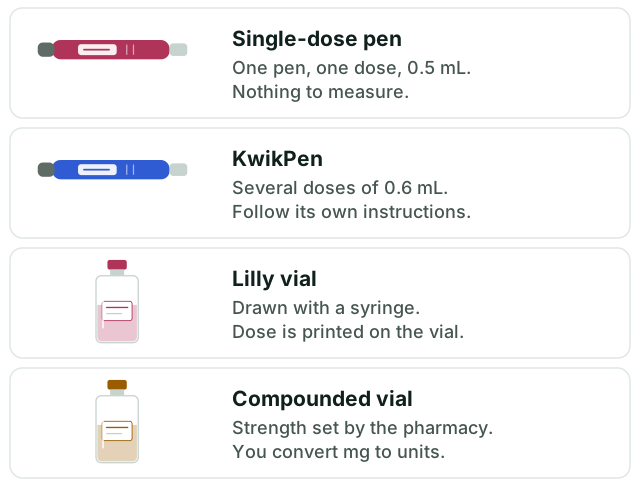
A single-dose Zepbound or Mounjaro pen holds one dose in 0.5 mL. You press the button and it delivers 2.5, 5, 7.5, 10, 12.5 or 15 mg, whichever strength was dispensed, so there are no units to work out. The Zepbound KwikPen and multi-dose vials on the current label deliver each dose in 0.6 mL and come with their own instructions, so follow those rather than this calculator.
Compounded tirzepatide comes in a vial holding several doses at a concentration the pharmacy chose. Your prescription is still written in milligrams. Your job is to turn that into a volume: units = dose (mg) ÷ concentration (mg/mL) × 100.
How many units is each tirzepatide dose?
It depends on the mg/mL on your vial. These rows are the steps on the tirzepatide label schedule, and your prescriber decides which one applies to you.
| Dose | 10 mg/mL | 17 mg/mL | 20 mg/mL | 30 mg/mL |
|---|---|---|---|---|
| 2.5 mg | 25 u | 14.7 u | 12.5 u | 8.3 u |
| 5 mg | 50 u | 29.4 u | 25 u | 16.7 u |
| 7.5 mg | 75 u | 44.1 u | 37.5 u | 25 u |
| 10 mg | 100 u | 58.8 u | 50 u | 33.3 u |
| 12.5 mg | 125 u* | 73.5 u | 62.5 u | 41.7 u |
| 15 mg | 150 u* | 88.2 u | 75 u | 50 u |
* More than a 1 mL syringe holds, which is why higher concentrations exist.
Why the same units can be the wrong dose
Units follow the vial, so a number that was right last month can be badly wrong today. A 20 mg/mL vial drawn to 50 units delivers 10 mg, four times the 2.5 mg starting dose. At the other end, a 30 mg/mL vial puts 0.3 mg in every unit, so one misread mark is a large share of a low dose. If a refill has a different concentration, the milligrams on your prescription stay the same and the units change. Ask the pharmacy to confirm the new number.
What to check on the vial before you draw
- The concentration, written as mg/mL. A label showing only a total with no volume does not give you this, so ask the pharmacy.
- The beyond-use date. The date on the pharmacy label is the one that counts. The general USP 797 rule for an opened multi-dose vial is 28 days unless the manufacturer states otherwise.
- What else is in it. Some pharmacies add vitamin B12, glycine or other ingredients. None were in the approval trials. The tirzepatide concentration is what you convert, and the additives should match what your prescriber ordered.
- The active ingredient. The approved products list tirzepatide, not a salt. A vial labeled with a tirzepatide salt is not the ingredient in the approved drug.
What people ask next
Is compounded tirzepatide still allowed? Since early 2025, when the shortage exemption ended, it has been lawful only when a prescriber documents a clinical reason a patient cannot use the approved product, and FDA does not review it. Every contraindication on the brand label still applies, including a personal or family history of medullary thyroid carcinoma or Multiple Endocrine Neoplasia syndrome type 2. The tirzepatide side effects guide covers the warnings, the dosage chart has the missed-dose rule, and the cost guide compares compounded prices with Lilly's own vials.