Peptide calculator: reconstitution and syringe units
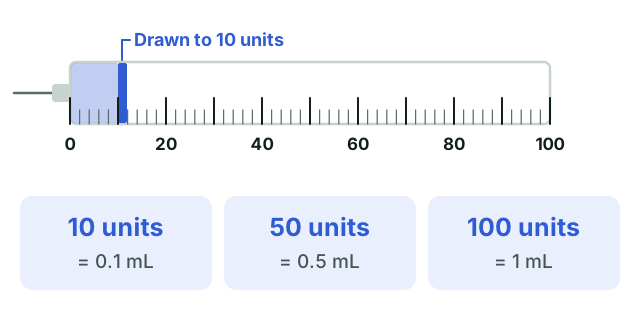
Vial amount, water added, prescribed dose. The calculator gives the concentration, the exact units to draw on a U-100 insulin syringe, and how many doses the vial holds, with a drawing of the syringe filled to that mark.
- Free, no login
- Math only, never a dose suggestion
- Arithmetic checked Oct 17, 2026

Reconstitution calculator
U-100 syringeWant this on paper? The printable dose chart covers every common vial and water amount.
Print the chartEmail it to meHow to use the peptide calculator
Fill in four boxes and read the big number. The calculator turns what is printed on your vial and your prescription into a mark on the syringe. It needs nothing else, and it does not know which peptide you have.
- Peptide in vial. The milligrams printed on the vial, such as 5 mg. This is the total amount of powder before any water goes in.
- Bacteriostatic water added. The milliliters that actually went into the vial. If your pharmacy's sheet names a volume, use that one. Some products come with their own diluent: Egrifta SV uses only the sterile water in its kit, so the product's instructions come first.
- Dose you were prescribed. Type the number, then check the mcg or mg menu beside it. That menu is where a thousandfold mistake happens.
- Syringe. Pick the size in your hand. The warnings under the result are written for that syringe.
The result gives four numbers: the units to draw (with the same amount in mL), the concentration of the mixed vial, how much peptide each unit holds, and how many whole doses the vial contains. If your vial arrived as a liquid, there is nothing to mix, and the mg/mL to units converter is the faster tool.
Worked example: 5 mg vial, 2 mL of water, 250 mcg dose
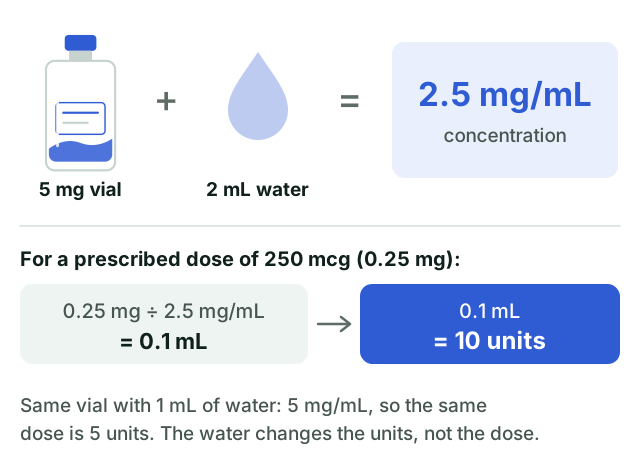
These are the numbers already loaded in the calculator. They show the math and are not a suggested dose. Reconstitution comes down to three divisions, and most mistakes happen in one of them.
- Concentration. Vial amount divided by water added. 5 mg ÷ 2 mL = 2.5 mg/mL.
- Amount per unit. A U-100 insulin syringe has 100 units in 1 mL, so divide by 100. 2.5 mg/mL ÷ 100 = 0.025 mg per unit, which is 25 mcg per unit.
- Units for the dose. Dose divided by amount per unit. 250 mcg ÷ 25 mcg per unit = 10 units, or 0.1 mL.
A dose written in milligrams works the same way once the units match. Take a 10 mg vial with 2 mL of water: that is 5 mg/mL, or 50 mcg per unit. A 1 mg dose is 1,000 mcg, and 1,000 ÷ 50 = 20 units, or 0.2 mL.
How many doses are in a vial?
Divide the amount in the vial by the dose. The 5 mg vial above holds 5,000 mcg, so it holds 20 doses of 250 mcg. That number is arithmetic, and it says nothing about how long the vial stays usable. Under the USP 797 standard as the CDC summarizes it, an opened multi-dose vial is dated and discarded within 28 days unless the manufacturer states another date. A beyond-use date printed by your pharmacy overrides that. If your doses are a week apart, 28 days covers only a handful of draws, however many the math allows.
How much bacteriostatic water should you add?
Use the volume on your pharmacy label or instruction sheet. Where you have a choice, remember that water never changes the dose. It changes how much liquid carries the dose, which decides how many units you read on the syringe.
| Water in a 5 mg vial | Concentration | Each unit holds | A 250 mcg dose is |
|---|---|---|---|
| 1 mL | 5 mg/mL | 50 mcg | 5 units |
| 2 mL | 2.5 mg/mL | 25 mcg | 10 units |
| 3 mL | About 1.67 mg/mL | About 16.7 mcg | 15 units |
Two limits keep a draw readable:
- Below about 3 units, misreading the syringe by one unit is about a third of the dose. More water spreads the same dose over more units, and the calculator warns you when a draw falls this low.
- Above 100 units, the dose will not fit a 1 mL syringe. The usual fix is less water in the next vial, or a vial with more peptide in it.
Already mixed it with a different amount? The peptide is not ruined; the concentration just changed. Enter the water that really went in, relabel the vial and use the new units. If you cannot say how much went in, call the pharmacy before drawing a dose. The bacteriostatic water guide covers what the liquid is and how long an opened vial lasts, and the printable dosing chart shows every common dose at one vial and water amount on a single sheet.
What do the units on an insulin syringe mean?
Units measure liquid. On a U-100 syringe, 100 units is always 1 mL, so 10 units is 0.1 mL whatever is in the barrel. How much drug those 10 units hold depends entirely on the vial. That is why a number of units copied from a friend, a forum or an old vial means nothing for the vial in front of you.
Which syringe should you use?
The smallest one that holds your draw, since finer marks are easier to read. FDA has said some patients were handed syringes far larger than the prescribed volume, so ask for a size that fits. Every size here is a U-100 syringe, the only kind this calculator is built for. A syringe marked for anything else gives a wrong dose.
| Syringe | Capacity | Marked every | Best for |
|---|---|---|---|
| 0.3 mL | 30 units | 1 unit (some half-unit) | Small draws under 30 units; easiest to read precisely |
| 0.5 mL | 50 units | 1 unit | Draws of 10 to 50 units |
| 1 mL | 100 units | 2 units | Draws over 50 units; the most common syringe sold |
On a 1 mL syringe the marks fall every 2 units, so a 5-unit draw sits between two lines. The calculator tells you when that happens. A smaller syringe usually solves it.
Common reconstitution mistakes
- Mixing up mg and mcg. 1 mg is 1,000 mcg. Entering 250 with the wrong menu setting moves the answer by a factor of 1,000. If a result looks wildly large or small, stop and recheck that menu.
- Treating units as milligrams. 10 units is a volume. In the worked example it holds 250 mcg, and in a 20 mg/mL vial it would hold 2 mg.
- Carrying old units over to a new vial. A vial with a different strength, or the same vial with a different amount of water, changes every number. Rerun the math each time.
- Entering the water you meant to add. Use what actually went in. Water left in the syringe never reached the vial.
- Leaving the vial unlabeled. Write the date and the concentration on it the day you mix. A week later you will not remember whether 1 mL or 2 mL went in, and that gap is a double or half dose.
- Drawing far too much. Most reports in FDA's alert on compounded semaglutide dosing errors involved patients drawing more than the prescribed dose from a multi-dose vial, in some cases five to 20 times the intended amount.
If you think you drew or injected too much, call your prescriber or Poison Control at 1-800-222-1222, which is open day and night. Call 911 for trouble breathing or if someone passes out.
What happens after the math
The step-by-step reconstitution guide covers the hands-on part: running the water slowly down the glass, swirling instead of shaking, checking that the liquid is clear, and storing the vial the way the pharmacy label says. Cloudiness, particles or a color change mean the vial should be thrown away. For where the dose goes, see the injection sites guide, and the printable dose tracker keeps a record of each draw and site.
What this calculator will not do
It will not tell you what dose to take. Doses on this site are reported from FDA labels and clinical trials on each peptide's page, and your prescriber sets yours. It also cannot check the first number you type. Products sold "for research use only" are not legal to use on people, and nothing verifies the milligrams printed on them, so correct arithmetic on one of those vials gives a false sense of precision. The FDA status tracker shows where each peptide stands.