Short answer
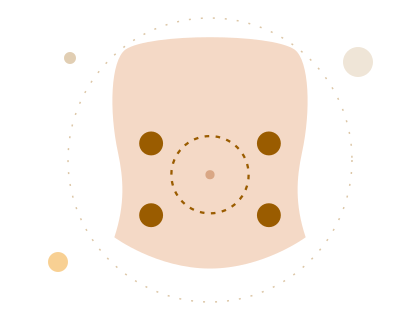
Most peptide drugs are injected under the skin of the abdomen, at least 2 inches from the navel, or the thigh, and some labels add the back of the upper arm. Your drug's label decides: Egrifta goes only in the abdomen. A different spot is used each time, and afterward the site is pressed, never rubbed.
- What it is
- A subcutaneous injection delivers medicine into the fat layer just under the skin, where it is absorbed slowly and steadily.
- FDA status
- Not a drug
- Evidence level
n/a
Peptide drugs are injected subcutaneously, into the fat under the skin, and most labels name the abdomen, the thigh or the back of the upper arm. Not every label names all three, so the first thing to check is your own drug’s instructions. The Zepbound and Wegovy instructions for use name the abdomen at least 2 inches from the belly button, the thigh, and the back of the upper arm. This guide, part of our peptide basics, describes that technique for prescribed, pharmacy-dispensed products. Peptides sold “for research use only” are not legal to use on people, and no injection guide changes that. If your product came as a powder, the reconstitution guide comes first.
The three sites
| Site | Where exactly | Notes from the labels |
|---|---|---|
| Abdomen | Below the ribs and above the hip bones, at least 2 inches (5 cm) from the navel | The site most people use for self-injection; both GLP-1 labels and MedlinePlus give the 2-inch rule. |
| Front of the thigh | The front or outer side of the upper thigh | Easy to reach sitting down; MedlinePlus specifies the outer side. |
| Back of the upper arm | The fatty area at the back, at least 3 inches below the shoulder and 3 inches above the elbow | The Zepbound instructions say another person should give injections here, because you cannot see or pinch it yourself. |
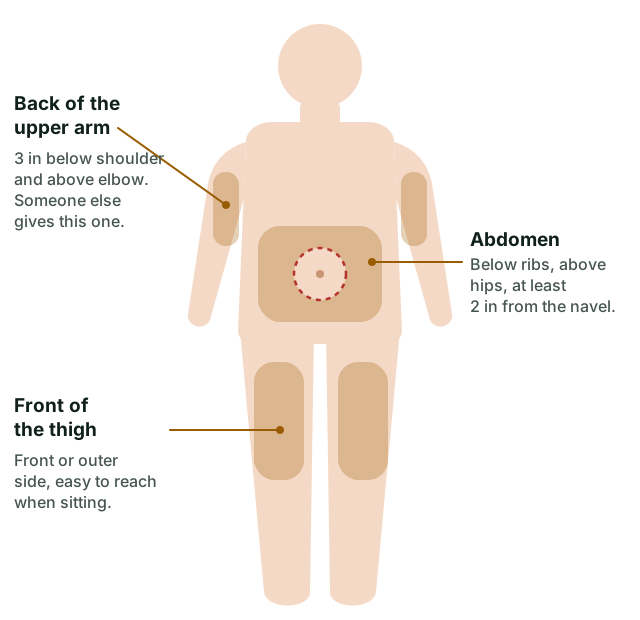
Whichever site you choose, the skin should be healthy: no redness, swelling, bruising, scarring or lumps. Do not inject into a muscle or a vein; the labels say subcutaneous only.
Which sites does each peptide label allow?
The label for each drug sets its own list, and some are shorter than the three above.
| Drug | Sites on the label |
|---|---|
| Zepbound (tirzepatide) | Abdomen or thigh; back of the upper arm if another person gives it |
| Wegovy (semaglutide) | Abdomen, thigh or upper arm |
| Egrifta WR, Egrifta SV (tesamorelin) | Abdomen only, avoiding scar tissue, bruises and the navel |
| Vyleesi (bremelanotide) | Abdomen or thigh |
| Forzinity (elamipretide) | Abdomen, at least 2 inches from the navel, or outer thigh |
| Teriparatide | Thigh or abdominal region |
Compounded peptides prescribed by a clinician usually follow the same technique, but a pharmacy label or prescriber instruction naming a site overrides any general guide. If the sheet names no site, ask before the first dose.
Does the injection site change how the drug works?
For tirzepatide, no. The Zepbound label says “similar exposure was achieved” with injection in the abdomen, thigh or upper arm, so the choice comes down to what you can reach comfortably. That finding belongs to that one drug. Other labels make their own statements, which is one reason a drug with an abdomen-only label should stay there.
Rotation, and why it matters
Moving the injection to a new spot each time protects the tissue under the skin and keeps absorption predictable. The Zepbound instructions say to change the injection site each week, and that you may use the same area of the body as long as you choose a different spot within it. MedlinePlus puts a number on it: at least 1 inch from the last injection.
The reason is a condition called lipohypertrophy, a rubbery thickening of the fat under the skin that builds up where the same spot is injected repeatedly. The 2016 insulin delivery recommendations in Mayo Clinic Proceedings call it “a frequent complication of therapy that distorts insulin absorption,” say injections should not be given into these lesions, and note that correct site rotation helps prevent them. Absorption from a lump is unpredictable, which for a dose-sensitive drug means unpredictable effect.
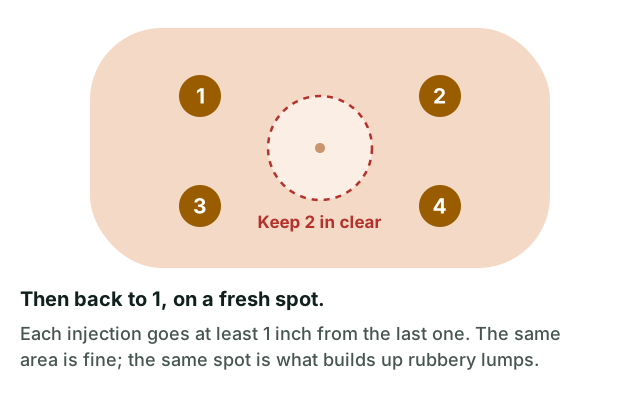
A simple pattern is enough. For a weekly drug whose label allows both the abdomen and the thigh:
| Week | Area | Spot within the area |
|---|---|---|
| 1 | Abdomen, left of the navel | Upper |
| 2 | Abdomen, right of the navel | Upper |
| 3 | Abdomen, left of the navel | Lower |
| 4 | Abdomen, right of the navel | Lower |
| 5 | Left thigh | Upper outer |
| 6 | Right thigh | Upper outer |
| 7 | Left thigh | Lower outer |
| 8 | Right thigh | Lower outer |
For a daily injection, the same idea applies on a smaller scale: each spot stays at least an inch from the last, which matters most for a label like Egrifta’s that keeps every dose in the abdomen. Writing the site next to the date removes the guesswork, and the dose tracker has a place for it.
How often are peptides injected?
That depends entirely on the drug and the prescription. Zepbound and Wegovy are weekly, while Egrifta WR and Forzinity are daily. The tirzepatide dosage chart shows how one label lays out its schedule. For unapproved peptides, no human dose or schedule has been established, so there is nothing for a chart to report.
Is subcutaneous the same as intramuscular?
No. A subcutaneous injection goes into the fat just under the skin, and an intramuscular injection goes deeper, into muscle. They use different needle lengths and different technique, and the labels in the table above are subcutaneous only. The 2016 insulin recommendations warn that intramuscular injection of long-acting insulin can cause severe low blood sugar, which is the kind of change that going too deep can make. If a prescription says intramuscular, ask the pharmacist to show you the technique rather than adapting this guide.
Needle length and gauge
Subcutaneous needles are short and thin. Insulin syringes, the standard for compounded vials, are described in an FDA 510(k) summary as coming in 28 to 32 gauge with needle lengths of 6 mm, 8 mm (5/16 inch) and 12.7 mm (1/2 inch), in 0.3 mL, 0.5 mL and 1 mL sizes. A higher gauge number means a thinner needle.
The 2016 Mayo Clinic Proceedings recommendations concluded that the shortest needles, 4 mm pen needles and 6 mm syringe needles, “are safe, effective, and less painful” and should be the first choice, including for adults with obesity. Pen drugs such as Zepbound take a separate screw-on pen needle, which is not included with the pen and should be new for every injection.
How to inject, step by step
- Wash your hands with soap and running water for at least a minute, and dry them with a clean paper towel.
- Check the medicine. Right drug, right strength, not expired, clear and colorless. The Zepbound instructions say not to use a pen if the medicine has been frozen, has particles, is cloudy or is discolored; the same applies to a reconstituted vial.
- Clean the site with an alcohol pad, wiping outward in a circle from the spot you plan to use, and let it air dry.
- Prepare the syringe. If drawing from a vial, inject air equal to your dose, draw the dose, tap bubbles to the top and push them back in, and confirm the units line. The mg/mL to units converter finds that line for a known concentration. With a pen, attach a new needle and prime it as the instructions describe.
- Pinch the skin. MedlinePlus describes pinching about an inch of skin and fat, not muscle, between thumb and finger. Follow what your pharmacist showed you, since needle lengths differ.
- Insert at 90 degrees, quickly and all the way in, then release the skin. MedlinePlus allows 45 degrees where there is little fat.
- Inject slowly. Push the plunger steadily until it stops. The Zepbound pen instructions say to hold the dose knob in while counting slowly to 5 before withdrawing.
- Withdraw and press, do not rub. Pull the needle straight out. If you see blood, press lightly with gauze or a cotton ball. The Zepbound instructions say not to rub the injection site.
- Dispose of the needle immediately in a sharps container, then wash your hands.
Does it hurt, and what helps?
Most people feel a brief sting, and some soreness at the site is expected. The steps that help come straight from the sources above: letting the alcohol dry fully before the needle goes in, using the shortest needle available, which the 2016 recommendations found less painful, and using a new needle every time, since a reused one is duller. Skin that is bruised, scarred or lumpy should be left alone.
Do you inject near the injury?
No label in the table above tells you to choose a site by the body part you want to treat. Injecting close to an injury is an idea from forums about unapproved peptides. No human injection protocol has been established for those peptides, and this site does not offer one.
Sharps disposal
Used needles and syringes go straight into an FDA-cleared sharps disposal container. The FDA says these are available through pharmacies, medical supply companies and health care providers, and that if one is not available a heavy-duty plastic household container, such as a laundry detergent bottle, can be used instead. Never put loose needles in household trash or recycling, and never flush them.
When the container is almost full, follow your community guidelines. The Zepbound instructions note that there may be state or local laws about disposal and point to the FDA’s safe sharps disposal site for state-by-state rules. Pen devices themselves, with the needle removed, can go in household trash according to the Zepbound instructions, but check your own product’s sheet.
When to call a clinician
Contact your prescriber or pharmacy if you notice:
- Signs of infection: spreading redness, swelling, warmth, red streaks, pus, or a fever. MedlinePlus lists these as reasons to call.
- Severe or persistent pain, especially pain that gets worse over the following day rather than better.
- A firm lump that does not fade over a week or two, or that keeps growing; that is the lipohypertrophy rotation is meant to prevent, and your prescriber will want to know absorption may be affected.
- An accidental stick from someone else’s used needle: the FDA says to wash the area immediately with soap and water or an antiseptic, then seek medical attention.
- A whole-body reaction such as hives, swelling of the face or throat, or trouble breathing, which is an emergency.
The site and the technique are the easy part of a prescription. The harder questions, what dose, what schedule and what side effects to expect, belong to the prescriber and to the drug’s own guide.
Compare
- LearnHow to reconstituteHow a prescribed freeze-dried vial is mixed with bacteriostatic water, the mg/mL and units math worked through, storage, and mistakes that waste a vial.
- LearnFDA approvedBacteriostatic waterSterile water with 0.9% benzyl alcohol, so one vial can be used for up to 28 days.
- GLP-1sFDA approvedSide effectsNausea hits 25% to 29% of people on Zepbound, mostly during dose increases.
Peptide news, sorted. Plus the printable dose chart.
Sorted, every Tuesday: the week's peptide and GLP-1 news in five minutes: FDA moves, new studies explained, and price changes. Subscribe and the one-page dose and injection-site chart arrives first.
Questions people ask
Is the stomach or the thigh better?
Do you need to pinch the skin?
Is a drop of blood or a small bump normal?
Can a syringe or pen needle be reused?
How do you throw away needles?
Do you inject a peptide near the injury?
Sources
Primary sources first: FDA labels and documents, peer-reviewed trials, registries.
- 1Zepbound (tirzepatide) KwikPen Instructions for Use, Eli Lilly, FDA-approved, January 2026pi.lilly.com
- 2Zepbound (tirzepatide) prescribing information, Eli Lilly, August 2026pi.lilly.com
- 3Wegovy (semaglutide) pen guide: choosing and rotating the injection site, Novo Nordiskwegovy.com
- 4Egrifta WR (tesamorelin) prescribing information, revised March 2025, via FDAaccessdata.fda.gov
- 5Egrifta SV (tesamorelin) for injection prescribing information, DailyMeddailymed.nlm.nih.gov
- 6Vyleesi (bremelanotide) prescribing information, 2019, via FDAaccessdata.fda.gov
- 7Forzinity (elamipretide) prescribing information, 2025, via FDAaccessdata.fda.gov
- 8Teriparatide injection prescribing information, DailyMeddailymed.nlm.nih.gov
- 9MedlinePlus Medical Encyclopedia. Subcutaneous (SQ) injections. Reviewed October 2025medlineplus.gov
- 10Frid AH et al. New Insulin Delivery Recommendations. Mayo Clin Proc 2016;91(9):1231-55pubmed.ncbi.nlm.nih.gov
- 11FDA 510(k) summary K233794, Insulin Syringe: needle gauges 28 to 32 G and lengths 6, 8 and 12.7 mm. March 2024accessdata.fda.gov
- 12FDA. Safely Using Sharps (Needles and Syringes) at Home, at Work and on Travelfda.gov
- 13CDC. Preventing Unsafe Injection Practices. Reviewed March 2024cdc.gov
More in Learn
- Are peptides safe?Approved peptide drugs have measured risks. Compounded ones skip FDA review. Research-use vials have no safety review. What is known about each kind.Read
- Bacteriostatic waterSterile water with 0.9% benzyl alcohol, so one vial can be used for up to 28 days. How it differs from sterile water, storage, and who must avoid it.Read
- FDA status trackerWhich peptides are FDA-approved, which HHS tolerates under conditions, and which are not legal to use. One row per peptide, with sources and check dates.Read
- How to read a COAWhat each line on a peptide COA means: HPLC purity, mass spec identity, net content, endotoxin and sterility, plus red flags and what a COA cannot prove.Read
- How to reconstituteHow a prescribed freeze-dried vial is mixed with bacteriostatic water, the mg/mL and units math worked through, storage, and mistakes that waste a vial.Read
- Peptide therapyPeptide therapy is a clinic term, not a medical one. It mixes FDA-approved, compounded and unapproved peptides. How to tell which you are being offered.Read
PeptideSorted Editorial Team
Editorial review
The PeptideSorted editors check every guide against its cited sources before publication: each number against its FDA label, trial or registry, the FDA status against current FDA and HHS documents, and the wording against our describe-never-prescribe rule. Licensed clinicians who join the review panel are listed by name on the editorial team page.
This page was checked against its cited sources by the PeptideSorted editorial team. Licensed clinicians on our review panel are listed on the editorial team page. Every health page cites primary sources and shows its review date. Read the editorial policy and how medical review works, or report an error via corrections. Educational only; not medical advice.