
Short answer
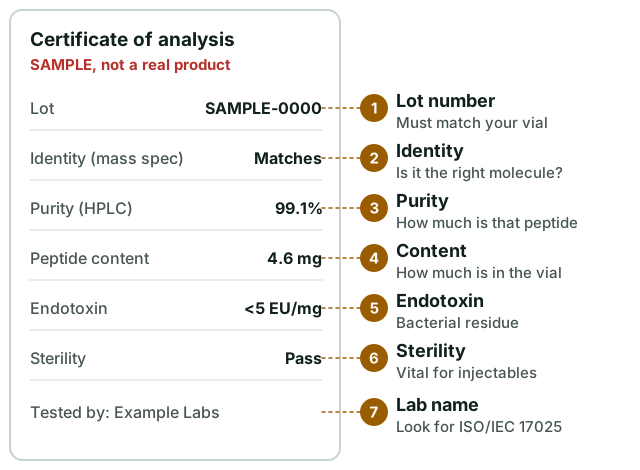
A certificate of analysis (COA) is a lab report on one batch, read line by line: identity by mass spectrometry, purity by HPLC, peptide content, plus endotoxin and sterility for anything injected. The lot number should match the vial, and the lab should be ISO/IEC 17025 accredited for those tests. Even a perfect COA cannot show a peptide is safe.
- What it is
- A document listing the tests run on a batch of a substance, the methods, the acceptance limits and the results, signed by the lab that ran them.
- FDA status
- Not a drug
- Evidence level
n/a
A certificate of analysis, or COA, is a laboratory’s report on one batch of a substance: which tests were run, by what method, what the acceptance limit was, and what the result was. Sellers post them as proof of quality, so reading one is a useful part of peptide basics. A COA can describe a powder, and that is where its reach ends. It cannot tell you a molecule is safe in people. The are peptides safe guide covers what lab tests of unregulated products have actually found, and the FDA status tracker covers what is legal.
| Line on the COA | Test usually used | The question it answers | What it cannot tell you |
|---|---|---|---|
| Identity | Mass spectrometry (MS, often LC-MS) | Is the molecule the right mass for the named peptide? | How much is there; whether the sequence order is right, unless fragments are analysed (MS/MS) |
| Purity | HPLC with UV detection | What share of the peptide material is the target peptide? | How many milligrams are in the vial; water, salts, metals, endotoxin |
| Content (assay, net peptide content) | Amino acid analysis, nitrogen analysis, or HPLC against a reference standard | How much peptide is actually in the vial or in each milligram of powder? | Whether the peptide is the right one, if identity was not tested |
| Endotoxin | Bacterial endotoxins test (LAL), USP chapter 85 | How much bacterial endotoxin is present, in EU per mg or per vial? | Whether live microbes are present |
| Sterility | Sterility test, USP chapter 71 | Did samples from the batch grow microbes? | Whether every vial is sterile, or whether endotoxin is present |
| Other impurities | Residual solvents, heavy metals, water (Karl Fischer), counterion content | What else is in the powder? | Anything not tested for |
Identity: mass spectrometry
Mass spectrometry weighs molecules. The COA should state the expected molecular mass for the named peptide and the mass the lab measured; the two should agree within the method’s stated tolerance. This is the test that catches the wrong substance in the vial, which is the most basic failure and one that official medicines labs keep finding in seized peptide products.
Its limits are worth knowing. A mass match confirms the right total mass, not that the amino acids are in the right order: a scrambled sequence of the same amino acids weighs the same. Tandem mass spectrometry (MS/MS), which breaks the peptide into fragments, can confirm the sequence. And a mass spectrum on its own says little about quantity.
Purity: HPLC
High-performance liquid chromatography (HPLC) pushes a dissolved sample through a column that separates molecules, and a UV detector records each one as a peak. Purity is normally reported as the main peak’s share of the total peak area, so “98.7%” means the target peptide made up 98.7% of what the detector saw. A COA that is useful shows the chromatogram itself, the detection wavelength, and the column and method, not just a number.
HPLC purity is the most quoted and most misread line on a COA:
- It describes the peptide material only. Water, salts and counterions are not in the denominator.
- It is blind to anything the detector cannot see at that wavelength, and to endotoxin and bacteria entirely.
- It says nothing about how much peptide is in the vial.
A purity figure on a label is a claim, not a test. In a 2024 study of semaglutide vials ordered from illegal online pharmacies, the products claimed 99% purity; the researchers measured 7.7% to 14.4%. An earlier study of the ten falsified peptide drugs most often seen on the Belgian market found purity as low as 5% for some peptides.
Content: why purity is not the same as how much you have
Synthetic peptides are made and purified using trifluoroacetic acid (TFA), so they usually come out as TFA salts: each peptide molecule carries counterions that add weight but are not peptide. Freeze-dried powder also holds water. Net peptide content is the share of the powder’s total weight that is peptide once those are counted, and it is measured separately, usually by amino acid analysis or nitrogen analysis. A powder can be 99% pure and still contain noticeably less than its weight in peptide.
Content is also where the label amount is checked. The same 2024 semaglutide study found vials holding 29% to 39% more drug than labeled. For a drug dosed in fractions of a milligram, an error in either direction changes the dose. This is why the reconstitution calculator and the reconstitution guide start from a pharmacy label with a verified strength: the arithmetic is only as good as the number on the vial.
Endotoxin
Endotoxin is a toxic fragment of the outer wall of certain bacteria. It causes fever, chills and, in large amounts, shock. It is the result that matters most for anything injected and the one most often missing from research-peptide COAs. It is measured with the bacterial endotoxins test described in USP chapter 85 and reported in endotoxin units (EU), usually per milligram or per vial.
Three points make this line hard to read on a research product:
- Dead bacteria still leave endotoxin. It is not removed by the benzyl alcohol in bacteriostatic water, and a sample can pass a sterility test and still contain it. In the 2024 semaglutide study, no viable microorganisms were found, but endotoxin was detected in every sample.
- The limit depends on the dose. For approved injectables, the endotoxin limit is calculated from the maximum dose per kilogram of body weight, under USP chapter 85 and FDA’s endotoxin testing guidance. A result has meaning only against a dose. A research-use product has no labeled human dose, so there is no valid limit to compare its result with.
- The ingredient matters as much as the test. In August 2026 at least 30 patients had sepsis-like reactions to compounded glutathione injections made from a dietary-supplement-grade ingredient. FDA’s response included the line that “testing alone does not ensure drug quality.”
Sterility
A sterility test incubates samples from a batch and checks for microbial growth; USP chapter 71 sets the method. A pass means the units tested grew nothing. It cannot show that every vial in the batch is sterile, and it cannot show that a vial stayed sterile after it was shipped, opened and punctured. Official labs have found the bacterium Bacillus cereus in illegal injectable peptide products.
Matching the COA to the vial
A COA is about one batch. Before reading any result, check that it is about the product in hand:
| Field | What to check |
|---|---|
| Product name and amount | Same peptide, same labeled mg per vial |
| Lot or batch number | Matches the number printed on the vial, exactly |
| Test date | Recent enough to cover the batch; a COA older than the product’s manufacture date cannot describe it |
| Who made it, who tested it | The manufacturer and the testing lab are named separately, with addresses |
| Sample description | What was received and how much; whether the lab sampled the batch or tested whatever it was sent |
| Methods and limits | Each test names a method and an acceptance limit, not only a result |
| Lab identity | Lab name, address, accreditation number, and a named person who approved the report |
Lab accreditation: ISO/IEC 17025
ISO/IEC 17025:2017 is the international standard for the competence, impartiality and consistent operation of testing and calibration laboratories. Accreditation to it is granted by an accreditation body for a defined scope: specific tests, on specific materials, by specific methods. A lab accredited for one test is not accredited for every test it runs. To check, look the lab up on the accreditation body’s public register and confirm that the tests on the COA, such as peptide identity by LC-MS or endotoxin by LAL, are on its scope. A logo on a PDF proves nothing on its own.
Accreditation tells you the lab can run the test properly. It does not tell you the sample came from the batch you hold. A third-party lab that tests whatever sample a seller mails in can produce a genuine report about a vial that was never sold.
Red flags
- No lot number, or a lot number that does not match the vial.
- The same COA used for several lots, sizes or products.
- Purity only: no identity, no content, no endotoxin, no sterility for something meant to be injected.
- A purity number with no chromatogram, no method and no acceptance limit.
- No lab name, no address, no accreditation number, no signature, or a lab that cannot be contacted.
- The manufacturer and the tester are the same company, with no independent test.
- Results that are suspiciously round or identical across batches.
- A COA image with edited text, mismatched fonts or a date that predates the product.
- “Research use only” on the label next to dosing instructions. FDA treats that combination as evidence the product is an unapproved drug intended for people.
What does the HHS policy expect a COA to show?
As of November 2, 2026, HHS’s interim policy on six compounded peptides makes the certificate a condition. It says HHS does not intend to take enforcement action against a state-licensed pharmacy, federal facility or licensed physician compounding those peptides when ten conditions are met, and one is a valid COA from an FDA-registered facility. The policy is not an approval, and its limits are set out in the FDA status tracker. Its appendix is still the most detailed public yardstick we have seen for a peptide COA, and it sets a bar well above a purity number.
| What the policy’s testing standard asks for | Why that goes beyond a purity figure |
|---|---|
| Identity by orthogonal methods, meaning at least two independent procedures relying on distinct principles, with 100% sequence coverage | One mass match cannot confirm the order of the amino acids |
| Assay by HPLC against an established quantitative reference standard | A reference standard turns a peak area into an actual quantity |
| Net peptide content, for example by quantitative amino acid analysis or nitrogen analysis | Purity alone says nothing about how much peptide is there |
| Peptide-related impurities, residual solvents, elemental impurities, residual TFA, counterions and water | These are the things a purity figure leaves out |
| Bacterial endotoxins and bioburden for injectable forms | The results that matter most for anything injected |
| The original manufacturer’s name, FDA Establishment Identifier number and address, plus batch number, synthesis and release dates, and expiry or retest date | Ties the report to a real, registered maker and a specific batch |
| Grade stated as “Intended for human drug compounding,” with a signed, dated statement of compliance with manufacturing rules | Separates material made for people from everything else |
All of this is aimed at a pharmacy receiving bulk ingredient, so a patient would not normally see it. The pharmacy label with your name on it is the document meant for you.
Why a COA does not make a research product legal or safe
Even regulated drug makers do not take a supplier’s COA on trust. Federal manufacturing rules let a drug maker accept a supplier’s report of analysis only if it runs at least one specific identity test itself and establishes the reliability of the supplier’s results “through appropriate validation of the supplier’s test results at appropriate intervals.” A single PDF from a seller is far short of that.
A COA also answers the wrong question for a person. It describes the composition of one sample. It does not show that the molecule is safe in humans: for BPC-157, FDA’s review found it “lacks sufficient information to know whether the drug would cause harm when administered to humans,” and a perfect COA changes none of that. It does not supply a dose, a stability date, storage conditions or a beyond-use date. And it does not change the law. Under 21 CFR 312.160, a product labeled for research may be shipped only for laboratory or animal research and is not legal to use on people, and FDA warning letters, including five sent to peptide sellers on August 24, 2026, have found that research disclaimers do not hold when a seller’s website offers dosing guidance and reconstitution calculators.
Patients who get approved drugs never see a COA, and do not need to. The batch was released against specifications FDA approved, made under manufacturing rules FDA inspects, with a label FDA reviewed. A compounded drug comes with a licensed pharmacy’s label, a patient name and a beyond-use date. Those are the documents written for the person using it. The peptide therapy guide explains how to check that a clinic and pharmacy are the real thing.
Compare
- LearnAre peptides safe?Approved peptide drugs have measured risks.
- LearnFDA status trackerWhich peptides are FDA-approved, which HHS tolerates under conditions, and which are not legal to use.
- LearnFDA approvedBacteriostatic waterSterile water with 0.9% benzyl alcohol, so one vial can be used for up to 28 days.
Peptide news, sorted. Plus the printable dose chart.
Sorted, every Tuesday: the week's peptide and GLP-1 news in five minutes: FDA moves, new studies explained, and price changes. Subscribe and the one-page dose and injection-site chart arrives first.
Questions people ask
What does 99% purity on a peptide COA mean?
What is the difference between purity and net peptide content?
How do I verify a COA is real?
Does a COA make a research peptide safe to inject?
What should a peptide COA include?
Sources
Primary sources first: FDA labels and documents, peer-reviewed trials, registries.
- 121 CFR 211.84, testing and approval or rejection of components (supplier report of analysis)law.cornell.edu
- 221 CFR 312.160, drugs for investigational use in laboratory research animals or in vitro testslaw.cornell.edu
- 3FDA. Pyrogen and endotoxins testing: questions and answers, guidance for industry (revised March 2026)fda.gov
- 4ISO/IEC 17025:2017, general requirements for the competence of testing and calibration laboratoriesiso.org
- 5Ashraf AR et al. Multifactor quality and safety analysis of semaglutide products sold by online sellers without a prescription. J Med Internet Res 2024;26:e65440doi.org
- 6Janvier S et al. Impurity profiling of the most frequently encountered falsified polypeptide drugs on the Belgian market. Talanta 2018;188:795-807doi.org
- 7Janvier S et al. Falsification of biotechnology drugs: current dangers and/or future disasters? J Pharm Biomed Anal 2018;161:175-191doi.org
- 8Erckes V et al. Towards a consensus for the analysis and exchange of TFA as a counterion in synthetic peptides. Pharmaceuticals 2025;18(8):1163doi.org
- 9FDA. FDA reminds compounders not to use dietary supplement grade glutathione in injectables, August 27, 2026fda.gov
- 10FDA warning letter to an online peptide seller, August 24, 2026 (one of five issued that day)fda.gov
- 11HHS. Enforcement Discretion Policy Regarding 503A Compounding Using Certain Peptide Bulk Drug Substances, with Appendices A and B, October 2026hhs.gov
- 12Federal Register. Notice of availability, FR Doc. 2026-22192, Docket HHS-OASH-2026-0496, RIN 0910-ZD94, published October 30, 2026public-inspection.federalregister.gov
- 13FDA. Certain bulk drug substances for use in compounding may present significant safety risksfda.gov
More in Learn
- Are peptides safe?Approved peptide drugs have measured risks. Compounded ones skip FDA review. Research-use vials have no safety review. What is known about each kind.Read
- Bacteriostatic waterSterile water with 0.9% benzyl alcohol, so one vial can be used for up to 28 days. How it differs from sterile water, storage, and who must avoid it.Read
- FDA status trackerWhich peptides are FDA-approved, which HHS tolerates under conditions, and which are not legal to use. One row per peptide, with sources and check dates.Read
- How to reconstituteHow a prescribed freeze-dried vial is mixed with bacteriostatic water, the mg/mL and units math worked through, storage, and mistakes that waste a vial.Read
- Injection sitesMost peptide drugs go under the skin of the abdomen or thigh, and some labels add the upper arm. Which sites each label names, plus rotation and technique.Read
- Peptide therapyPeptide therapy is a clinic term, not a medical one. It mixes FDA-approved, compounded and unapproved peptides. How to tell which you are being offered.Read
PeptideSorted Editorial Team
Editorial review
The PeptideSorted editors check every guide against its cited sources before publication: each number against its FDA label, trial or registry, the FDA status against current FDA and HHS documents, and the wording against our describe-never-prescribe rule. Licensed clinicians who join the review panel are listed by name on the editorial team page.
This page was checked against its cited sources by the PeptideSorted editorial team. Licensed clinicians on our review panel are listed on the editorial team page. Every health page cites primary sources and shows its review date. Read the editorial policy and how medical review works, or report an error via corrections. Educational only; not medical advice.