
Short answer
Peptides are short chains of amino acids, used as medicines to treat diabetes, obesity, osteoporosis, prostate cancer and other conditions under FDA labels. Online, the same word covers compounded, investigational and unapproved research products for muscle, skin and aging, where human evidence is thin. Knowing which kind you mean matters more than the word.
- What it is
- A molecule made of amino acids linked in a chain. The body makes many of its own (insulin, GLP-1, oxytocin), and drug makers copy or modify them.
- FDA status
- Not a drug
- Evidence level
n/a
Peptides are short chains of amino acids, the same building blocks that make up protein, and as medicines they treat diabetes, obesity, osteoporosis, some cancers and more. The word gets used far more loosely online, so the first job is to work out which kind of peptide you are reading about. This is the starting point for our peptide basics. The peptides A to Z covers each molecule one at a time.
Online, one word covers four very different products.
| Group | What it means | Examples | How to tell |
|---|---|---|---|
| FDA-approved peptide drugs | Reviewed by the FDA, made under manufacturing rules, with a label that states what the drug is for and what it does | Semaglutide (Wegovy, Ozempic), tirzepatide (Zepbound, Mounjaro), teriparatide (Forteo), oxytocin (Pitocin), tesamorelin (Egrifta) | A prescribing information document on DailyMed |
| Compounded peptides | Made by a licensed pharmacy for an individual patient under section 503A or 503B of the Food, Drug and Cosmetic Act; no FDA review of the product | Compounded tirzepatide and semaglutide; sermorelin | A pharmacy label with the patient’s name and a beyond-use date; no FDA label for the product itself |
| Investigational peptides | In registered clinical trials, not yet approved | Retatrutide | ClinicalTrials.gov entries; no approved product |
| Research chemicals | Sold with “research use only” or “not for human consumption” stickers, outside any prescription or pharmacy system, with no approval for any use | BPC-157, ipamorelin, melanotan II, epitalon, and semaglutide or tirzepatide sold this way | No prescription, no pharmacy, no label with a strength you can verify |
The last group is where the risk sits. In a March 2026 warning letter the FDA told one vendor that “despite statements on your product labeling marketing your products for ‘Research Use Only’,” the evidence showed the products were intended as drugs for human use, which made them unapproved new drugs. Products in this group are not approved or legal for human use, and nothing on this site is written to help use them.
What is a peptide, exactly?
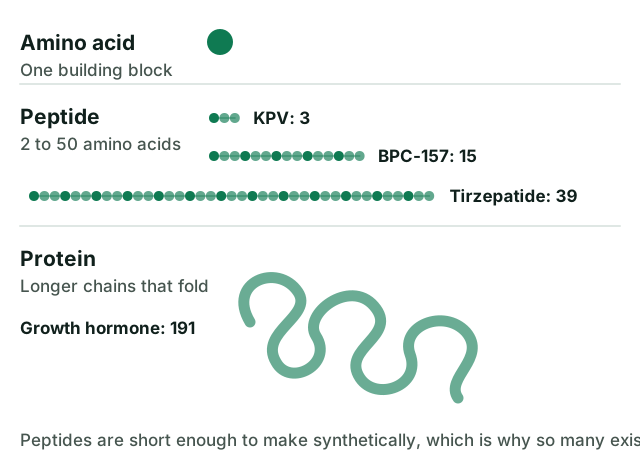
A peptide is two or more amino acids joined in a chain, and the National Human Genome Research Institute glossary puts the typical range at 2 to 50. Longer chains are polypeptides, and the proteins inside cells are built from one or more of those. The FDA draws its regulatory line a little lower, defining a protein as any amino acid chain “greater than 40 amino acids in size,” which is why insulin, at just over that, is now regulated as a biological product while shorter molecules like semaglutide are regulated as drugs. Chemists would call all of them peptides. For scale, tirzepatide has 39 amino acids, and growth hormone, at 191, is a folded protein.
What do peptides do in the body?
Many peptides act as signals, carrying a message from one tissue to another. The body makes hundreds of its own. Insulin tells cells to take up sugar. GLP-1 tells the brain you have eaten and prompts insulin release after a meal. Oxytocin triggers contractions during labor. Nearly every peptide drug is a copy of one of these signals, modified to last longer in the blood.
The Wegovy label is a useful illustration of what that looks like. Semaglutide shares 94% of its sequence with the body’s own GLP-1, with a fatty acid attached so it binds to albumin in the blood and a swap at one position so the enzyme DPP-4 cannot chop it up. That engineering is why a hormone the body clears in minutes becomes a once-weekly injection.
What approved peptides are used for
The approved list is the one with evidence attached, so it is the best answer to the question in the title.
| Peptide | Brand | What the label says it is for |
|---|---|---|
| Semaglutide | Wegovy | A GLP-1 receptor agonist for chronic weight management, with a reduced-calorie diet and increased physical activity |
| Tirzepatide | Zepbound, Mounjaro | A GIP and GLP-1 receptor agonist for chronic weight management and type 2 diabetes; see the tirzepatide guide |
| Teriparatide | Forteo | A parathyroid hormone analog (the first 34 amino acids of the 84-amino-acid hormone) that builds bone in osteoporosis |
| Oxytocin | Pitocin | Inducing or strengthening labor when there is a medical reason, and controlling bleeding after delivery, by intravenous infusion in a hospital |
| Leuprolide | Vabrinty and other brands | A synthetic nine-amino-acid peptide for advanced prostate cancer |
| Octreotide | Generic | A cyclic eight-amino-acid peptide that lowers growth hormone in acromegaly and eases severe diarrhea and flushing from certain tumors |
| Tesamorelin | Egrifta WR | Reducing excess abdominal fat in adults with HIV and lipodystrophy; the label says it is not for weight loss |
| Bremelanotide | Vyleesi | Acquired, generalized hypoactive sexual desire disorder in premenopausal women |
The GLP-1 hub covers the first two in depth because they are the peptides most people are asking about.
What are peptides used for, by goal?
Most searches start from a goal rather than a molecule. The honest picture is that a peptide has FDA approval for very few of the goals people hope for. For the rest, approved options that are not peptides may exist, and the goal guides cover them.
| Goal | FDA-approved peptide for it? | Where the human evidence stands | Read more |
|---|---|---|---|
| Weight loss | Yes: semaglutide (Wegovy), tirzepatide (Zepbound) | Large randomized trials | Peptides for weight loss |
| Building muscle | No | Small trials of growth-hormone-raising drugs, mostly in older adults or people with HIV | Peptides for muscle |
| Skin aging | No | Cosmetic ingredients tested in small studies | Peptides for skin |
| Sleep | No | A few small studies | Peptides for sleep |
| Hair loss | No | No adequately powered human trial | Peptides for hair |
| Injury healing | No | Mostly animal studies | BPC-157 guide |
What compounded peptides are used for
Compounding fills two gaps. The first is copies of approved drugs, such as compounded tirzepatide, which pharmacies may make under specific conditions; the compounded tirzepatide guide explains when that is allowed and what to check on the vial.
The second is substances with no approved product on the market. Sermorelin is the clearest example: it was approved as Geref for growth hormone testing and pediatric growth hormone deficiency, the manufacturer discontinued it in 2008, and the FDA later determined it was not withdrawn for safety or effectiveness reasons. Today it exists only as a compounded product.
A third, newer category is contested. As of November 2, 2026, an interim HHS policy says HHS does not intend to take enforcement action against pharmacies compounding BPC-157, TB-500, MOTS-c, epitalon, KPV or semax when ten conditions are met, including a patient-specific prescription and a single active ingredient. None of the six is FDA-approved, none is on the list of substances pharmacies may use, and no rule has been proposed. The policy is a choice not to enforce, not evidence that these peptides work, and blends fall outside it.
Compounded does not mean reviewed. The FDA does not approve compounded drugs or test each batch; quality rests on the pharmacy, which is why a pharmacy label with a strength and a beyond-use date is the minimum to look for, and why the reconstitution guide starts from that label.
Are peptides steroids?
No. Peptides are chains of amino acids, and anabolic steroids are a different class of molecule built on a cholesterol-like ring. The two get lumped together because some peptides are marketed to people who want more muscle, but they are chemically unrelated.
Are peptides natural?
Some are, and most peptide medicines are not quite. The body makes its own peptides, but a drug is usually a synthetic version changed on purpose. Semaglutide shares 94% of its sequence with natural GLP-1, and teriparatide is only the first 34 amino acids of an 84-amino-acid hormone. Those changes are what make them useful as drugs. Being natural would say nothing about safety in any case, since a hormone the body makes can still cause harm at the wrong dose.
Do peptides really work?
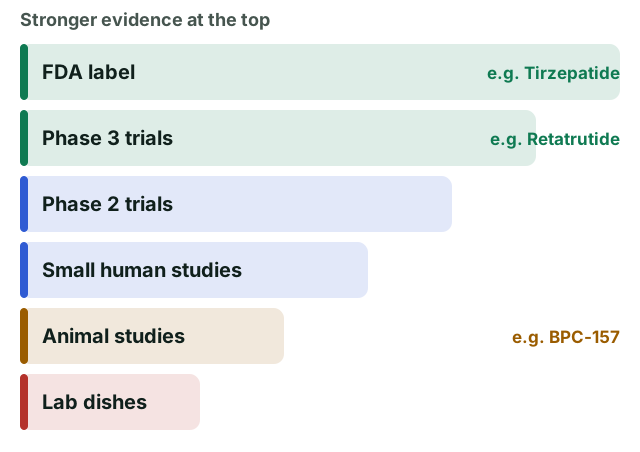
Specific peptides work for specific conditions, and the word on its own promises nothing. A claim about semaglutide for weight or teriparatide for bone rests on randomized trials. A claim about a research peptide for healing or longevity usually rests on animal studies. The useful question is always which peptide, for what, and in whom. Each peptide profile answers those three for one molecule.
What peptides should I take?
That question belongs to a prescriber who knows your history, and the answer may be none. The safer order is to start from the diagnosis or goal, ask what is approved for it, and only then ask whether a peptide fits. Our goals overview sets out the options by goal, including ones that are not peptides.
Are collagen peptides the same thing?
They are peptides, but they are a very different product from anything above. Collagen peptides are fragments of the protein collagen, broken down and sold to be swallowed as a supplement. They are not drugs, and nothing in them is injected.
The evidence for skin is genuinely disputed. A 2025 meta-analysis in the American Journal of Medicine pooled 23 randomized trials with 1,474 people. Overall it found benefits for hydration, elasticity and wrinkles, but studies without company funding and high-quality studies showed no effect, and it concluded there is “no clinical evidence” to support collagen for preventing or treating skin aging. A 2026 meta-analysis in the Journal of Cosmetic Dermatology pooled 35 trials with 2,534 people and reached a narrower, more favorable view: real improvements in hydration, and in elasticity at 12 weeks, no effect on wrinkles, and similar results in independent and sponsored trials. Two careful reviews disagreeing is itself a finding.
What about peptides in skincare?
Peptide serums are sold as cosmetics, which means the claims on the bottle are about appearance. The FDA says “whether a product is a cosmetic or a drug under the law is determined by a product’s intended use,” and that certain claims can make a product a drug even if it is marketed as a cosmetic. A serum has not been through FDA review for effectiveness. The peptide serum guide covers what the ingredients have and have not been shown to do.
How are peptides taken?
Almost all of them are injected under the skin. Swallowed, a peptide is digested like the protein in a meal before much of it can be absorbed, so pills are the exception and injections are the rule. HHS’s own policy says “achieving adequate oral bioavailability of peptides is inherently difficult and complex.”
Oral semaglutide (Rybelsus and the Wegovy pill) is the best-known exception. Approved injectable peptides come as prefilled pens (Wegovy, Zepbound, Forteo), as vials for hospital infusion (Pitocin), or as powders reconstituted before injection (Egrifta). Compounded peptides often arrive as a freeze-dried powder in a multi-dose vial that the patient mixes with bacteriostatic water and draws up with an insulin syringe. The injection sites guide covers where they go and how the technique works, and which sites each label allows.
The honest state of the evidence
Approved peptides have the strongest evidence a drug can have: large randomized trials, reviewed by the FDA, summarized on the label. Compounded copies of those drugs contain the same molecule, but the product in the vial has not been reviewed.
Research-chemical peptides sit at the other end. The FDA’s own language for BPC-157, when it reviewed the substance for compounding, was that the agency “lacks sufficient information to know whether the drug would cause harm when administered to humans,” with “no, or only limited, safety-related information” for the proposed routes. Similar wording applies to epitalon, MOTS-c, selank, semax and thymosin alpha-1 on the same page. For most of these, the published studies are in animals, and a human trial that would settle the question has not been run. That is the evidence level, and each peptide profile on this site states it plainly. Whether they are safe gets its own page: are peptides safe.
How to check a peptide’s FDA status
Four checks answer almost any “is it approved” question:
- DailyMed. If a prescribing information document exists for the molecule, there is an approved product. Search the generic name, not the brand.
- The 503A bulk drug substances lists. The FDA sorts nominated compounding ingredients into category 1 (under evaluation), category 2 (may present significant safety risks) and category 3 (nominated without adequate support), and keeps a separate page for category 2 substances and for nominations later withdrawn. BPC-157 appears on that page.
- ClinicalTrials.gov. A registered Phase 2 or Phase 3 trial means investigational, which is a reason for hope, not a reason to inject it.
- Warning letters. The FDA publishes the letters it sends to vendors; a molecule that shows up there has been sold illegally, whatever the website said.
Status changes, sometimes several times a year, and the FDA status tracker keeps it in one place. If a peptide is not on an approved label, not compounded within the rules, and not in a trial or a narrow early-access arrangement, there is no approved or legal way for it to reach a person. That is the plain answer to what it is used for.
Compare
- LearnFDA status trackerWhich peptides are FDA-approved, which HHS tolerates under conditions, and which are not legal to use.
- LearnHow to reconstituteHow a prescribed freeze-dried vial is mixed with bacteriostatic water, the mg/mL and units math worked through, storage, and mistakes that waste a vial.
- PeptidesNot FDA approvedBPC-157BPC-157 is unapproved and has no proven benefit in people.
Peptide news, sorted. Plus the printable dose chart.
Sorted, every Tuesday: the week's peptide and GLP-1 news in five minutes: FDA moves, new studies explained, and price changes. Subscribe and the one-page dose and injection-site chart arrives first.
Questions people ask
Are peptides the same as steroids?
Are peptides legal?
Do peptides work for weight loss?
Can you take peptides without needles?
What is a GLP-1?
What is the difference between a peptide and a protein?
Sources
Primary sources first: FDA labels and documents, peer-reviewed trials, registries.
- 1National Human Genome Research Institute. Talking Glossary of Genomic and Genetic Terms: Peptidegenome.gov
- 2FDA. Definition of the Term Biological Product, final rule. Federal Register, February 21 2020federalregister.gov
- 3Wegovy (semaglutide) injection prescribing information, Novo Nordisk, DailyMeddailymed.nlm.nih.gov
- 4Zepbound (tirzepatide) prescribing information, Eli Lilly, via FDAaccessdata.fda.gov
- 5Forteo (teriparatide injection) prescribing information, Eli Lilly, DailyMeddailymed.nlm.nih.gov
- 6Pitocin (oxytocin injection) prescribing information, DailyMeddailymed.nlm.nih.gov
- 7Leuprolide acetate (Vabrinty) prescribing information, DailyMeddailymed.nlm.nih.gov
- 8Octreotide acetate injection prescribing information, DailyMeddailymed.nlm.nih.gov
- 9Egrifta WR (tesamorelin) prescribing information, revised March 2025, via FDAaccessdata.fda.gov
- 10Vyleesi (bremelanotide) prescribing information, 2019, via FDAaccessdata.fda.gov
- 11Min T, Bain SC. The role of tirzepatide, dual GIP and GLP-1 receptor agonist, in the management of type 2 diabetes: the SURPASS clinical trials. Diabetes Ther 2021;12:143-157pmc.ncbi.nlm.nih.gov
- 12Norditropin (somatropin) prescribing information, DailyMeddailymed.nlm.nih.gov
- 13Novo Nordisk Form 6-K. Wegovy pill approved in the US as first oral GLP-1 for weight management, December 22, 2025sec.gov
- 14Drugs@FDA. Rybelsus (semaglutide) tablets, NDA 213051accessdata.fda.gov
- 15FDA. Determination that Geref (sermorelin acetate) injection was not withdrawn for reasons of safety or effectiveness. Federal Register, March 4 2013federalregister.gov
- 16FDA. Certain Bulk Drug Substances for Use in Compounding May Present Significant Safety Risks (503A category 2 and withdrawn nominations, including BPC-157)fda.gov
- 17FDA. Is it a cosmetic, a drug, or both? (content current as of September 11, 2024)fda.gov
- 18HHS. Enforcement Discretion Policy Regarding 503A Compounding Using Certain Peptide Bulk Drug Substances, with Appendices A and B, October 2026hhs.gov
- 19Federal Register. Notice of availability, FR Doc. 2026-22192, Docket HHS-OASH-2026-0496, RIN 0910-ZD94, published October 30, 2026public-inspection.federalregister.gov
- 20AJMC. Lilly expands retatrutide access amid doctor pushback, August 5, 2026ajmc.com
- 21Myung SK, Park Y. Effects of collagen supplements on skin aging: a systematic review and meta-analysis of randomized controlled trials. Am J Med 2025;138(9):1264-1277amjmed.com
- 22Batool A et al. Oral collagen peptides and skin rejuvenation: a systematic review and an updated meta-analysis of randomized controlled trials. J Cosmet Dermatol 2026;25(7):e71041pmc.ncbi.nlm.nih.gov
- 23FDA Warning Letter to Gram Peptides, March 31 2026: research-use-only peptides are unapproved new drugs intended for human usefda.gov
More in Learn
- Are peptides safe?Approved peptide drugs have measured risks. Compounded ones skip FDA review. Research-use vials have no safety review. What is known about each kind.Read
- Bacteriostatic waterSterile water with 0.9% benzyl alcohol, so one vial can be used for up to 28 days. How it differs from sterile water, storage, and who must avoid it.Read
- FDA status trackerWhich peptides are FDA-approved, which HHS tolerates under conditions, and which are not legal to use. One row per peptide, with sources and check dates.Read
- How to read a COAWhat each line on a peptide COA means: HPLC purity, mass spec identity, net content, endotoxin and sterility, plus red flags and what a COA cannot prove.Read
- How to reconstituteHow a prescribed freeze-dried vial is mixed with bacteriostatic water, the mg/mL and units math worked through, storage, and mistakes that waste a vial.Read
- Injection sitesMost peptide drugs go under the skin of the abdomen or thigh, and some labels add the upper arm. Which sites each label names, plus rotation and technique.Read
PeptideSorted Editorial Team
Editorial review
The PeptideSorted editors check every guide against its cited sources before publication: each number against its FDA label, trial or registry, the FDA status against current FDA and HHS documents, and the wording against our describe-never-prescribe rule. Licensed clinicians who join the review panel are listed by name on the editorial team page.
This page was checked against its cited sources by the PeptideSorted editorial team. Licensed clinicians on our review panel are listed on the editorial team page. Every health page cites primary sources and shows its review date. Read the editorial policy and how medical review works, or report an error via corrections. Educational only; not medical advice.