
Short answer
No peptide is FDA-approved for hair loss, and none has evidence close to finasteride or minoxidil. Peptide studies are small, often company-linked and usually test mixtures. Finasteride added 107 to 138 hairs against placebo in 1,553 men over two years, and topical minoxidil beat placebo in a 393-man, 48-week trial and is approved for women too.
No peptide is approved to treat hair loss, and none has trial evidence close to the two drugs that are. Copper peptides, biotinoyl tripeptide-1 and acetyl tetrapeptide-3 appear in many serums, backed by lab data and a handful of small, short studies, many tied to the companies that make them. Finasteride and minoxidil have multi-center, placebo-controlled trials and FDA labels. This goal sits with the others in the peptides by goal index.
| Option | FDA status | Best controlled human evidence | Who ran it |
|---|---|---|---|
| Finasteride 1 mg (Propecia), tablet | Approved December 1997 for male pattern hair loss in men only | Two 1-year trials, 1,553 men aged 18 to 41, with a second-year extension: 107 more hairs at 1 year and 138 more at 2 years than placebo in a 5.1 cm2 area of the crown; hair kept thinning on placebo | Lead author from the maker, then reviewed by FDA |
| Minoxidil, topical | Sold over the counter; a 5% foam for women was announced as FDA-approved in 2014 | 393 men, 48 weeks: 5% beat 2% and placebo, with 45% more regrowth than 2%. In 113 women, 5% foam once daily matched 2% solution twice daily over 24 weeks | Multicenter trial in men; no funder named in the abstracts |
| Copper peptides (GHK-Cu, AHK-Cu) | Cosmetic ingredient; not approved for hair loss | No adequately powered human trial found. AHK-Cu lengthened human hair follicles in a dish; a copper-binding peptide enlarged follicles in rats about as much as minoxidil | Lab groups |
| GHK joined to 5-aminolevulinic acid (no copper) | Not approved for hair loss | 45 men, 6 months, randomized, double-blind: hair count rose more than placebo in a 1 cm circle, with no difference in length or thickness | University hospital, with a company thanked |
| Biotinoyl tripeptide-1 (in Procapil) | Cosmetic ingredient; not approved for hair loss | Pilot placebo-controlled study of 35 men over 4 months measured the ratio of growing to resting hairs, not hair counts; other studies uncontrolled or combined with other treatments | Mostly sponsored, per a 2025 review |
| Acetyl tetrapeptide-3 (in a herbal combination) | Cosmetic ingredient; not approved for hair loss | 32 adults, 24 weeks, triple-blind: the combination and 3% minoxidil both raised terminal hair count by about 8%, with no significant difference between them | University authors; no funding or conflicts declared |
| Gly-Pro-Ile-Gly-Ser, a pentapeptide | Not approved for hair loss | 22 Japanese men, 4 months, double-blind, randomized against placebo: a higher share of thick hairs; a 2026 review says the rise in density was not significant | Authors from Shiseido |
What people hope for, and what the studies measured
People searching this want new hair where it has thinned, ideally without a daily drug and its side effects. Peptide studies rarely test that directly. Some count hairs in a tiny circle of scalp. Others report the ratio of growing to resting hairs, or the share of thick hairs. Those can move without visible new coverage, and a 2026 review pointed out that peptide studies use so many different measures that results are hard to compare. It called whether a treatment enables normal hair growth in bald areas the measure that matters most.
Compare that with finasteride’s two-year trials, which counted hairs in a fixed scalp area and added an expert panel’s review of photographs.
Do copper peptides work for hair?
Copper peptides are still a laboratory finding for hair. A 2007 Seoul National University study found that the copper tripeptide AHK-Cu, at very low concentrations, lengthened human hair follicles kept alive outside the body and made the cells at the follicle’s base multiply. A 1993 primate-center review reported that a copper-binding peptide enlarged follicles on fuzzy rats, an effect similar to topical minoxidil. A 2026 systematic review of GHK-Cu lists pattern hair loss among the uses that still need well-designed human trials.
The study many websites cite as a human GHK-Cu hair trial needs a closer look. In 2016, Korean researchers gave 45 men a scalp spray containing GHK joined to 5-aminolevulinic acid, at 50 or 100 mg/mL, or a placebo, once daily for 6 months. Counted in a 1 cm circle, hair rose by 71.5 and 52.6 against 9.6 on placebo. The lower dose did better than the higher one, and hair length and thickness did not differ between groups. The paper describes GHK with no copper, and its chemical formula contains none, so it is not a test of a copper peptide serum. The topical GHK-Cu evidence is mostly about skin, and the copper peptide serum guide covers what to check on a label.
Biotinoyl tripeptide-1, acetyl tetrapeptide-3 and others
Biotinoyl tripeptide-1 is GHK with biotin attached, best known as part of Procapil, a cosmetic ingredient that also contains apigenin and oleanolic acid. A 2025 review in the International Journal of Trichology described a pilot placebo-controlled study in 35 men using a 3% lotion for 4 months, which reported a better ratio of growing (anagen) to resting (telogen) hairs, and a 6-month open-label study of 56 patients with no control group. The review’s verdict on these and similar actives: small samples, “conflicts of interest in the form of sponsorship,” and “a lack of head-to-head comparison with the standard methods of treatment.”
Acetyl tetrapeptide-3 is the peptide in the ingredient Capixyl. We found two human studies, and both tested mixtures. In 2013, a study of 30 volunteers over 4 months reported a 46% rise in the growing-to-resting ratio with a red clover and peptide mixture, against a 33% fall on placebo. The corresponding author worked for the cosmetics company behind the ingredient. In 2020, a 32-person trial found no significant difference between an herbal combination and 3% minoxidil, but 32 people is far too few to show that two treatments are equal.
Two more peptides have reached people. The pentapeptide Gly-Pro-Ile-Gly-Ser raised the share of thick hairs in a 22-man Shiseido study. Water-soluble chicken egg yolk peptides, taken by mouth at 250 mg a day, gave higher hair density than placebo after 24 weeks in a 76-person study of women, according to a 2026 review. Authors of the original paper included staff of two companies.
What the best recent review concluded
A 2026 review in Biomedicines surveyed peptides for hair loss and was blunt about the gap. Most data come from cell cultures and mice. The clinical studies of acetyl tetrapeptide-3 and the pentapeptide lacked enough participants, and the human studies it reviewed did not offer meaningful comparison with minoxidil or finasteride, “which undermines their credibility.” It also noted that peptides pass poorly through skin and that immune reactions to them still need proper study in people.
One larger test is underway. A randomized, double-blind trial in Bangkok is comparing a peptide hair serum with 2% minoxidil in about 80 adults over 24 weeks, with a cosmeceutical company as collaborator and hair count as the main outcome. The registry lists it as recruiting as of this update, with no results posted, so it says nothing yet.
Why the approved drugs win on evidence
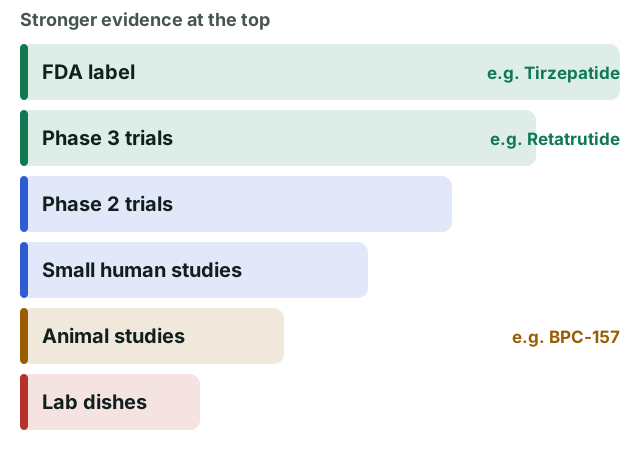
Size and length explain most of the gap, more than any failure of peptides. Finasteride’s trials enrolled 1,553 men and ran for two years. Minoxidil’s 393-man trial ran 48 weeks against both placebo and a lower dose. No peptide hair study comes close. Drug makers fund their own trials too, but FDA then reviews the data. A cosmetic serum has no such step. On the ladder below, peptides for hair sit on the small human studies rung, while finasteride and minoxidil have reached the top.
| Finasteride 1 mg | Topical minoxidil | |
|---|---|---|
| Label covers | Men with male pattern hair loss only | Regrowth on top of the scalp; the women’s foam is used once daily |
| Time to see benefit | Label: daily use for 3 months or more. AAD: usually about 4 months | Women’s foam label: as early as 3 months, at least 6 months for some. AAD: about 6 to 12 months |
| If it is stopped | Trial gains reversed within 12 months | Normal hair loss restarts; the women’s foam label says regrown hair is probably lost in 3 to 4 months |
| Common problems | Sexual side effects in 3.8% against 2.1% on placebo in year 1 | Itching and scalp irritation, more with 5% than 2%; unwanted facial hair |
The American Academy of Dermatology (AAD) says the earlier treatment starts, the more likely regrowth is. It also says minoxidil tends to work better alongside another treatment.
Finasteride safety
Beyond the trial rates above, the Propecia label lists these reports from general use: sexual dysfunction that continued after stopping, male infertility or poor semen quality, testicular pain, breast tenderness and enlargement, male breast cancer, and depression, suicidal ideation and suicidal behavior. Finasteride lowers PSA, a prostate cancer blood test, so anyone taking it should tell the clinician reading that test. In a long study of a 5 mg dose, high-grade prostate cancer occurred in 1.8% against 1.1% on placebo; the label says the meaning for the 1 mg dose is unknown. Anyone with low mood or thoughts of self-harm while taking finasteride should contact a clinician promptly. In a crisis in the US, call or text 988, at any hour.
Minoxidil safety
The women’s Drug Facts label says not to use it if hair loss is sudden or patchy, if there is no family history of hair loss, if the reason is unknown, if it follows childbirth, if the scalp is red, inflamed, infected or painful, or under age 18. It says to ask a doctor first with heart disease. It tells users to stop and ask a doctor for chest pain, rapid heartbeat, faintness or dizziness, sudden unexplained weight gain, swollen hands or feet, scalp irritation, unwanted facial hair, or no regrowth at 6 months. It also warns that minoxidil may be harmful during pregnancy or breastfeeding, and that shedding may continue for up to 2 weeks after starting, which it calls temporary. The label says it will not work for all women.
Compounded and off-label versions
Two versions sold for hair are not FDA-approved for it. Compounded topical finasteride has no approved formulation. In an alert dated April 2025, FDA described 32 adverse event reports from 2019 to 2024, including erectile dysfunction, anxiety, suicidal ideation, brain fog and depression, and most reports said the effects continued after stopping. Some patients said they had been told a topical carried no risk. FDA also warned that women could be exposed through contact with the applied product.
Oral minoxidil is a blood pressure tablet that some prescribers use off-label for hair. Its label carries a boxed warning for pericardial effusion, fluid around the heart, and says use to promote hair growth “is not an approved indication.” That warning was written for severe high blood pressure. Hair doses are lower, but an analysis of FDA adverse event reports still found a pericardial effusion signal at every dose range it checked, up to 10 mg. Those reports cannot prove the drug was the cause. Its authors recommended the lowest effective dose. Both products are worth a direct conversation with a prescriber about risk.
What else do dermatologists offer?
The AAD lists several options besides minoxidil and finasteride. It says spironolactone is effective in about 40% of women with female pattern hair loss. Laser therapy is described as safe and painless but needing many sessions. Platelet-rich plasma, injections made from a patient’s own blood, usually starts monthly for 3 months and continues every 3 to 6 months. A hair transplant is described as an effective and permanent solution for pattern baldness.
Is it really pattern hair loss?
Treatment depends on the cause, so that comes first. The AAD says losing 50 to 100 hairs a day is normal. Heavy shedding can follow surgery, high fever, chemotherapy or childbirth, and hereditary hair loss is more common than infection. Hairstyles that pull, ringworm and alopecia areata are other causes. A dermatologist may order a blood test or scalp biopsy.
See a clinician rather than trying a serum if hair falls out suddenly or in patches, if the scalp is red, sore or scaly, or if you cannot tell why it is happening. The minoxidil label excludes those situations for the same reason.
For women
Finasteride is not indicated for women. Its label contraindicates it in women who are or may become pregnant, because it can cause abnormalities of the external genitals in a male fetus, and warns women who may be pregnant not to handle crushed or broken tablets. Topical minoxidil is the approved option for female pattern hair loss, and the women’s foam label describes use once daily. The peptides for women page covers other female-specific labels.
What to look for on a hair serum label
Look past the front of the bottle to the ingredient list. These are the standard names: copper tripeptide-1, biotinoyl tripeptide-1 and acetyl tetrapeptide-3. Check whether the peptide is the only active or one of several, because almost every human result above comes from a mixture.
Then read the claims. FDA treats a product that claims to “restore hair growth” as a drug, which would need approval. That is why serums promise hair that looks fuller or stronger. A cosmetic that claims to regrow hair is being sold as an unapproved drug. If a serum says it works as well as minoxidil, ask to see a published trial.
If hair loss started on a GLP-1 drug
Hair shedding has been linked to the GLP-1 weight-loss drugs. A 2026 meta-analysis of nine interventional studies (4,114 users) found hair loss about 3.3 times more often than on placebo, in roughly 3.9% of users. A separate review pointed to rapid weight loss as a possible contributor. That is a conversation for the prescriber of the GLP-1 drug, and no reason to add an unapproved peptide.
What about injected peptides for hair?
We found no human hair trial of injected GHK-Cu, BPC-157 or TB-500 in a PubMed search on November 2, 2026. A September 2026 NPR report found no published human data showing injected GHK-Cu is safe or effective. As of November 2, 2026, HHS says it does not intend to take enforcement action against pharmacies compounding six named peptides under strict conditions. GHK-Cu is not one of them, none of the six is FDA-approved, and the policy says nothing about whether any of them grows hair. Vials sold for “research use only” are not legal to use on people.
Compare
- SkincareCopper peptide serumCopper peptide serum contains GHK-Cu, listed as copper tripeptide-1.
- GoalsWomenThe peptides with real evidence for women are approved drugs with rules written for women: libido, the pill, pregnancy, bone.
- LearnFDA status trackerWhich peptides are FDA-approved, which HHS tolerates under conditions, and which are not legal to use.
Peptide news, sorted. Plus the printable dose chart.
Sorted, every Tuesday: the week's peptide and GLP-1 news in five minutes: FDA moves, new studies explained, and price changes. Subscribe and the one-page dose and injection-site chart arrives first.
Questions people ask
Do copper peptides regrow hair?
What is the best peptide for hair growth?
What is biotinoyl tripeptide-1?
Are peptide hair serums FDA-approved?
Can women use finasteride?
Can GLP-1 drugs cause hair loss?
Sources
Primary sources first: FDA labels and documents, peer-reviewed trials, registries.
- 1Kaufman KD et al. Finasteride in the treatment of men with androgenetic alopecia. J Am Acad Dermatol 1998pubmed.ncbi.nlm.nih.gov
- 2Propecia (finasteride) prescribing information, FDA structured label, version dated October 14, 2024accessdata.fda.gov
- 3Drugs@FDA. Propecia (finasteride), NDA 020788, approved December 19, 1997accessdata.fda.gov
- 4Olsen EA et al. A randomized clinical trial of 5% topical minoxidil versus 2% topical minoxidil and placebo in men with androgenetic alopecia. J Am Acad Dermatol 2002pubmed.ncbi.nlm.nih.gov
- 5Blume-Peytavi U et al. 5% minoxidil foam once daily versus 2% minoxidil solution twice daily in women with androgenetic alopecia. J Am Acad Dermatol 2011pubmed.ncbi.nlm.nih.gov
- 6Practical Dermatology. Women's Rogaine 5% minoxidil topical aerosol receives FDA approval, November 4, 2014practicaldermatology.com
- 7Minoxidil 5% topical aerosol for women, Drug Facts label, via DailyMeddailymed.nlm.nih.gov
- 8Loniten (minoxidil tablets) prescribing information, via FDAaccessdata.fda.gov
- 9Low-dose oral minoxidil and associated adverse events: analyses of the FDA Adverse Event Reporting System, with a focus on pericardial effusionspmc.ncbi.nlm.nih.gov
- 10FDA. FDA alerts health care providers, compounders and consumers of potential risks associated with compounded topical finasteride products (content current as of April 22, 2025)fda.gov
- 11Fan C et al. Overview of short peptides for hair loss. Biomedicines 2026pubmed.ncbi.nlm.nih.gov
- 12Pyo HK et al. The effect of tripeptide-copper complex on human hair growth in vitro. Arch Pharm Res 2007pubmed.ncbi.nlm.nih.gov
- 13Uno H, Kurata S. Chemical agents and peptides affect hair growth. J Invest Dermatol 1993pubmed.ncbi.nlm.nih.gov
- 14Lee WJ et al. Efficacy of a complex of 5-aminolevulinic acid and glycyl-histidyl-lysine peptide on hair growth. Ann Dermatol 2016pubmed.ncbi.nlm.nih.gov
- 15Najafi N et al. Systematic review of GHK-Cu in topical microneedle delivery: a case for expanded clinical trials. Arch Intern Med Res 2026pubmed.ncbi.nlm.nih.gov
- 16Bikash C. Topical alternatives for hair loss: beyond the conventional. Int J Trichology 2025pubmed.ncbi.nlm.nih.gov
- 17Lueangarun S, Panchaprateep R. An herbal extract combination (biochanin A, acetyl tetrapeptide-3 and ginseng) versus 3% minoxidil for androgenetic alopecia: a 24-week randomized triple-blind trial. J Clin Aesthet Dermatol 2020pubmed.ncbi.nlm.nih.gov
- 18Loing E et al. A new strategy to modulate alopecia using a combination of two specific and unique ingredients. J Cosmet Sci 2013pubmed.ncbi.nlm.nih.gov
- 19Iwabuchi T et al. The topical penta-peptide Gly-Pro-Ile-Gly-Ser increases the proportion of thick hair in Japanese men with androgenetic alopecia. J Cosmet Dermatol 2016pubmed.ncbi.nlm.nih.gov
- 20Nakamura T et al. Naturally occurring hair growth peptide: water-soluble chicken egg yolk peptides stimulate hair growth through induction of vascular endothelial growth factor production. J Med Food 2018pubmed.ncbi.nlm.nih.gov
- 21ClinicalTrials.gov. Peptide hair serum compared with topical 2% minoxidil for androgenetic alopecia, NCT07536100clinicaltrials.gov
- 22American Academy of Dermatology. Hair loss: diagnosis and treatmentaad.org
- 23American Academy of Dermatology. Hair loss: overviewaad.org
- 24FDA. Is it a cosmetic, a drug, or both? (Or is it soap?)fda.gov
- 25Cheng PL, Chang HC. GLP-1 receptor agonists and hair loss: a systematic review and meta-analysis. Diabetes Res Clin Pract 2026pubmed.ncbi.nlm.nih.gov
- 26Gupta AK et al. GLP-1 therapies and hair loss: a systematic review of current evidence. Sci Prog 2026pubmed.ncbi.nlm.nih.gov
- 27HHS. Enforcement Discretion Policy Regarding 503A Compounding Using Certain Peptide Bulk Drug Substances, with Appendices A and B, October 2026hhs.gov
- 28Federal Register. Notice of availability, FR Doc. 2026-22192, Docket HHS-OASH-2026-0496, RIN 0910-ZD94, published October 30, 2026public-inspection.federalregister.gov
- 2921 CFR 312.160, drugs for investigational use in laboratory research animals or in vitro testslaw.cornell.edu
- 30988 Suicide & Crisis Lifeline988lifeline.org
- 31NPR (via WNYC). The copper peptide trend has gone from creams to injections, ahead of the science, September 7, 2026wnyc.org
More in Goals
- Glow blendGlow is an injectable blend of GHK-Cu, BPC-157 and TB-500, never tested in people and outside the HHS policy. See what each ingredient really shows.Read
- Klow blendKlow is Glow plus KPV: four unapproved peptides in one vial, never tested in people and outside the HHS policy for three reasons. See what KPV adds.Read
- Muscle growthNo peptide is FDA-approved to build muscle. What tesamorelin, sermorelin, CJC-1295, ipamorelin and MK-677 did to lean mass and strength in human trials.Read
- SkinA few skin peptides beat a control in small, mostly company-run trials. None is FDA-approved. See the evidence by type and what has stronger proof.Read
- SleepNo peptide is FDA-approved for sleep. DSIP's 1980s trials were mixed, epitalon and selank have no sleep trials, and proven insomnia treatments exist.Read
- Weight lossSemaglutide and tirzepatide are the FDA-approved peptides with strong weight-loss trials. AOD-9604 and MOTS-c are not. See the evidence, group by group.Read
PeptideSorted Editorial Team
Editorial review
The PeptideSorted editors check every guide against its cited sources before publication: each number against its FDA label, trial or registry, the FDA status against current FDA and HHS documents, and the wording against our describe-never-prescribe rule. Licensed clinicians who join the review panel are listed by name on the editorial team page.
This page was checked against its cited sources by the PeptideSorted editorial team. Licensed clinicians on our review panel are listed on the editorial team page. Every health page cites primary sources and shows its review date. Read the editorial policy and how medical review works, or report an error via corrections. Educational only; not medical advice.