
Short answer
A copper peptide serum is a cosmetic containing GHK-Cu, listed on labels as copper tripeptide-1. Its skin evidence is thin: a 2026 review found only two randomized trials, and the best-known facial results were never fully published. Studies used roughly 0.05% to 2%, but most serums state no percentage. FDA does not check that serums work.
- What it is
- A cosmetic serum containing GHK-Cu (copper tripeptide-1), a copper-binding tripeptide, sold to improve the look of aging skin.
- FDA status
- Not a drug
Copper peptide serums are cosmetics. They do not need FDA approval and FDA does not review them for effectiveness. Injectable GHK-Cu is a different product: an unapproved drug.
- Evidence level
Early human studies
Small or uncontrolled human studies only.
A copper peptide serum is a cosmetic containing GHK-Cu, a three-amino-acid peptide bound to copper. Lab studies are promising, but the human evidence is thin, and no one has shown a best strength. Serums are cosmetics, FDA does not approve them or review whether they work, and PeptideSorted names no products. What follows is about using the label and the evidence to judge a bottle. The skincare peptides index has the related guides, and the GHK-Cu topical evidence page sets out each study in full.
What does a copper peptide serum do?
It is sold to firm skin and soften fine lines, and the proof in people is much weaker than the proof in cells. A 2026 systematic review in Aesthetic Surgery Journal found 20 eligible studies. Eighteen were preclinical and only 2 were randomized controlled trials. Here is how the common claims hold up.
| Common claim | What the studies found | How strong |
|---|---|---|
| Builds collagen | A small early study reported more collagen in 70% of skin treated with GHK-Cu, against 50% with vitamin C and 40% with retinoic acid after a month | Weak: small, biopsy-based, and reviews disagree on its length |
| Reduces wrinkles | Two 2002 studies in 71 and 41 women reported improvement over 12 weeks, published only as conference abstracts. A 2026 review also describes reduced wrinkle volume and depth against controls in one randomized trial | Weak: never fully peer reviewed, or small |
| Speeds healing after laser | 13 patients, randomized: no objective difference in redness, wrinkles or skin quality; patients were more satisfied | Weak, and objectively negative |
| Heals wounds | A 0.4% cream in 86 patients with leg ulcers did no better than placebo | Negative in this trial |
| Improves acne scars | With microneedling, early benefit and no difference by week 16 | Weak |
| Regrows hair | No adequately powered human trial | Unproven; see peptides for hair growth |
Who wrote the literature matters here. A 2026 systematic review found that about 35% of the primary GHK-Cu papers in its window included the researcher who first isolated the peptide or a colleague, both tied to a company selling copper peptide products. Its authors said this limits how independent the evidence is. A separate 2024 review noted a “surprising absence of clinical studies” for GHK-Cu and its palmitoyl form.
Is a copper peptide serum better than retinol?
Nothing shows that it is. No published study compares a modern copper peptide serum with retinol. The early biopsy study above is the only comparison with retinoic acid we found, and it was small and never fully published. Prescription tretinoin has an FDA label, while a copper peptide serum has neither that nor comparable trials. Daily sunscreen has the strongest prevention evidence for aging skin: 24% less skin aging in a randomized trial of 903 adults over 4.5 years. The peptides for skin guide compares these options side by side.
Finding it on the label
| What the label says | What it means |
|---|---|
| Copper tripeptide-1 | GHK-Cu. This is its INCI name, the standard name on cosmetic ingredient lists. |
| Palmitoyl tripeptide-1 | The same three amino acids with a fatty acid attached and no copper. A different ingredient. |
| “Copper peptides” or “copper complex” on the front | Marketing language. Check the ingredient list for copper tripeptide-1. |
The sample below shows both ingredients on one list, which is how many shoppers mix them up.
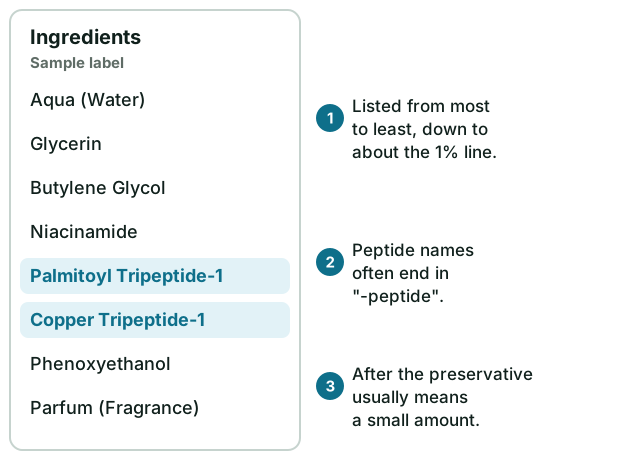
Position on the list. US rules require ingredients in descending order of amount, except that anything at 1% or less may be listed in any order after the ingredients above 1%. Because published studies used roughly 0.05% to 2%, where copper tripeptide-1 sits near the end of a list tells you little about how much is there.
What concentration did the studies use?
Studies ranged from about 0.05% to 2%, and none fixed a best strength.
| Source | Concentration | What it tells you |
|---|---|---|
| Range across topical studies (2026 systematic review) | 0.05% to 2% | The span tested; no study fixed a best strength |
| Bishop et al. 1992, leg ulcer trial | 0.4% cream | Randomized, 86 patients; no better than placebo |
| Acne-scar study with microneedling, 2025 (summarized in a 2026 review) | 0.5% to 1% serum | Early benefit, no difference by week 16 |
| Most-cited facial cream studies, 2002 | Not reported | Published only as conference abstracts |
Because the strongest cosmetic studies never reported a concentration, there is no evidence-based minimum to look for. A serum that states its percentage at least lets you compare it with this range. The GHK-Cu dosage page converts percentages to milligrams.
Stability and formulation
Laboratory findings from a 2024 review of GHK-Cu formulation:
- It dissolves easily in water (about 325 mg/mL) and is strongly water-loving, which is why serums are a common format.
- Skin-like pH is fine. Solutions at pH 5.5 and 7.4 showed no detectable breakdown at 60 °C over 14 days.
- Oxidizing conditions are the main threat. In a 0.5% hydrogen peroxide solution, only 84.2% of GHK-Cu remained after one hour, the worst result of the stress tests.
- Some formula ingredients matter. In one test, a charged surfactant (dicetyl phosphate) made GHK-Cu less stable inside lipid carriers, while carriers without it showed no breakdown after a month at 40 °C.
These were laboratory tests of raw material and carriers. They do not tell you how long any given product stays potent once opened.
Does GHK-Cu get into skin?
Not easily through intact skin. In a 2015 laboratory study, almost no peptide passed through untreated human skin in nine hours, while skin pre-treated with microneedles let 134 nanomoles through. Reviews describe liposomes and other carriers that improve passage in the lab. So the formula and the way it is applied may matter as much as the percentage. It is also why a result in cultured cells, where the peptide sits directly on the cells, says little about a bottle used on intact skin at home.
Mixing with other actives: what is actually known
Advice on what not to combine with copper peptides is widely repeated, and very little of it has data behind it.
| Combination | What is known | Human evidence |
|---|---|---|
| Oxidizing products | Oxidizing conditions broke down GHK-Cu fastest in stability tests | None |
| Low-molecular-weight hyaluronic acid | A 1 to 9 GHK-Cu to hyaluronic acid ratio raised collagen IV production in skin cells and skin samples | None; laboratory only |
| Microneedling or dermarollers | Greatly increases how much enters the skin; one acne-scar study flagged hyperpigmentation (skin darkening) | Small studies only |
| Acetyl hexapeptide-8 | A 2024 chemistry study notes this peptide binds copper ions | None; whether it matters in a routine is unknown |
| Vitamin C, retinoids, exfoliating acids | We found no published study testing them together with GHK-Cu | None |
The general advice that does have a source comes from the American Academy of Dermatology (AAD): start with one anti-aging product, because using several at the same time can irritate skin.
Side effects and patch testing
The safety record is mostly silence. A 2024 review found no published studies of GHK-Cu’s side effects, and a 2026 review noted the hyperpigmentation flag in one microneedling study. Neither means the ingredient is risk-free. It means the question has barely been studied.
The AAD recommends testing a new product on a quarter-sized spot, such as the underside of the arm, twice a day for 7 to 10 days, and not using it if the skin turns red, itchy or swollen. It also advises stopping any anti-aging product that stings, burns or tingles. Anything severe that does not settle is one for a dermatologist.
What to expect
Expect modest changes at best. The AAD says most anti-aging products take at least six weeks to work, and sometimes up to three months, and that a moisturizer can plump fine lines within days, so a fast change is not proof the copper peptide did it. It also says effective products come in all price ranges, so a high price is no evidence of potency. If a product claims to “regenerate cells” or restore hair growth, FDA treats that as a drug claim, and the product is being sold as an unapproved drug.
Serum is not injection
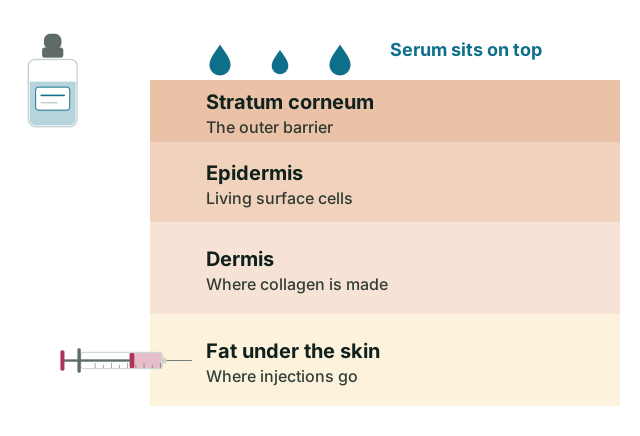
Copper peptide serums are legal cosmetics. Injectable GHK-Cu is an unapproved drug. FDA held it in its significant-safety-risk category for compounding from September 2023 until the nomination was withdrawn in April 2026, and it still says compounded injectable GHK-Cu may pose immune-reaction risk from aggregation and peptide impurities, with limited human data. A September 2026 NPR report found no published human data showing injection is safe or effective.
As of November 2, 2026, HHS says it does not intend to take enforcement action against pharmacies compounding six named peptides under strict conditions. None of the six is FDA-approved, the policy approves nothing, and GHK-Cu is not on the list, so injectable GHK-Cu still has no compounding route. Vials labeled “research use only” are not legal to use on people. The GHK-Cu overview covers that side.
Compare
Peptide news, sorted. Plus the printable dose chart.
Sorted, every Tuesday: the week's peptide and GLP-1 news in five minutes: FDA moves, new studies explained, and price changes. Subscribe and the one-page dose and injection-site chart arrives first.
Questions people ask
What does a copper peptide serum do?
What should a copper peptide serum list on its label?
What concentration of copper peptide is effective?
Can I use a copper peptide serum with vitamin C or retinol?
Should I use copper peptides with microneedling?
Is a copper peptide serum the same as GHK-Cu injections?
Sources
Primary sources first: FDA labels and documents, peer-reviewed trials, registries.
- 1PubChem. Copper tripeptide-1 (GHK-Cu), CID 71587328pubchem.ncbi.nlm.nih.gov
- 2PubChem. Palmitoyl tripeptide-1 (Pal-GHK), CID 10231864pubchem.ncbi.nlm.nih.gov
- 3Najafi N et al. A systematic review of the mechanisms and therapeutic applications of GHK-Cu in topical microneedle delivery. Arch Intern Med Res 2026pubmed.ncbi.nlm.nih.gov
- 4Mortazavi SM et al. Topically applied GHK as an anti-wrinkle peptide: advantages, problems and prospective. BioImpacts 2024pubmed.ncbi.nlm.nih.gov
- 5Mokhtar J et al. The regenerative potential of GHK-Cu in aesthetic medicine (systematic review). Aesthet Surg J 2026pubmed.ncbi.nlm.nih.gov
- 6Schagen SK. Topical peptide treatments with effective anti-aging results. Cosmetics 2017mdpi.com
- 7Miller TR et al. Effects of topical copper tripeptide complex on CO2 laser-resurfaced skin. Arch Facial Plast Surg 2006pubmed.ncbi.nlm.nih.gov
- 8Bishop JB et al. A prospective randomized evaluator-blinded trial of two potential wound healing agents for the treatment of venous stasis ulcers. J Vasc Surg 1992pubmed.ncbi.nlm.nih.gov
- 9Li H et al. Microneedle-mediated delivery of copper peptide through skin. Pharm Res 2015pubmed.ncbi.nlm.nih.gov
- 10Wyrzykowski D et al. Influence of the modification of the cosmetic peptide Argireline on the affinity toward copper(II) ions. J Pept Sci 2024pubmed.ncbi.nlm.nih.gov
- 11Hughes MC et al. Sunscreen and prevention of skin aging: a randomized trial. Ann Intern Med 2013pubmed.ncbi.nlm.nih.gov
- 12FDA. Certain bulk drug substances for use in compounding may present significant safety risks (content current as of April 22, 2026)fda.gov
- 13FDA. 503A categories update, September 29, 2023 (copy hosted by the Alliance for Pharmacy Compounding)join.a4pc.org
- 14HHS. Enforcement Discretion Policy Regarding 503A Compounding Using Certain Peptide Bulk Drug Substances, with Appendices A and B, October 2026hhs.gov
- 15Federal Register. Notice of availability, FR Doc. 2026-22192, Docket HHS-OASH-2026-0496, RIN 0910-ZD94, published October 30, 2026public-inspection.federalregister.gov
- 16NPR (via WNYC). The copper peptide trend has gone from creams to injections, ahead of the science, September 7, 2026wnyc.org
- 1721 CFR 312.160, drugs for investigational use in laboratory research animals or in vitro testslaw.cornell.edu
- 1821 CFR 701.3, designation of ingredients on cosmetic labelslaw.cornell.edu
- 19FDA. FDA authority over cosmetics: how cosmetics are not FDA-approved, but are FDA-regulated (content current as of November 18, 2025)fda.gov
- 20FDA. Is it a cosmetic, a drug, or both? (or is it soap?) (content current as of September 11, 2024)fda.gov
- 21American Academy of Dermatology. How to select anti-aging skin care productsaad.org
- 22American Academy of Dermatology. How to maximize results from anti-aging skin care productsaad.org
- 23American Academy of Dermatology. How to test skin care products (last updated August 10, 2021)aad.org
More in Skincare
- Choosing a peptide serumNo trial compares finished peptide serums, so no honest best list exists. Use this label checklist: named peptides, percent, claims, patch test, timing.Read
- Peptide serumPeptide serums are cosmetics backed by small, often company-run studies. What each type does, how to read the label, and what has stronger evidence.Read
- SNAP-8SNAP-8 is a trade name for acetyl octapeptide-3. No published study tests it alone, and its wrinkle figure comes from the supplier. See the evidence.Read
PeptideSorted Editorial Team
Editorial review
The PeptideSorted editors check every guide against its cited sources before publication: each number against its FDA label, trial or registry, the FDA status against current FDA and HHS documents, and the wording against our describe-never-prescribe rule. Licensed clinicians who join the review panel are listed by name on the editorial team page.
This page was checked against its cited sources by the PeptideSorted editorial team. Licensed clinicians on our review panel are listed on the editorial team page. Every health page cites primary sources and shows its review date. Read the editorial policy and how medical review works, or report an error via corrections. Educational only; not medical advice.