
Short answer
There is no established injected dose of GHK-Cu, because no human trial of injected GHK-Cu has ever been published. Topical studies used creams, gels and serums at roughly 0.05% to 2%, and one 1992 ulcer trial of a 0.4% cream did no better than placebo. GHK-Cu is not FDA-approved as a drug.
- What it is
- A naturally occurring tripeptide (glycine, histidine, lysine) bound to a copper ion, used in skin-care products as copper tripeptide-1.
- FDA status
- Not FDA approved
Not FDA-approved. Injectable GHK-Cu was in 503A category 2 from September 2023 until its nomination was withdrawn in April 2026 and has no compounding route; non-injectable GHK-Cu is in category 1 (under evaluation) on the May 14, 2026 list. GHK-Cu is not in the October 2026 HHS peptide policy.
- Evidence level
Early human studies
Small or uncontrolled human studies only.
Nobody knows the right injected dose of GHK-Cu for a person, because no one has tested one. What does exist are the concentrations used in topical studies of GHK-Cu, and those are the real answer for anyone holding a serum. The two questions need keeping apart: a percentage in a cream and a milligram amount under the skin are different exposures with different legal status. Nothing here is a recommendation. GHK-Cu is not FDA-approved for any use.
What the topical studies used
| Study | What it tested | Concentration | Result or purpose |
|---|---|---|---|
| Bishop et al. 1992 | 86 patients with venous leg ulcers, randomized | 0.4% tripeptide copper cream | No better than placebo |
| Canapp et al. 2003 | Rats with ischemic wounds | 2% GHK-Cu gel | Faster wound closure than vehicle or no treatment |
| Hostynek et al. 2011 (as summarized in a 2026 review) | Human cadaver skin in a lab | 0.68% aqueous solution | Measured how much crosses skin; passive passage was poor |
| Li et al. 2015 | Human skin in a lab, with and without microneedles | 5.8 mM solution | No peptide crossed intact skin in 9 hours; microneedle-treated skin let it through |
| Split-face acne-scar study 2025 (as summarized in a 2026 review) | People with acne scars, microneedling with or without serum | 0.5% to 1% serum | Early benefit, no difference at week 16, hyperpigmentation flagged |
| Eyebrow study 2026 (as summarized in a 2026 review) | 18 participants, split-face | Nominal 2% serum | Better eyebrow hair count and diameter over 12 weeks, no serious adverse effects |
| Range across the literature | Creams, gels, serums | 0.05% to 2% | The span a 2026 systematic review reported for topical use |
Two things stand out. Many of the most cited cosmetic studies, including the 2002 facial cream and eye cream studies in 71 and 41 women, did not report a concentration in any full publication, because they were never fully published. And the one randomized trial with a stated concentration and a hard clinical outcome, the 1992 ulcer trial, was negative. The topical GHK-Cu guide covers each study in detail.
A registered phase 2 trial (NCT07437586) is testing a topical GHK-Cu gel on standardized skin wounds in 60 healthy adults. It applies the gel once daily for 14 days, was recruiting on November 2, 2026, and has no results.
How often, and for how long, on the skin?
Where studies report a schedule, the gel or serum went on once or twice a day. The 2016 nano-carrier wrinkle study used twice-daily application for 8 weeks, and the CuHeal wound trial is using once-daily application for 14 days. Most human studies ran 8 to 16 weeks. Those are study designs, and none of them was built to find the best schedule. The directions on a serum are the manufacturer’s, not a tested regimen. With no drug label, there is no missed-dose rule to report, and no study has looked at what skipping a day does.
Why there is no injected dose
No human data. A ClinicalTrials.gov search on November 2, 2026 found no registered trial of injected GHK-Cu. FDA’s own assessment says “there are limited data in humans to inform safety-related considerations,” and cites a possible risk of immune reactions from aggregated peptide and impurities.
Animal doses vary a hundredfold. A 2026 systematic review lists injected doses in animals of 0.2 to 20 micrograms per gram of body weight per day, into the abdominal cavity. One microgram per gram is the same as one milligram per kilogram. The same review notes that GHK-Cu has a biphasic dose response, meaning higher concentrations can weaken or reverse the effect seen at lower ones, so more is not simply better.
Scaling animal doses does not work here. FDA’s 2005 guidance on first human doses exists to choose a cautious starting point for a monitored phase 1 trial, and it assumes formal toxicology studies. Those studies have not been published for injected GHK-Cu, so we do not convert any animal figure to a human one. A 2018 review by researchers tied to a copper peptide company did scale a rat GHK dose straight up by body weight. That is the simple multiplication FDA’s method rejects, no human study has tested the result, and we do not repeat it here.
Copper complicates it. A peptide dose here is also a metal dose. A 2026 review in Pharmaceutics says dietary copper limits cannot be converted into limits for injection, and that studies tracking what happens to the peptide and the copper separately have not been reported. Someone adding up “how much copper is that” from a nutrition label is comparing the wrong things.
Is there a schedule or cycle for injections?
No tested one. Questions like “how many mg per day,” “how often,” “how long to run it” and “where to inject” have no answer from human research. Any figure you find for these comes from clinics, sellers or forums. The October 2026 HHS peptide policy offers no help either: GHK-Cu is not on its list, and that policy sets no doses for anything.
The arithmetic people get wrong
Topical percentages
A percentage on a cosmetic is weight per weight. The conversion is fixed:
| Concentration | GHK-Cu per gram of product | GHK-Cu in a 30 g jar |
|---|---|---|
| 0.05% | 0.5 mg | 15 mg |
| 0.4% | 4 mg | 120 mg |
| 1% | 10 mg | 300 mg |
| 2% | 20 mg | 600 mg |
How much of that reaches living skin is a separate question. Laboratory studies show that most of it does not cross intact skin. Labels rarely help: US rules require ingredients in descending order of amount, but anything at 1% or less may appear in any order after the ingredients above 1%.
Vials and syringe units
Research vials are freeze-dried powder that the user mixes with water, and our reconstitution guide explains the general process for any peptide. We include the math because errors with vials can be large. It does not mean injecting GHK-Cu is supported or lawful. Syringe units measure volume, not peptide. A U-100 insulin syringe holds 100 units per mL, so 1 unit is 0.01 mL. The peptide per unit depends only on how much water went in.
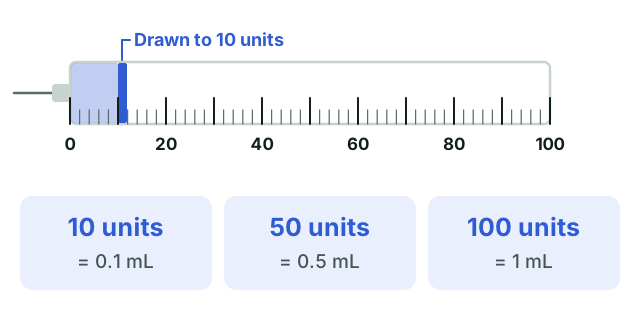
The vial size below is an example for the arithmetic, not a fact about any product, and the water volumes are not recommendations.
| Example: 50 mg vial mixed with | Concentration | Peptide per unit (U-100) |
|---|---|---|
| 2.5 mL | 20 mg/mL | 0.2 mg |
| 5 mL | 10 mg/mL | 0.1 mg |
The table stops at concentration on purpose, because no GHK-Cu dose exists to fill in. The reconstitution calculator below does the same math for any vial and any volume, and the mg/mL to units converter works the other way round.
Reconstitution calculator
U-100 syringeWhere the math goes wrong:
- Confusing mg and mcg. 1 mg is 1,000 mcg. A slip between them is a thousandfold error.
- Treating units as milligrams. A unit is a hundredth of a milliliter and contains whatever the concentration says.
- Reading a cosmetic percentage as an injectable dose. A 1% serum figure says nothing about what is safe under the skin.
- Applying more serum to get more effect. The biphasic response in lab work is a reason not to assume this, and no human study has tested it.
- Trusting the vial label. Research-grade vials carry no FDA-verified identity, purity, potency or sterility, so perfect arithmetic still rests on an unverified number.
Not approved, not legal to inject
GHK-Cu has never been approved as a drug. Non-injectable GHK-Cu is in 503A category 1 on FDA’s May 14, 2026 list, which lets pharmacies compound products such as creams under FDA’s interim policy. Injectable GHK-Cu was placed in category 2 for significant safety risks in September 2023, and after its nomination was withdrawn in April 2026 it sits in no category, with no compounding route. Vials sold for research use only are not legal to use on people: 21 CFR 312.160 allows shipment only for laboratory animal or test-tube work, and FDA warning letters, including one in August 2026, have said such labels do not make a product legal when it is marketed for people. Each change is logged on the FDA status tracker.
Compare
Peptide news, sorted. Plus the printable dose chart.
Sorted, every Tuesday: the week's peptide and GLP-1 news in five minutes: FDA moves, new studies explained, and price changes. Subscribe and the one-page dose and injection-site chart arrives first.
Questions people ask
What is the standard GHK-Cu injection dose?
How much GHK-Cu per day?
What concentration of GHK-Cu is in a serum?
How much bacteriostatic water goes in a 50 mg vial of GHK-Cu?
Can the rat or mouse doses be scaled to a person?
Sources
Primary sources first: FDA labels and documents, peer-reviewed trials, registries.
- 1Najafi N et al. A systematic review of the mechanisms and therapeutic applications of GHK-Cu in topical microneedle delivery. Arch Intern Med Res 2026pubmed.ncbi.nlm.nih.gov
- 2Mateescu DM et al. GHK-Cu as a bioactive metallopeptide and drug-delivery cargo: a systematic evidence-mapping review. Pharmaceutics 2026pmc.ncbi.nlm.nih.gov
- 3Bishop JB et al. A prospective randomized evaluator-blinded trial of two potential wound healing agents for the treatment of venous stasis ulcers. J Vasc Surg 1992pubmed.ncbi.nlm.nih.gov
- 4Canapp SO et al. The effect of topical tripeptide-copper complex on healing of ischemic open wounds. Vet Surg 2003pubmed.ncbi.nlm.nih.gov
- 5Hostynek JJ et al. Human skin penetration of a copper tripeptide in vitro as a function of skin layer. Inflamm Res 2011pubmed.ncbi.nlm.nih.gov
- 6Li H et al. Microneedle-mediated delivery of copper peptide through skin. Pharm Res 2015pubmed.ncbi.nlm.nih.gov
- 7Mortazavi SM et al. Topically applied GHK as an anti-wrinkle peptide: advantages, problems and prospective. BioImpacts 2024pubmed.ncbi.nlm.nih.gov
- 8Pickart L, Margolina A. Regenerative and protective actions of the GHK-Cu peptide in the light of the new gene data. Int J Mol Sci 2018pubmed.ncbi.nlm.nih.gov
- 9FDA. Guidance for industry: estimating the maximum safe starting dose in initial clinical trials for therapeutics in adult healthy volunteers, July 2005fda.gov
- 10FDA. Certain bulk drug substances for use in compounding may present significant safety risks (content current as of April 22, 2026)fda.gov
- 11FDA. Bulk drug substances nominated for use in compounding under section 503A, category list (updated May 14, 2026)fda.gov
- 12HHS. Enforcement Discretion Policy Regarding 503A Compounding Using Certain Peptide Bulk Drug Substances, with Appendices A and B, October 2026hhs.gov
- 13ClinicalTrials.gov. Phase 2 split-wound study of topical GHK-Cu gel, NCT07437586clinicaltrials.gov
- 1421 CFR 701.3, designation of ingredients on cosmetic labelslaw.cornell.edu
- 1521 CFR 312.160, drugs for investigational use in laboratory research animals or in vitro testslaw.cornell.edu
- 16FDA warning letter 735063 to a peptide seller, August 24, 2026fda.gov
More on GHK-Cu
- OverviewGHK-CuGHK-Cu is a copper peptide with small skin studies behind it. Cosmetic serums need no approval; injected GHK-Cu has no human trials or compounding route.
- TopicalDoes topical GHK-Cu work? A few small studies, mostly 8 to 16 weeks, with mixed results. Each study, how to spot copper tripeptide-1, and irritation risks.Read
PeptideSorted Editorial Team
Editorial review
The PeptideSorted editors check every guide against its cited sources before publication: each number against its FDA label, trial or registry, the FDA status against current FDA and HHS documents, and the wording against our describe-never-prescribe rule. Licensed clinicians who join the review panel are listed by name on the editorial team page.
This page was checked against its cited sources by the PeptideSorted editorial team. Licensed clinicians on our review panel are listed on the editorial team page. Every health page cites primary sources and shows its review date. Read the editorial policy and how medical review works, or report an error via corrections. Educational only; not medical advice.