
Short answer
MK-677 (ibutamoren) is an oral small-molecule drug, not a peptide, that raises growth hormone by mimicking ghrelin. It added about 1.1 kg of lean mass in a year-long trial without improving strength, and a hip-fracture trial stopped over heart failure. It is not FDA-approved, no human dose is established for general use, and WADA bans it.
- What it is
- An oral, non-peptide small molecule that activates the ghrelin receptor and raises growth hormone and IGF-1. Also called ibutamoren mesylate and, in current trials, LUM-201.
- FDA status
- Not FDA approved
Not FDA-approved for any use. Ibutamoren mesylate is in 503A category 2 (since September 29, 2023) and 503B category 2 (since December 29, 2022), where FDA cites potential congestive heart failure. FDA says it is excluded from the dietary supplement definition. HHS's October 2026 enforcement policy does not cover it.
- Evidence level
Phase 2 trials
Mid-size human trials; doses are still being studied.
MK-677, also called ibutamoren, is a pill that raises growth hormone, and it is not a peptide. It is a small-molecule drug that copies the hormone ghrelin. It is on this site because it is sold next to peptides, because it works on the same receptor as ipamorelin, and because people searching for peptides keep landing on it. It is not FDA-approved for anything. In trials it raised IGF-1 and added a little lean mass without making anyone stronger, and one trial was stopped early over heart failure. Capsules or liquids sold “for research use only” are not legal for people to take.
| Question | Short answer |
|---|---|
| What is it? | An oral small molecule; not a peptide, not a SARM, not a steroid |
| What does it do? | Activates the ghrelin receptor and raises growth hormone and IGF-1 |
| Is it FDA-approved? | No, for no use |
| Best human evidence for muscle | One year, 65 healthy older adults: fat-free mass +1.1 kg against -0.5 kg on placebo, with no change in strength or function |
| Biggest safety signal | Congestive heart failure, which stopped a hip-fracture trial and is the reason FDA gives for category 2 |
| Other known effects | Higher fasting glucose, lower insulin sensitivity, more appetite, leg swelling |
| Can it be sold as a supplement? | No. FDA says it is excluded from the definition of a dietary supplement |
| Allowed in sport? | No. WADA bans it at all times |
Why a non-peptide is on a peptide site
A peptide is a short chain of amino acids. It is usually digested if swallowed, which is why most peptide drugs are injected. MK-677 is a different kind of chemical that survives the gut, and that is its whole appeal: people get a growth hormone effect without a needle.
Everything else about it looks like the peptide world. WADA lists it beside ipamorelin. FDA handles it in the same compounding categories. It is sold through the same channels, and clinics and forums discuss it in the same breath. The guide to what peptides are covers the chemistry if you want it.
The difference matters for safety in one specific way. MK-677 has been through much larger and longer human trials than most products sold as peptides, so more of its risks are actually known.
How does MK-677 work?
MK-677 switches on the ghrelin receptor, the same switch ipamorelin uses, and the pituitary responds by releasing more growth hormone. In 32 healthy adults aged 64 to 81, 25 mg a day for up to 4 weeks nearly doubled average 24-hour growth hormone, by making the natural pulses larger and without changing their number. IGF-1 (insulin-like growth factor 1, the hormone the liver makes in response) rose from 141 to 265 mcg/L at 4 weeks, into the range of young adults.
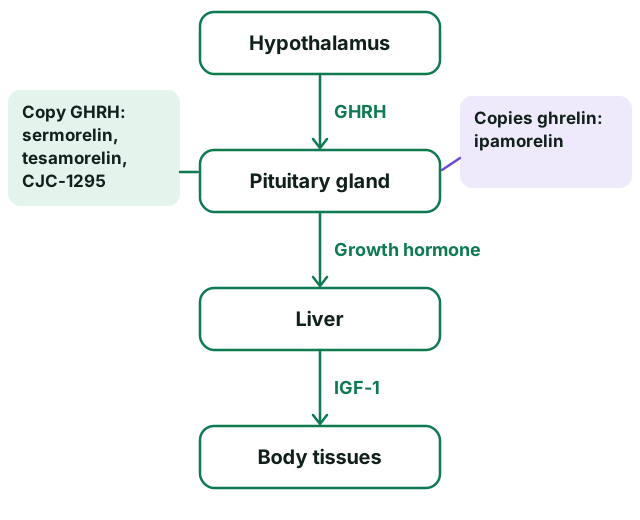
MK-677 follows the ghrelin branch of that diagram. Because ghrelin is also a hunger signal, appetite is one of its most reliable effects.
What the human trials found
Most of these trials gave 25 mg once a day by mouth, under medical supervision. That is what was studied, and it is reported here as history. No dose is established for general use, and nothing below is a guide to taking it.
| Study | Who | Length | What was found |
|---|---|---|---|
| Chapman et al. 1996 | 32 healthy adults aged 64 to 81; placebo or 2, 10 or 25 mg daily | Up to 4 weeks | Growth hormone about doubled and IGF-1 reached young-adult levels at 25 mg. Fasting glucose rose from 5.4 to 6.8 mmol/L |
| Copinschi et al. 1997 | 8 young and 6 older adults | 1 to 2 weeks | More deep sleep and REM sleep than placebo |
| Murphy et al. 1998 | 8 healthy men aged 24 to 39 on a calorie-restricted diet | 7 days on drug | Nitrogen balance +0.31 g a day against -1.48 on placebo, a sign the body was holding on to protein |
| Svensson et al. 1998 | 24 men with obesity | 8 weeks | IGF-1 up about 40%. Fat-free mass rose. Belly and total fat did not change. Glucose tolerance worsened |
| Nass et al. 2008 | 65 healthy adults aged 60 to 81 | 1 year, with a second year | Fat-free mass +1.1 kg against -0.5 kg on placebo. No change in strength or function, visceral fat or total fat. Weight +2.7 kg against +0.8 kg |
| Bach et al. 2004 | 161 hip-fracture patients aged 65 and over | 6 months | IGF-1 rose 84% against 17%. No significant difference in function or independent living |
| Adunsky et al. 2011 | 123 elderly hip-fracture patients | Planned 24 weeks; stopped early | IGF-1 rose. Gait speed improved but most functional measures did not. Stopped for a heart failure signal |
| Sevigny et al. 2008 | 563 people with mild to moderate Alzheimer’s disease | 1 year | IGF-1 up 60% to 73%. No effect on the course of the disease |
| Fatty liver pilot, NCT05364684 | 12 adults on open-label treatment; 7 finished | 6 months | No significant difference in liver fat, liver scan score or ALT against historical placebo data |
The pattern repeats. The hormone numbers move reliably, and the outcome that matters to a patient mostly does not. Alzheimer’s patients had IGF-1 up by about 70% and got no benefit. Hip-fracture patients had higher IGF-1 and little functional gain.
Trials are still running, under a different name. Lumos Pharma calls ibutamoren mesylate LUM-201, and it registered a phase 3 trial in 150 children with growth hormone deficiency, begun in May 2026, with primary completion expected in December 2027. That trial screens carefully and excludes many children. A drug being tested in a monitored pediatric trial is a long way from a product someone orders online.
Does MK-677 build muscle?
It adds lean mass, and the best trial could not show it makes anyone stronger. Over a year, older adults on MK-677 gained 1.1 kg of fat-free mass and those on placebo lost 0.5 kg. Strength and function did not change, though the authors note the trial was not powered to test function.
Three details change how that number should be read.
- Weight rose by more than lean mass. The MK-677 group gained 2.7 kg in total, and limb fat rose more than on placebo. Visceral (deep belly) fat did not fall.
- Young, fit people have no comparable trial. The muscle data are in older adults and in men with obesity. For growth hormone itself, a review of fit adults found 2.1 kg more lean mass with no gain in strength or exercise capacity, and more soft tissue swelling. See peptides for muscle growth for the full picture.
- Lean mass is not all muscle. The measurement counts body water and other non-fat tissue.
How long does MK-677 take to work?
Hormone levels move in days to weeks, and any change in body composition was measured in months. IGF-1 rose by 2 weeks in the 1996 trial and was higher again at 4. Fat-free mass was up at 8 weeks in men with obesity and at 12 months in older adults. Those are measurements, and no trial has shown when, or whether, a person would feel or see a difference. The one sleep study lasted up to two weeks in 14 people and is too small to rest a claim on.
MK-677 side effects and safety signals
Side effects in the year-long trial were mostly mild, but that trial enrolled healthy older adults under close supervision. The serious signal came from frailer patients.
| Effect | What the studies show |
|---|---|
| Congestive heart failure | Adunsky 2011 was stopped early after a safety signal “in a limited number of patients.” The authors concluded MK-0677 “has an unfavorable safety profile in this patient population” |
| Blood sugar | Fasting glucose rose about 5 mg/dL (0.3 mmol/L) over a year, and insulin sensitivity fell. Glucose tolerance worsened within 8 weeks in men with obesity. High blood sugar was reported in 4 of 12 people in the liver pilot |
| Appetite | The most common complaint in the year-long trial, fading within a few months. Reported by 7 of 12 people in the liver pilot |
| Swelling and muscle pain | Transient, mild leg swelling and muscle pain in the year-long trial |
| Joint pain | 3 of 12 in the liver pilot |
| Cortisol | Rose in the year-long trial. Shorter trials did not show a lasting rise |
| Weight | About 1.9 kg more gained than on placebo over a year |
| LDL cholesterol | Fell in the year-long trial |
The heart failure signal is why FDA treats this drug differently from most on its list. FDA’s safety page puts it plainly: “Ibutamoren mesylate poses significant safety risks due to the potential for congestive heart failure in certain patients.” The published abstract does not give case counts, and we have not quoted the figures that circulate online because we could not trace them to the paper.
Growth hormone and IGF-1 are growth factors, so people with a cancer history have added reason to talk to a doctor first. We found no long-term cancer data for MK-677. Trials have excluded people with unstable medical problems, recent cancer or complicated diabetes, so they say little about those groups. Nothing here is a clean bill of health for anyone else: the heart failure case shows that a risk can stay hidden until a vulnerable group takes the drug.
Who has the most reason to avoid it
- Anyone with heart failure, or swelling and breathlessness from heart or kidney disease
- Anyone with diabetes, prediabetes or insulin resistance
- Anyone with a history of cancer
- Frail older adults, the group in which the heart failure signal appeared
- Children and teenagers, outside a supervised trial
- People who are pregnant or trying to conceive, because no safety data exist
- Tested athletes
MK-677 has no label, so this list is built from the trial results above and is not an official contraindication list.
When to get medical help
NHLBI lists these as signs of heart failure: difficulty breathing, a persistent cough, extreme tiredness, trouble sleeping lying flat, and swelling in the ankles, feet, legs or abdomen with weight gain. Call 911 for severe trouble breathing or chest pain. See a clinician soon for unusual thirst, passing urine often or hazy eyesight, which the CDC lists as diabetes symptoms. Tell any clinician what you took, since it will not show up on your medication list.
Is MK-677 FDA-approved or legal?
No, MK-677 is not FDA-approved, and there is no legal route for selling it as a supplement or for pharmacies to compound it under the bulks system.
| Date | What happened |
|---|---|
| December 29, 2022 | FDA placed ibutamoren mesylate in 503B category 2, for outsourcing facilities |
| September 29, 2023 | FDA placed it in 503A category 2, substances that raise significant safety risks |
| December 19, 2025 | After lab tests found undeclared ibutamoren mesylate in iKids-Growth IGF-1 Support products, FDA’s warning letter to Agebox stated that ibutamoren is excluded from the definition of a dietary supplement and that the products “are unapproved new drugs” |
| May 14, 2026 | Still in 503A category 2, one of few September 2023 additions left there |
| October 30, 2026 | HHS published an enforcement policy for six peptides. Ibutamoren is not one of them |
Three points in plain English:
- It cannot be a dietary supplement. A substance first studied as a drug falls outside the supplement definition unless it was sold as a food or supplement before that. FDA says ibutamoren was not. A “growth hormone support” bottle containing it is an unapproved drug, and in the iKids case it was not even on the label.
- Category 2 is still in force. Many peptides dropped off that list in 2026 when nominators withdrew. Ibutamoren stayed.
- The October 2026 policy changes nothing here. As of November 2, 2026, HHS says it does not intend to take enforcement action over compounding of six named peptides, on conditions. MK-677 is not one of them, and it is not a peptide.
Is MK-677 banned in sport?
Yes. WADA names ibutamoren (MK-677) as a growth hormone secretagogue in section S2.2.4 of its Prohibited List, in the 2026 list and in the 2027 list that takes effect January 1, 2027. It is banned at all times. Tested athletes should also know it can appear undeclared in supplements, as the iKids case shows.
How MK-677 compares
| MK-677 | Ipamorelin | Tesamorelin | Growth hormone (somatropin) | |
|---|---|---|---|---|
| What it is | Oral small molecule | Five-amino-acid peptide | 44-amino-acid peptide | 191-amino-acid protein |
| Works through | Ghrelin receptor | Ghrelin receptor | GHRH receptor | Growth hormone receptor |
| How it is given | By mouth | By vein in published studies | Injection under the skin | Injection |
| FDA status | Not approved | Not approved | Approved for excess belly fat in HIV lipodystrophy | Approved for labeled uses |
| Largest controlled data | 563 people for 1 year | 117 people for up to 7 days | Two phase 3 trials | Review of 27 trial groups in fit adults |
| Shown to improve strength? | No | Never tested | Not its use | Not in fit adults |
Tesamorelin and somatropin are the only ones here that a prescriber can use for a labeled purpose. If a clinician suspects growth hormone deficiency, the route is testing and, if confirmed, approved treatment. The FDA status tracker shows how each of these stands.
Questions to ask a prescriber
MK-677 has no approved product, so there is no labeled price, insurance route or patient program. The only regulated way anyone receives it is inside a clinical trial. If you have been offered it or are already taking it:
- What am I trying to change, and is there an approved treatment for it?
- Should my fasting glucose, HbA1c and IGF-1 be checked?
- Do I have any heart, kidney or blood pressure problem that makes fluid retention risky?
- Does my cancer history or family history matter here?
- Could a product I already take contain something undeclared?
- If I want more muscle, what would resistance training and enough protein do for me?
Compare
Peptide news, sorted. Plus the printable dose chart.
Sorted, every Tuesday: the week's peptide and GLP-1 news in five minutes: FDA moves, new studies explained, and price changes. Subscribe and the one-page dose and injection-site chart arrives first.
Questions people ask
Is MK-677 a peptide?
Is MK-677 a SARM or a steroid?
Does MK-677 build muscle?
What are the side effects of MK-677?
Is MK-677 legal?
Is MK-677 FDA-approved?
Sources
Primary sources first: FDA labels and documents, peer-reviewed trials, registries.
- 1Nass R et al. Effects of an oral ghrelin mimetic (MK-677) on body composition and clinical outcomes in healthy older adults. Ann Intern Med 2008pubmed.ncbi.nlm.nih.gov
- 2Adunsky A et al. MK-0677 (ibutamoren mesylate) for the treatment of patients recovering from hip fracture: a multicenter, randomized, placebo-controlled phase IIb study. Arch Gerontol Geriatr 2011pubmed.ncbi.nlm.nih.gov
- 3ClinicalTrials.gov NCT00128115. Treatment of sarcopenia in post-hip fracture patients (Merck), terminatedclinicaltrials.gov
- 4Bach MA et al. The effects of MK-0677, an oral growth hormone secretagogue, in patients with hip fracture. J Am Geriatr Soc 2004pubmed.ncbi.nlm.nih.gov
- 5Sevigny JJ et al. Growth hormone secretagogue MK-677: no clinical effect on AD progression in a randomized trial. Neurology 2008pubmed.ncbi.nlm.nih.gov
- 6Chapman IM et al. Stimulation of the GH-IGF-I axis by daily oral administration of a GH secretogogue (MK-677) in healthy elderly subjects. J Clin Endocrinol Metab 1996pubmed.ncbi.nlm.nih.gov
- 7Murphy MG et al. MK-677, an orally active growth hormone secretagogue, reverses diet-induced catabolism. J Clin Endocrinol Metab 1998pubmed.ncbi.nlm.nih.gov
- 8Svensson J et al. Two-month treatment of obese subjects with the oral growth hormone secretagogue MK-677 increases GH secretion, fat-free mass, and energy expenditure. J Clin Endocrinol Metab 1998pubmed.ncbi.nlm.nih.gov
- 9Copinschi G et al. Prolonged oral treatment with MK-677, a novel growth hormone secretagogue, improves sleep quality in man. Neuroendocrinology 1997pubmed.ncbi.nlm.nih.gov
- 10ClinicalTrials.gov NCT05364684. The impact of ibutamoren on nonalcoholic fatty liver disease: a pilot study (Massachusetts General Hospital), posted resultsclinicaltrials.gov
- 11ClinicalTrials.gov NCT06948214. Phase 3 study of LUM-201 in children with growth hormone deficiency (Lumos Pharma)clinicaltrials.gov
- 12FDA. Certain bulk drug substances for use in compounding may present significant safety risks (content current as of April 22, 2026)fda.gov
- 13FDA. Bulk drug substances nominated for use in compounding under section 503A, category list (updated May 14, 2026)fda.gov
- 14FDA warning letter to Agebox Inc., December 19, 2025fda.gov
- 15HHS. Enforcement Discretion Policy Regarding 503A Compounding Using Certain Peptide Bulk Drug Substances, with Appendices A and B, October 2026hhs.gov
- 16Federal Register. Notice of availability, FR Doc. 2026-22192, Docket HHS-OASH-2026-0496, RIN 0910-ZD94, published October 30, 2026public-inspection.federalregister.gov
- 17WADA. 2027 Prohibited List, in effect January 1, 2027wada-ama.org
- 18WADA 2026 Prohibited List, official text as reprinted in the Dutch Treaty Series (Trb. 2026, 25)zoek.officielebekendmakingen.nl
- 19Liu H et al. Systematic review: the effects of growth hormone on athletic performance. Ann Intern Med 2008pubmed.ncbi.nlm.nih.gov
- 20NHLBI. Heart failure: symptomsnhlbi.nih.gov
- 21CDC. Diabetes symptomscdc.gov
- 2221 CFR 312.160, drugs for investigational use in laboratory research animals or in vitro testslaw.cornell.edu
PeptideSorted Editorial Team
Editorial review
The PeptideSorted editors check every guide against its cited sources before publication: each number against its FDA label, trial or registry, the FDA status against current FDA and HHS documents, and the wording against our describe-never-prescribe rule. Licensed clinicians who join the review panel are listed by name on the editorial team page.
This page was checked against its cited sources by the PeptideSorted editorial team. Licensed clinicians on our review panel are listed on the editorial team page. Every health page cites primary sources and shows its review date. Read the editorial policy and how medical review works, or report an error via corrections. Educational only; not medical advice.