Short answer
BPC-157 is an unapproved synthetic peptide with no proven benefit in people. It speeds healing in rats, but human data come from five small studies, none testing skin injections or capsules. As of November 2, 2026, HHS says it does not intend to act against pharmacies compounding it under ten conditions. That is not FDA approval.
- What it is
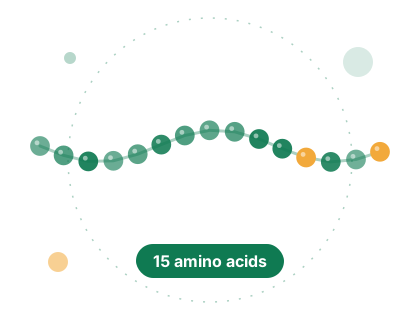
- A synthetic 15-amino-acid fragment of a protein found in human gastric juice, studied for tissue healing in animals.
- FDA status
- Not FDA approved
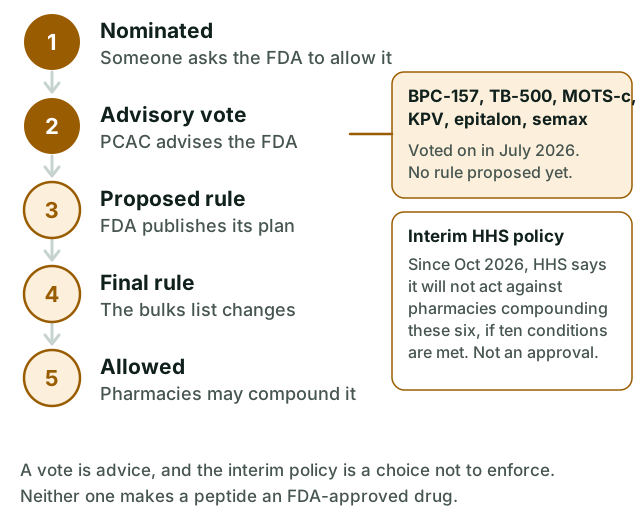
Not FDA-approved. An advisory committee voted 8 to 6 for it in July 2026, against FDA staff advice. As of November 2, 2026 no rule has been proposed, but an interim HHS policy says HHS does not intend to take enforcement action against compounding of BPC-157 acetate that meets ten conditions.
- Evidence level
Early human studies
Small or uncontrolled human studies only.
BPC-157 has no proven benefit in people, and it is not FDA-approved for anything. The enthusiasm comes from three decades of rat studies, mostly from one laboratory in Zagreb, showing faster healing of tendon, muscle, ligament and gut. The human record is five small studies, and none of them tested the ways most people use it, which are an injection under the skin or a capsule. If you are weighing it up, read BPC-157 side effects next, then BPC-157 dosage, which explains why no human dose exists.
| Your question | The short answer, as of November 2, 2026 |
|---|---|
| Is it FDA-approved? | No, for no use. FDA found no approved product in any country |
| Can a pharmacy compound it? | Tolerated under an interim HHS policy, with ten conditions. BPC-157 acetate only, for injection under the skin or into muscle, oral or topical use. It is not on the 503A bulks list and no rule has been proposed |
| Is any benefit proven in people? | No |
| How much human data exists? | Five small studies with fewer than 120 people in all, counting placebo groups, plus one registered oral study with no results |
| Is there an established human dose? | No |
| Is long-term use safe? | Unknown. FDA found no cancer studies and no animal studies of the routes people use |
| Is it allowed in sport? | No. WADA bans it at all times |
What is BPC-157?
BPC-157 is a chain of 15 amino acids (Gly-Glu-Pro-Pro-Pro-Gly-Lys-Pro-Ala-Asp-Asp-Ala-Gly-Leu-Val), which makes it a pentadecapeptide. It is a partial sequence of a larger protein called Body Protection Compound, isolated from human gastric juice, and you may also see it called Bepecin or PL-14736. What circulates today is made synthetically. It resists breakdown in stomach acid, which is unusual for a peptide and is why the original researchers tried it both by injection and by mouth.
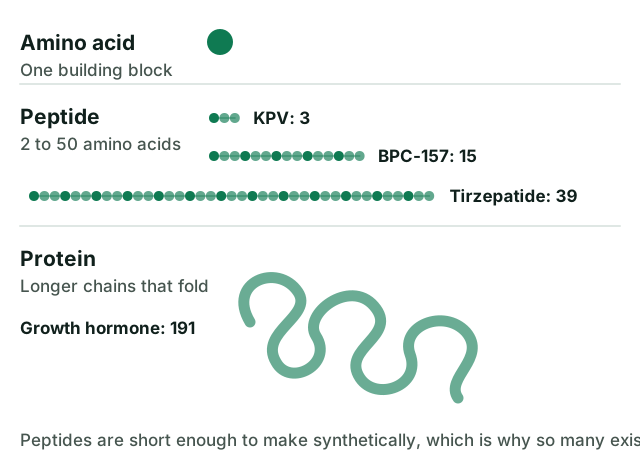
Two forms exist, the free base and the acetate salt, and FDA treats them as different bulk substances. The distinction matters now, because the HHS policy names only the acetate.
How is BPC-157 supposed to work?
Nobody has pinned it down. Researchers have proposed that it raises growth factors and their receptors, dampens inflammatory signals, encourages new blood vessels (angiogenesis) and stimulates nitric oxide. FDA’s July 2026 review said the molecular targets “have not been identified” and that the mechanisms “remain poorly understood,” which made it hard to judge whether the rat results are biologically plausible.
What are the benefits of BPC-157?
No benefit of BPC-157 has been established in people. Every benefit you will read about traces back to animal work or to a small human study with no comparison group.
| Claimed benefit | What the animal work shows | What exists in people |
|---|---|---|
| Tendon and ligament healing | Faster recovery in rats after tendon cuts | No controlled study |
| Muscle healing | Faster recovery in crushed rat muscle, even on steroids | No controlled study |
| Knee pain | Not the relevant model | A phone follow-up of 16 clinic patients; 14 reported relief. No control group |
| Gut healing and colitis | Faster healing in rat ulcer and fistula models | One 53-patient enema trial, reported only as an abstract, too thin to show benefit |
| Bladder pain | Not the relevant model | 12 women in a single-arm clinic study |
| Brain and nerve repair | Reported in rat models by the Zagreb group | None |
These are the animal studies people cite most, with what was done in each.
| Study | Model | What was given | What was found |
|---|---|---|---|
| Staresinic et al. 2003, J Orthop Res | Rats, Achilles tendon cut through | 10 mcg/kg, 10 ng/kg or 10 pg/kg injected into the abdomen once daily for up to 14 days | Treated rats regained tendon strength, function and structure faster than saline controls |
| Pevec et al. 2010, Med Sci Monit | Rats, crushed calf muscle, some also given a corticosteroid | Injection into the abdomen or a cream applied locally, once daily | Faster muscle healing and full function; reversed the healing delay caused by the steroid |
| Chang et al. 2011, J Appl Physiol | Rat tendon cells in a dish | BPC-157 added to the culture | More cell outgrowth, better survival under oxidative stress, more migration |
| Seiwerth et al. 2018, Curr Pharm Des (review) | The group’s gut, tendon, ligament, muscle and bone models | Same regimens as the gut studies | Authors report consistent benefit by injection, by mouth and locally |
| Sikiric et al. 2016, Curr Neuropharmacol (review) | Brain-gut and nerve models | Various | Authors report nerve-protective and behavioral effects in rats |
Taken together, they show a repeatable effect in rats and rat cells, which is a fair reason for scientific interest. They do not show the same thing happens in a person. Most of the positive studies come from a single group, FDA noted that dose-response relationships have not been established, and a 2025 review noted that every published human study reports a positive result, which raises the possibility of publication bias.
What do the human studies show?
FDA’s review found five clinical studies. Read the middle column closely, because none of these is how BPC-157 is usually used.
| Study | Who | How it was given | What was reported |
|---|---|---|---|
| Veljaca 2002 and 2003, meeting abstracts | 32 healthy people; 24 received BPC-157 | Enema, placebo-controlled | Headache and flatulence were most common, with no obvious difference from placebo. Most blood levels were too low to measure |
| Ruenzi 2005, meeting abstract | 53 people with mild to moderate ulcerative colitis | Enema daily for 2 weeks, placebo-controlled | Disease score fell 3.2 points on BPC-157 and 1.6 on placebo. The confidence interval for the gap included zero |
| Lee and Padgett 2021 | 17 charts reviewed, 16 patients reached by phone | Injected into the knee, alone or with thymosin beta-4 | 14 of 16 reported relief. No control group, imaging or validated scores |
| Lee 2024 | 12 women with interstitial cystitis | Injected into the bladder wall, once | No adverse events reported; no control group |
| Lee and Burgess 2025 | 2 adults | Intravenous infusion on two days | No side effects reported in this two-person pilot |
FDA called the colitis abstract “inadequate to support the efficacy and safety” of BPC-157. A 2026 systematic review in Acta Orthopaedica Belgica looked at the three clinic studies, judged all of them poor quality, rated the certainty of evidence very low, and concluded that BPC-157 “should not be used clinically in humans outside ethically approved, regulated, high-quality clinical trials.” A 2025 narrative review reached a similar view, and a 2026 American Journal of Sports Medicine review said the knee study had “significant methodological flaws.”
Two more entries belong here. A phase 1 oral study registered in 2015 (NCT02637284) planned to give tablets to 42 healthy volunteers in Mexico, but no results have been posted and FDA could not find a publication. A University of Arkansas pilot in people recovering from rotator cuff surgery (NCT07803250) is listed as not yet recruiting, with a planned start in January 2027.
How long does BPC-157 take to work?
Nobody can say, because no controlled study has measured it in people. A preprint reported by AJMC in October 2026 searched more than 15 million medical records and found 1,039 people with documented use. Of the 354 whose response was recorded, 79% reported improvement. That sounds encouraging until you see what is missing: there was no placebo or untreated comparison, no standard dose or formulation, and about half of users were taking something else as well. The same analysis recorded people stopping because of clinician advice or adverse events. It has not been peer reviewed.
Is BPC-157 safe?
Its safety in people is unknown. The small studies reported no serious adverse events, but they were short, and FDA said the authors gave limited safety information. FDA concluded there is “insufficient clinical safety information to characterize the safety profile.” Animal toxicology turned up possible clotting and liver signals, and no one has run a cancer study. FDA’s largest stated worry for injected BPC-157 is immunogenicity, meaning an immune reaction against the peptide. The BPC-157 side effects guide sets out each report and the red flags.
FDA status and the October 2026 HHS policy
BPC-157 has never had a New Drug Application. The only process it has been through concerns the bulk substances that pharmacies may use under section 503A of the Food, Drug, and Cosmetic Act.
| Date | What happened |
|---|---|
| September 29, 2023 | FDA placed BPC-157 in 503A category 2, for bulk substances that raise significant safety risks, citing possible immunogenicity and limited safety information |
| April 22, 2026 | BPC-157 left category 2 after its nominators withdrew. HHS says neither the placement nor the removal changed its status under 503A |
| July 23, 2026 | FDA’s Pharmacy Compounding Advisory Committee reviewed it for ulcerative colitis. FDA staff proposed against listing. The committee voted 8 to 6, with one abstention, in favor |
| October 28 to 30, 2026 | HHS announced an interim enforcement discretion policy covering BPC-157 and five other peptides, published in the Federal Register on October 30 |
| November 13, 2026 | Written comments on the policy close |
What the policy does
As of November 2, 2026, HHS says it does not intend to take enforcement action against a state-licensed pharmacy, federal facility or licensed physician compounding BPC-157 when all ten conditions are met, until a final rule decides whether it goes on the 503A bulks list. It came from the Secretary’s office, and HHS says one aim is to discourage use of research-use-only peptides from foreign manufacturers. The main conditions for BPC-157 are:
- The acetate form with the sequence HHS specifies, for injection under the skin or into muscle, oral or topical use.
- A bulk substance from an FDA-registered, CGMP-compliant manufacturer, with a valid certificate of analysis.
- One active ingredient per product, so blends are out.
- A valid patient-specific prescription.
- Reporting of serious adverse events and quality problems to FDA MedWatch and the states involved.
- For oral products, documentation that the formulation reaches adequate bioavailability in humans.
What the policy does not do
- It does not make BPC-157 FDA-approved, and FDA has not reviewed any compounded product for safety, effectiveness or quality.
- It does not put BPC-157 on the 503A bulks list. No rule has been proposed.
- It creates no rights. The notice says it is “not binding on HHS or the public,” calls itself a draft in places, and says HHS may revisit it if a safety signal or quality problem appears.
- It covers 503A compounding only, so outsourcing facilities (503B) are outside it.
- It does not bind states, which can be stricter.
- It changes none of the evidence. HHS’s own statement stresses that it does not establish safety or effectiveness.
FDA staff and HHS read the same record differently. FDA’s reviewers concluded that BPC-157 is not well characterized and proposed against listing it. HHS’s appendix cites newly submitted certificates of analysis, documented use and the policy’s safeguards. Public Citizen urged HHS to rescind the policy, and a viewpoint in JAMA from researchers at the Center for Science in the Public Interest argued that listing would undermine the drug approval process.
What research use only means
The phrase comes from 21 CFR 312.160, which lets a company ship an unapproved drug only for tests in laboratory animals or in test tubes, with a label reading “Not for use in humans.” A vial sold to an individual through a consumer website does not fit that rule, and FDA warning letters in 2024 and 2026 found the sellers’ own marketing showed the products were meant for people. Research-use-only BPC-157 is not legal to use on people, and the HHS policy gives it no cover. The policy’s certificate requirements exist because of what such products can contain.
How does BPC-157 compare with approved treatment?
There is no head-to-head study of BPC-157 against anything. For ulcerative colitis, the use FDA reviewed, the agency lists many approved options, from mesalamine to biologic drugs, and says the available data do not support BPC-157 in that disease. For a sports injury, NIAMS describes rest, ice, compression and elevation for many injuries, physical therapy for more severe ones, and surgery in some cases, with exercise-based rehabilitation before returning to activity. A peptide with no human efficacy data is not a like-for-like alternative to any of these. Its usual partner is TB-500, and the BPC-157 and TB-500 guide covers the pair.
Oral versus injectable claims
Sellers market capsules and injectable vials side by side and imply similar results. The rat work did use oral dosing, usually in drinking water, in gut-injury models. FDA found no human study of either route and no human absorption data after oral dosing. HHS’s own testing appendix refers to the “low oral bioavailability” of peptides, and the policy expects anyone compounding an oral form to hold evidence that it is absorbed. The BPC-157 capsules guide goes through what that means for supplement-style products.
Cost and access
This site does not list sellers, clinics or prices for BPC-157, and we are not suggesting anyone seek it out. Being tolerated under an enforcement policy is a long way from being shown to help.
Is BPC-157 banned in sport?
Yes. WADA added BPC-157 by name to class S0, non-approved substances, in the 2022 Prohibited List. S0 substances are prohibited at all times, in and out of competition, and the current List still names it. A compounding policy in the United States has no bearing on anti-doping rules.
Questions to ask a prescriber
If a clinician brings up BPC-157, these questions show quickly how carefully it is being handled:
- What is this meant to treat, and what evidence do you have for that in people?
- Which approved or better-studied options have we not tried?
- Is this a single-peptide product compounded for me by a state-licensed pharmacy, and does our state permit it?
- Can the pharmacy show the certificate of analysis and name the original manufacturer?
- How will you decide whether it is helping, and when will we stop?
- Who do I call if I react to it, and how is that reported to FDA?
Who has the most reason for caution
There is no FDA label, so there is no official list of contraindications. Nobody has been shown to benefit, and the groups below are where the missing data matter most. This is our reading of FDA’s review and of who the registered trials excluded.
- Pregnancy or breastfeeding. Both registered studies exclude these groups. A single rat study looked at fetal development, and no study covered a full reproductive cycle.
- A history of cancer. No carcinogenicity study exists, and BPC-157 is proposed to encourage new blood vessels.
- Bleeding disorders or blood thinners. Clotting times shifted in animals, shorter in rats and longer in dogs.
- Liver disease. Liver-related changes appeared in female rats.
- Autoimmune disease. The Arkansas pilot excludes it, and immune reactions are FDA’s main concern with injected peptides.
- Tested athletes. A positive test carries a ban.
Compare
- PeptidesNot FDA approvedDosageThere is no established BPC-157 dose for people.
- PeptidesNot FDA approvedTB-500TB-500 is a seven-amino-acid fragment of thymosin beta-4, and FDA found no human use data on it.
- LearnFDA status trackerWhich peptides are FDA-approved, which HHS tolerates under conditions, and which are not legal to use.
Recent news on this
Peptide news, sorted. Plus the printable dose chart.
Sorted, every Tuesday: the week's peptide and GLP-1 news in five minutes: FDA moves, new studies explained, and price changes. Subscribe and the one-page dose and injection-site chart arrives first.
Questions people ask
Is BPC-157 FDA-approved?
Is BPC-157 legal now?
What are the proven benefits of BPC-157?
Are there any human trials of BPC-157?
Is BPC-157 banned in sport?
Does oral BPC-157 work?
Sources
Primary sources first: FDA labels and documents, peer-reviewed trials, registries.
- 1FDA. Briefing document for BPC-157-related bulk drug substances, Pharmacy Compounding Advisory Committee, July 23-24, 2026fda.gov
- 2HHS. Enforcement Discretion Policy Regarding 503A Compounding Using Certain Peptide Bulk Drug Substances, with Appendices A and B, October 2026hhs.gov
- 3Federal Register. Notice of availability, FR Doc. 2026-22192, Docket HHS-OASH-2026-0496, RIN 0910-ZD94, published October 30, 2026public-inspection.federalregister.gov
- 4Fox Rothschild. HHS moves to pull peptides out of the research-use-only market and into pharmacies, October 2026foxrothschild.com
- 5RAPS. HHS will permit compounding of six peptides ahead of formal rulemaking, October 29, 2026raps.org
- 6AJMC. 5 things to know about HHS's interim peptide compounding policy, October 29, 2026ajmc.com
- 7AJMC. BPC-157 'Wolverine peptide' use rose 33-fold despite scant evidence, October 29, 2026ajmc.com
- 8Poolton JT et al. Human evidence for BPC-157 in orthopaedic and regenerative medicine: a systematic review of efficacy and safety. Acta Orthop Belg 2026pubmed.ncbi.nlm.nih.gov
- 9McGuire FP et al. Regeneration or risk? A narrative review of BPC-157 for musculoskeletal healing. Curr Rev Musculoskelet Med 2025pmc.ncbi.nlm.nih.gov
- 10Vasireddi N et al. Emerging use of BPC-157 in orthopaedic sports medicine: a systematic review. HSS J 2025pubmed.ncbi.nlm.nih.gov
- 11Mayfield CK et al. Injectable peptide therapy: a primer for orthopaedic and sports medicine physicians. Am J Sports Med 2026pubmed.ncbi.nlm.nih.gov
- 12Lee E, Padgett B. Intra-articular injection of BPC 157 for multiple types of knee pain. Altern Ther Health Med 2021pubmed.ncbi.nlm.nih.gov
- 13Lee E, Burgess K. Safety of intravenous infusion of BPC157 in humans: a pilot study. Altern Ther Health Med 2025pubmed.ncbi.nlm.nih.gov
- 14Staresinic M et al. Gastric pentadecapeptide BPC 157 accelerates healing of transected rat Achilles tendon. J Orthop Res 2003pubmed.ncbi.nlm.nih.gov
- 15Chang CH et al. The promoting effect of pentadecapeptide BPC 157 on tendon healing involves tendon outgrowth, cell survival, and cell migration. J Appl Physiol 2011pubmed.ncbi.nlm.nih.gov
- 16Pevec D et al. Impact of pentadecapeptide BPC 157 on muscle healing impaired by systemic corticosteroid application. Med Sci Monit 2010pubmed.ncbi.nlm.nih.gov
- 17Seiwerth S et al. BPC 157 and standard angiogenic growth factors. Gastrointestinal tract healing, lessons from tendon, ligament, muscle and bone healing. Curr Pharm Des 2018pubmed.ncbi.nlm.nih.gov
- 18Sikiric P et al. Brain-gut axis and pentadecapeptide BPC 157: theoretical and practical implications. Curr Neuropharmacol 2016pubmed.ncbi.nlm.nih.gov
- 19ClinicalTrials.gov. Phase 1 oral safety and pharmacokinetics study of PCO-02 (BPC-157) in healthy volunteers (NCT02637284)clinicaltrials.gov
- 20ClinicalTrials.gov. Impact of BPC-157 on recovery from rotator cuff repair surgery (NCT07803250)clinicaltrials.gov
- 21FDA. Bulk drug substances nominated for use in compounding under section 503A, category list (updated May 14, 2026)fda.gov
- 22FDA. Certain bulk drug substances for use in compounding may present significant safety risksfda.gov
- 23FDA. 503A categories update, September 29, 2023 (copy hosted by the Alliance for Pharmacy Compounding)join.a4pc.org
- 24FDA. July 23-24, 2026 meeting of the Pharmacy Compounding Advisory Committeefda.gov
- 25RAPS. FDA advisory committee backs two controversial peptides, July 23, 2026raps.org
- 26NIAMS. Tendinitis and sports injuriesniams.nih.gov
- 27WADA. 2022 Prohibited List now in force (BPC-157 added to S0), January 1, 2022wada-ama.org
- 28WADA. The Prohibited List (current)wada-ama.org
- 2921 CFR 312.160, drugs for investigational use in laboratory research animals or in vitro testslaw.cornell.edu
- 30FDA warning letter to Gram Peptides, March 31, 2026fda.gov
- 31FDA warning letter to Summit Research Peptides, December 10, 2024fda.gov
Go deeper on BPC-157
- BPC-157 and TB-500No controlled human study has tested BPC-157 and TB-500 together. One rat study found no added benefit, and a blended vial falls outside the HHS policy.Read
- CapsulesNo human study shows BPC-157 capsules are absorbed or work. See the rat data, the stomach-acid claim, the supplement question and what HHS now requires.Read
- DosageThere is no established BPC-157 dose for people. See what rat and human studies used, why rat doses do not convert, and how syringe units really work.Read
- Side effectsNobody has measured BPC-157 side effect rates. See what small studies and FDA reports show, the animal warning signs, injection risks and when to get help.Read
PeptideSorted Editorial Team
Editorial review
The PeptideSorted editors check every guide against its cited sources before publication: each number against its FDA label, trial or registry, the FDA status against current FDA and HHS documents, and the wording against our describe-never-prescribe rule. Licensed clinicians who join the review panel are listed by name on the editorial team page.
This page was checked against its cited sources by the PeptideSorted editorial team. Licensed clinicians on our review panel are listed on the editorial team page. Every health page cites primary sources and shows its review date. Read the editorial policy and how medical review works, or report an error via corrections. Educational only; not medical advice.