Short answer
PT-141 is bremelanotide, an FDA-approved injection sold as Vyleesi for premenopausal women with acquired, generalized low sexual desire that causes distress. In two 24-week trials it modestly raised desire and lowered distress versus placebo, and 40% of women had nausea. It is not approved for men or after menopause.
- What it is
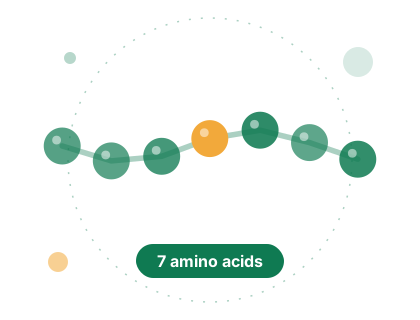
- A synthetic ring-shaped seven-amino-acid peptide that activates melanocortin receptors, sold as Vyleesi.
- FDA status
- FDA approved
Vyleesi (bremelanotide injection) was approved June 21, 2019 for premenopausal women with acquired, generalized hypoactive sexual desire disorder. It is not approved for men, for postmenopausal women, or to enhance sexual performance.
- Evidence level
FDA label
Dosing comes from the FDA-approved prescribing information.
PT-141 is bremelanotide, and it is one of the few names in our peptide index that FDA has actually approved. Since June 21, 2019 it has been sold as Vyleesi, a 1.75 mg autoinjector for one narrow group: premenopausal women with acquired, generalized hypoactive sexual desire disorder (HSDD), meaning low desire that causes distress and is not explained by another condition, a relationship problem or a medicine. It is not approved for men, for women after menopause, or to enhance sexual performance.
| Quick answer | PT-141 (bremelanotide, Vyleesi) |
|---|---|
| FDA status | Approved June 21, 2019, for one use |
| Who it is approved for | Premenopausal women with acquired, generalized HSDD |
| Label dose | 1.75 mg under the skin, as needed, at least 45 minutes before sex |
| How often | One dose in 24 hours at most; more than 8 a month not recommended |
| Average effect | A modest rise in desire and drop in distress; no change in satisfying sexual events |
| Most common side effects | Nausea 40%, flushing 20%, injection site reactions 13%, headache 11% |
| Do not use with | Uncontrolled high blood pressure or known cardiovascular disease |
| Not approved for | Men, women after menopause, sexual performance |
The PT-141 dosage guide covers the label dose, timing and syringe arithmetic in detail.
What is PT-141?
PT-141 is a synthetic cyclic heptapeptide, a ring-shaped chain of seven amino acids. It was developed as an analogue of melanotan II, an earlier experimental melanocortin peptide, and “PT-141” was its code name during development. Each Vyleesi autoinjector holds 1.75 mg of bremelanotide in 0.3 mL of solution. The label says to use the abdomen or thigh, and storage is at or below 77°F, away from light, with no freezing.
How does PT-141 work?
Bremelanotide activates melanocortin receptors, a family of receptors that respond to the hormone alpha-MSH. According to the label it acts on several subtypes, with MC1R and MC4R most relevant at the approved dose. MC4R receptors sit on nerve cells throughout the brain. Even so, the label states plainly that “the mechanism by which VYLEESI improves HSDD in women is unknown.” MC1R sits on the skin’s pigment cells, which is why darkening of the skin is a known side effect.
Who is PT-141 for?
The label’s group is tighter than most people expect. All of these have to be true:
- She has not gone through menopause.
- Her low desire is acquired: she had no problem with desire before.
- It is generalized: it happens regardless of the type of stimulation, situation or partner.
- It causes marked distress or trouble between partners.
- It is not explained by a medical or mental health condition, a relationship problem, or a medicine or other drug.
Someone whose desire dropped after starting an antidepressant, for example, does not fit that last line, and the conversation with a prescriber starts somewhere else. In the trials the women were 19 to 56 years old, with a mean age of 39. The broader picture for women, including what is unstudied, is on the peptides for women page.
Does PT-141 work? The RECONNECT trials
Yes, on average, by a small margin. FDA approved Vyleesi on two identical phase 3 trials, known as RECONNECT (studies 301 and 302), run from 2015 to 2016.
| What the trials did | |
|---|---|
| Who | 1,267 premenopausal women randomized (1,247 in the safety population); mean age 39; acquired, generalized HSDD for at least 6 months |
| What | Bremelanotide 1.75 mg or placebo, self-injected under the skin about 45 minutes before expected sexual activity, as needed |
| Limits in the trial | No more than one dose in 24 hours and no more than 12 per month |
| How often used | Most used it two to three times a month; median of 10 injections in 24 weeks |
| Length | 24 weeks double-blind, then an optional 52-week open-label extension |
| Main measures | Desire score from the Female Sexual Function Index (range 1.2 to 6) and distress from low desire (range 0 to 4) |
What it found
| Result | Bremelanotide | Placebo |
|---|---|---|
| Desire score, mean change (study 1 / study 2) | +0.5 / +0.6 | +0.2 / +0.2 |
| Distress score, mean change (study 1 / study 2) | -0.7 / -0.7 | -0.4 / -0.4 |
| Meaningful rise in desire (1.2 points or more) | About 25% | About 17% |
| Meaningful drop in distress (1 point or more) | About 35% | About 31% |
| Change in satisfying sexual events | No difference | No difference |
| Stopped the trial because of side effects | 18% | 2% |
Both trials met their goals with statistical significance. Integrated across the two, the difference from placebo was 0.35 points on desire and 0.33 points on distress. The effect was real but small, and FDA’s own summary notes there was no change in the number of satisfying sexual events. More women on bremelanotide left the double-blind phase early (40% versus 13% in study 1, 39% versus 25% in study 2). A 2022 subgroup analysis found the benefit held across age, weight and testosterone-level subgroups, with few exceptions.
Put the numbers side by side and the honest read is this: roughly one woman in four had a meaningful rise in desire on the drug, and about one in six did on placebo.
How long does PT-141 take to work, and how long does it last?
The label dose is taken at least 45 minutes before sex, and blood levels peak about an hour after injection. How long the effect lasts is not known. The label says “the duration of efficacy after each dose is unknown” and leaves the timing partly to each patient’s experience. The clock that matters most is 8 weeks: the label says to stop if there is no improvement by then.
PT-141 side effects
Nausea is the one to expect. From the Vyleesi label, pooled phase 3 data (627 women on bremelanotide, 620 on placebo):
| Side effect | Bremelanotide | Placebo |
|---|---|---|
| Nausea | 40% | 1.3% |
| Flushing | 20% | 0.3% |
| Injection site reactions | 13% | 8% |
| Headache | 11% | 2% |
| Vomiting | 5% | 0.2% |
| Cough | 3.3% | 1.3% |
| Fatigue | 3.2% | 0.5% |
| Hot flush | 2.7% | 0.2% |
| Tingling or numbness | 2.6% | 0% |
| Dizziness | 2.2% | 0.5% |
| Nasal congestion | 2.1% | 0.5% |
Most were mild (31%) or moderate (40%) and short-lived. Serious adverse reactions were reported in 1.1% on bremelanotide and 0.5% on placebo.
Nausea was highest after the first dose (21% of patients) and fell to about 3% with later doses. It usually started within an hour and lasted about two hours. 13% took anti-nausea medicine and 8% left the trials because of it.
What helps nausea. Less than you might hope. Taking ondansetron (an anti-nausea drug) 30 minutes beforehand did not help in a 228-woman study, and the label does not recommend it. Using ondansetron after the nausea starts has not been formally studied. The label’s position is that nausea improves for most people with the second dose, and that a prescriber can consider anti-nausea treatment for those who want to continue, or stopping Vyleesi if it is persistent or severe.
Blood pressure. Each dose raised blood pressure by up to 6 mmHg systolic and 3 mmHg diastolic, peaking 2 to 4 hours after the injection, with heart rate falling by up to 5 beats per minute. Values usually returned to baseline within 12 hours. Vyleesi is contraindicated in uncontrolled high blood pressure or known cardiovascular disease.
Hyperpigmentation. Focal darkening of the face, gums or breasts occurred in 1% of women using up to 8 doses a month. In a separate study of daily dosing, 38% developed it after 8 days. FDA’s 2019 announcement said it did not go away in about half of affected patients after stopping. Women with darker skin were more likely to be affected.
Other label warnings. Bremelanotide may slow stomach emptying and so delay oral medicines. The label says to avoid it with oral drugs that depend on reaching a threshold level to work, such as antibiotics, and to consider stopping it if a pain reliever you need to work quickly is delayed. It can sharply lower blood levels of oral naltrexone. One case of acute hepatitis occurred in the open-label extension; the label says the drug’s role could not be ruled out. Women who could become pregnant are advised to use contraception, based on animal findings.
When to call the prescriber
- Nausea that is severe or does not go away.
- New dark patches on the face, gums or breasts.
- A possible pregnancy. The label says to stop Vyleesi if pregnancy is suspected.
- An oral medicine that seems delayed or weaker than usual.
- No improvement in desire after 8 weeks.
How much does PT-141 cost?
Vyleesi is sold in cartons of four autoinjectors. Drugs.com listed cash prices of about $930 to $956 for four as of November 2, 2026. What people actually pay can be far lower, and insurance coverage varies.
| Route | What the source says |
|---|---|
| Pharmacy cash price, 4 autoinjectors | About $930 to $956 (Drugs.com) |
| Commercial insurance with the manufacturer’s copay help | As little as $0 for eligible patients, 18 or older, up to 2 fills every 30 days (Cosette) |
| No insurance coverage for Vyleesi | A 4-dose box for $99 through the manufacturer’s program (Cosette) |
| Medicaid, TRICARE and other government-funded plans | Not eligible for the manufacturer’s copay help |
These programs can change or end at any time, so confirm the current terms with the pharmacy before filling.
PT-141 vs Addyi
Flibanserin (Addyi) is the other FDA-approved drug for HSDD, and it works very differently. It is a daily bedtime pill, not a peptide. Its label was revised in December 2025 and now covers women under 65, while Vyleesi remains limited to premenopausal women. Neither is for men or to enhance performance. Separate trials cannot rank these two drugs against each other, so the table compares how they are used.
| Vyleesi (PT-141) | Addyi (flibanserin) | |
|---|---|---|
| Form | Injection under the skin | Tablet by mouth |
| When | As needed, at least 45 minutes before sex | 100 mg every night at bedtime |
| Who the label covers | Premenopausal women | Women under 65 |
| Boxed warning | None | Yes: severe low blood pressure and fainting with alcohol close in time, with moderate or strong CYP3A4 inhibitors, or with liver problems |
| Most common side effects | Nausea, flushing, injection site reactions, headache | Dizziness, sleepiness, nausea, fatigue |
| Stop if no improvement | After 8 weeks | After 8 weeks |
PT-141 for men: the evidence level
PT-141 is not approved for men, and the evidence in men is early and old. Bremelanotide was first developed for erectile dysfunction:
| Study | Who | Dose and route | What was measured |
|---|---|---|---|
| Diamond et al. 2004 | Healthy men and men with mild to moderate erectile dysfunction | Nasal spray, a range of doses | Erections on a lab monitor; significant above 7 mg |
| Rosen et al. 2004 | Healthy men; men with an inadequate response to sildenafil | Injection under the skin, 0.3 to 10 mg in healthy men; 4 or 6 mg in patients | Erections on a lab monitor; significant above 1 mg in healthy men and at both patient doses |
| Diamond et al. 2005 | 19 men with erectile dysfunction | 7.5 mg nasal spray plus 25 mg sildenafil | Erection response greater than sildenafil alone |
These were small, short, company-run studies that measured erections in a laboratory, not desire or real-world outcomes. FDA then raised concerns about blood pressure spikes with the nasal spray, the developer’s partner pulled out, and the developer announced it was dropping bremelanotide as an erectile dysfunction drug. Development later resumed with the under-the-skin injection, the form tested in women. No phase 3 trial in men has been published, and the Vyleesi label states it “is not indicated for the treatment of HSDD in postmenopausal women or in men.” A 2026 review in Sexual Medicine Reviews counts bremelanotide among the most clinically established sexual-medicine peptides, with approval for a selected indication, and notes that use of peptides in this field is often driven by off-label prescribing and direct-to-consumer promotion while long-term safety data are limited.
The early nasal spray matters for anyone looking at PT-141 nasal products today: that is the form FDA raised blood pressure concerns about, and no nasal product is approved.
Compounded and research-only PT-141
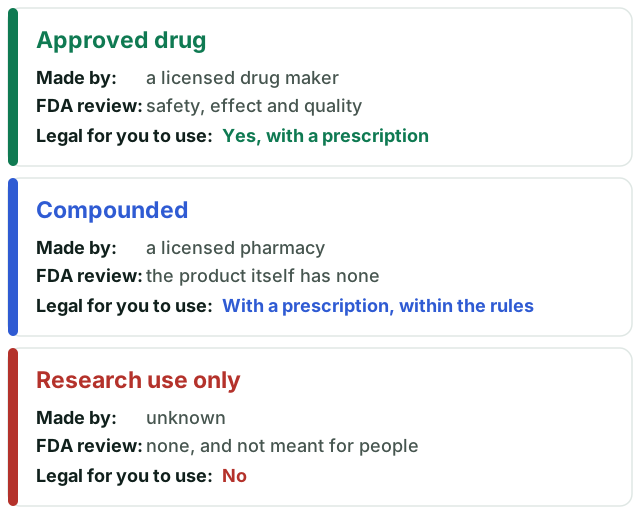
Three different things get sold as PT-141, and the law treats them differently.
| Product | Legal position |
|---|---|
| Vyleesi autoinjector | FDA-approved, prescription, dispensed by a licensed pharmacy |
| Compounded bremelanotide from a licensed pharmacy | Not an approved product. Section 503A lets pharmacies compound from bulk substances that are components of FDA-approved drugs, which bremelanotide has been since 2019. Other conditions apply, including a limit on making copies of a commercially available drug unless a prescriber documents a significant difference for the patient. FDA has published no statement specific to compounded bremelanotide since approval that we could find. |
| Vials labeled for research use only | Unapproved new drugs. An August 24, 2026 FDA warning letter named “PT-141 (Bremelanotide)” among peptides sold for research use and found the labels no defense. They are not legal to use on people. Under 21 CFR 312.160 that labeling is for laboratory animal and test-tube work. |
The history matters here. An FDA warning letter in 2020, about a pharmacy inspected in 2018 before Vyleesi was approved, listed bremelanotide among substances that could not be compounded under 503A because it was not then a component of an approved drug. Approval changed that one fact. It did not give compounded versions an FDA label, a reviewed dose, or verified quality. As of November 2, 2026, HHS’s October 2026 enforcement policy for six peptides does not include PT-141; that policy addresses substances that are not components of an approved drug.
Who should not use PT-141
The Vyleesi label lists uncontrolled high blood pressure and known cardiovascular disease as contraindications and says it is not recommended for anyone at high risk of cardiovascular disease. It should be stopped if pregnancy is suspected, and avoided by anyone taking oral naltrexone for alcohol or opioid dependence. The label advises stopping after 8 weeks if there is no improvement, and caution in severe kidney or liver impairment, where nausea and vomiting may be worse. It is not for use in children.
Questions to ask a prescriber
- Does my low desire fit the label, or could a medicine, a health condition or the relationship explain it?
- Is my blood pressure controlled well enough, and what is my cardiovascular risk?
- Do I take any oral medicine that could be affected, especially an antibiotic or naltrexone?
- Which would suit me better, an as-needed injection or a nightly pill?
- What contraception should I use while on it?
- How will we judge whether it is working at 8 weeks?
For the latest on status, see the FDA status tracker.
Compare
- PeptidesFDA approvedDosageThe Vyleesi label dose of PT-141 is 1.75 mg under the skin at least 45 minutes before sex, once in 24 hours at most.
- GoalsWomenThe peptides with real evidence for women are approved drugs with rules written for women: libido, the pill, pregnancy, bone.
- LearnFDA status trackerWhich peptides are FDA-approved, which HHS tolerates under conditions, and which are not legal to use.
Peptide news, sorted. Plus the printable dose chart.
Sorted, every Tuesday: the week's peptide and GLP-1 news in five minutes: FDA moves, new studies explained, and price changes. Subscribe and the one-page dose and injection-site chart arrives first.
Questions people ask
Is PT-141 the same as Vyleesi?
What does PT-141 do?
Does PT-141 work for men?
How well does Vyleesi work?
What are the side effects of PT-141?
Is compounded PT-141 legal?
Sources
Primary sources first: FDA labels and documents, peer-reviewed trials, registries.
- 1Vyleesi (bremelanotide injection) prescribing information, revised March 2024, via DailyMeddailymed.nlm.nih.gov
- 2Drugs@FDA. Vyleesi (bremelanotide), NDA 210557, approved June 21, 2019accessdata.fda.gov
- 3FDA. FDA approves new treatment for hypoactive sexual desire disorder in premenopausal women, June 21, 2019 (press release, via BioSpace)biospace.com
- 4Kingsberg SA et al. Bremelanotide for the treatment of hypoactive sexual desire disorder: two randomized phase 3 trials. Obstet Gynecol 2019pubmed.ncbi.nlm.nih.gov
- 5Simon JA et al. Prespecified and integrated subgroup analyses from the RECONNECT phase 3 studies of bremelanotide. J Womens Health 2022pubmed.ncbi.nlm.nih.gov
- 6Hadley ME, Dorr RT. Melanocortin peptide therapeutics: historical milestones, clinical studies and commercialization. Peptides 2006pubmed.ncbi.nlm.nih.gov
- 7Rosen RC et al. Safety, pharmacokinetics and pharmacodynamic effects of subcutaneously administered PT-141 in healthy male subjects and in patients with an inadequate response to Viagra. Int J Impot Res 2004pubmed.ncbi.nlm.nih.gov
- 8Diamond LE et al. Double-blind, placebo-controlled evaluation of intranasal PT-141 in healthy males and patients with mild-to-moderate erectile dysfunction. Int J Impot Res 2004pubmed.ncbi.nlm.nih.gov
- 9Diamond LE et al. Co-administration of low doses of intranasal PT-141 and sildenafil to men with erectile dysfunction. Urology 2005pubmed.ncbi.nlm.nih.gov
- 10Drug Store News. Palatin to cut staff, cancel work on ED drugdrugstorenews.com
- 11Vasylieva V et al. Peptides in urology and sexual medicine: clinical effectiveness, dosing, indications, and safety. Sex Med Rev 2026pubmed.ncbi.nlm.nih.gov
- 1221 U.S.C. 353a, pharmacy compounding (section 503A)law.cornell.edu
- 13FDA. Guidance: compounded drug products that are essentially copies of a commercially available drug product under section 503A, January 2018fda.gov
- 14FDA warning letter 594743 to a compounding pharmacy, April 1, 2020 (inspection August to October 2018)fda.gov
- 15FDA warning letter 735063 to a peptide seller naming PT-141, August 24, 2026fda.gov
- 16HHS. Enforcement Discretion Policy Regarding 503A Compounding Using Certain Peptide Bulk Drug Substances, with Appendices A and B, October 2026hhs.gov
- 1721 CFR 312.160, drugs for investigational use in laboratory research animals or in vitro testslaw.cornell.edu
- 18Addyi (flibanserin) prescribing information, revised December 2025, via FDAaccessdata.fda.gov
- 19Drugs.com. Vyleesi prices, checked November 2, 2026drugs.com
- 20Cosette Pharmaceuticals. Vyleesi official site: how to get Vyleesi and copay terms, checked November 2, 2026vyleesi.com
Go deeper on PT-141
PeptideSorted Editorial Team
Editorial review
The PeptideSorted editors check every guide against its cited sources before publication: each number against its FDA label, trial or registry, the FDA status against current FDA and HHS documents, and the wording against our describe-never-prescribe rule. Licensed clinicians who join the review panel are listed by name on the editorial team page.
This page was checked against its cited sources by the PeptideSorted editorial team. Licensed clinicians on our review panel are listed on the editorial team page. Every health page cites primary sources and shows its review date. Read the editorial policy and how medical review works, or report an error via corrections. Educational only; not medical advice.