Short answer
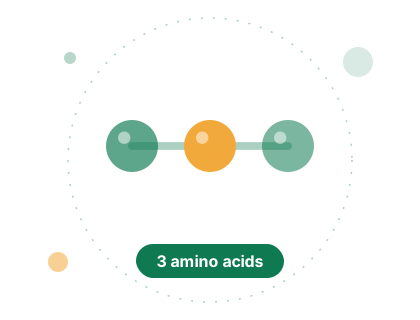
GHK-Cu is a three-amino-acid peptide bound to copper, sold as the cosmetic ingredient copper tripeptide-1 and as an unapproved injectable. Creams and serums need no FDA approval if they make no drug claims, and their evidence is a handful of small studies. Injected GHK-Cu has never been tested in a human trial and is not FDA-approved.
- What it is
- A naturally occurring tripeptide (glycine, histidine, lysine) bound to a copper ion, used in skin-care products as copper tripeptide-1.
- FDA status
- Not FDA approved
Never approved as a drug. Injectable GHK-Cu was in 503A category 2 (significant safety risks) from September 29, 2023 until its nomination was withdrawn in April 2026; non-injectable GHK-Cu is back in category 1 on the May 14, 2026 list, with an advisory committee review promised before the end of February 2027. GHK-Cu is not covered by the October 2026 HHS peptide policy.
- Evidence level
Early human studies
Small or uncontrolled human studies only.
GHK-Cu is two products sharing one name. On a serum label it is a cosmetic ingredient, copper tripeptide-1, with a small body of human skin studies behind it. In a vial it is an unapproved injectable drug with no human trials at all. GHK-Cu is not FDA-approved for any use, and it is listed with the other unapproved peptides in our Peptides A-Z. Almost every confusing thing you will read about it comes from blurring these two products together.
| Cosmetic cream or serum | Compounded non-injectable | Injectable vial | |
|---|---|---|---|
| What the law treats it as | A cosmetic, if it makes no drug claims | A compounded drug | An unapproved new drug |
| FDA approval | Not required | None; FDA does not review compounded products | None, ever |
| Human evidence | A few small studies | The same topical studies | No published or registered trial |
| Status as of November 2, 2026 | Sold as a cosmetic | In 503A category 1, under evaluation; needs a prescription | In no 503A category, no compounding route |
| October 2026 HHS peptide policy | Not relevant | Not on the list | Not on the list |
What is GHK-Cu?
GHK is a tripeptide, a chain of three amino acids: glycine, histidine and lysine. It binds copper very tightly, and the copper-bound form is GHK-Cu. It occurs naturally in human blood plasma and was first described in 1973. Reviews report plasma GHK levels of about 200 ng/mL at age 20 falling to about 80 ng/mL by age 60. The versions in skin care and in vials are made synthetically.
The same molecule appears under several names:
| Name | Where you see it | What it is |
|---|---|---|
| GHK-Cu | Research papers, vial labels | The copper-bound tripeptide |
| Copper tripeptide-1 | Cosmetic ingredient lists (INCI name) | The same molecule |
| Prezatide copper | Drug-name databases | The same molecule |
| Palmitoyl tripeptide-1 | Cosmetic ingredient lists | GHK with a fatty acid attached and no copper, a different ingredient |
If you have wondered why copper peptide serums look blue, the color comes from the copper. The copper(II) complex absorbs visible light around 580 to 600 nm. A blue tint tells you copper is present. It tells you nothing about strength or purity.
What are the benefits of GHK-Cu?
The benefits are best established in lab work, and they get thinner as you move toward people. In skin cells and animal wounds, GHK-Cu increases collagen, elastin and glycosaminoglycan production and changes the activity of enzymes that break down skin proteins. A 2026 evidence-mapping review in Pharmaceutics, which searched through August 2026, called it “a promising but unproven therapeutic cargo rather than a clinically validated regenerative drug.”
| Claimed benefit | Best human evidence | How strong |
|---|---|---|
| Fewer fine lines and wrinkles | Small studies, several published only as abstracts | Weak |
| Firmer, denser skin | The same 2002 conference abstracts | Weak |
| Wound healing | Two ulcer trials, one positive and one negative | Mixed |
| Better results after laser resurfacing | One 13-person trial, no objective difference | Weak, negative on objective measures |
| Acne scars | A split-face study with an early benefit gone by week 16 | Weak |
| Hair growth | An 18-person eyebrow study of a nominal 2% serum; a small case series mixed with minoxidil and dutasteride | Very weak |
| Acne itself | We found no controlled human study | None found |
| Anti-aging from injections | No human study | None |
What the topical studies actually found
A 2026 systematic review in Aesthetic Surgery Journal found 20 eligible studies, of which 18 were preclinical and 2 were randomized controlled trials. A 2024 review called the absence of clinical studies “surprising” given how widely the ingredient is sold.
| Study | Who | What was applied | What was found |
|---|---|---|---|
| Bishop et al. 1992, J Vasc Surg | 86 patients with venous leg ulcers, randomized, evaluator-blinded | 0.4% tripeptide copper cream vs silver sulfadiazine cream vs placebo | Copper peptide cream did no better than placebo |
| Mulder et al. 1994, Wound Repair Regen | Diabetic foot ulcers, randomized, evaluator-blinded, vehicle-controlled | GHK-Cu gel plus standard wound care | Median ulcer closure 98.5% vs 60.8% with vehicle; infections 7% vs 34% |
| Leyden 2002 (two conference abstracts) | 71 women (face) and 41 women (eyes) with photodamage | GHK-Cu facial cream; GHK-Cu eye cream vs placebo and vitamin K cream | Reported gains in skin density and thickness, fewer fine lines; never published as full papers |
| Miller et al. 2006, Arch Facial Plast Surg | 13 patients after CO2 laser resurfacing, randomized | Skin-care regimen with or without GHK-Cu | No measurable difference in redness or wrinkles; higher patient satisfaction with GHK-Cu (P = .04) |
Three cautions apply to the whole body of work. The most cited cosmetic “trials” exist only as meeting abstracts. A 2026 systematic review found that about 35% of the primary GHK-Cu literature it covered was co-written by the researcher who first isolated the peptide and a colleague, both affiliated with a company that sells copper peptide products. And GHK-Cu does not pass easily through intact skin: in a 2015 laboratory study, no peptide crossed untreated human skin in nine hours, while skin pre-treated with microneedles let it through.
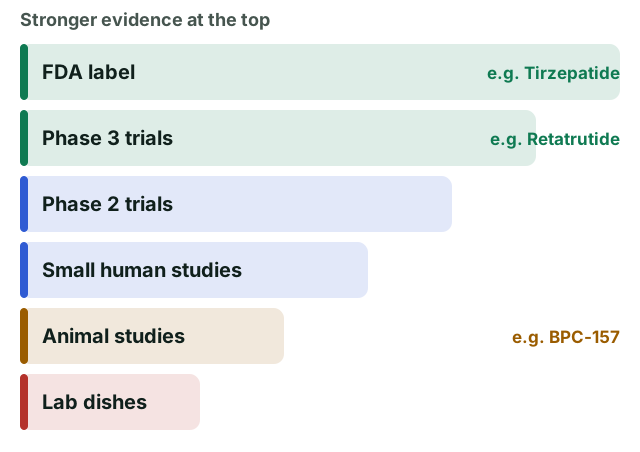
Topical GHK-Cu sits on the small-human-studies rung. A registered phase 2 trial (NCT07437586) is testing a gel on small standardized wounds in 60 healthy adults, and it was still recruiting with no results on November 2, 2026.
How long does it take to work? No study has answered that well. Human studies mostly ran 8 to 16 weeks, so a fair trial of any cosmetic serum is measured in months, and even then the evidence does not promise a visible change. Our topical GHK-Cu guide goes through each study and how to read a label, and our guide to copper peptide serums covers buying and using one. For hair, the closest human data a 2026 review could cite was a small case series that delivered copper peptides together with minoxidil and dutasteride, so the effect of GHK-Cu alone cannot be separated; see peptides for hair.
GHK-Cu side effects
Long use is not the same as measured safety. The topical ingredient has been sold in cosmetics for decades, according to the researchers who first studied it, but independent published safety data are scarce.
- On the skin. A 2024 review stated that no studies have been published on its side effects. A 2026 review flagged a hyperpigmentation (skin darkening) risk in one acne-scar study that paired GHK-Cu serum with microneedling. The 2026 eyebrow study reported no serious adverse effects in 18 people.
- Copper allergy. Copper is a recognized contact sensitizer in susceptible people, and a broken skin barrier or a penetration-enhancing product raises exposure.
- Injections. Unknown. See below.
A sting that does not settle, spreading redness or a rash is a reason to stop and show the label to a pharmacist or dermatologist. Trouble breathing or swelling of the face or throat after any product is an emergency. Cosmetic companies must report serious adverse events to FDA.
People with Wilson disease, an inherited condition in which copper cannot be cleared and builds up in the liver and brain, have a specific reason to ask their specialist before using any copper-containing product. No study has examined GHK-Cu in this group. We also found no data on pregnancy or breastfeeding.
Why injected GHK-Cu is a different question
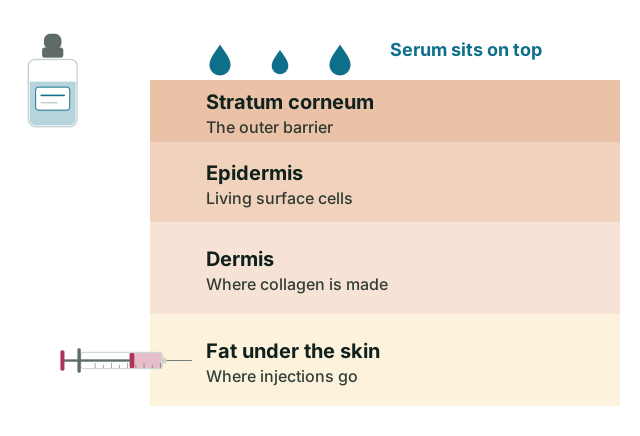
None of the topical evidence carries over to injection. A cream sits on or in the upper skin, and an injection bypasses the barrier that keeps most of the peptide out. There is no published human trial of injected GHK-Cu, and a ClinicalTrials.gov search on November 2, 2026 found no registered one; the registered studies are of topical products or patches. The only injection data come from animals, such as a 1996 study that injected a tripeptide-copper complex into wounds on dogs’ paw pads.
What is unknown about injecting it:
- Immune reactions. FDA’s stated concern is that compounded injectable GHK-Cu “may pose risk for immunogenicity due to the potential for aggregation and peptide-related impurities.” Immunogenicity means the body mounting an immune response against the product.
- Human safety data. FDA’s same entry says “there are limited data in humans to inform safety-related considerations.”
- Copper load. The 2026 Pharmaceutics review calls cumulative copper burden the dominant long-term concern with repeated exposure, says labile (loosely held) copper can catalyze damaging reactions, and says dietary copper limits cannot be converted into limits for injection. Formal absorption, distribution and excretion studies of the intact complex have not been reported.
- Dose. No study has measured what blood levels an injection produces or how long they last. The GHK-Cu dosage page explains why there is no human dose.
- Product quality. Research-grade vials have no FDA-verified identity, purity, potency or sterility.
Where do you inject GHK-Cu? No injection site has been tested in a human trial, so there is no answer with evidence behind it. What about before-and-after photos? No controlled study of injected GHK-Cu exists, so those photos have no comparison group, no verified product and no record of what else changed, such as lighting, skin care or a procedure. Injectable blends that pair GHK-Cu with other unapproved peptides are covered on the glow blend page; combining unknowns does not reduce them.
Cosmetic or drug: why the same molecule has two legal lives
US law sorts products by intended use, not by ingredient. A cosmetic is something applied to the body “for cleansing, beautifying, promoting attractiveness, or altering the appearance.” A drug is something intended to diagnose, cure, mitigate, treat or prevent disease, or to affect the structure or function of the body. FDA says intended use is shown by the product’s claims, by why consumers choose it, and sometimes by its ingredients. Its own examples of claims that turn a product into a drug include claims to “regenerate cells” or “restore hair growth.”
So a copper peptide serum sold to improve the look of skin is a cosmetic and needs no FDA approval. Cosmetics are still regulated. Since the 2022 cosmetics law, companies must keep records supporting a product’s safety, report serious adverse events to FDA within 15 business days, and register manufacturing facilities, and FDA can order a recall in serious cases. The same molecule in a vial meant for injection is a drug, and because no GHK-Cu drug has ever been approved, it is an unapproved new drug. The legal status follows the product, not the peptide.
Is GHK-Cu legal? FDA status in detail
GHK-Cu has never had a New Drug Application. Its only drug-side regulatory history is in the 503A process, which decides which bulk substances state-licensed pharmacies may use to compound drugs for individual patients.
| Date | What happened |
|---|---|
| September 29, 2023 | FDA split GHK-Cu by route. Non-injectable GHK-Cu went into category 1 (under evaluation; FDA does not intend to act against compounding with it while evaluation continues). Injectable GHK-Cu went into category 2, “significant safety risks,” which means pharmacies could not compound it under the interim policy. |
| April 22, 2026 | The nominators withdrew their GHK-Cu nominations. FDA removed non-injectable GHK-Cu from category 1 that day, and its safety-risk page now lists injectable GHK-Cu among substances whose nominations were withdrawn. |
| May 5, 2026 | One nominator told FDA it had meant to withdraw only the injectable nomination and wanted to keep the non-injectable one. |
| May 14, 2026 | FDA’s updated list puts “GHK-Cu (except for injectable routes of administration)” back in category 1 and says FDA intends to consult its Pharmacy Compounding Advisory Committee (PCAC) “before the end of February 2027” on adding GHK-Cu to the bulks list. |
| October 28-30, 2026 | HHS issued an interim enforcement policy for six other peptides. GHK-Cu is not one of them. |
| November 2, 2026 | FDA’s 2027 committee page carries only an early announcement with no date. No GHK-Cu meeting date has been published. |
In practice, a pharmacy may compound a non-injectable GHK-Cu product, such as a cream, for a patient with a prescription under FDA’s interim category 1 policy, if the other 503A conditions are met. Injectable GHK-Cu sits in no category after the withdrawal, which restores nothing: it has no compounding route and remains an unapproved new drug. The October 2026 HHS enforcement policy that made headlines changes none of this, because GHK-Cu is not on its list and that policy covers single-ingredient products only. A future PCAC vote would be advice only, and as the BPC-157 history shows, a vote does not change the law until FDA publishes a rule.
What research use only actually means
Vials labeled “for research use only” are not legal to use on people. The phrase comes from 21 CFR 312.160, which lets a company ship an unapproved drug only for tests in laboratory animals or in test tubes, with a label reading “Not for use in humans.” FDA warning letters to peptide sellers, including one dated August 24, 2026, have found that “research use only” and “not for human or veterinary use” labels do not change the legal picture when the seller’s website shows the products are meant for people. The label is not a loophole.
Access, and what to ask first
Cosmetic serums are sold over the counter, and most do not state a percentage, which makes price a poor guide to strength. A compounded cream needs a prescription, and compounded drugs generally fall outside standard pharmacy benefits, so it would likely be paid for out of pocket. Injectable GHK-Cu has no approved product and no lawful source for injection.
If a dermatologist, med spa or clinic brings up GHK-Cu, it is reasonable to ask:
- Is this a cosmetic, a compounded prescription or an injection, and which route has human data?
- What percentage of copper tripeptide-1 is in it, and who tested that?
- If microneedling is involved, what goes into my skin, and is that product made for that use?
- Do I have a history of metal allergy, keloids or pigment problems that changes the risk?
- What result would you expect by 12 weeks, and how would we measure it?
Compare
Peptide news, sorted. Plus the printable dose chart.
Sorted, every Tuesday: the week's peptide and GLP-1 news in five minutes: FDA moves, new studies explained, and price changes. Subscribe and the one-page dose and injection-site chart arrives first.
Questions people ask
Is GHK-Cu FDA-approved?
What are the benefits of GHK-Cu?
Is GHK-Cu the same as copper tripeptide-1?
What are the side effects of GHK-Cu?
Are GHK-Cu injections safe?
Can a pharmacy compound GHK-Cu?
Sources
Primary sources first: FDA labels and documents, peer-reviewed trials, registries.
- 1FDA. Bulk drug substances nominated for use in compounding under section 503A, category list (updated May 14, 2026)fda.gov
- 2FDA. 503A categories update, September 29, 2023 (copy hosted by the Alliance for Pharmacy Compounding)join.a4pc.org
- 3FDA. Certain bulk drug substances for use in compounding may present significant safety risks (content current as of April 22, 2026)fda.gov
- 4FDA. 2027 meeting materials, Pharmacy Compounding Advisory Committeefda.gov
- 5FDA. Meeting of the Pharmacy Compounding Advisory Committee, early announcement (GHK-Cu, cathelicidin, dihexa acetate, melanotan II and PEG-MGF)fda.gov
- 6HHS. Enforcement Discretion Policy Regarding 503A Compounding Using Certain Peptide Bulk Drug Substances, with Appendices A and B, October 2026hhs.gov
- 7FDA. Is it a cosmetic, a drug, or both? (or is it soap?) (content current as of September 11, 2024)fda.gov
- 8FDA. Modernization of Cosmetics Regulation Act of 2022 (content current as of October 29, 2026)fda.gov
- 9PubChem. Copper tripeptide-1 (GHK-Cu, prezatide copper), CID 71587328pubchem.ncbi.nlm.nih.gov
- 10PubChem. Tripeptide-1 (GHK), CID 73587pubchem.ncbi.nlm.nih.gov
- 11PubChem. Palmitoyl tripeptide-1 (Pal-GHK), CID 10231864pubchem.ncbi.nlm.nih.gov
- 12Pickart L, Margolina A. Regenerative and protective actions of the GHK-Cu peptide in the light of the new gene data. Int J Mol Sci 2018pubmed.ncbi.nlm.nih.gov
- 13Dou Y et al. The potential of GHK as an anti-aging peptide. Aging Pathobiol Ther 2020pubmed.ncbi.nlm.nih.gov
- 14Mortazavi SM et al. Topically applied GHK as an anti-wrinkle peptide: advantages, problems and prospective. BioImpacts 2024pubmed.ncbi.nlm.nih.gov
- 15Najafi N et al. A systematic review of the mechanisms and therapeutic applications of GHK-Cu in topical microneedle delivery. Arch Intern Med Res 2026pubmed.ncbi.nlm.nih.gov
- 16Mokhtar J et al. The regenerative potential of GHK-Cu in aesthetic medicine (systematic review). Aesthet Surg J 2026pubmed.ncbi.nlm.nih.gov
- 17Mateescu DM et al. GHK-Cu as a bioactive metallopeptide and drug-delivery cargo: a systematic evidence-mapping review. Pharmaceutics 2026pmc.ncbi.nlm.nih.gov
- 18Bishop JB et al. A prospective randomized evaluator-blinded trial of two potential wound healing agents for the treatment of venous stasis ulcers. J Vasc Surg 1992pubmed.ncbi.nlm.nih.gov
- 19Mulder GD et al. Enhanced healing of ulcers in patients with diabetes by topical treatment with glycyl-l-histidyl-l-lysine copper. Wound Repair Regen 1994pubmed.ncbi.nlm.nih.gov
- 20Miller TR et al. Effects of topical copper tripeptide complex on CO2 laser-resurfaced skin. Arch Facial Plast Surg 2006pubmed.ncbi.nlm.nih.gov
- 21Li H et al. Microneedle-mediated delivery of copper peptide through skin. Pharm Res 2015pubmed.ncbi.nlm.nih.gov
- 22Swaim SF et al. Effect of locally injected medications on healing of pad wounds in dogs. Am J Vet Res 1996pubmed.ncbi.nlm.nih.gov
- 23ClinicalTrials.gov. Phase 2 split-wound study of topical GHK-Cu gel, NCT07437586clinicaltrials.gov
- 24MedlinePlus Genetics. Wilson diseasemedlineplus.gov
- 25AJMC. HHS draft policy eases enforcement on 6 compounded peptides, 2026ajmc.com
- 2621 CFR 312.160, drugs for investigational use in laboratory research animals or in vitro testslaw.cornell.edu
- 27FDA warning letter 735063 to a peptide seller, August 24, 2026fda.gov
Go deeper on GHK-Cu
- DosagePublished GHK-Cu studies used creams and serums from about 0.05% to 2%. No human study has tested an injected dose. See the concentrations and the math.Read
- TopicalDoes topical GHK-Cu work? A few small studies, mostly 8 to 16 weeks, with mixed results. Each study, how to spot copper tripeptide-1, and irritation risks.Read
PeptideSorted Editorial Team
Editorial review
The PeptideSorted editors check every guide against its cited sources before publication: each number against its FDA label, trial or registry, the FDA status against current FDA and HHS documents, and the wording against our describe-never-prescribe rule. Licensed clinicians who join the review panel are listed by name on the editorial team page.
This page was checked against its cited sources by the PeptideSorted editorial team. Licensed clinicians on our review panel are listed on the editorial team page. Every health page cites primary sources and shows its review date. Read the editorial policy and how medical review works, or report an error via corrections. Educational only; not medical advice.