
Short answer
Glow is a marketing name for an injectable blend of GHK-Cu, BPC-157 and TB-500, and no human study has ever tested it. None of the three is FDA-approved. The blend falls outside the interim HHS compounding policy twice over: it has more than one active ingredient, and GHK-Cu is not on the list. GHK-Cu's human data come from skin products.
- What it is
- A seller-defined mix of three unapproved peptides in one injectable vial. There is no standard formula.
- FDA status
- Not FDA approved
None of the three ingredients is FDA-approved. As of November 2, 2026 no rule has been proposed. An interim HHS policy covers BPC-157 and TB-500 only as single-ingredient products under ten conditions; GHK-Cu is not on its list, so a Glow blend is outside it.
- Evidence level
Animal studies only
No controlled human trials. Everything below is animal or lab data.
Glow is a seller’s label on a vial, usually holding three unapproved peptides: GHK-Cu, BPC-157 and TB-500. It is marketed for skin, hair and healing. No human study has ever tested it. Because the name belongs to the market and not to any regulator or pharmacopeia, doses, ratios and purity vary from seller to seller, so two products called Glow may not be the same thing.
The most useful thing to know is that the evidence people quote for Glow mostly comes from creams and rats, and Glow is an injection.
| Ingredient | What it is | On the interim HHS list? | Best human evidence |
|---|---|---|---|
| GHK-Cu | A three-amino-acid peptide (glycine, histidine, lysine) bound to copper; found naturally in human plasma, where levels fall with age | No | Small controlled studies of skin products. No published trial of injection |
| BPC-157 | A 15-amino-acid fragment of a protein from human gastric juice | Yes, acetate, single ingredient only | Five small studies by enema and by knee, bladder or intravenous routes; none by skin injection |
| TB-500 | A synthetic 7-amino-acid fragment of thymosin beta-4, listed by FDA as “Thymosin Beta-4, Fragment (LKKTETQ)” | Yes, acetate, single ingredient only | None. FDA found no human data by any route |
| The Glow blend | All three in one vial | No. Blends are outside the policy | None |
What do people expect from Glow?
Mostly better skin: smoother texture, fewer fine lines, some glow, thicker hair, faster recovery after procedures. The logic offered is that a collagen peptide and two healing peptides should add up. Each piece of that logic comes from a different kind of study on a different part of the body, and nobody has joined them together in a test. No study has measured skin quality, hair or wrinkles in anyone who injected this mix.
No combination study exists
Every claim made for Glow is assembled from separate studies of separate ingredients, most of them in cells or animals. Nobody has tested whether the three interact, whether one changes how the others are absorbed or broken down, or whether mixing them in one vial keeps each stable. FDA’s reviewers noted that the stability and immune properties of peptides are “highly sensitive” to how a product is made. Three thinly studied injectables in one vial do not add up to three times the evidence. Together they make a new, unstudied product.
Is the Glow blend legal?
A Glow blend falls outside the interim HHS policy for two separate reasons. As of November 2, 2026, HHS says it does not intend to take enforcement action against a state-licensed pharmacy, federal facility or licensed physician compounding BPC-157 or TB-500 when all ten conditions are met.
- It is a blend. Condition seven requires a single active ingredient, so any multi-peptide product is out, even when each ingredient is on the list.
- GHK-Cu is not on the list. The policy names six peptides, and GHK-Cu is not one of them.
Covering two of the three ingredients does not cover the vial. The policy gives Glow nothing.
That policy also carries limits of its own. BPC-157 and TB-500 remain unapproved and off the 503A bulks list, no rule has been proposed, and FDA has not reviewed any compounded product. The notice says it is “not binding on HHS or the public,” HHS may revisit it, and states can be stricter.
GHK-Cu has its own path. Injectable GHK-Cu went into FDA’s category 2 in 2023, and its nomination was withdrawn in April 2026. FDA’s May 14, 2026 list returned GHK-Cu “except for injectable routes of administration” to category 1 and says FDA intends to consult its advisory committee before the end of February 2027. FDA’s safety page says of injectable GHK-Cu that “there are limited data in humans to inform safety-related considerations.”
Products labeled “research use only” are not legal to use on people. Most Glow vials are sold that way, and 21 CFR 312.160 allows such products to ship only for tests in laboratory animals or test tubes. A March 2026 FDA warning letter treated the label as no defense when the marketing pointed to human use. HHS says one aim of its policy is to discourage research-use-only peptides, so they gain nothing from it. The FDA status tracker follows each ingredient.
What does the evidence show for each part?
GHK-Cu
The case for GHK-Cu rests on decades of laboratory work, much of it reviewed by authors at a skin-care company, showing effects on collagen, wound repair and gene expression in cells and animals. The human data are cosmetic. One randomized study gave GHK-Cu skin products to 13 patients after CO2 laser resurfacing: blinded evaluators found no difference in redness, wrinkles or skin quality, although patients using GHK-Cu rated their satisfaction higher. A 2026 systematic review called the human literature “thin and fragmented.” The topical GHK-Cu guide covers the cream studies.
A September 2026 NPR report found “no data from published human studies” showing that injecting it is safe and effective. The clinicians it quoted were blunter. Dermatologist David Goldberg of Mount Sinai said he would not “sleep well at night, until the human studies are actually done.” Dermatologist Marisa Garshick worried that buyers have no assurance of quality or dose. A nurse practitioner at a longevity clinic described patients with injection-site irritation, infections and liver problems, including some who injected too much and had elevated liver enzymes and copper, though he said it was unclear whether the peptide, other substances or impurities were to blame. NPR named overloading the body with copper and a dangerous immune reaction as potential risks of injection.
BPC-157
Three decades of rat studies, mostly from one laboratory in Zagreb, show faster healing of tendon, muscle and gut injuries. The human record is five small studies, none testing skin, and none using an injection under the skin. A 2026 systematic review rated the certainty of human evidence as very low. No study has looked at BPC-157 for wrinkles, skin tone or hair in people, so its place in a “glow” product is a stretch from gut and tendon research.
TB-500
TB-500 is often treated as if it were thymosin beta-4, and FDA says flatly that they are not the same substance. It is a small piece of that protein. The human trials people cite used the full 43-amino-acid molecule: a topical gel in 73 patients with venous leg ulcers and eye drops in 9 patients with severe dry eye. Neither tested TB-500 or injection. FDA found no human data on TB-500 and no toxicity studies.
Injection versus topical: the distinction that matters most
A cream and an injection reach different layers of the body and are regulated differently, and results do not transfer between them. A copper peptide serum or cream is a cosmetic: FDA does not approve cosmetics before sale, and a product stays a cosmetic only as long as it claims to change appearance and not to treat a condition. A Glow vial is meant to be injected, which makes it an unapproved drug.
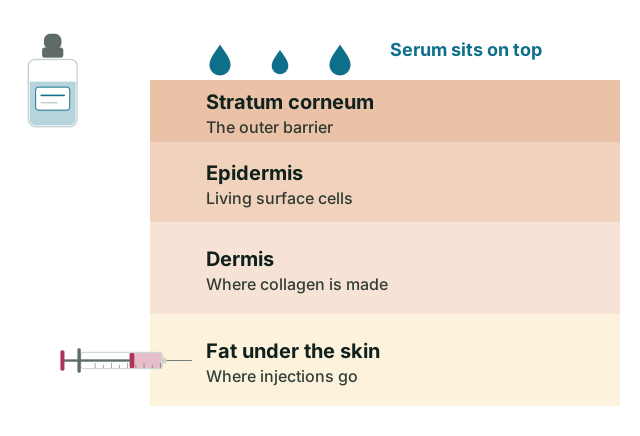
Skin-cream studies of GHK-Cu measured wrinkles and appearance after weeks of application to the face. They say nothing about what happens when GHK-Cu, plus two other peptides, goes into the fat beneath the skin, and travels from there. If what appeals to you about Glow is the copper peptide, a serum is the form with human skin data, modest as they are. The copper peptide serum guide covers what to look for.
What are the risks of Glow?
Nobody has measured them for the blend. What exists is a set of warnings about its parts and about unregulated injections.
- A reaction involving skin, of all things. FDA’s database holds a report of a woman who injected a BPC-157 and TB-500 research product and developed widespread darkening of her skin and gums, which came back when she used it again. Those are two of Glow’s three ingredients.
- Immune reactions. FDA says injected peptides such as BPC-157 and TB-500 may pose a significant risk of immunogenicity, an immune response against the peptide, with outcomes ranging from nothing noticeable to life-threatening.
- Animal safety signals. BPC-157 changed clotting times and liver markers in 28-day rat and dog studies. TB-500 has no toxicity studies at all.
- A blended unknown. If something goes wrong, nobody can say which ingredient caused it. That is the reason HHS gave for the single-ingredient rule.
- What is in the vial. There is no standard formula, and research-labeled products have no verified identity, strength or sterility. Infection and dosing mistakes are risks with any home injection.
The BPC-157 side effects guide includes red flags, and the are peptides safe guide covers the wider risks. There is no human dose for the blend and none for any part of it, so we do not discuss amounts.
What works for skin instead?
The treatments below have a far longer track record than any injected peptide, and they are what a dermatologist is likely to raise. The American Academy of Dermatology lists these for wrinkles and sun-damaged skin:
| Option | What it is | Where it fits |
|---|---|---|
| Daily sun protection | Sunscreen and shade, every day, even when overcast; no tanning beds | AAD says it can help prevent, slow and even reverse signs of sun damage, and improves results from other treatment |
| Moisturizer | Everyday skin care | Fine lines and dryness |
| Prescription retinoid | A cream applied to the skin | Wrinkles and sun damage |
| Fillers and Botox | In-office injections of FDA-regulated products | Wrinkles |
| Chemical peels, microdermabrasion, laser resurfacing | In-office procedures | Wrinkles and sun damage |
If thinning hair is what brought you here, the hair goals guide covers that separately, and the skin goals guide covers what peptides can and cannot do for skin.
How long does Glow take to work?
Nobody can say, since no study has shown that it works at all. Timelines posted online are anecdotes. Before-and-after photos cannot separate a peptide from lighting, skin care, weight change or the passing of time, which is why controlled trials with blinded evaluators exist. In the one randomized GHK-Cu study above, patients rated their satisfaction higher while blinded evaluators saw no difference, which shows how far feeling better and measured change can drift apart.
How does Glow compare with Klow and the Wolverine stack?
All three are seller names for mixes of the same small group of peptides. None has a controlled human trial as a blend.
| Wolverine | Glow | Klow | |
|---|---|---|---|
| BPC-157 | Yes | Yes | Yes |
| TB-500 | Yes | Yes | Yes |
| GHK-Cu | No | Yes | Yes |
| KPV | No | No | Yes |
| Marketed for | Injury healing | Skin, hair, healing | Skin, healing, inflammation |
| Controlled human trial of the blend | None | None | None |
| Inside the HHS policy as a blend? | No | No | No |
The Wolverine stack page covers the two-peptide version.
Why is GHK-Cu not on the HHS list?
HHS does not explain the omission, but the timing is plain. The six peptides on the list are the ones FDA’s advisory committee recommended in July 2026. GHK-Cu was not part of that review, and FDA has said it intends to consult its committee before the end of February 2027. That could change its position. It would not by itself produce evidence that injecting it is safe.
Questions to ask before anyone injects you
If a clinic offers you Glow, a few questions will tell you a lot:
- Is this a single product made for me, or a blend? A blend is outside the HHS policy.
- Does it contain GHK-Cu for injection? It is not on the HHS list.
- Who made it, and can I see a certificate of analysis for this lot?
- What human evidence do you have for this exact product?
- Who do I call if I react, and how is that reported to FDA?
Banned in sport
For athletes, WADA names BPC-157 in class S0 (non-approved substances) and “thymosin-β4 and its derivatives, e.g. TB-500” in class S2. Both are banned at all times, so a Glow product is a doping risk whatever its label says about skin. The Klow blend is the same mix with KPV added.
Compare
Peptide news, sorted. Plus the printable dose chart.
Sorted, every Tuesday: the week's peptide and GLP-1 news in five minutes: FDA moves, new studies explained, and price changes. Subscribe and the one-page dose and injection-site chart arrives first.
Questions people ask
What is in the Glow peptide blend?
Is the Glow peptide blend FDA-approved?
Has Glow been tested in humans?
Is a GHK-Cu serum the same as a Glow injection?
Does Glow make your skin better?
Is the Glow blend banned in sport?
Sources
Primary sources first: FDA labels and documents, peer-reviewed trials, registries.
- 1HHS. Enforcement Discretion Policy Regarding 503A Compounding Using Certain Peptide Bulk Drug Substances, with Appendices A and B, October 2026hhs.gov
- 2Federal Register. Notice of availability, FR Doc. 2026-22192, Docket HHS-OASH-2026-0496, RIN 0910-ZD94, published October 30, 2026public-inspection.federalregister.gov
- 3Fox Rothschild. HHS moves to pull peptides out of the research-use-only market and into pharmacies, October 2026foxrothschild.com
- 4FDA. Briefing document for BPC-157-related bulk drug substances, Pharmacy Compounding Advisory Committee, July 23-24, 2026fda.gov
- 5FDA. Briefing document for TB-500-related bulk drug substances, Pharmacy Compounding Advisory Committee, July 23-24, 2026fda.gov
- 6Superpower. GLOW peptide blend: GHK-Cu, BPC-157 and TB-500, and how KLOW differs (updated September 28, 2026)superpower.com
- 7Pickart L et al. GHK peptide as a natural modulator of multiple cellular pathways in skin regeneration. Biomed Res Int 2015pubmed.ncbi.nlm.nih.gov
- 8Miller TR et al. Effects of topical copper tripeptide complex on CO2 laser-resurfaced skin. Arch Facial Plast Surg 2006pubmed.ncbi.nlm.nih.gov
- 9Najafi N et al. Systematic review of GHK-Cu in topical microneedle delivery: a case for expanded clinical trials. Arch Intern Med Res 2026pubmed.ncbi.nlm.nih.gov
- 10Poolton JT et al. Human evidence for BPC-157 in orthopaedic and regenerative medicine: a systematic review of efficacy and safety. Acta Orthop Belg 2026pubmed.ncbi.nlm.nih.gov
- 11Guarnera G et al. The effect of thymosin treatment of venous ulcers. Ann N Y Acad Sci 2010pubmed.ncbi.nlm.nih.gov
- 12Sosne G et al. Thymosin beta 4 improves signs and symptoms of severe dry eye in a phase 2 randomized trial. Cornea 2015pubmed.ncbi.nlm.nih.gov
- 13FDA. Bulk drug substances nominated for use in compounding under section 503A, category list (updated May 14, 2026)fda.gov
- 14FDA. Certain bulk drug substances for use in compounding may present significant safety risksfda.gov
- 15McDermott Will & Schulte. Bulk list bound: PCAC backs majority of peptides in two-day public meeting, July 27, 2026mcdermottlaw.com
- 16NPR (via WNYC). The copper peptide trend has gone from creams to injections, ahead of the science, September 7, 2026wnyc.org
- 17FDA. Is it a cosmetic, a drug, or both? (Or is it soap?)fda.gov
- 18American Academy of Dermatology. How dermatologists treat sun-damaged skinaad.org
- 19Finnish Center for Integrity in Sports (SUEK). Doping agent classes and substances 2026 (WADA List text by class)kamu.suek.fi
- 20WADA. The Prohibited List (current)wada-ama.org
- 2121 CFR 312.160, drugs for investigational use in laboratory research animals or in vitro testslaw.cornell.edu
- 22FDA warning letter to Gram Peptides, March 31, 2026fda.gov
More in Goals
- Hair growthNo peptide is FDA-approved for hair loss. See what the small peptide studies measured, who paid for them, and how minoxidil and finasteride compare.Read
- Klow blendKlow is Glow plus KPV: four unapproved peptides in one vial, never tested in people and outside the HHS policy for three reasons. See what KPV adds.Read
- Muscle growthNo peptide is FDA-approved to build muscle. What tesamorelin, sermorelin, CJC-1295, ipamorelin and MK-677 did to lean mass and strength in human trials.Read
- SkinA few skin peptides beat a control in small, mostly company-run trials. None is FDA-approved. See the evidence by type and what has stronger proof.Read
- SleepNo peptide is FDA-approved for sleep. DSIP's 1980s trials were mixed, epitalon and selank have no sleep trials, and proven insomnia treatments exist.Read
- Weight lossSemaglutide and tirzepatide are the FDA-approved peptides with strong weight-loss trials. AOD-9604 and MOTS-c are not. See the evidence, group by group.Read
PeptideSorted Editorial Team
Editorial review
The PeptideSorted editors check every guide against its cited sources before publication: each number against its FDA label, trial or registry, the FDA status against current FDA and HHS documents, and the wording against our describe-never-prescribe rule. Licensed clinicians who join the review panel are listed by name on the editorial team page.
This page was checked against its cited sources by the PeptideSorted editorial team. Licensed clinicians on our review panel are listed on the editorial team page. Every health page cites primary sources and shows its review date. Read the editorial policy and how medical review works, or report an error via corrections. Educational only; not medical advice.