
Short answer
Some topical peptides improve the look of fine lines in small controlled trials, but none is an FDA-approved drug. A signal peptide beat its own moisturizer in 93 women, and Argireline beat placebo in 60 people, yet an independent study found no effect. Daily sunscreen and prescription tretinoin have stronger evidence for aging skin.
“Peptides for skin” usually means peptides in creams and serums, because that is where the controlled human evidence sits. A few have improved the look of fine lines in small trials, though the studies are short, many were run by the ingredient’s maker, and no peptide is an FDA-approved drug for aging skin. Sunscreen and prescription tretinoin have stronger evidence for the same goal. If skin is only one of your questions, the peptides by goal index sorts the rest.
Dermatology researchers sort topical peptides into four groups. Collagen supplements sit apart as a fifth because they are swallowed.
| Type | Example | How it is supposed to work | Best controlled human evidence | Who ran it |
|---|---|---|---|---|
| Signal peptide | Palmitoyl pentapeptide-4 (pal-KTTKS) | Designed to signal skin cells to make more collagen | 93 women aged 35 to 55, 12 weeks, double-blind, split-face: the moisturizer with 3 ppm pal-KTTKS reduced wrinkles and fine lines more than the same moisturizer alone, by image analysis and expert graders | Authors from Procter & Gamble |
| Carrier peptide | Copper tripeptide (GHK-Cu) | Delivers copper, a cofactor for enzymes that cross-link collagen | 13 patients after CO2 laser resurfacing, randomized: no objective difference in redness, wrinkles or skin quality; patients using GHK-Cu were more satisfied | No funder named in the abstract; about 35% of the wider GHK-Cu literature involves people tied to a copper peptide company |
| Neurotransmitter-inhibiting peptide | Acetyl hexapeptide-8 (Argireline) | Interferes with the nerve-signal machinery that botulinum toxin targets, to relax expression lines | 60 people, 3 to 1 randomization, twice daily around the eyes for 4 weeks: 48.9% rated improved on the peptide against 0% on placebo. An independent 4-week split-face study of 19 women found no difference between sides | Hospital authors (2013); one surgeon reporting no competing interests (2023) |
| Enzyme-inhibitor peptide | Soy, rice and silk peptides | Slow enzymes that break down skin proteins | A 2017 review said “only very few or no in vivo studies have been conducted” | Not applicable |
| Collagen supplement (oral) | Hydrolyzed collagen peptides | Swallowed fragments of collagen, claimed to support skin collagen | 23 trials, 1,474 people: positive overall, no effect in trials without industry funding or in high-quality trials (2025 meta-analysis) | Mixed; funding explained the benefit |
What people hope for, and what the studies measured
Most people typing this search want fewer fine lines, firmer skin, softer frown lines or better texture. The trials measured something narrower. The pal-KTTKS trial used image analysis of facial photographs and expert graders. The Argireline trial used a global assessment and replicas of the skin surface. Neither shows that a serum rebuilt collagen in living skin, and neither tested firmness over years.
The sizes are worth keeping in mind too. A 2026 meta-analysis searched for every randomized trial of peptides for skin aging and found 19, with 1,341 participants. Only 2 of those tested a peptide on the skin. The other 17 tested peptides taken by mouth. The topical effect on wrinkles was smaller than the oral one and did not reach statistical significance, and the authors warned that the trials differed so much that pooled numbers should be read with caution.
Which peptide has the best evidence for wrinkles?
Palmitoyl pentapeptide-4 has the strongest single trial, and acetyl hexapeptide-8 has the most contested record. That comparison is between ingredients, because no published trial pits one finished serum against another. It also reflects how much each has been studied, which is a different thing from how well each works. A peptide with no published trial may simply be untested, and a label cannot tell you. None of these has shown what sunscreen or tretinoin has shown in larger or longer trials.
How to read each result
Signal peptides. The pal-KTTKS trial has the cleanest design in this list, because each woman used the peptide cream on one side of her face and the identical cream without it on the other. A second study, in 49 women over four months, also favored the peptide over its vehicle. Other trials added niacinamide and a second peptide, so they cannot isolate the effect.
Argireline. It beat placebo in one randomized trial, and it failed in a smaller independent one. Its developers wrote that it had much lower efficacy than botulinum toxin. The independent author concluded that “the effect of Argireline was not proven.” The original 2002 report of up to 30% less wrinkle depth used an emulsion described as 10% hexapeptide. The US Cosmetic Ingredient Review panel found the peptide safe only up to 0.005%, with too little data above that, so the 2002 figure may say little about a normal serum.
Copper peptides. GHK-Cu has the deepest laboratory literature of any skin peptide, with effects on collagen, wound repair and gene activity in cells and animals. The human evidence has not kept pace. A 2026 systematic review found 20 eligible studies, 18 of them preclinical and only 2 randomized trials. The topical GHK-Cu evidence page goes through the cream studies one at a time.
Enzyme-inhibitor peptides. A 2017 review said the relevance of this group “is still unclear.” If a label promotes soy or rice peptides, treat that as an untested idea.
Who paid for the studies
Funding does not make a result false, and the trials behind approved drugs are often paid for by the drug’s maker. The difference is that FDA then reviews the data before approval. Cosmetic data get no such review, so the reader has to do the checking.
- Pal-KTTKS: every author on the 93-woman trial worked for Procter & Gamble.
- The tretinoin comparison below: funded by Procter & Gamble, with authors who were company employees or paid consultants.
- GHK-Cu: a 2026 systematic review found about 35% of the primary literature in its window included the peptide’s discoverer or a colleague, both tied to a company that sells copper peptide products.
- Collagen supplements: the benefit appeared in pharmaceutically funded trials and disappeared in the rest.
A 2017 review also noted that studies of many cosmetic peptides “are not frequently published in scientific journals.” So the numbers on a product page often cannot be checked at all.
Can peptides get through the skin?
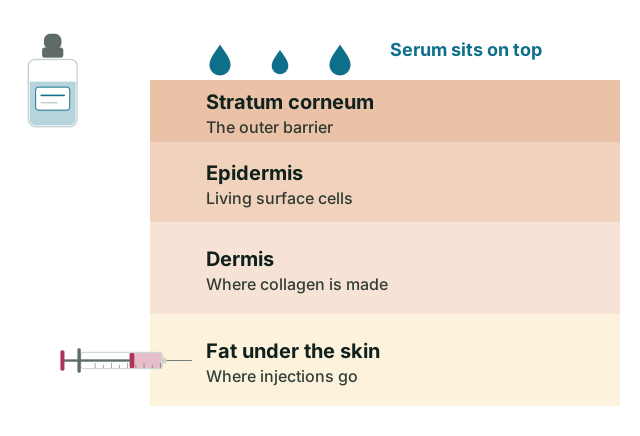
Mostly not far, and that is the weak point for the whole category. In an FDA laboratory study of a 10% acetyl hexapeptide-8 emulsion on human skin, most of the peptide washed off the surface. About 0.22% stayed in the outer dead-cell layer, about 0.01% reached the epidermis, and none was detected in the dermis, where collagen is made. A 2025 review called it uncertain whether the peptide reaches nerve-muscle junctions at all, and said its water-loving nature and size limit passage.
Chemists try to help by attaching a fatty acid, which is the “palmitoyl” on many labels. Copper binding and microneedling also raise passage in lab tests. How much reaches the target from a finished serum on a real face is rarely measured. A serum starts on the outer barrier, and an injection is placed far below it.
What works better for aging skin?
Daily sunscreen has the strongest prevention evidence, and tretinoin has an FDA label for fine wrinkles. The American Academy of Dermatology (AAD) calls sunscreen and moisturizer the two most effective anti-aging products and says anti-aging products in general “deliver modest results.”
| Option | Status | What the evidence shows | The catch |
|---|---|---|---|
| Daily broad-spectrum sunscreen | Sold over the counter | Randomized trial of 903 adults over 4.5 years: daily users showed no detectable increase in skin aging, 24% less than people using it at their own discretion | Prevention, and only if used daily |
| Tretinoin 0.02% cream (Renova) | FDA-approved drug | Five controlled trials over 24 weeks. Only two adequately showed benefit for fine wrinkles, and it has not shown benefit for coarse wrinkles, blotchy pigment or sagging | 32% had severe irritation, or needed a break or a mild steroid. Not for use in pregnancy |
| Moisturizer | Cosmetic | The AAD says it can plump fine lines in a few days | Temporary |
| Botulinum toxin (Botox Cosmetic) | FDA-approved drug | Approved for temporary improvement of moderate to severe frown, crow’s feet and forehead lines and neck bands. In glabellar trials the effect lasted about 3 to 4 months | Given by intramuscular injection. Boxed warning that toxin effects may spread from the injection site, with possible swallowing and breathing difficulties |
| Peptide serum | Cosmetic | The small studies on this page | Modest and less certain, though generally gentle |
The tretinoin label carries a useful reality check. It says the cream “does not eliminate wrinkles,” and many patients using only the inactive cream also saw improvement while following a skin care and sun-protection program. Part of what people credit to an active may come from the routine around it.
Are peptides better than retinol?
No trial shows a peptide alone outperforming a retinoid, the vitamin A family that includes retinol and prescription tretinoin. The closest test is a 2010 trial of 196 women aged 40 to 65. One group used a three-product cosmetic routine containing niacinamide, peptides, an SPF 30 lotion and a cosmetic retinoid (retinyl propionate). The other used a routine built around prescription 0.02% tretinoin.
At 8 weeks, expert graders scored the cosmetic routine significantly better (P<0.01), and 58% of women in that group looked better against 41% on tretinoin. At 24 weeks, in a smaller group of 25 per arm, the two did not differ. Tretinoin caused more dryness. The trial shows that a well-built routine can compete. It cannot show what the peptides added, because the routine contained a retinoid and niacinamide as well, and Procter & Gamble paid for it.
Can you use peptides with retinol or vitamin C?
We found no published evidence of a problem, but the question has barely been tested. The 2010 routine combined peptides with a retinoid and was tolerated better than tretinoin. For copper peptides, we found no study of use alongside vitamin C or retinoids. The AAD’s general advice is to add one anti-aging product at a time, because several at once can irritate skin. The copper peptide serum guide sets out what is known about mixing.
Do collagen supplements work for skin?
Probably not, once you remove the weakest and most conflicted trials. A 2021 review of 19 trials (1,125 people) concluded that 90 days of collagen reduced wrinkles and improved elasticity and hydration. A 2025 review of 23 trials split them by funding and quality. The benefit came from the pharmaceutically funded and lower-quality trials. High-quality trials showed no significant effect on hydration, elasticity or wrinkles, and neither did trials without that funding. Its authors concluded that there is “currently no clinical evidence to support the use of collagen supplements to prevent or treat skin aging.”
How long does it take to see a change?
Most anti-aging products take at least six weeks and sometimes up to three months, according to the AAD. The peptide trials above ran from 4 to 12 weeks, and tretinoin’s ran 24. A change within days is more likely to be moisture plumping fine lines. The AAD adds that results may fade once a product is stopped.
Side effects and who should be careful
Peptide serums look gentle in the published studies. The 2026 meta-analysis reported no severe adverse events across its trials, and the 19-woman split-face study saw no allergic reactions or irritation. These trials were too small to catch rare reactions, and a reaction can come from any ingredient in the bottle.
- Patch testing. The AAD suggests testing a new product on a quarter-sized spot, such as the inner arm, twice daily for 7 to 10 days, and not using it if a reaction appears.
- Stinging. The AAD says to stop a product that stings, burns or tingles.
- Pregnancy. The tretinoin label says it should not be used during pregnancy. If you are pregnant or trying to conceive, raise any retinoid with your clinician.
- Sun. Tretinoin raises sunburn risk, and its label calls for sunscreen of at least SPF 15 and protective clothing.
- Severe reactions. A dermatologist should see any reaction that is severe or does not settle.
What to look for on a label
This site names no products, so the useful question is what a label can tell you. Look for a specific peptide name in the ingredient list, such as palmitoyl pentapeptide-4, acetyl hexapeptide-8 or copper tripeptide-1, and a stated percentage if the brand gives one. Be wary of a long list of trademarked blends with no numbers. The guide to choosing a peptide serum has the full checklist, and the peptide serum guide explains how the names are built.
Why no peptide serum is FDA-approved
FDA classifies a product by what it claims to do. A cream that claims to improve appearance is a cosmetic and needs no FDA approval before sale. A product that claims to treat disease or to “regenerate cells” is a drug and needs approval. That is why skin peptide products talk about how skin looks. It also means no peptide serum has been through FDA review for effectiveness, and companies, not FDA, carry the legal duty to make sure a cosmetic is safe.
What about injecting peptides for skin?
Injecting a peptide for skin has no published human evidence behind it. Some sellers now market GHK-Cu, and blends like the Glow blend, as injections. That is a different product from a cream: an unapproved drug. FDA says compounded injectable GHK-Cu may carry immune-reaction risk from aggregation and peptide impurities, with limited human data. A September 2026 NPR investigation found no published human data showing injected GHK-Cu is safe or effective, and one clinician it quoted described injection-site irritation, infections and high copper and liver enzymes in patients who injected products from online sellers, although the cause was unclear.
As of November 2, 2026, HHS says it does not intend to take enforcement action against pharmacies compounding six named peptides under strict conditions. None of the six is FDA-approved, the policy approves nothing, and GHK-Cu is not on the list. Injectable GHK-Cu still has no compounding route, and blends fall outside the policy even when every ingredient is listed. Vials labeled “research use only” are not legal to use on people. Evidence from creams does not carry over to any of this.
Compare
- SkincareChoosing a peptide serumNo trial compares finished peptide serums, so no honest best list exists.
- SkincarePeptide serumPeptide serums are cosmetics backed by small, often company-run studies.
- GoalsNot FDA approvedGlow blendGlow is an injectable blend of GHK-Cu, BPC-157 and TB-500, never tested in people and outside the HHS policy.
Peptide news, sorted. Plus the printable dose chart.
Sorted, every Tuesday: the week's peptide and GLP-1 news in five minutes: FDA moves, new studies explained, and price changes. Subscribe and the one-page dose and injection-site chart arrives first.
Questions people ask
Do peptides actually do anything for skin?
Are peptides better than retinol?
Is Argireline like Botox?
Do collagen supplements work for skin?
How long do peptides take to work on skin?
Is a copper peptide cream the same as injecting GHK-Cu?
Sources
Primary sources first: FDA labels and documents, peer-reviewed trials, registries.
- 1Gorouhi F, Maibach HI. Role of topical peptides in preventing or treating aged skin. Int J Cosmet Sci 2009pubmed.ncbi.nlm.nih.gov
- 2Robinson LR et al. Topical palmitoyl pentapeptide provides improvement in photoaged human facial skin. Int J Cosmet Sci 2005pubmed.ncbi.nlm.nih.gov
- 3Blanes-Mira C et al. A synthetic hexapeptide (Argireline) with antiwrinkle activity. Int J Cosmet Sci 2002pubmed.ncbi.nlm.nih.gov
- 4Wang Y et al. The anti-wrinkle efficacy of argireline in Chinese subjects: a randomized, placebo-controlled study. Am J Clin Dermatol 2013pubmed.ncbi.nlm.nih.gov
- 5Henseler H. Investigating the effects of Argireline in a skin serum containing hyaluronic acids on skin surface wrinkles. GMS Interdiscip Plast Reconstr Surg DGPW 2023pubmed.ncbi.nlm.nih.gov
- 6Kraeling ME et al. In vitro skin penetration of acetyl hexapeptide-8 from a cosmetic formulation (FDA laboratory study). Cutan Ocul Toxicol 2015pubmed.ncbi.nlm.nih.gov
- 7Zdrada-Nowak J et al. Acetyl hexapeptide-8 in cosmeceuticals: a review of skin permeability and efficacy. Int J Mol Sci 2025pubmed.ncbi.nlm.nih.gov
- 8Johnson W Jr et al. Safety assessment of acetyl hexapeptide-8 amide as used in cosmetics (Cosmetic Ingredient Review). Int J Toxicol 2025pubmed.ncbi.nlm.nih.gov
- 9Schagen SK. Topical peptide treatments with effective anti-aging results. Cosmetics 2017mdpi.com
- 10Nukaly HY et al. Oral and topical peptides for skin aging: systematic review and meta-analysis of randomized controlled trials. Front Med 2026pubmed.ncbi.nlm.nih.gov
- 11Pickart L et al. GHK peptide as a natural modulator of multiple cellular pathways in skin regeneration. Biomed Res Int 2015pubmed.ncbi.nlm.nih.gov
- 12Miller TR et al. Effects of topical copper tripeptide complex on CO2 laser-resurfaced skin. Arch Facial Plast Surg 2006pubmed.ncbi.nlm.nih.gov
- 13Najafi N et al. Systematic review of GHK-Cu in topical microneedle delivery: a case for expanded clinical trials. Arch Intern Med Res 2026pubmed.ncbi.nlm.nih.gov
- 14Mokhtar J et al. The regenerative potential of GHK-Cu in aesthetic medicine (systematic review). Aesthet Surg J 2026pubmed.ncbi.nlm.nih.gov
- 15de Miranda RB et al. Effects of hydrolyzed collagen supplementation on skin aging: a systematic review and meta-analysis. Int J Dermatol 2021pubmed.ncbi.nlm.nih.gov
- 16Myung SK, Park Y. Effects of collagen supplements on skin aging: a systematic review and meta-analysis of randomized controlled trials. Am J Med 2025pubmed.ncbi.nlm.nih.gov
- 17Hughes MC et al. Sunscreen and prevention of skin aging: a randomized trial. Ann Intern Med 2013pubmed.ncbi.nlm.nih.gov
- 18Renova (tretinoin cream) 0.02% prescribing information, via DailyMeddailymed.nlm.nih.gov
- 19Fu JJ et al. A randomized, controlled comparative study of the wrinkle reduction benefits of a cosmetic niacinamide/peptide/retinyl propionate product regimen vs. a prescription 0.02% tretinoin product regimen. Br J Dermatol 2010pmc.ncbi.nlm.nih.gov
- 20Botox Cosmetic (onabotulinumtoxinA) prescribing information, revised October 2024, via DailyMeddailymed.nlm.nih.gov
- 21American Academy of Dermatology. How to select anti-aging skin care productsaad.org
- 22American Academy of Dermatology. How to maximize results from anti-aging skin care productsaad.org
- 23American Academy of Dermatology. How to test skin care productsaad.org
- 24FDA. Is it a cosmetic, a drug, or both? (Or is it soap?)fda.gov
- 25FDA. FDA authority over cosmetics: how cosmetics are not FDA-approved, but are FDA-regulated (content current as of November 18, 2025)fda.gov
- 26FDA. Certain bulk drug substances for use in compounding may present significant safety risks (content current as of April 22, 2026)fda.gov
- 27HHS. Enforcement Discretion Policy Regarding 503A Compounding Using Certain Peptide Bulk Drug Substances, with Appendices A and B, October 2026hhs.gov
- 28Federal Register. Notice of availability, FR Doc. 2026-22192, Docket HHS-OASH-2026-0496, RIN 0910-ZD94, published October 30, 2026public-inspection.federalregister.gov
- 2921 CFR 312.160, drugs for investigational use in laboratory research animals or in vitro testslaw.cornell.edu
- 30NPR (via WNYC). The copper peptide trend has gone from creams to injections, ahead of the science, September 7, 2026wnyc.org
More in Goals
- Glow blendGlow is an injectable blend of GHK-Cu, BPC-157 and TB-500, never tested in people and outside the HHS policy. See what each ingredient really shows.Read
- Hair growthNo peptide is FDA-approved for hair loss. See what the small peptide studies measured, who paid for them, and how minoxidil and finasteride compare.Read
- Klow blendKlow is Glow plus KPV: four unapproved peptides in one vial, never tested in people and outside the HHS policy for three reasons. See what KPV adds.Read
- Muscle growthNo peptide is FDA-approved to build muscle. What tesamorelin, sermorelin, CJC-1295, ipamorelin and MK-677 did to lean mass and strength in human trials.Read
- SleepNo peptide is FDA-approved for sleep. DSIP's 1980s trials were mixed, epitalon and selank have no sleep trials, and proven insomnia treatments exist.Read
- Weight lossSemaglutide and tirzepatide are the FDA-approved peptides with strong weight-loss trials. AOD-9604 and MOTS-c are not. See the evidence, group by group.Read
PeptideSorted Editorial Team
Editorial review
The PeptideSorted editors check every guide against its cited sources before publication: each number against its FDA label, trial or registry, the FDA status against current FDA and HHS documents, and the wording against our describe-never-prescribe rule. Licensed clinicians who join the review panel are listed by name on the editorial team page.
This page was checked against its cited sources by the PeptideSorted editorial team. Licensed clinicians on our review panel are listed on the editorial team page. Every health page cites primary sources and shows its review date. Read the editorial policy and how medical review works, or report an error via corrections. Educational only; not medical advice.