
Short answer
A peptide serum is a cosmetic with short amino acid chains meant to soften the look of fine lines. Some peptides have small controlled studies, many run by ingredient makers, and a 2026 meta-analysis found only two randomized topical trials. FDA does not approve serums or check that they work. Sunscreen and tretinoin have stronger evidence.
- What it is
- A cosmetic serum containing one or more short synthetic peptides, sold to improve the look of fine lines and firmness.
- FDA status
- Not a drug
Cosmetics, including peptide serums, do not need FDA approval before sale, and FDA does not review them for effectiveness. A serum that claims to treat a disease or change the body's structure is being sold as an unapproved drug.
- Evidence level
Early human studies
Small or uncontrolled human studies only.
A peptide serum is a cosmetic containing short, man-made chains of amino acids, the building blocks of proteins. Makers design these peptides to signal collagen production, to deliver copper, to block an enzyme or to quiet the nerve signals behind expression lines. Some have small controlled studies. Most of the data are short, small and paid for by the companies selling the ingredient. Serums are cosmetics, FDA does not approve them or check that they work, and PeptideSorted names no products and ranks none. The skincare peptides index lists every guide in this set.
| Kind | What it is meant to do | Common INCI name (label name) | Best-known controlled study | What was found |
|---|---|---|---|---|
| Signal | Prompt skin cells to make collagen and other support proteins | Palmitoyl pentapeptide-4 | 93 women aged 35 to 55, 12 weeks, split-face, double-blind, moisturizer with 3 ppm vs the same moisturizer without | Fewer fine lines and wrinkles than placebo on image analysis; well tolerated. Run by a consumer-products company. |
| Carrier | Deliver copper into skin | Copper tripeptide-1 (GHK-Cu) | Small studies, several only published as conference abstracts | Mixed; see copper peptide serum |
| Enzyme-inhibitor | Block enzymes that break down skin proteins or make pigment | Soy, rice and silk peptides | Very few or no human studies, according to a 2017 review | Relevance unclear |
| Neurotransmitter-inhibiting | Damp the nerve signal that makes muscles contract, sold as “Botox-like” | Acetyl hexapeptide-8 (also called acetyl hexapeptide-3) | 60 adults, 4 weeks, randomized 3 to 1 against placebo, around the eyes | 48.9% judged improved vs 0% on placebo |
Do peptide serums actually work?
Some do a little, on the measures their studies used, and the case is weaker than the marketing suggests. Four problems run through the evidence.
- Few randomized trials. A 2026 meta-analysis of randomized trials of peptides for skin aging found 19 eligible trials with 1,341 participants. Only 2 tested topical peptides; the other 17 tested peptides taken by mouth. The pooled effect on wrinkles was modest, and the topical effect did not reach statistical significance.
- Mixtures muddy the answer. A 2017 review noted that many studies tested products containing several actives or a moisturizer base, so “the observed results cannot be claimed clearly to be the effect of the used peptide.”
- Unpublished data. The same review said clinical studies for many cosmetic peptides “are not frequently published in scientific journals,” and some rest on a single small study.
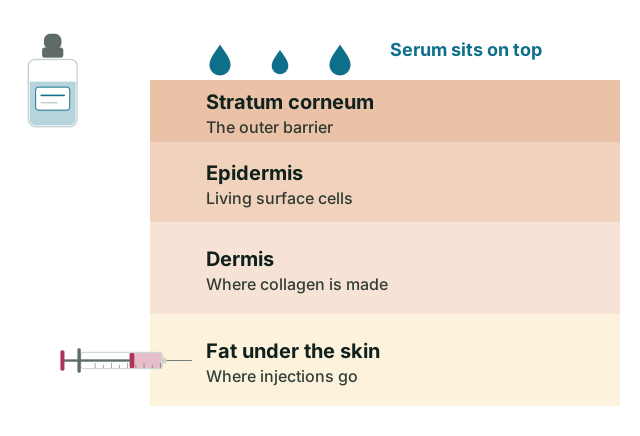
- Penetration is the weak point. Most peptides are water-loving and too large to pass easily through the outer skin barrier.
Signal peptides
Signal peptides are fragments modeled on pieces of collagen or other skin proteins. The most studied is palmitoyl pentapeptide-4, the five-amino-acid sequence KTTKS with a fatty acid (palmitic acid) attached to help it into skin. Besides the 93-woman trial above, a 2017 review describes a 49-woman, four-month double-blind study and two periorbital studies of 42 and 35 women, although those used products that also contained niacinamide and another peptide, so the peptide’s own share of the effect cannot be separated. Other signal peptides on labels include palmitoyl tripeptide-1, palmitoyl tetrapeptide-7, palmitoyl tripeptide-3/5 and tetrapeptide-21, each with one or two small studies of 10 to 60 people.
Carrier peptides
The carrier peptide in skin care is GHK-Cu, listed as copper tripeptide-1. It is a natural tripeptide bound to copper. The cosmetic evidence is mostly small studies, and the best-known facial results were never published in full. The GHK-Cu topical evidence page goes study by study.
Enzyme-inhibitor peptides
These are mostly plant-derived peptide mixtures, such as soybean, rice bran and silk peptides, said to block enzymes that break down collagen or produce pigment. A 2017 review of controlled studies said that “only very few or no in vivo studies have been conducted” in this group, and that their relevance “is still unclear.”
Neurotransmitter-inhibiting peptides
These are modeled on SNAP-25, a nerve-cell protein that botulinum toxin targets. The idea is to weaken the signal from nerve to muscle and soften expression lines. The best-studied is acetyl hexapeptide-8, and its record is the most instructive in skin care because the results disagree.
| Study | Who | What | Result |
|---|---|---|---|
| Blanes-Mira et al. 2002 (developer study) | 10 women, 30 days | Emulsion described as 10% hexapeptide | Wrinkle depth reduced up to 30% |
| Wang et al. 2013 | 60 Chinese adults, 4 weeks, randomized 3 to 1 vs placebo | Applied twice daily around the eyes | 48.9% judged improved vs 0% with placebo; roughness down on skin replicas |
| Henseler 2023 (independent) | 19 women, 4 weeks, double-blind split-face | Hyaluronic acid serum with vs without the peptide | No significant difference between sides |
The SNAP-8 page covers its longer relative, acetyl octapeptide-3.
Can peptides get through the skin?
Most do not get far. In an FDA laboratory study of a 10% acetyl hexapeptide-8 emulsion on human skin, 99.7% washed off the surface, 0.22% stayed in the outer dead-cell layer, and none was found in the dermis. A 2025 review concluded that topical delivery to muscle “is likely impossible” and that any effect is probably happening near the skin surface. Adding a fatty acid, the “palmitoyl” in many names, is a common way to improve passage. Injectable peptides reach a different layer altogether, which is why a serum study tells you nothing about an injection, and the reverse.
What is the best peptide serum?
No published trial compares finished peptide serums, so nobody can name a best one on evidence, whatever a ranking says. Studies test an ingredient or a single company’s formula. What can be compared is the ingredient record.
| If your goal is | Peptide names to look for | How good the evidence is |
|---|---|---|
| Fine lines | Palmitoyl pentapeptide-4 | Best single trial, but company-run and appearance-based |
| Expression lines | Acetyl hexapeptide-8 | Mixed: one positive randomized trial, one independent null study |
| A copper peptide | Copper tripeptide-1 | Thin, with 2 randomized trials among 20 eligible studies in a 2026 review |
| Dark spots or pigment | Soy or rice peptides | Very few or no human studies |
Price is no guide. The American Academy of Dermatology (AAD) says effective anti-aging products come in all price ranges. The full method, including claims to distrust, is in the guide to choosing a peptide serum.
How to read an INCI list
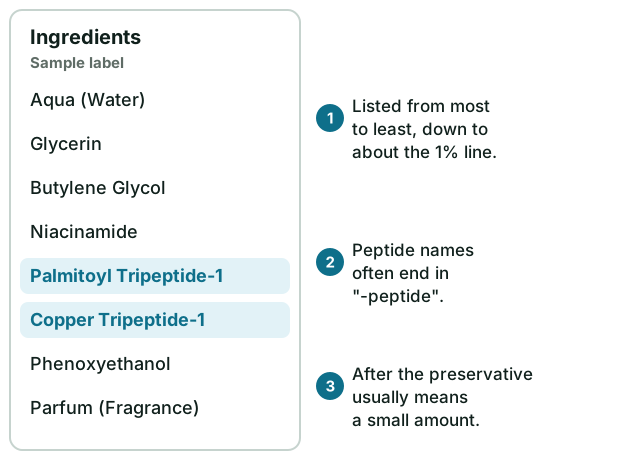
INCI names are the standard ingredient names on cosmetic labels. Peptide names follow a pattern: an optional prefix for a chemical add-on, then “peptide” with a prefix for its length, then a number that identifies the particular sequence.
| Part of the name | Meaning | Example |
|---|---|---|
| di-, tri-, tetra-, penta-, hexa-, octa- | 2, 3, 4, 5, 6 or 8 amino acids | Tripeptide = 3 amino acids |
| Palmitoyl | A fatty acid attached to help it enter skin | Palmitoyl pentapeptide-4 |
| Acetyl | An acetyl group attached, usually for stability | Acetyl hexapeptide-8 |
| Copper | Bound to a copper ion | Copper tripeptide-1 |
| The number after the dash | An identifier, not a strength or a grade; one molecule can even carry two numbers | Acetyl hexapeptide-8 and acetyl hexapeptide-3 are the same molecule |
Order on the list. US rules require ingredients in descending order of amount, but anything at 1% or less may be listed in any order after the ingredients above 1%. Peptides are typically used far below 1%: the palmitoyl pentapeptide-4 trial used 3 parts per million (0.0003%), and the US Cosmetic Ingredient Review panel found acetyl hexapeptide-8 safe “at concentrations up to 0.005%.” So a peptide near the end of a list says nothing about how much is there.
Trade names are not INCI names. Front-of-pack names for peptide blends are supplier trademarks. The ingredient list on the back shows which peptides are actually present.
Are peptide serums safe?
Published peptide studies report few problems. The 2005 palmitoyl pentapeptide-4 trial reported it was “well tolerated,” the 2023 split-face study saw no allergic reactions or irritation, and the 2026 meta-analysis reported no severe adverse events across its trials. The safety review panel found data insufficient to call acetyl hexapeptide-8 safe above 0.005%.
Reactions still happen, and the cause is often another ingredient. The AAD notes that a preservative can trigger allergic contact dermatitis. It recommends testing any new product on a quarter-sized spot, such as the underside of the arm, twice daily for 7 to 10 days, and stopping if the skin becomes red, itchy or swollen. A severe reaction that does not settle is one for a dermatologist.
Peptide serum vs retinol and sunscreen
Sunscreen and tretinoin both have stronger evidence than any peptide serum. A serum can sit on top of them, and it does not replace them.
| What it is | Evidence | Trade-off | |
|---|---|---|---|
| Daily broad-spectrum sunscreen | Prevention | Randomized trial of 903 adults over 4.5 years: daily users showed no detectable increase in skin aging, and 24% less aging than occasional users | Must be used daily |
| Prescription tretinoin 0.02% cream | FDA-approved drug | Approved as an add-on for fine facial wrinkles, alongside skin care and sun avoidance; its label says it “does not eliminate wrinkles” | In trials almost all users had some local irritation, and 32% had severe irritation or needed a break or a mild steroid. Not for use in pregnancy |
| Peptide serum | Cosmetic | A handful of small, mostly company-run studies; 2 qualifying randomized trials in a 2026 meta-analysis | Generally gentle; effect modest and less certain |
The closest head-to-head test is a 2010 Procter & Gamble-funded trial in 196 women. A three-product cosmetic routine containing peptides, niacinamide and a cosmetic retinoid scored better than a 0.02% tretinoin routine on expert grading at 8 weeks, with no difference at 24 weeks in a subgroup, and caused less dryness. That is encouraging for a well-built routine. It says little about peptides alone, because the routine contained a retinoid too.
The tretinoin label adds a useful reality check: in its controlled trials, many patients using only the inactive cream also saw the improvement they wanted in fine wrinkles, while following a skin care and sun-avoidance program with sunscreen, protective clothing and moisturizer. The AAD calls sunscreen and moisturizer the two most effective anti-aging products, and says anti-aging products “deliver modest results.”
If tretinoin has irritated your skin, a gentler cosmetic may be easier to live with, and that is a fair reason to choose one, provided you expect less from it.
Can you use a peptide serum with retinol or vitamin C?
There is little evidence of harm, and little of benefit. The 2010 routine combined peptides with a retinoid and was well tolerated. We found no published study of copper peptides combined with vitamin C or retinoids. The AAD advises against starting several anti-aging products at once, because that can irritate skin.
How long does a peptide serum take to work?
The AAD says most anti-aging products take at least six weeks, and sometimes up to three months. The peptide trials above ran 4 to 12 weeks. A moisturizer can plump fine lines in a few days, so a very quick change may be hydration. Results may fade once a product is stopped.
Cosmetic, not drug
FDA states that cosmetic products and ingredients “do not need FDA premarket approval,” apart from color additives, and that companies are legally responsible for their safety. FDA does not review cosmetics for effectiveness. If a serum claims to treat a disease or change how the body works, for example to “regenerate cells,” FDA treats it as a drug, and an unapproved one.
Injectable peptides are a separate world and are not cosmetics at all. Vials labeled “research use only” are not legal to use on people. For the broader question of what helps aging skin, see peptides for skin.
Compare
Peptide news, sorted. Plus the printable dose chart.
Sorted, every Tuesday: the week's peptide and GLP-1 news in five minutes: FDA moves, new studies explained, and price changes. Subscribe and the one-page dose and injection-site chart arrives first.
Questions people ask
Do peptide serums actually work?
What is the best peptide serum?
Are peptides better than retinol or retinoids?
Can peptides get through the skin?
Do peptide serums cause irritation?
Is a peptide serum FDA-approved?
Sources
Primary sources first: FDA labels and documents, peer-reviewed trials, registries.
- 1Gorouhi F, Maibach HI. Role of topical peptides in preventing or treating aged skin. Int J Cosmet Sci 2009pubmed.ncbi.nlm.nih.gov
- 2Schagen SK. Topical peptide treatments with effective anti-aging results. Cosmetics 2017mdpi.com
- 3Nukaly HY et al. Oral and topical peptides for skin aging: systematic review and meta-analysis of randomized controlled trials. Front Med 2026pubmed.ncbi.nlm.nih.gov
- 4Robinson LR et al. Topical palmitoyl pentapeptide provides improvement in photoaged human facial skin. Int J Cosmet Sci 2005pubmed.ncbi.nlm.nih.gov
- 5Blanes-Mira C et al. A synthetic hexapeptide (Argireline) with antiwrinkle activity. Int J Cosmet Sci 2002pubmed.ncbi.nlm.nih.gov
- 6Wang Y et al. The anti-wrinkle efficacy of argireline, a synthetic hexapeptide, in Chinese subjects: a randomized, placebo-controlled study. Am J Clin Dermatol 2013pubmed.ncbi.nlm.nih.gov
- 7Henseler H. Investigating the effects of Argireline in a skin serum containing hyaluronic acids on skin surface wrinkles. GMS Interdiscip Plast Reconstr Surg DGPW 2023pubmed.ncbi.nlm.nih.gov
- 8Kraeling ME et al. In vitro skin penetration of acetyl hexapeptide-8 from a cosmetic formulation (FDA laboratory study). Cutan Ocul Toxicol 2015pubmed.ncbi.nlm.nih.gov
- 9Zdrada-Nowak J et al. Acetyl hexapeptide-8 in cosmeceuticals: a review of skin permeability and efficacy. Int J Mol Sci 2025pubmed.ncbi.nlm.nih.gov
- 10Johnson W Jr et al. Safety assessment of acetyl hexapeptide-8 amide as used in cosmetics (Cosmetic Ingredient Review). Int J Toxicol 2025pubmed.ncbi.nlm.nih.gov
- 11Mortazavi SM et al. Topically applied GHK as an anti-wrinkle peptide: advantages, problems and prospective. BioImpacts 2024pubmed.ncbi.nlm.nih.gov
- 12Mokhtar J et al. The regenerative potential of GHK-Cu in aesthetic medicine (systematic review). Aesthet Surg J 2026pubmed.ncbi.nlm.nih.gov
- 13Hughes MC et al. Sunscreen and prevention of skin aging: a randomized trial. Ann Intern Med 2013pubmed.ncbi.nlm.nih.gov
- 14Tretinoin cream 0.02% prescribing information (indications and adverse reactions), via DailyMeddailymed.nlm.nih.gov
- 15Fu JJ et al. A randomized, controlled comparative study of the wrinkle reduction benefits of a cosmetic niacinamide/peptide/retinyl propionate product regimen vs. a prescription 0.02% tretinoin product regimen. Br J Dermatol 2010pmc.ncbi.nlm.nih.gov
- 16PubChem. Acetyl hexapeptide-8 (acetyl hexapeptide-3), CID 71587772pubchem.ncbi.nlm.nih.gov
- 1721 CFR 701.3, designation of ingredients on cosmetic labelslaw.cornell.edu
- 1821 CFR 312.160, drugs for investigational use in laboratory research animals or in vitro testslaw.cornell.edu
- 19FDA. FDA authority over cosmetics: how cosmetics are not FDA-approved, but are FDA-regulated (content current as of November 18, 2025)fda.gov
- 20FDA. Is it a cosmetic, a drug, or both? (or is it soap?) (content current as of September 11, 2024)fda.gov
- 21American Academy of Dermatology. How to select anti-aging skin care productsaad.org
- 22American Academy of Dermatology. How to maximize results from anti-aging skin care productsaad.org
- 23American Academy of Dermatology. How to test skin care products (last updated August 10, 2021)aad.org
More in Skincare
- Copper peptide serumCopper peptide serum contains GHK-Cu, listed as copper tripeptide-1. See what studies found, the strengths tested, what is known on mixing, and its limits.Read
- Choosing a peptide serumNo trial compares finished peptide serums, so no honest best list exists. Use this label checklist: named peptides, percent, claims, patch test, timing.Read
- SNAP-8SNAP-8 is a trade name for acetyl octapeptide-3. No published study tests it alone, and its wrinkle figure comes from the supplier. See the evidence.Read
PeptideSorted Editorial Team
Editorial review
The PeptideSorted editors check every guide against its cited sources before publication: each number against its FDA label, trial or registry, the FDA status against current FDA and HHS documents, and the wording against our describe-never-prescribe rule. Licensed clinicians who join the review panel are listed by name on the editorial team page.
This page was checked against its cited sources by the PeptideSorted editorial team. Licensed clinicians on our review panel are listed on the editorial team page. Every health page cites primary sources and shows its review date. Read the editorial policy and how medical review works, or report an error via corrections. Educational only; not medical advice.