Short answer
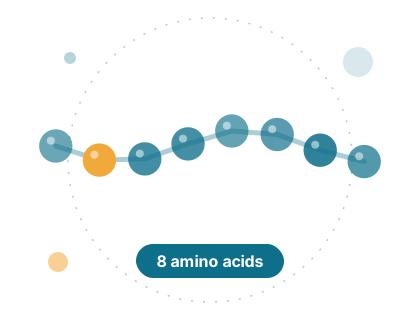
SNAP-8 is a supplier's trade name for acetyl octapeptide-3, an eight-amino-acid cosmetic peptide sold to soften expression lines. We found no peer-reviewed study testing it alone. Its headline wrinkle figure comes from the supplier, and the two published human studies tested multi-ingredient microneedle patches. It is a cosmetic ingredient, not an FDA-approved drug.
- What it is
- A synthetic eight-amino-acid cosmetic peptide (acetyl octapeptide-3), modeled on part of the nerve protein SNAP-25.
- FDA status
- Not a drug
A cosmetic ingredient. Cosmetics do not need FDA approval before sale, and FDA does not review them for effectiveness.
- Evidence level
Early human studies
Small or uncontrolled human studies only.
SNAP-8 is the trade name a cosmetic ingredient supplier uses for acetyl octapeptide-3, a lab-made chain of eight amino acids sold to soften expression lines such as crow’s feet. It is a cosmetic ingredient, not an FDA-approved drug, and FDA does not review cosmetics for effectiveness. We found no peer-reviewed study that tested it on its own, so its reputation rests on supplier claims and on studies of a shorter relative. The skincare peptides index has the wider set, and the peptide serum guide shows where this peptide fits.
What is SNAP-8?
SNAP-8 is acetyl hexapeptide-8, better known by the trade name Argireline, with two amino acids added to the end.
| Acetyl octapeptide-3 (SNAP-8) | Acetyl hexapeptide-8 | |
|---|---|---|
| Length | 8 amino acids | 6 amino acids |
| Sequence | Ac-Glu-Glu-Met-Gln-Arg-Arg-Ala-Asp-NH2 | Ac-Glu-Glu-Met-Gln-Arg-Arg-NH2 |
| Molecular weight | 1,075 daltons | 887 daltons |
| Other names | PubChem also lists acetyl glutamyl heptapeptide-3 | Also listed as acetyl hexapeptide-3; sold under the trade name Argireline |
| Published human studies of the peptide alone | None found | Several, including randomized trials |
| Formal safety assessment | None found from the US Cosmetic Ingredient Review panel | Found safe as used at up to 0.005% (2025) |
The added amino acids are alanine and aspartic acid. Both peptides are modeled on the start of SNAP-25, a nerve-cell protein that helps release acetylcholine, the chemical messenger that makes muscles contract. The supplier describes SNAP-8 as competing with SNAP-25 “for a position in the SNARE complex, essential for the muscle contraction.” The SNARE complex is the protein machinery that botulinum toxin disrupts, which is why these peptides are marketed as “Botox-like.”
Does SNAP-8 work?
Nobody independent has shown that it does. That is different from showing it fails: the test has simply not been published.
Supplier data
The supplier’s listing describes SNAP-8 as a “premium topical alternative to botulinum toxin injections,” says it acts against “persistent expression wrinkles” and claims “up to 56% roughness reduction.” The listing does not say how many people were tested, for how long, against what control, or whether the results were peer reviewed. Larger wrinkle-reduction figures repeated on retail and blog sites could not be traced to any published study, so this page does not repeat them.
Published human studies
A PubMed search for acetyl octapeptide-3, SNAP-8 and acetyl glutamyl heptapeptide on November 2, 2026 returned two records. Both tested multi-ingredient microneedle patches rather than a serum.
| Study | Who | What was applied | Length | Result | Who ran it |
|---|---|---|---|---|---|
| Avcil et al. 2020, J Cosmet Dermatol | Healthy adults with aged skin; single centre, no placebo described | Hyaluronic acid microneedle patch with acetyl octapeptide-3, an arginine/lysine polypeptide, palmitoyl tripeptide-5, adenosine and seaweed extracts | 12 weeks | Fine lines 25.8% lower; no skin reactions reported | Authors from two companies and a skin-testing laboratory |
| Shin et al. 2024, Ann Dermatol | 24 healthy adults; one eye area treated, the other given a hyaluronic acid-only patch | Dissolving microneedle patch with acetyl octapeptide-3, a vitamin C derivative and sodium cyclic lysophosphatidic acid | 28 days | Better eye-wrinkle scores than the placebo patch; no adverse effects | Most authors employed by a microneedle patch company |
Neither study can say what acetyl octapeptide-3 did on its own, because each product combined it with other actives. Both used microneedles, which push ingredients past the skin barrier in a way a serum does not. Both had authors from companies in the microneedle patch business. So a figure like 25.8% describes a whole patch, and it should not be read as a SNAP-8 result, let alone a serum result.
SNAP-8 vs Argireline
Argireline has the longer record, and that record is mixed. Because SNAP-8 is marketed as an extension of acetyl hexapeptide-8, the shorter peptide is the closest guide to what to expect.
- The shorter peptide has more studies. A 2002 developer study in 10 women reported wrinkle depth down up to 30% after 30 days. A 2013 randomized trial in 60 adults found 48.9% judged improved, compared with 0% on placebo, after 4 weeks.
- Not every study is positive. An independent 2023 double-blind split-face study of 19 women found no significant difference between a serum with acetyl hexapeptide-8 and the same serum without it.
- Getting into skin is the problem. In an FDA laboratory study, 99.7% of acetyl hexapeptide-8 applied in a cosmetic emulsion washed off the surface, and none reached the dermis. A 2025 review concluded that delivering it to muscle through the skin “is likely impossible.” The octapeptide is about 20% heavier, and we found no published study of how well it penetrates.
- A head-to-head comparison does not exist. We found no published study comparing acetyl octapeptide-3 with acetyl hexapeptide-8.
- Safety review. The Cosmetic Ingredient Review panel concluded acetyl hexapeptide-8 is safe in cosmetics “at concentrations up to 0.005%” and that data were insufficient above that. We found no equivalent assessment for acetyl octapeptide-3.
SNAP-8 vs Botox
No published study compares them, and they are not the same kind of product. Botox Cosmetic is an FDA-approved drug injected into muscle. A SNAP-8 serum is a cosmetic that sits on the skin.
| SNAP-8 serum | Botox Cosmetic (onabotulinumtoxinA) | |
|---|---|---|
| Status | Cosmetic ingredient; FDA does not review effectiveness | FDA-approved drug |
| How it reaches the target | Applied to the surface; whether it reaches muscle is doubtful | Injected into the muscle |
| Approved for | Nothing; cosmetics carry appearance claims only | Temporary improvement of moderate to severe frown lines, crow’s feet, forehead lines and neck bands in adults |
| Human evidence | No published study of the peptide alone | Placebo-controlled trials; effect on frown lines lasted about 3 to 4 months |
| Main safety point | Little data; no formal safety assessment found | Boxed warning that toxin effects may spread from the injection site, with possible swallowing and breathing difficulties |
The author of the 2023 split-face study reached the same place for the shorter peptide, concluding that it is no alternative to botulinum toxin. The peptide’s own developers wrote that its efficacy was much lower than the toxin’s. If you have seen “Botox in a bottle” on a label, that is a marketing line, and no published data support it.
What has stronger evidence for lines?
If you want softer lines and are weighing a serum, these have firmer evidence behind them.
| Option | What it is | Evidence |
|---|---|---|
| Daily broad-spectrum sunscreen | Prevention | 903 adults, 4.5 years: 24% less skin aging than discretionary use |
| Tretinoin 0.02% cream | FDA-approved prescription drug | Approved as an add-on for fine facial wrinkles; its label says it does not eliminate them; 32% had severe irritation or needed a break or mild steroid; not for use in pregnancy |
| Botulinum toxin | FDA-approved injected drug | Approved for the expression lines listed above, given by a clinician |
A serum can still be a reasonable personal choice. It simply has much less behind it.
How much is in a product?
Very little peptide. The supplier sells SNAP-8 as a water-based solution containing 0.05% acetyl octapeptide-3 and suggests using 3% to 10% of that solution in a finished product. That works out to roughly 0.0015% to 0.005% of the peptide itself. A figure such as “10% SNAP-8” on a bottle refers to the solution; at the supplier’s stated strength that is about 0.005% peptide.
On an ingredient list, look for acetyl octapeptide-3, because SNAP-8 is a trade name and may appear only on the front of the pack. The supplier’s listing gives the ingredient as acetyl octapeptide-3 with caprylyl glycol. US rules let ingredients at 1% or less appear in any order after those above 1%, so position on the list does not show the amount. The guide to choosing a peptide serum explains what else a label can tell you.
How to read a SNAP-8 claim
When a brand quotes a percentage for SNAP-8, three questions usually settle it. Does the number come from a published study, or from a supplier sheet with no study details? Did the test use the peptide alone, or a mixture? A 2017 review warned that with mixtures the results “cannot be claimed clearly to be the effect of the used peptide.” And was it a serum, or a microneedle patch? If a brand cannot answer those, the figure tells you nothing about the bottle in your hand.
Can you use SNAP-8 with retinol, vitamin C or Argireline?
We found no published study of these combinations, for benefit or harm. Serums that pair SNAP-8 with acetyl hexapeptide-8 are making an untested assumption that the two add up. The American Academy of Dermatology (AAD) advises starting one anti-aging product at a time, because several at once can irritate skin.
Side effects and irritation
The two patch studies reported no skin reactions or adverse effects. Neither was designed to detect rare reactions, and we found no formal safety assessment of this peptide. The AAD suggests testing any new product on a quarter-sized spot twice daily for 7 to 10 days, and advises stopping one that stings, burns or tingles. Any vial or powder labeled “research use only”, whatever the peptide, is not legal to use on people.
How long would it take to see a change?
No study of SNAP-8 alone can answer that. The AAD says most anti-aging products take at least six weeks and sometimes up to three months. The patch studies ran 28 days and 12 weeks, but microneedles make those timelines a poor guide to a serum.
The bottom line on evidence
SNAP-8 is a plausible idea with almost no independent data. Its relative, acetyl hexapeptide-8, has small and mixed human studies and a penetration problem. Under US law the supplier and the brand are responsible for safety, and no one is required to prove to FDA that a cosmetic works. For the broader evidence on aging skin, see peptides for skin.
Compare
Peptide news, sorted. Plus the printable dose chart.
Sorted, every Tuesday: the week's peptide and GLP-1 news in five minutes: FDA moves, new studies explained, and price changes. Subscribe and the one-page dose and injection-site chart arrives first.
Questions people ask
What is SNAP-8?
Does SNAP-8 work?
Is SNAP-8 better than Argireline (acetyl hexapeptide-8)?
Is SNAP-8 like Botox?
How much SNAP-8 is in a serum?
Does SNAP-8 have side effects?
Sources
Primary sources first: FDA labels and documents, peer-reviewed trials, registries.
- 1PubChem. Acetyl octapeptide-3 (Ac-Glu-Glu-Met-Gln-Arg-Arg-Ala-Asp-NH2), CID 76283482pubchem.ncbi.nlm.nih.gov
- 2PubChem. Acetyl hexapeptide-8 (acetyl hexapeptide-3; Ac-Glu-Glu-Met-Gln-Arg-Arg-NH2), CID 71587772pubchem.ncbi.nlm.nih.gov
- 3Ingredient supplier listing for SNAP-8 peptide solution: INCI composition, peptide content, use level and claims (Knowde)knowde.com
- 4Avcil M et al. Efficacy of bioactive peptides loaded on hyaluronic acid microneedle patches: a monocentric clinical study. J Cosmet Dermatol 2020pubmed.ncbi.nlm.nih.gov
- 5Shin JY et al. Clinical safety and efficacy evaluation of a dissolving microneedle patch having dual anti-wrinkle effects. Ann Dermatol 2024pubmed.ncbi.nlm.nih.gov
- 6Blanes-Mira C et al. A synthetic hexapeptide (Argireline) with antiwrinkle activity. Int J Cosmet Sci 2002pubmed.ncbi.nlm.nih.gov
- 7Wang Y et al. The anti-wrinkle efficacy of argireline, a synthetic hexapeptide, in Chinese subjects: a randomized, placebo-controlled study. Am J Clin Dermatol 2013pubmed.ncbi.nlm.nih.gov
- 8Henseler H. Investigating the effects of Argireline in a skin serum containing hyaluronic acids on skin surface wrinkles. GMS Interdiscip Plast Reconstr Surg DGPW 2023pubmed.ncbi.nlm.nih.gov
- 9Kraeling ME et al. In vitro skin penetration of acetyl hexapeptide-8 from a cosmetic formulation (FDA laboratory study). Cutan Ocul Toxicol 2015pubmed.ncbi.nlm.nih.gov
- 10Zdrada-Nowak J et al. Acetyl hexapeptide-8 in cosmeceuticals: a review of skin permeability and efficacy. Int J Mol Sci 2025pubmed.ncbi.nlm.nih.gov
- 11Johnson W Jr et al. Safety assessment of acetyl hexapeptide-8 amide as used in cosmetics (Cosmetic Ingredient Review). Int J Toxicol 2025pubmed.ncbi.nlm.nih.gov
- 12Schagen SK. Topical peptide treatments with effective anti-aging results. Cosmetics 2017mdpi.com
- 13Botox Cosmetic (onabotulinumtoxinA) prescribing information, revised October 2024, via DailyMeddailymed.nlm.nih.gov
- 14Hughes MC et al. Sunscreen and prevention of skin aging: a randomized trial. Ann Intern Med 2013pubmed.ncbi.nlm.nih.gov
- 15Renova (tretinoin cream) 0.02% prescribing information, via DailyMeddailymed.nlm.nih.gov
- 16American Academy of Dermatology. How to test skin care products (last updated August 10, 2021)aad.org
- 17American Academy of Dermatology. How to maximize results from anti-aging skin care productsaad.org
- 18FDA. FDA authority over cosmetics: how cosmetics are not FDA-approved, but are FDA-regulated (content current as of November 18, 2025)fda.gov
- 1921 CFR 701.3, designation of ingredients on cosmetic labelslaw.cornell.edu
- 2021 CFR 312.160, drugs for investigational use in laboratory research animals or in vitro testslaw.cornell.edu
More in Skincare
- Copper peptide serumCopper peptide serum contains GHK-Cu, listed as copper tripeptide-1. See what studies found, the strengths tested, what is known on mixing, and its limits.Read
- Choosing a peptide serumNo trial compares finished peptide serums, so no honest best list exists. Use this label checklist: named peptides, percent, claims, patch test, timing.Read
- Peptide serumPeptide serums are cosmetics backed by small, often company-run studies. What each type does, how to read the label, and what has stronger evidence.Read
PeptideSorted Editorial Team
Editorial review
The PeptideSorted editors check every guide against its cited sources before publication: each number against its FDA label, trial or registry, the FDA status against current FDA and HHS documents, and the wording against our describe-never-prescribe rule. Licensed clinicians who join the review panel are listed by name on the editorial team page.
This page was checked against its cited sources by the PeptideSorted editorial team. Licensed clinicians on our review panel are listed on the editorial team page. Every health page cites primary sources and shows its review date. Read the editorial policy and how medical review works, or report an error via corrections. Educational only; not medical advice.