Peptides by goal
People do not search for a peptide; they search for an outcome. This section starts from the goal and says honestly which peptides have human evidence for it, which have only animal data, and which are FDA-approved for something else entirely.

| Goal | Does any peptide have evidence? | The short version |
|---|---|---|
| Weight loss | Yes, with approved drugs. | Tirzepatide, semaglutide and orforglipron have phase 3 trials and FDA labels. |
| Muscle growth | Indirect at best. | No peptide is approved for muscle. Tesamorelin added about 1.2 kg of lean mass in HIV trials, lost after stopping; no strength benefit shown. |
| Injury and tendon healing | Animal data only. | BPC-157 and TB-500 (the "Wolverine stack") have rodent studies and no controlled human trials. |
| Skin | Topicals have some evidence. | Small randomized cosmetic trials back some signal peptides in creams; injected blends like Glow and Klow have no human data. |
| Hair growth | No; the approved drugs have the evidence. | Copper and biotinoyl peptides have lab and small sponsored studies. Minoxidil and finasteride have large trials. |
| Sexual function | One approved drug, narrow use. | Bremelanotide (Vyleesi) is approved for acquired HSDD in premenopausal women. |
| Sleep | Not established. | DSIP had small, mixed trials decades ago and lost a PCAC vote in July 2026; selank has no sleep trials. |
Guides
- Glow blendGlow is an injectable blend of GHK-Cu, BPC-157 and TB-500, never tested in people and outside the HHS policy. See what each ingredient really shows.
- Klow blendKlow is Glow plus KPV: four unapproved peptides in one vial, never tested in people and outside the HHS policy for three reasons. See what KPV adds.
- Hair growthNo peptide is FDA-approved for hair loss. See what the small peptide studies measured, who paid for them, and how minoxidil and finasteride compare.
- Muscle growthNo peptide is FDA-approved to build muscle. What tesamorelin, sermorelin, CJC-1295, ipamorelin and MK-677 did to lean mass and strength in human trials.
- SkinA few skin peptides beat a control in small, mostly company-run trials. None is FDA-approved. See the evidence by type and what has stronger proof.
- SleepNo peptide is FDA-approved for sleep. DSIP's 1980s trials were mixed, epitalon and selank have no sleep trials, and proven insomnia treatments exist.
- Weight lossSemaglutide and tirzepatide are the FDA-approved peptides with strong weight-loss trials. AOD-9604 and MOTS-c are not. See the evidence, group by group.
- WomenThe peptides with real evidence for women are approved drugs with rules written for women: libido, the pill, pregnancy, bone. Most others are untested.
- Wolverine stackThe Wolverine stack is BPC-157 plus TB-500 for injury healing. It has no controlled human evidence, and blended vials fall outside the interim HHS policy.
Start with the approved option
Where an FDA-approved drug exists for a goal, it has trials, a label and a known side-effect profile, so every goal page starts there. For weight loss, that means the drugs in the GLP-1 section. For sexual function, one narrow option exists in PT-141. For hair, the drugs with large trials are not peptides at all, and the same holds for much of skin care.
How strong is the evidence?
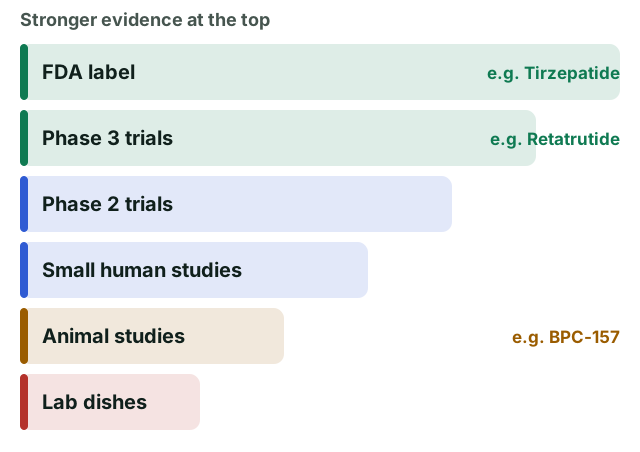
The table above sorts each goal by the best evidence that exists, and the gaps are wide. A lab dish or a rat study can suggest an idea. It cannot tell you what a peptide will do in a person, at what dose, or with what harm. Muscle growth shows why this matters: the best human data come from tesamorelin in HIV trials, with lean mass gained and then lost after stopping, and no strength benefit shown.
How stacks are judged here
A "stack" is two or more peptides sold together under a brand name such as Glow, Klow or Wolverine. The name is marketing. The ingredients are the same unapproved peptides listed in the A–Z, and no combination has been tested in people. Each stack page lists what is in it, the FDA status of each part, and the evidence for each part on its own, which is the most anyone can honestly say.
As of November 2, 2026, blends also sit outside the interim HHS policy on six peptides. HHS says it does not intend to take enforcement action against compounding of those six when ten conditions are met, and one condition is a single active ingredient per product. That holds even when every ingredient in a blend is on the list. The policy is not an approval: none of the six is FDA-approved or on the 503A bulks list, no rule has been proposed, and FDA has not reviewed any compounded product. It creates no rights, HHS may revisit it, states can be stricter, and the evidence has not changed.
What to do with a goal instead
Take the goal to a clinician before you take it to a product. Ask what has been shown to work for it, what the realistic result is, and what the risks are for you. If a goal is specific to women or sleep is the problem, those pages list what has actual trials behind it. Whatever the goal, products sold "for research use only" are not legal to use on people. The are peptides safe guide explains why.