
Short answer
No peptide is FDA-approved for sleep, and the human evidence is thin. DSIP had a few small, mixed insomnia trials decades ago, epitalon and selank have no published sleep trials, and growth-hormone releasers deepened sleep only in tiny lab studies. Cognitive behavioral therapy for insomnia is usually the first treatment recommended.
No peptide is approved to treat insomnia, and sleep is the goal where the peptide evidence is thinnest. What exists is a few small studies from the 1980s and 1990s, most run in sleep laboratories with intravenous injections, plus Russian anxiety trials that did not measure sleep. Several of these compounds went before an FDA advisory committee in July 2026, the most recent independent look at them. Sleep sits with the other outcomes in our peptides by goal index.
What has been tested in human sleep
| Compound | FDA status, November 2, 2026 | Human sleep evidence |
|---|---|---|
| DSIP (emideltide) | Not approved. Advisory committee voted 6 to 7 against it for compounding on July 24, 2026, matching FDA staff’s proposal. Not covered by the HHS policy | Small placebo-controlled insomnia studies, all intravenous, in the 1980s and 1992. Results mixed: one positive, two finding little clinical benefit |
| Epitalon | Not approved. Committee recommended it for insomnia against FDA staff advice; no rule. Named in the interim HHS policy, with conditions | None. FDA found no published study of epitalon in people with insomnia; the one human study measured a melatonin marker, not sleep |
| Selank, a 7-amino-acid peptide | Not approved; category 2 in 2023, nomination since withdrawn; no compounding route. Not covered by the HHS policy | No published sleep trial found. Russian trials tested it for anxiety |
| GHRH and its analogs (the sermorelin family) | Not approved for sleep. Tesamorelin is approved for HIV-related belly fat only | Repeated intravenous GHRH increased deep sleep in healthy men in one lab study. No sleep benefit with nightly injections in older adults |
| Ibutamoren (MK-677), oral, not a peptide | Not approved; 503A category 2 as of May 2026 | 8 young and 6 older adults: more deep sleep and REM sleep over 1 to 2 weeks |
What people hope for, and what was measured
Most people searching for a sleep peptide want to fall asleep faster, wake less in the night and feel rested, without the hangover or dependence they associate with sleeping pills. The studies above rarely asked those questions of people with insomnia. The growth hormone work measured brain-wave sleep stages in healthy volunteers. The epitalon study measured a urine marker. Only the DSIP trials enrolled people with chronic insomnia, and the largest had 16 patients.
DSIP
Delta sleep-inducing peptide promoted sleep in animal experiments, and in the 1980s it had a brief run of human testing, much of it by one research group. The most positive study, published in 1987, gave 14 middle-aged people with chronic insomnia DSIP by intravenous injection on 7 nights under double-blind conditions and reported that sleep improved to the level of normal controls. The same year, a double-blind crossover study in insomniacs found that apparent gains were already present at baseline and concluded the improvement was “of little clinical significance.” A 1992 Dutch trial of 16 insomniacs found weak effects, partly explained by a change in the placebo group, and concluded that DSIP “is not likely to be of major therapeutic benefit.”
That is essentially the whole human record. In July 2026, FDA reviewed emideltide (DSIP) for opioid withdrawal, chronic insomnia and narcolepsy. FDA staff proposed that it not be added to the list pharmacies may compound from, and the advisory committee agreed, voting 6 to 7 with one abstention. It was the only one of the seven peptides reviewed that week to be turned down.
Growth hormone secretagogues and sleep
Growth hormone is released in a large pulse early in the night, during deep sleep, which is why researchers tested whether GH-releasing compounds change sleep. These compounds all act upstream, at the pituitary, rather than supplying growth hormone itself.
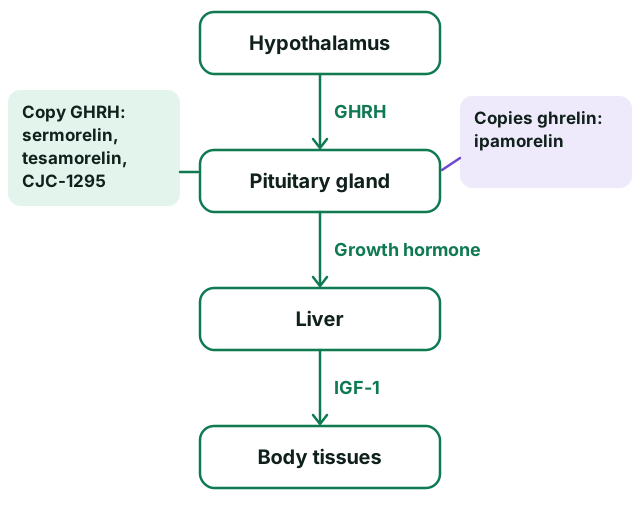
- GHRH by vein, in healthy men. In a 1996 German study, four intravenous doses of GHRH spread through the evening increased slow-wave (deep) sleep and REM sleep against placebo in healthy volunteers. A continuous infusion of the same total dose did nothing measurable.
- GHRH in older people. The effect did not hold up with age. In two older men, repeated GHRH did not improve sleep. In a 16-week study of 19 adults aged 55 to 71 who injected a GHRH 1-29 analog under the skin each night, questionnaire-rated sleep quality was unchanged.
- MK-677. In 8 young adults, a week of high-dose MK-677 at bedtime increased stage 4 sleep by about half and REM sleep by more than a fifth against placebo; in 6 older adults, REM sleep rose by nearly half. MK-677 is not a peptide, and a year-long trial in older adults found it raised fasting glucose and reduced insulin sensitivity.
The MK-677 study had 14 people in total and the older-men GHRH study had 2. None of the growth hormone studies enrolled people with diagnosed insomnia, and the one that looked most like real use, nightly shots at home for 16 weeks, found no change.
Does epitalon help sleep?
No study has shown that it does. Epitalon is marketed for sleep because it is linked to the pineal gland, which makes melatonin, the hormone that signals night to the body. FDA reviewed it for insomnia in a memo dated May 12, 2026 and found no published study of its effectiveness in people with insomnia, and no clinical study of it given by injection, the form proposed.
The one human study FDA found took 40 women aged 40 to 50, mostly night-shift workers, whose melatonin markers were low, and gave them an under-the-tongue spray or placebo for 20 days. A melatonin breakdown product in urine rose 1.7-fold on epitalon. The study “did not evaluate sleep outcomes.” FDA also pointed out that low melatonin levels “have not been consistently associated with insomnia in elderly adults,” so raising a melatonin marker would not by itself show better sleep. It found no animal studies measuring sleep either, and said there were insufficient data to rule out immune reactions to injected epitalon.
Selank
Selank is a 7-amino-acid peptide (Thr-Lys-Pro-Arg-Pro-Gly-Pro) developed in Russia. The trials found on PubMed are Russian studies of anxiety, such as a 62-patient comparison against the benzodiazepine medazepam, not of sleep. A 2021 review in the Journal of Clinical Pharmacology described selank and phenibut as “poorly studied Russian drugs” that are “inexplicably sold to US consumers as dietary supplements.” In the US it is not approved and has no compounding route.
Where the October 2026 HHS policy fits
On October 28, 2026, HHS announced an interim policy, published in the Federal Register on October 30. As of November 2, 2026, HHS says it does not intend to take enforcement action against a state-licensed pharmacy, federal facility or licensed physician compounding one of six peptides, if ten conditions are met, until a final rule decides each one. Of the sleep compounds:
| Compound | In the HHS policy? |
|---|---|
| Epitalon | Yes, as epitalon acetate by injection under the skin or into muscle, dispensed in intermittent courses, under all ten conditions |
| Emideltide (DSIP) | No |
| Selank | No |
| MK-677 | No, and it is not a peptide |
| Sermorelin and other GHRH analogs | No |
Enforcement discretion is a choice not to enforce. It is not an approval, it does not create a right, and HHS can revisit it if a safety problem appears. It covers 503A pharmacies only, states can be stricter, and public comments are open until November 13, 2026. It also says nothing about whether epitalon helps sleep; the evidence is where FDA left it in May. Products sold “for research use only” gain nothing from the policy. Under 21 CFR 312.160 that label covers shipment for lab or animal tests, and those products are not legal to use on people. The FDA status tracker follows each compound.
What is approved for insomnia?
Several treatments have the evidence the peptides lack. The National Heart, Lung, and Blood Institute (NHLBI) says cognitive behavioral therapy for insomnia (CBT-I), a 6- to 8-week program that teaches you to fall asleep faster and stay asleep longer, is “usually recommended as the first treatment option for long-term insomnia.” FDA’s epitalon memo lists approved medicine classes alongside it:
| Approach | Examples named by FDA or NHLBI | Notes from the label or NHLBI |
|---|---|---|
| CBT-I | Structured therapy over 6 to 8 weeks | NHLBI’s usual first choice for long-term insomnia |
| Orexin receptor antagonists | Suvorexant (Belsomra) | Blocks the wake-promoting neuropeptides orexin A and B; contraindicated in narcolepsy |
| Benzodiazepine receptor agonists | Eszopiclone, zaleplon, zolpidem | Prescription only; NHLBI lists anxiety as a possible side effect |
| Melatonin receptor agonists | Ramelteon (Rozerem) | Prescription drug, distinct from supplement melatonin |
| Benzodiazepines | Quazepam, triazolam | NHLBI says they can be habit-forming and are meant for only a few weeks |
The closest thing to an approved “sleep peptide” works the other way round. The Belsomra label explains that “the orexin neuropeptide signaling system plays a role in wakefulness,” and suvorexant blocks orexin from binding its receptors. So the one FDA-approved sleep drug class built around a peptide system blocks a peptide instead of adding one. It carries its own warnings: complex sleep behaviors such as sleep-walking and sleep-driving, worsening depression or suicidal thinking, and next-day impairment.
Over-the-counter melatonin is not the answer the marketing suggests either. NHLBI says “research has not proven that melatonin is an effective treatment for insomnia,” and lists daytime sleepiness, headaches, upset stomach and worsening depression among its side effects.
Why trying a peptide first carries a cost
Chronic insomnia is not a small problem to experiment around. FDA’s memo, citing NHLBI, notes that it increases the risk of high blood pressure, coronary heart disease, diabetes and cancer, and is linked to psychiatric disorders and self-medication with alcohol. Months spent on an untested injection are months without a treatment that works.
The products carry risks of their own. A research vial has no verified contents or sterility. MK-677 raised blood sugar in older adults. FDA found no clinical study of epitalon given by injection, and the DSIP trials were too small and too short to say much about safety.
Questions to bring to a clinician
- Could a medicine I already take, or another health problem, be part of the cause?
- Is CBT-I available, in person or online, and how long would it take?
- If a medicine makes sense, which class fits, and what are its label warnings?
- How will we know in a few weeks whether the plan is working?
Compare
- PeptidesNot FDA approvedEpitalonEpitalon is a four-amino-acid peptide sold for aging and sleep.
- PeptidesNot FDA approvedSelankSelank is a nasal anxiety peptide registered in Russia and not FDA-approved.
- LearnFDA status trackerWhich peptides are FDA-approved, which HHS tolerates under conditions, and which are not legal to use.
Peptide news, sorted. Plus the printable dose chart.
Sorted, every Tuesday: the week's peptide and GLP-1 news in five minutes: FDA moves, new studies explained, and price changes. Subscribe and the one-page dose and injection-site chart arrives first.
Questions people ask
What is the best peptide for sleep?
Does DSIP work for insomnia?
Is DSIP covered by the HHS peptide policy?
Does epitalon help you sleep?
Does sermorelin improve sleep?
Sources
Primary sources first: FDA labels and documents, peer-reviewed trials, registries.
- 1Schneider-Helmert D. Effects of delta-sleep-inducing peptide on 24-hour sleep-wake behaviour in severe chronic insomnia. Eur Neurol 1987pubmed.ncbi.nlm.nih.gov
- 2Schneider-Helmert D, Schoenenberger GA. Effects of DSIP in man: multifunctional psychophysiological properties besides induction of natural sleep. Neuropsychobiology 1983pubmed.ncbi.nlm.nih.gov
- 3Monti JM et al. Study of delta sleep-inducing peptide efficacy in improving sleep on short-term administration to chronic insomniacs. Int J Clin Pharmacol Res 1987pubmed.ncbi.nlm.nih.gov
- 4Bes F et al. Effects of delta sleep-inducing peptide on sleep of chronic insomniac patients: a double-blind study. Neuropsychobiology 1992pubmed.ncbi.nlm.nih.gov
- 5Marshall L et al. Greater efficacy of episodic than continuous GHRH administration in promoting slow-wave sleep. J Clin Endocrinol Metab 1996pubmed.ncbi.nlm.nih.gov
- 6Murck H et al. Longtime administration of GHRH does not restore the reduced efficiency of GHRH on sleep endocrine activity in 2 old-aged subjects. Pharmacopsychiatry 1997pubmed.ncbi.nlm.nih.gov
- 7Khorram O et al. Endocrine and metabolic effects of long-term administration of [Nle27]GHRH-(1-29)-NH2 in age-advanced men and women. J Clin Endocrinol Metab 1997pubmed.ncbi.nlm.nih.gov
- 8Copinschi G et al. Prolonged oral treatment with MK-677, a novel growth hormone secretagogue, improves sleep quality in man. Neuroendocrinology 1997pubmed.ncbi.nlm.nih.gov
- 9Nass R et al. Effects of an oral ghrelin mimetic (MK-677) on body composition and clinical outcomes in healthy older adults. Ann Intern Med 2008pubmed.ncbi.nlm.nih.gov
- 10Zozulia AA et al. Efficacy and possible mechanisms of action of selank in generalized anxiety disorder and neurasthenia. Zh Nevrol Psikhiatr Im S S Korsakova 2008pubmed.ncbi.nlm.nih.gov
- 11Vyunova TV et al. Peptide-based anxiolytics: the molecular aspects of heptapeptide selank biological activity. Protein Pept Lett 2018pubmed.ncbi.nlm.nih.gov
- 12Doyno CR, White CM. Sedative-hypnotic agents that impact GABA receptors: flunitrazepam, GHB, phenibut and selank. J Clin Pharmacol 2021pubmed.ncbi.nlm.nih.gov
- 13FDA. July 23-24, 2026 meeting of the Pharmacy Compounding Advisory Committeefda.gov
- 14FDA. Briefing document, Pharmacy Compounding Advisory Committee meeting, July 23-24, 2026fda.gov
- 15FDA. Briefing document: evaluation of epitalon-related bulk drug substances (epitalon free base and epitalon acetate), Pharmacy Compounding Advisory Committee, July 23-24, 2026 (memo dated May 12, 2026)fda.gov
- 16McDermott Will & Schulte. Bulk list bound: PCAC backs majority of peptides in two-day public meeting, July 27, 2026mcdermottlaw.com
- 17FDA. Certain bulk drug substances for use in compounding may present significant safety risksfda.gov
- 18FDA. Bulk drug substances nominated for use in compounding under section 503A, category list (updated May 14, 2026)fda.gov
- 19HHS. Enforcement Discretion Policy Regarding 503A Compounding Using Certain Peptide Bulk Drug Substances, with Appendices A and B, October 2026hhs.gov
- 20Federal Register. Notice of availability, FR Doc. 2026-22192, Docket HHS-OASH-2026-0496, RIN 0910-ZD94, published October 30, 2026public-inspection.federalregister.gov
- 21NHLBI. Insomnia: treatmentnhlbi.nih.gov
- 22Belsomra (suvorexant) prescribing information, revised March 2025, via FDAaccessdata.fda.gov
- 2321 CFR 312.160, drugs for investigational use in laboratory research animals or in vitro testslaw.cornell.edu
More in Goals
- Glow blendGlow is an injectable blend of GHK-Cu, BPC-157 and TB-500, never tested in people and outside the HHS policy. See what each ingredient really shows.Read
- Hair growthNo peptide is FDA-approved for hair loss. See what the small peptide studies measured, who paid for them, and how minoxidil and finasteride compare.Read
- Klow blendKlow is Glow plus KPV: four unapproved peptides in one vial, never tested in people and outside the HHS policy for three reasons. See what KPV adds.Read
- Muscle growthNo peptide is FDA-approved to build muscle. What tesamorelin, sermorelin, CJC-1295, ipamorelin and MK-677 did to lean mass and strength in human trials.Read
- SkinA few skin peptides beat a control in small, mostly company-run trials. None is FDA-approved. See the evidence by type and what has stronger proof.Read
- Weight lossSemaglutide and tirzepatide are the FDA-approved peptides with strong weight-loss trials. AOD-9604 and MOTS-c are not. See the evidence, group by group.Read
PeptideSorted Editorial Team
Editorial review
The PeptideSorted editors check every guide against its cited sources before publication: each number against its FDA label, trial or registry, the FDA status against current FDA and HHS documents, and the wording against our describe-never-prescribe rule. Licensed clinicians who join the review panel are listed by name on the editorial team page.
This page was checked against its cited sources by the PeptideSorted editorial team. Licensed clinicians on our review panel are listed on the editorial team page. Every health page cites primary sources and shows its review date. Read the editorial policy and how medical review works, or report an error via corrections. Educational only; not medical advice.