Short answer
Selank is a synthetic seven-amino-acid peptide registered in Russia as a 0.15% nasal drop for anxiety, and it is not FDA-approved for any use. Its human evidence is a few small Russian trials without placebo groups. HHS's October 2026 compounding policy does not cover it, and no US pharmacy may lawfully compound it.
- What it is
- A synthetic heptapeptide (Thr-Lys-Pro-Arg-Pro-Gly-Pro) developed in Russia as an anxiolytic, sold there as Selank 0.15% nasal drops.
- FDA status
- Not FDA approved
Not FDA-approved. Placed in 503A category 2 (significant safety risks) as selank acetate on September 29, 2023; the nomination was later withdrawn, leaving it in no category and with no compounding route. Not on the July 2026 or February 2027 PCAC agendas, and not among the six peptides in HHS's October 2026 enforcement policy.
- Evidence level
Early human studies
Small or uncontrolled human studies only.
Selank is an anxiety peptide with a real drug registration in Russia, where it is an over-the-counter nasal drop, and no standing at all in the United States. It is not FDA-approved, it is not part of any approved drug, and as of November 2, 2026 it has no lawful compounding route. That Russian registration is the main reason it looks more established than most of the names in our peptide index. The evidence behind it is much thinner than the registration suggests.
| Quick answer | Selank |
|---|---|
| What it is | Synthetic peptide of seven amino acids, built on tuftsin |
| FDA status | Not approved for any use |
| Where it is registered | Russia, as 0.15% nasal drops for anxiety and stress disorders in adults |
| Human evidence | A few small Russian trials against or alongside benzodiazepines; none against placebo that we could find |
| US compounding | No lawful route; not covered by HHS’s October 2026 policy |
| Established US dose | None |
| Injected selank | No published trial; FDA flags immune-reaction risk |
What is selank?
Selank is seven amino acids: threonine, lysine, proline, arginine, proline, glycine, proline (Thr-Lys-Pro-Arg-Pro-Gly-Pro). The first four are tuftsin, a short fragment of an antibody protein that acts on immune cells, and the last three (Pro-Gly-Pro) extend it. Most of the published studies list researchers from the Russian Academy of Sciences’ Institute of Molecular Genetics and Mental Health Research Center among their authors.
What does selank do?
Selank is reported to reduce anxiety, but how it does this is not settled. Three explanations appear in the literature, all from the group that developed it or its close collaborators:
- Enkephalins. A 2001 study found selank blocked enzymes in blood that break down enkephalins, the body’s own calming opioid-like peptides, and proposed that as its anti-anxiety mechanism.
- GABA. A 2018 lab study on brain cell membranes found selank changed how GABA, the brain’s main calming signal, binds to its receptors. Benzodiazepines act on that same system. A 2021 review in the Journal of Clinical Pharmacology grouped selank with phenibut as drugs with “GABAergic mechanisms.”
- Immune signals. Other papers describe effects on cytokines, the immune system’s signaling molecules.
None of this has been independently confirmed in people outside Russia.
What is selank used for?
In Russia, selank is registered for anxiety and stress. Russia’s medicines reference (RLS) lists the product as follows:
| Field | What it says |
|---|---|
| Product | Selank 0.15% nasal drops (1.5 mg selank per mL), 3 mL bottles |
| Registration certificate | LP-No(010951)-(RG-RU) |
| Holder and maker | INPC Peptogen, Moscow |
| Drug class | Other anxiolytics (ATC code N05BX) |
| Labeled use | Adults 18 and over: anxiety states (including panic attacks, neurasthenia, asthenia, sleep disturbance) and prevention and treatment of stress disorders |
| Labeled dosing | Two drops in each nostril three times a day for a 14-day course, repeatable after 1 to 3 weeks |
| Contraindications | Hypersensitivity, pregnancy, breastfeeding, under 18 |
| Side effects listed | Allergic reactions, unpleasant taste; frequency unknown |
| Prescription status | Over the counter |
That is the dosing the Russian label states for its nasal product. It is not a US dose, and the label says nothing about injecting selank, which is how many online products are sold. PeptideSorted could not confirm the original registration date from a primary source, so this page does not give one.
Does selank work? What the human studies show
Selank may ease anxiety, but the studies cannot show how well. These are the trials we could find:
| Study | Who | What was compared | What was reported |
|---|---|---|---|
| Zozulia et al. 2008 | 62 patients with generalized anxiety disorder or neurasthenia | Selank (30) vs medazepam, a benzodiazepine (32) | Similar anxiety reduction on standard rating scales; selank also described as reducing fatigue |
| Medvedev et al. 2014 | 60 patients with anxiety-phobic and somatoform disorders | Selank vs phenazepam, a benzodiazepine | Anxiety relief reported, lasting about a week after the last dose |
| Medvedev et al. 2015 | 70 patients with anxiety disorders | Phenazepam alone (30) vs phenazepam plus selank (40) | Faster effect and fewer benzodiazepine side effects with the combination |
Three things limit what these studies can show. They are small and short, around two weeks of treatment. They compare selank with older Russian benzodiazepines, not with placebo or with current first-line treatments. And they come largely from the research group and institute that developed selank, published in Russian-language journals, so their methods are hard to check. There is no published trial of selank by injection, which is the form sold online in the United States.
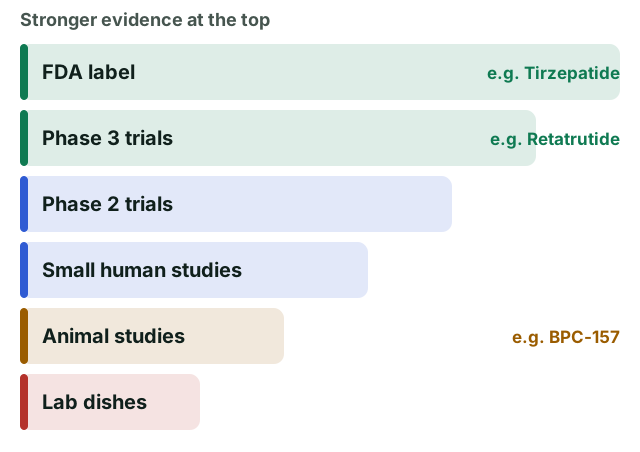
In the language this site uses for evidence, selank sits on the small-human-studies rung. Without a placebo group, a shared improvement on selank and on a benzodiazepine could partly reflect expectation or time.
Selank benefits: the claims against the evidence
The benefits listed on selank pages online go well beyond anxiety. Most trace back to the Russian label or to rodent work.
| Claimed benefit | Where the claim comes from | What human evidence exists |
|---|---|---|
| Less anxiety | Russian label; trials above | Small trials, no placebo group |
| Less fatigue | Zozulia 2008 | One small trial described an anti-fatigue effect |
| Better memory and focus | Russian label; Medvedev 2014 described “mild” nootropic effects | Secondary findings in anxious patients; we found no trial in healthy people |
| Better mood | Russian label | The studies above were anxiety trials, not depression trials |
| Better sleep | Russian label lists sleep disturbance under anxiety states | No published sleep trial found; see peptides for sleep |
| Immune support | Uchakina 2008 | Changes in cytokine levels, with no clinical outcome measured |
How long does selank take to work?
No study has measured this cleanly. The Russian trials judged results over about two weeks, and one reported that the anxiety effect lasted about a week after the last dose. The Russian product information says selank reaches the blood within 30 seconds of being dropped into the nose, and that plasma levels fall over 5 to 5.5 minutes. So the peptide itself is gone quickly, and any lasting effect would have to come from something downstream that no one has mapped in people.
Selank side effects
Selank’s side effects are poorly documented, which is different from saying it has none. The Russian label lists two: allergic reactions, including delayed ones, and an unpleasant taste when the drops reach the throat. Both are marked “frequency unknown.” The label also warns that the methylparaben preservative in the drops can cause allergic reactions. All of this describes the Russian product. It tells you little about a vial sold online.
The Russian label also says selank causes no drug dependence and does not affect driving. Those statements have not been tested in any independent study we could find. The 2021 US review was blunt, calling selank and phenibut “poorly studied Russian drugs” and arguing that agents with GABA activity should be evaluated for abuse potential “before public access ensues.”
FDA’s own assessment, on its page of compounding substances with safety concerns, is that injected selank acetate “may pose risk for immunogenicity” (an immune reaction) “due to the potential for aggregation and peptide-related impurities,” and that FDA “lacks important information regarding any safety issues raised by selank acetate administered to humans.”
Selank dosage: is there a human dose?
No human dose has been established for the United States. The only dosing with any official standing is the Russian label’s schedule for its own 0.15% nasal drops, shown above, and that says nothing about what is safe for you. No study has tested a dose by injection, so any injected dose you see online is a guess. Because selank products are unregulated here, the strength in the bottle is unverified too.
Selank vs semax
Selank and semax are related Russian peptides, often sold as a pair, but they differ in origin, intended use and US standing.
| Selank | Semax | |
|---|---|---|
| Built on | Tuftsin, an antibody fragment | ACTH(4-10), a fragment of the hormone ACTH, without the hormone activity |
| Russian drug class | Anxiolytic (N05BX) | Nootropic (N06BX) |
| Russian product | 0.15% nasal drops, over the counter | 0.1% and 1% nasal drops, prescription |
| Russian label on anxiety | Used to treat it | Disorders with anxiety are a contraindication |
| FDA advisory review | None | Reviewed July 2026 |
| HHS October 2026 policy | Not covered | Covered with conditions, as a nasal free base only |
| FDA-approved | No | No |
The anxiety line is the one to notice. Russia’s own label treats anxiety with one and lists it as a reason to avoid the other, so “selank and semax” blends cannot be assumed to fit the same person. FDA’s semax review found one website offering a 50:50 blend. No study we found has tested one.
Selank’s legal status in the US
As of November 2, 2026, selank has no lawful US route: no approval, no bulks-list entry and no enforcement policy covering it.
| Date | What happened |
|---|---|
| September 29, 2023 | FDA placed selank acetate (TP-7) in 503A category 2, bulk substances that raise significant safety risks, alongside BPC-157, epitalon and others. |
| By April 22, 2026 | The nomination was withdrawn. FDA’s safety-risk page now lists selank acetate under “nominated but withdrawn,” and the May 14, 2026 category list shows it in no category. |
| April 2026 | FDA announced advisory committee reviews of 12 withdrawn peptides, seven in July 2026 and five before the end of February 2027. Selank is not on either list. |
| October 2026 | HHS said it does not intend to take enforcement action against compounding of six peptides under ten conditions. Selank is not one of the six. |
| November 2, 2026 | Selank is not on the 503A bulks list, not under evaluation, and not scheduled for review. |
Being dropped from category 2 because a nominator withdrew does not make a substance compoundable. It removes it from the process altogether, so selank remains an unapproved new drug with no lawful route to a US patient. Semax took a different path: FDA’s advisory committee reviewed it in July 2026 and HHS later listed it, with limits. None of that carries over to selank, however often the two are sold together.
A 2021 review noted selank being sold to US consumers as a dietary supplement. That label does not change its status either.
What research use only means
Online sellers label selank vials “for research use only.” Under 21 CFR 312.160, that label allows shipment only for tests in laboratory animals or test tubes, marked “Not for use in humans.” It does not make spraying or injecting the product legal for a person. A Belgian medicines lab that analyses seized products has found selank and semax in suspicious preparations and noted they are freely sold online as powder for injection and as nasal sprays. A product bought this way has no verified identity, strength or sterility, and a seller’s certificate of analysis does not change that; the COA guide explains why.
Is selank banned in sport?
Selank is not named on the 2026 WADA Prohibited List. WADA’s class S0 bans, at all times, any pharmacological substance not covered elsewhere on the List and “with no current approval by any governmental regulatory health authority for human therapeutic use.” Selank’s Russian registration means it is not obvious that S0 applies. An athlete subject to testing should get a ruling from their national anti-doping organization rather than assume either way.
What to watch for
- No US safety review. FDA has never reviewed a selank application, and the published safety data are short Russian trials.
- Injection is unstudied. The registered product is a nasal drop. FDA flagged immune-reaction risk for injected selank.
- Combining with sedatives. One Russian trial gave selank with a benzodiazepine, and a lab study found selank changed how diazepam and olanzapine affected GABA binding. No study has looked at interactions with other anti-anxiety or sleep medicines used in the US.
- Pregnancy and breastfeeding. The Russian label lists both as contraindications, because no clinical studies were done. It also excludes anyone under 18.
- Allergy. Stop and get care for swelling, hives or trouble breathing after any product.
PeptideSorted does not link to sellers of selank or any other unapproved peptide. The are peptides safe guide covers what testing of research-market peptides has found.
What to do about anxiety instead
Anxiety has treatments with far stronger evidence, and a prescriber can help match one to you. NIMH says generalized anxiety disorder is usually treated with therapy, medication or both. Cognitive behavioral therapy (CBT) is a research-supported psychotherapy commonly used for it. Medicines include SSRI and SNRI antidepressants, buspirone and benzodiazepines.
Questions worth asking at that visit:
- Could a health condition or another medicine be driving this?
- Would CBT, a medicine or both suit me better?
- How long should a treatment take to show an effect, and how will we measure it?
If you have already tried selank or anything like it, tell your clinician and bring the label.
The FDA status tracker follows selank’s position alongside every other peptide.
Compare
Peptide news, sorted. Plus the printable dose chart.
Sorted, every Tuesday: the week's peptide and GLP-1 news in five minutes: FDA moves, new studies explained, and price changes. Subscribe and the one-page dose and injection-site chart arrives first.
Questions people ask
What is selank used for?
Is selank FDA-approved?
Does selank work for anxiety?
Is selank safe?
Is selank approved in Russia?
Is selank banned in sport?
Sources
Primary sources first: FDA labels and documents, peer-reviewed trials, registries.
- 1RLS Encyclopedia of Medicines (Russia). Selank 0.15% nasal drops, registration certificate LP-No(010951)-(RG-RU), product information (updated July 15, 2025)rlsnet.ru
- 2Zozulia AA et al. Efficacy and possible mechanisms of action of a new peptide anxiolytic selank in the therapy of generalized anxiety disorders and neurasthenia. Zh Nevrol Psikhiatr Im S S Korsakova 2008;108(4):38-48pubmed.ncbi.nlm.nih.gov
- 3Medvedev VE et al. A comparison of the anxiolytic effect and tolerability of selank and phenazepam in the treatment of anxiety disorders. Zh Nevrol Psikhiatr Im S S Korsakova 2014;114(7):17-22pubmed.ncbi.nlm.nih.gov
- 4Medvedev VE et al. Optimization of the treatment of anxiety disorders with selank. Zh Nevrol Psikhiatr Im S S Korsakova 2015;115(6):33-40pubmed.ncbi.nlm.nih.gov
- 5Zozulya AA et al. The inhibitory effect of Selank on enkephalin-degrading enzymes as a possible mechanism of its anxiolytic activity. Bull Exp Biol Med 2001;131(4):315-7doi.org
- 6Uchakina ON et al. Immunomodulatory effects of selank in patients with anxiety-asthenic disorders. Zh Nevrol Psikhiatr Im S S Korsakova 2008;108(5):71-5pubmed.ncbi.nlm.nih.gov
- 7Vyunova TV et al. Peptide-based anxiolytics: the molecular aspects of heptapeptide selank biological activity. Protein Pept Lett 2018;25(10):914-923pubmed.ncbi.nlm.nih.gov
- 8Doyno CR, White CM. Sedative-hypnotic agents that impact GABA receptors: flunitrazepam, GHB, phenibut and selank. J Clin Pharmacol 2021;61 Suppl 2:S114-S128pubmed.ncbi.nlm.nih.gov
- 9Vanhee C et al. The occurrence of putative cognitive enhancing research peptides in seized pharmaceutical preparations. Drug Test Anal 2020;12(3):371-381doi.org
- 10FDA. Certain bulk drug substances for use in compounding may present significant safety risks (content current as of April 22, 2026)fda.gov
- 11FDA. 503A categories update, September 29, 2023 (copy hosted by the Alliance for Pharmacy Compounding)join.a4pc.org
- 12FDA. Bulk drug substances nominated for use in compounding under section 503A, category list (updated May 14, 2026)fda.gov
- 13RAPS. FDA considers adding a dozen peptides to its bulk drug compounding list, April 16, 2026raps.org
- 14HHS. Enforcement Discretion Policy Regarding 503A Compounding Using Certain Peptide Bulk Drug Substances, with Appendices A and B, October 2026hhs.gov
- 15RLS Encyclopedia of Medicines (Russia). Semax 0.1% and 1% nasal drops, product informationrlsnet.ru
- 16FDA. Briefing document: evaluation of semax-related bulk drug substances, Pharmacy Compounding Advisory Committee, July 23-24, 2026fda.gov
- 17NIMH. Generalized anxiety disorder: when worry gets out of controlnimh.nih.gov
- 18WADA 2026 Prohibited List, official text as reprinted in the Dutch Treaty Series (Trb. 2026, 25)zoek.officielebekendmakingen.nl
- 19WADA. The Prohibited List (current)wada-ama.org
- 2021 CFR 312.160, drugs for investigational use in laboratory research animals or in vitro testslaw.cornell.edu
PeptideSorted Editorial Team
Editorial review
The PeptideSorted editors check every guide against its cited sources before publication: each number against its FDA label, trial or registry, the FDA status against current FDA and HHS documents, and the wording against our describe-never-prescribe rule. Licensed clinicians who join the review panel are listed by name on the editorial team page.
This page was checked against its cited sources by the PeptideSorted editorial team. Licensed clinicians on our review panel are listed on the editorial team page. Every health page cites primary sources and shows its review date. Read the editorial policy and how medical review works, or report an error via corrections. Educational only; not medical advice.