Short answer
Semax is a synthetic seven-amino-acid nasal peptide registered in Russia for stroke and other brain conditions, and it is not FDA-approved. FDA staff found insufficient evidence that it works. As of November 2, 2026, HHS says it does not intend to act against compounding nasal semax under ten conditions, which is not an approval.
- What it is
- A synthetic heptapeptide (Met-Glu-His-Phe-Pro-Gly-Pro) based on a fragment of the hormone ACTH, sold in Russia as 0.1% and 1% nasal drops.
- FDA status
- Not FDA approved
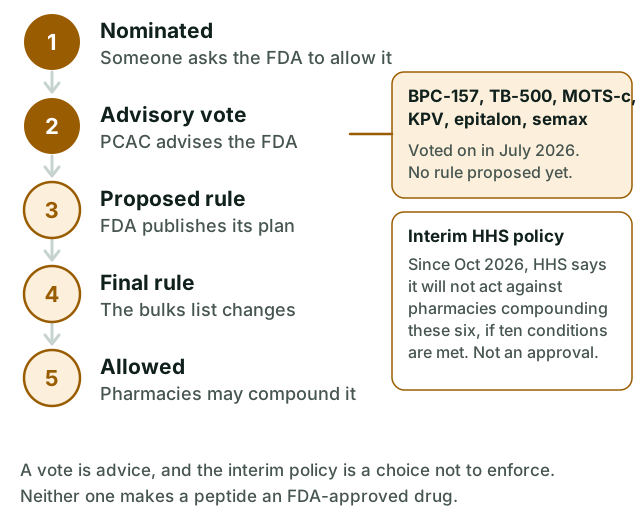
Not FDA-approved. Placed in 503A category 2 on September 29, 2023; nominations later withdrawn. FDA staff advised against adding it to the bulks list; the PCAC voted 8 to 5 for it on July 24, 2026. HHS's October 2026 enforcement policy covers semax free base for intranasal use only, under ten conditions. No proposed or final rule as of November 2, 2026.
- Evidence level
Early human studies
Small or uncontrolled human studies only.
Semax is a Russian nasal peptide with a drug registration there and no FDA approval here. In the peptide index it stands out for one reason: as of November 2, 2026, HHS says it does not intend to take enforcement action against pharmacies compounding it as a nasal product, if ten conditions are met. FDA’s own staff had advised against adding it to the compounding list, and they found too little evidence that it works. Both facts are true at once, and neither one makes semax an approved drug.
| Quick answer | Semax |
|---|---|
| What it is | Synthetic peptide of seven amino acids, based on a fragment of the hormone ACTH |
| FDA status | Not approved for any use |
| Where it is registered | Russia, as 0.1% and 1% nasal drops, by prescription |
| What FDA staff concluded | Insufficient evidence for cerebral ischemia, migraine or trigeminal neuralgia |
| Advisory committee | Voted 8 to 5 on July 24, 2026 to recommend it, against staff advice |
| HHS policy | Semax free base, nasal only, under ten conditions; injected semax is not covered |
| Established US dose | None |
What is semax?
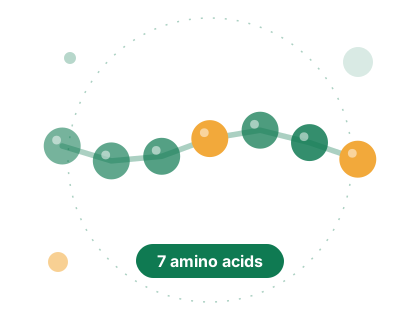
Semax is seven amino acids: methionine, glutamic acid, histidine, phenylalanine, proline, glycine, proline (Met-Glu-His-Phe-Pro-Gly-Pro). It is an analog of ACTH(4-10), a fragment of adrenocorticotropic hormone, the signal that tells the adrenal glands to make cortisol. FDA describes it as lacking the hormonal effects of ACTH while keeping nerve and behavior effects seen in research. The Pro-Gly-Pro tail is thought to protect it from being broken down quickly.
One practical problem is the name. “Semax” is a common name with no US adopted drug name. FDA says it has found multiple salts and derivatives, including different active substances, sold under that same word, and that none of the websites it checked said which form they contained. Semax free base and semax acetate count as different ingredients, which matters because the HHS policy covers only the free base.
How does semax work?
No one knows in people. FDA calls semax’s mechanisms “poorly understood” and says its effects come from rodent studies. In rats and mice, semax raised levels of two brain growth signals, BDNF and NGF, increased serotonin activity, reduced clotting, eased pain when injected, and had antidepressant-like and anti-anxiety-like effects. FDA found no study in humans of how semax moves through the body by any route.
What is semax used for?
In Russia, semax is a prescription drug for serious brain conditions. Russia’s medicines reference (RLS) and Vidal list two strengths. Prescribing in Russia is by a doctor and by condition, and those schedules are not repeated here because they are not US doses.
| Field | What it says |
|---|---|
| Product | Semax nasal drops, 0.1% and 1% |
| Maker | INPC Peptogen, Moscow |
| Drug class | Nootropics (ATC code N06BX) |
| 0.1% labeled uses | Memory and thinking problems from blood vessel disease of the brain, recovery after stroke, transient circulation problems, recovery after head injury, brain surgery or anesthesia, some nerve and optic nerve conditions, stress and mental fatigue, and attention disorders in children |
| 1% labeled use | Acute ischemic stroke |
| Prescription status | Prescription only |
In the United States, FDA found semax marketed through wellness clinics, concierge practices and online retailers for a far longer list: anxiety, depression, memory and attention, stroke, nerve regeneration, diabetic neuropathy, ADHD, opioid withdrawal, ALS, Parkinson’s disease, Alzheimer’s disease, optic nerve atrophy, pain and stomach protection. Being marketed for something is not evidence for it. The most striking item on that list is anxiety, because Russia’s own product information lists disorders with anxiety as a reason not to use semax.
Does semax work?
Semax has not been shown to work for any use FDA could evaluate. FDA reviewed it for three proposed uses: cerebral ischemia (poor blood flow to the brain), migraine and trigeminal neuralgia (severe facial nerve pain).
| Use reviewed | What FDA could assess | FDA’s conclusion |
|---|---|---|
| Cerebral ischemia | One meeting abstract with no clinical function results | Insufficient evidence |
| Migraine | 12 adults, one dose, no control group: 4 of 12 reported the headache stopped; for 8 the pain lessened but did not go | Insufficient evidence; not effective for most subjects in that study |
| Trigeminal neuralgia | 25 adults, one dose, no control group: no change in typical neuralgia; some pain relief in 9 adults with a related condition, without fewer attacks | Insufficient evidence; the authors themselves concluded semax has no pain-relieving activity of its own by this measure |
Two caveats cut in opposite directions. FDA did not review several Russian-language stroke papers because full English translations were not available, so its finding reflects what it could read. And Russian registration does not fill that gap: no one outside Russia has been able to check those trials in the way FDA checks a drug application. Professional guidelines for stroke, migraine and trigeminal neuralgia do not mention semax.
Semax for focus, memory and ADHD
The evidence for focus and memory in healthy people is a handful of tiny studies, and none shows a lasting real-world benefit. FDA did not evaluate “nootropic” use as its own category, and it left ADHD out because it found no supporting literature, although the Russian 0.1% product lists attention disorders in children. Sources differ on the minimum age: RLS says 5 and Vidal says 7.
| Study | Who | What was given | What it measured |
|---|---|---|---|
| Kaplan et al. 1996, as described by FDA | 19 healthy men | Nasal semax, 1 mg daily for 2 days or 0.25 mg once | Side effects not discussed |
| Lebedeva et al. 2018 | 24 healthy adults (14 semax, 10 placebo) | Nasal 1% semax once | A change on brain scans within 20 minutes; thinking or memory was not the reported outcome |
| Panikratova et al. 2020, as described by FDA | 14 healthy adults, possibly the same people as above | Nasal semax, 1.2 mg | Side effects not discussed |
A change on a brain scan is a change on a brain scan. It does not tell you that anyone thought faster, remembered more or did better at work.
Semax side effects
Semax’s side effects are largely unknown, because most studies did not record them. The Russian product information lists one: mild irritation of the nose lining with long use. FDA looked harder and found:
- Very little safety reporting. Across about 33 to 47 healthy adults, 69 adults with medical conditions and 451 children, one paper said no adverse events occurred. The rest did not discuss them, and three were meeting abstracts.
- One FDA adverse event report. Through December 3, 2025, FDA’s database held one report: a consumer who said she had eye pain and burning after using 0.1% nasal drops bought online, with a hospital stay. The pain had not resolved a year later. A report does not prove the product caused it.
- Bleeding concern. Rat studies showed anticoagulant effects. FDA said this raises concern about bleeding in people at risk or on medicines that increase bleeding.
- Abuse potential. In mice, semax increased amphetamine-driven dopamine release in a brain area tied to reward. FDA called this concerning, and no study has tested whether semax is addictive.
- Immune reactions. FDA is concerned about immunogenicity (an immune response against the peptide) from injected or nasal forms, because of possible aggregation and impurities.
- Missing basics. FDA found no acute toxicity, repeat-dose toxicity, reproductive or standard cancer studies.
HHS read the same record differently. Its policy says the intranasal human record covers several hundred subjects “with no reported adverse outcome” and calls the bleeding and abuse concerns mechanistic. Those two statements fit together: few bad outcomes were reported, in studies that mostly did not report safety.
How long does semax last?
No human data can answer this. FDA found no pharmacokinetic study in people. In rat blood and brain tissue, semax is broken down quickly. The Russian product information says it reaches the brain within 4 minutes and that a single dose acts for 20 to 24 hours, which it attributes to active fragments, but those are the maker’s statements, and FDA found no human pharmacokinetic data.
Semax dosage: is there a human dose?
No human dose has been established in the United States, and no study supports any dose by injection. FDA found no literature at all on injecting semax under the skin, which also answers the common search for how much to inject. Published nasal studies used different schedules in small groups, and the figures above describe what those studies gave, not a recommendation. A dose printed on a website does not come from any US label.
Semax’s legal status in the US
As of November 2, 2026, semax is unapproved, is not on the 503A bulks list, and is the subject of an interim HHS policy of non-enforcement with limits.
| Date | What happened |
|---|---|
| September 29, 2023 | FDA placed semax (heptapeptide) in 503A category 2, substances that raise significant safety risks. |
| By April 22, 2026 | The nominations were withdrawn. FDA’s safety-risk page lists semax under “nominated but withdrawn,” and FDA chose to evaluate the free base and acetate on its own initiative. |
| May 11, 2026 | FDA staff concluded the criteria “weigh against” adding either form to the bulks list. |
| July 24, 2026 | The Pharmacy Compounding Advisory Committee voted 8 to 5 to recommend semax, against the staff recommendation. |
| October 28, 2026 | HHS announced its enforcement discretion policy for six peptides, published in the Federal Register on October 30. |
| November 2, 2026 | No proposed or final rule. Written comments are open until November 13, 2026. |
What the HHS policy does and does not do
HHS says it does not intend to take enforcement action against a state-licensed pharmacy, federal facility or licensed physician compounding semax, until a final rule settles whether it goes on the 503A bulks list, when all ten conditions are met. For semax, the main limits are these:
| Condition | What it means for semax |
|---|---|
| Form | Free base only. Semax acetate is not covered |
| Route | Intranasal only. Injected semax is not covered |
| Ingredients | One active ingredient. A semax and selank blend is outside the policy |
| Source | Bulk substance from an FDA-registered, CGMP-compliant maker, with a valid certificate of analysis |
| Prescription | A valid prescription for an individual patient |
| Reporting | Compounder reports serious adverse events and quality problems to FDA MedWatch and the states involved |
| Label | “This is a compounded drug product. Not for resale.” |
| Packaging | The only device packaged with it may be an FDA 510(k)-cleared syringe |
Read that last row against the route row and you see a practical gap: the policy covers a nasal product but limits co-packaged devices to a syringe. FDA staff had separately raised “strong concerns” about a compounded nasal spray because no information showed how a suitable container and pump would be chosen and qualified. How pharmacies will handle this is not yet clear.
The limits matter as much as the headline. FDA has not reviewed any compounded semax for safety, effectiveness or quality. The notice says the policy “does not establish any rights for any person and is not binding on HHS or the public,” and calls it a draft in places. HHS may revisit it if a safety signal or quality problem appears. It covers 503A compounding only, so outsourcing facilities are not covered, and states can be stricter. A decision about enforcement is also not evidence: the clinical data on whether semax works have not changed.
This is a description of a policy, not a suggestion to seek semax out.
Semax vs selank
Semax and selank are often sold together, but they are not interchangeable. Semax is classed in Russia as a nootropic and lists anxiety disorders as a contraindication. Selank is classed as an anxiolytic and is used for anxiety. Semax went through FDA’s advisory process and is named in the HHS policy. Selank did neither, and it has no compounding route.
Cost and access
There is no FDA-approved semax to fill at a US pharmacy, and we do not list prices or sources for unapproved peptides. A prescriber is the right person to ask whether any option is appropriate, and for most of the conditions on the marketing lists, FDA-approved treatments exist. FDA noted approved drugs for preventing and treating stroke, for migraine, and for trigeminal neuralgia.
What research use only means
Products labeled “for research use only” get nothing from the HHS policy, which says it is meant to discourage their use. They remain not legal to use on people. Under 21 CFR 312.160 that label is for laboratory animal and test-tube work, marked “Not for use in humans.” A Belgian medicines lab has found semax in suspicious seized preparations sold online. A seller’s certificate does not change any of this, as the COA guide explains.
Is semax banned in sport?
Semax is not named on the 2026 WADA Prohibited List. Class S0 bans any substance not covered elsewhere and “with no current approval by any governmental regulatory health authority for human therapeutic use.” Because semax is registered in Russia, it is not obvious that S0 applies. An athlete subject to testing should ask their national anti-doping organization.
Who should avoid semax
The Russian product information lists the first six of these as contraindications. The last comes from FDA’s review:
- Pregnancy and breastfeeding.
- Acute psychosis.
- Disorders with anxiety.
- A history of seizures.
- Children below the labeled age.
- Allergy to any ingredient.
- People at risk of bleeding, or on medicines that raise bleeding risk.
Abuse potential has not been tested, which matters for anyone with a history of substance misuse.
Sudden weakness, trouble speaking or a drooping face can be a stroke, which is an emergency. Call 911. Semax has no role there in US care.
Questions to ask a prescriber
- What approved treatment exists for what I am trying to fix?
- If you are considering compounded semax, is it the nasal free base, and from which pharmacy?
- Do any of my medicines raise my bleeding risk?
- What would we measure to know it was working, and when would we stop?
More on the differences between product types is in are peptides safe, and the FDA status tracker follows any rule that comes next.
Compare
Recent news on this
Peptide news, sorted. Plus the printable dose chart.
Sorted, every Tuesday: the week's peptide and GLP-1 news in five minutes: FDA moves, new studies explained, and price changes. Subscribe and the one-page dose and injection-site chart arrives first.
Questions people ask
What is semax used for?
Is semax FDA-approved?
Does semax work?
What are the side effects of semax?
Can semax be injected?
Are semax and selank the same?
Sources
Primary sources first: FDA labels and documents, peer-reviewed trials, registries.
- 1FDA. Briefing document: evaluation of semax-related bulk drug substances (semax free base and semax acetate), Pharmacy Compounding Advisory Committee, July 23-24, 2026 (memo dated May 11, 2026)fda.gov
- 2HHS. Enforcement Discretion Policy Regarding 503A Compounding Using Certain Peptide Bulk Drug Substances, with Appendices A and B, October 2026hhs.gov
- 3Federal Register. Notice of availability, FR Doc. 2026-22192, Docket HHS-OASH-2026-0496, RIN 0910-ZD94, published October 30, 2026public-inspection.federalregister.gov
- 4RAPS. FDA advisory committee backs two more peptides, rejects one for compounding list, July 24, 2026raps.org
- 5RAPS. HHS will permit compounding of six peptides ahead of formal rulemaking, October 29, 2026raps.org
- 6FDA. July 23-24, 2026 meeting of the Pharmacy Compounding Advisory Committeefda.gov
- 7FDA. Certain bulk drug substances for use in compounding may present significant safety risks (content current as of April 22, 2026)fda.gov
- 8FDA. 503A categories update, September 29, 2023 (copy hosted by the Alliance for Pharmacy Compounding)join.a4pc.org
- 9FDA. Bulk drug substances nominated for use in compounding under section 503A, category list (updated May 14, 2026)fda.gov
- 10RLS Encyclopedia of Medicines (Russia). Semax 0.1% and 1% nasal drops, product informationrlsnet.ru
- 11Vidal Russia. Semax 0.1% nasal drops, registration certificate LP-No(009449)-(RG-RU)vidal.ru
- 12Lebedeva IS et al. Effects of Semax on the default mode network of the brain. Bull Exp Biol Med 2018;165(5):653-656pubmed.ncbi.nlm.nih.gov
- 13Vanhee C et al. The occurrence of putative cognitive enhancing research peptides in seized pharmaceutical preparations. Drug Test Anal 2020;12(3):371-381doi.org
- 14WADA 2026 Prohibited List, official text as reprinted in the Dutch Treaty Series (Trb. 2026, 25)zoek.officielebekendmakingen.nl
- 1521 CFR 312.160, drugs for investigational use in laboratory research animals or in vitro testslaw.cornell.edu
PeptideSorted Editorial Team
Editorial review
The PeptideSorted editors check every guide against its cited sources before publication: each number against its FDA label, trial or registry, the FDA status against current FDA and HHS documents, and the wording against our describe-never-prescribe rule. Licensed clinicians who join the review panel are listed by name on the editorial team page.
This page was checked against its cited sources by the PeptideSorted editorial team. Licensed clinicians on our review panel are listed on the editorial team page. Every health page cites primary sources and shows its review date. Read the editorial policy and how medical review works, or report an error via corrections. Educational only; not medical advice.