Short answer
Ipamorelin is an unapproved five-amino-acid peptide that makes the pituitary release growth hormone by mimicking ghrelin. Its published human studies were intravenous, and its main trial, after bowel surgery, found no significant benefit. FDA's advisers voted 0 to 12 against compounding it in 2024. No human dose has been established, and WADA bans it.
- What it is
- A synthetic five-amino-acid peptide that activates the ghrelin receptor and triggers a pulse of growth hormone.
- FDA status
- Not FDA approved
Not FDA-approved for any use and not on the 503A bulks list. Ipamorelin acetate entered 503A and 503B category 2 on September 29, 2023; the PCAC voted 0 yes, 12 no, 1 abstain on October 29, 2024; the 503A nomination was later withdrawn and the 503B category 2 entry remains. HHS's October 2026 enforcement policy does not cover it.
- Evidence level
Early human studies
Small or uncontrolled human studies only.
Ipamorelin is a lab-made peptide that makes the pituitary gland release a short burst of growth hormone, and that is about all it has been shown to do in people. It is not FDA-approved for anything. Its published human studies gave it through a vein, its one published efficacy trial found no significant benefit, and no human dose has been established. Most people meet it as half of the CJC-1295 and ipamorelin pair, but it has a separate history, which is the subject here. Vials labeled “for research use only” cannot legally be used on people, whatever the website implies.
| Question | Short answer |
|---|---|
| What is it? | A synthetic chain of five amino acids, developed at Novo Nordisk and described in 1998 |
| What does it do? | Activates the ghrelin receptor, which triggers a pulse of growth hormone |
| Is it FDA-approved? | No, for no use |
| Can a pharmacy compound it? | Not under section 503A. It is not on the bulks list, and FDA’s advisers voted against it in 2024 |
| Best human evidence | One published phase 2 trial, 117 patients after bowel surgery: no significant benefit |
| Proven benefit for muscle, fat, sleep or aging? | None. No published trial measured these |
| Established human dose? | None |
| Allowed in sport? | No. WADA bans it at all times |
What does ipamorelin do?
Ipamorelin switches on the ghrelin receptor, which sets off growth hormone release. Ghrelin is a hormone made in the stomach, and its receptor is also called the growth hormone secretagogue receptor (a secretagogue is anything that prompts a gland to secrete). FDA’s 2024 review describes ipamorelin acting mainly on ghrelin receptors in neurons of the hypothalamus that carry growth hormone-releasing hormone (GHRH), which in turn drives release from the pituitary. Sermorelin, tesamorelin and CJC-1295 use a different switch, the GHRH receptor itself.
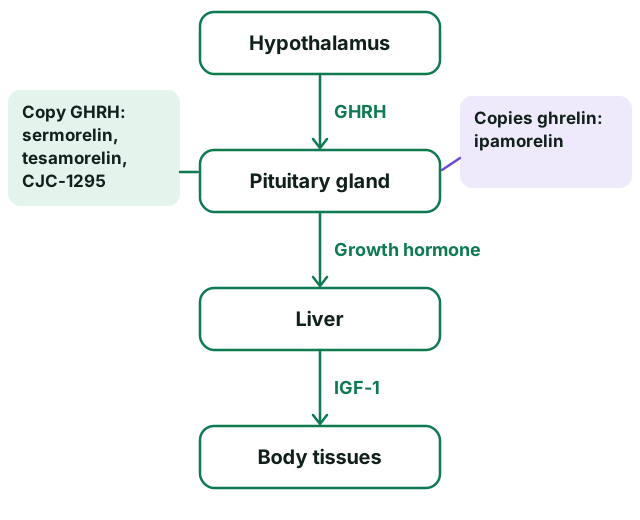
The response is a pulse. In healthy men given a 15-minute infusion, growth hormone rose to a sharp single peak at about 40 minutes and fell to very low levels at every dose by 6 hours. Ipamorelin itself had a half-life of about 2 hours, meaning half of it cleared in that time.
What set it apart from older peptides on the same receptor was selectivity. In pigs it released growth hormone without raising the stress hormones ACTH and cortisol, even at more than 200 times the effective dose, which is why its developers called it “the first selective growth hormone secretagogue.” FDA repeats that it acts without major effects on those hormones, citing that early work. Selective does not mean safe, and it says nothing about what a person would feel or gain.
Its structure matters too. Ipamorelin contains unnatural amino acids, which FDA points out are less well understood for safety than the natural ones, and which make the peptide harder to characterize and purify.
Why people take it
Marketing has moved a long way from the science. FDA found ipamorelin promoted for weight loss, anti-aging, inflammatory conditions, better sleep and bodybuilding, in injectable, nasal and oral forms, increasingly through medical spas and wellness clinics. The company that tested it had a different goal entirely: getting the bowel working again after surgery.
None of the marketed uses has a published human trial behind it. That is the single most useful fact for anyone weighing this peptide. The claims come from what growth hormone does at high levels or in people who lack it, then assume a short pulse from a peptide will do the same.
What the human studies found
Only a handful of human studies exist, and FDA’s reviewers found no others when they searched in 2024.
| Study | Who | What was given | What was found |
|---|---|---|---|
| Gobburu et al. 1999, Pharm Res | Healthy men, 8 per dose level (6 on drug and 2 on placebo in FDA’s summary) | One 15-minute intravenous infusion at five dose levels | One growth hormone peak at about 40 minutes; half-life about 2 hours. FDA notes the paper reports no adverse events |
| Beck et al. 2014, Int J Colorectal Dis (NCT00672074) | 117 adults having bowel resection; 114 received study drug | 0.03 mg/kg intravenously twice daily, for up to 7 days or until discharge, or placebo | Median time to first tolerated meal 25.3 hours versus 32.6 hours on placebo, not statistically significant (p = 0.15). No significant difference on secondary outcomes |
| Helsinn dose-finding trial (NCT01280344) | 320 adults after bowel resection | Three dose levels against placebo | Completed May 2014. No results posted on ClinicalTrials.gov |
A gap of 7.3 hours looks like a win until you read the p-value, which means a difference that size could easily be chance in a trial this small. A subgroup having open surgery did recover faster, and the authors urged caution about the whole result. A 2020 review quoted by FDA called the findings disappointing and said development was discontinued.
The larger trial is the odd one out. It enrolled 320 patients, finished in 2014 and has never posted results, so nobody outside the company can say what it found.
These trials were built to answer a surgical question. Not one of them measured muscle, body fat, sleep, skin or recovery from training. FDA concluded that “there are no data to support the effectiveness” of ipamorelin by injection under the skin for growth hormone deficiency or for bowel recovery, and it found no effectiveness data for any other use.
What results can you expect, and how long do they take?
Nobody can give you a timeline, because no trial has measured a result that a person would notice. Claims of “better sleep in a week” or “leaner in three months” come from clinics and forums, and no published study backs them.
Two findings from related drugs are worth knowing. In a review of trials in fit adults, growth hormone itself added about 2.1 kg of lean mass without improving strength or exercise capacity. MK-677, an oral drug on the same receptor as ipamorelin, added 1.1 kg of fat-free mass over a year in older adults, again with no change in strength or function, and it raised fasting glucose. The guide to peptides for muscle growth sets those trials side by side.
The response may also fade. The 1999 data suggested prolonged exposure does not necessarily keep growth hormone release going, and FDA raised a concern that people with partial growth hormone deficiency could lose responsiveness over time as their stores run down.
Who is ipamorelin for?
No group of patients has been shown to benefit. FDA evaluated it for the two uses nominated or studied, and both already have approved treatment:
- Growth hormone deficiency. FDA points to approved recombinant growth hormone, including daily somatropin and the weekly products somapacitan and lonapegsomatropin. Macimorelin (Macrilen), an approved oral drug on the same receptor as ipamorelin, is used to diagnose the condition in adults.
- Slow bowel recovery after surgery (postoperative ileus). FDA names alvimopan as the only approved drug for speeding gut recovery after bowel resection.
If tiredness, weight gain or lost muscle is what brought you here, the useful first step is finding the cause. A random growth hormone level cannot do that, because the hormone swings through the day. FDA’s review notes that diagnosis relies on symptoms plus stimulation testing, with IGF-1 (insulin-like growth factor 1, the hormone the liver makes in response to growth hormone) used for screening.
Ipamorelin side effects
The only controlled side-effect data come from hospital patients who received it by vein after bowel surgery. They were sick, recovering from major surgery and watched closely, so these numbers cannot tell you what a daily injection under the skin does to a healthy adult.
| Event in Beck et al. 2014 | Ipamorelin (56 people) | Placebo (58 people) |
|---|---|---|
| Any adverse event | 87.5% | 94.8% |
| Low potassium (hypokalemia) | 12.5% | 3.4% |
| Insomnia | 10.7% | 5.2% |
| High blood sugar at discharge (hyperglycemia) | 14.3% | 8.6% |
| Serious adverse events | 17.9% | 15.5% |
| Infection | 10.7% | 10.3% |
| Leak at the surgical join (anastomotic leak) | 3.6% | 1.7% |
| Readmitted within 30 days | 12.5% | 8.6% |
Nausea, vomiting and abdominal bloating were the most common complaints in both groups, and numerically lower on ipamorelin. Three people stopped ipamorelin, because of nausea, high blood pressure or low blood pressure. Most serious events came after treatment had finished.
Two people on ipamorelin died. Both had surgery for colon cancer and developed a leak at the surgical join. The authors described the drug as well tolerated. FDA was more careful: it said it is unclear whether the deaths were related to ipamorelin, but that their occurrence, along with the higher rates of low potassium and high blood sugar, raises safety concerns about its use in compounding.
Reports from outside trials are almost nonexistent, which reflects how little gets reported, not how safe a product is. FDA’s adverse event database held two non-serious reports through September 2023. One man had watery eyes and headache after 17 days of a nasal spray bought online, which he reported was not packaged in a sterile manner. Another had elbow pain after two months of injections combining ipamorelin with sermorelin, which makes the cause impossible to assign.
What FDA is worried about that nobody has measured
- The risks of raised growth hormone and IGF-1. Approved growth hormone labels warn of increased risk of tumors, glucose intolerance and diabetes, raised pressure around the brain, fluid retention, underactive adrenal and thyroid glands, and pancreatitis. FDA says there is not enough data to conclude ipamorelin would avoid these.
- Heart rhythm. The approved drug on the same receptor, macimorelin, carries a risk of QT prolongation, a change in the heart’s electrical timing. Ipamorelin has not been shown to be free of it.
- Immune reactions. Injected peptides can provoke them, more so under the skin, and impurities or clumping make that worse. FDA is concerned even though the chain is only five amino acids long.
- Reward and craving. Ghrelin receptors sit in brain areas that process reward. FDA says ipamorelin could in theory reinforce use, and that animal data are insufficient to know.
- Fertility and pregnancy. In mice, both ghrelin and a drug that blocks its receptor harmed fertilization and fetal development. Whether ipamorelin does the same is unknown.
- Long-term toxicity. FDA found no published repeat-dose, genetic toxicity or cancer studies in animals.
Who has the most reason for caution
Ipamorelin has no label, so it has no official contraindications. The closest model is tesamorelin, an approved drug that raises growth hormone, which is contraindicated in pregnancy, in active cancer, and in people whose pituitary axis has been disrupted by surgery, tumor, radiation or head injury. Add anyone with diabetes or prediabetes, given the blood sugar findings, and anyone tested under anti-doping rules.
When to get medical help
There is no official warning-sign list for ipamorelin. The labels of drugs that raise growth hormone are the nearest guide.
- Headache with vision changes, nausea or vomiting. The somatropin label ties these to raised pressure around the brain, usually within the first 8 weeks of treatment.
- Hives, widespread itching, flushing or rash after a dose. The tesamorelin label says to stop and get prompt medical attention for a suspected allergic reaction. Call 911 for trouble breathing.
- Unusual thirst, passing urine often, or hazy eyesight. The CDC lists these as signs of high blood sugar and diabetes.
- Swelling, joint or muscle pain, or numb or tingling hands. The somatropin label lists swelling, joint pain, muscle pain and carpal tunnel syndrome.
Tell any clinician exactly what you injected, and bring the vial if you still have it.
Is ipamorelin FDA-approved or legal?
No. Ipamorelin has never been approved for any use, and no pharmacy has a lawful route to compound it under section 503A, the part of federal law that covers pharmacy compounding for individual patients. A substance needs an official monograph, a place in an approved drug, or a spot on the 503A bulks list. FDA found ipamorelin has none of these.
| Date | What happened |
|---|---|
| September 29, 2023 | FDA placed ipamorelin acetate in category 2, substances that raise significant safety risks, for both 503A pharmacies and 503B outsourcing facilities |
| October 29, 2024 | The Pharmacy Compounding Advisory Committee (PCAC), FDA’s outside advisers, reviewed it for growth hormone deficiency and postoperative ileus. FDA proposed against listing. The vote was 0 yes, 12 no, 1 abstain on each form, citing a lack of information supporting safety and efficacy |
| By April 2026 | FDA’s safety-risk page lists ipamorelin acetate among nominations withdrawn. It remains in 503B category 2 |
| May 14, 2026 | FDA’s 503A list shows it in no category |
| October 30, 2026 | HHS published an enforcement policy covering six other peptides. Ipamorelin is not one of them |
FDA’s proposal rested on four points. The substance is poorly characterized, and endotoxin testing for injections is lacking. There are no safety or effectiveness data for the injection under the skin that was nominated. The one clinical study raised safety concerns, including the two deaths. And approved drugs already exist for the conditions in question. FDA’s safety-risk page repeats that a published study “identified serious adverse events including death when ipamorelin was administered intravenously.”
You may have read that peptides were freed up in October 2026. As of November 2, 2026, HHS says it does not intend to take enforcement action over compounding of six named peptides, on conditions. Ipamorelin, CJC-1295 and MK-677 are not among them, so ipamorelin’s position has not changed. Leaving the 503A category list did not help it either: the nomination was withdrawn, which left it with no category and no route.
Elsewhere the picture is similar. FDA notes that Australia added ipamorelin to its Poisons Standard as a performance and image enhancing drug, which makes possession without authority illegal there.
Is ipamorelin banned in sport?
Yes. The World Anti-Doping Agency (WADA) names ipamorelin as a growth hormone secretagogue in section S2.2.4 of its Prohibited List, in the 2026 list and in the 2027 list that takes effect January 1, 2027. Class S2 is banned at all times, in and out of competition.
How ipamorelin compares with its relatives
They share an end point, more growth hormone, and very little else. None of these has been compared head to head with ipamorelin in a published trial.
| Drug | Works through | How it is given | FDA status |
|---|---|---|---|
| Ipamorelin | Ghrelin receptor | By vein in published studies | Not approved |
| MK-677 (ibutamoren) | Ghrelin receptor | By mouth | Not approved; not a peptide |
| Macimorelin (Macrilen) | Ghrelin receptor | Oral solution | Approved to diagnose adult growth hormone deficiency |
| CJC-1295 | GHRH receptor | Under the skin in published studies | Not approved |
| Sermorelin | GHRH receptor | Injection | Geref approvals withdrawn in 2009, not for safety reasons; compounded today |
| Tesamorelin | GHRH receptor | Daily injection under the skin | Approved for excess belly fat in HIV lipodystrophy |
| Somatropin | Is growth hormone | Injection | Approved for growth hormone deficiency and other labeled uses |
For a fuller side-by-side, see ipamorelin vs tesamorelin. The CJC-1295 and ipamorelin dosage page shows exactly what the studies gave and why the schedules found online do not follow from them.
Questions to ask a prescriber
There is no approved ipamorelin product, so there is no manufacturer, no labeled price and no patient program to compare. If a clinic offers it, these questions show quickly whether the conversation is grounded:
- Has my growth hormone been properly tested, or are we treating a symptom?
- What exactly is in this product, who made it, and on what legal basis is it being supplied, given that ipamorelin is not on the 503A bulks list?
- What outcome are we trying to change, and how will we measure it?
- Which blood tests will you check, and how often? Would that include blood sugar and IGF-1?
- Does my cancer history, diabetes risk or pregnancy plan change the answer?
- Is there an approved treatment for what I actually have?
The FDA status tracker keeps the dated record for ipamorelin alongside every other peptide on this site.
Compare
- PeptidesNot FDA approvedCJC-1295 / IpamorelinCJC-1295 and ipamorelin raise growth hormone two ways, but no published trial tested the pair.
- PeptidesNot FDA approvedIpamorelin vs tesamorelinTesamorelin is FDA-approved with phase 3 data for one use.
- PeptidesNot FDA approvedMK-677 (ibutamoren)MK-677 is an oral drug, not a peptide.
Peptide news, sorted. Plus the printable dose chart.
Sorted, every Tuesday: the week's peptide and GLP-1 news in five minutes: FDA moves, new studies explained, and price changes. Subscribe and the one-page dose and injection-site chart arrives first.
Questions people ask
What does ipamorelin do?
Is ipamorelin safe?
What are the side effects of ipamorelin?
Does ipamorelin help you lose weight or build muscle?
Is ipamorelin FDA-approved?
What is the difference between ipamorelin and sermorelin?
Sources
Primary sources first: FDA labels and documents, peer-reviewed trials, registries.
- 1FDA. Briefing document on ipamorelin-related bulk drug substances, Pharmacy Compounding Advisory Committee, October 29, 2024fda.gov
- 2FDA. Final summary minutes, Pharmacy Compounding Advisory Committee, October 29, 2024 (ipamorelin)fda.gov
- 3Raun K et al. Ipamorelin, the first selective growth hormone secretagogue. Eur J Endocrinol 1998pubmed.ncbi.nlm.nih.gov
- 4Gobburu JV et al. Pharmacokinetic-pharmacodynamic modeling of ipamorelin, a growth hormone releasing peptide, in human volunteers. Pharm Res 1999pubmed.ncbi.nlm.nih.gov
- 5Beck DE et al. Prospective, randomized, controlled, proof-of-concept study of the ghrelin mimetic ipamorelin for the management of postoperative ileus in bowel resection patients. Int J Colorectal Dis 2014pubmed.ncbi.nlm.nih.gov
- 6ClinicalTrials.gov NCT00672074. Phase 2 study of ipamorelin for postoperative ileus (Helsinn)clinicaltrials.gov
- 7ClinicalTrials.gov NCT01280344. Phase 2 dose-finding study of ipamorelin for recovery of gastrointestinal function after bowel resection (Helsinn)clinicaltrials.gov
- 8FDA. Certain bulk drug substances for use in compounding may present significant safety risks (content current as of April 22, 2026)fda.gov
- 9FDA. Bulk drug substances nominated for use in compounding under section 503A, category list (updated May 14, 2026)fda.gov
- 10FDA. 503A categories update, September 29, 2023 (copy hosted by the Alliance for Pharmacy Compounding)join.a4pc.org
- 11HHS. Enforcement Discretion Policy Regarding 503A Compounding Using Certain Peptide Bulk Drug Substances, with Appendices A and B, October 2026hhs.gov
- 12Federal Register. Notice of availability, FR Doc. 2026-22192, Docket HHS-OASH-2026-0496, RIN 0910-ZD94, published October 30, 2026public-inspection.federalregister.gov
- 13WADA. 2027 Prohibited List, in effect January 1, 2027wada-ama.org
- 14WADA 2026 Prohibited List, official text as reprinted in the Dutch Treaty Series (Trb. 2026, 25)zoek.officielebekendmakingen.nl
- 15Liu H et al. Systematic review: the effects of growth hormone on athletic performance. Ann Intern Med 2008pubmed.ncbi.nlm.nih.gov
- 16Nass R et al. Effects of an oral ghrelin mimetic (MK-677) on body composition and clinical outcomes in healthy older adults. Ann Intern Med 2008pubmed.ncbi.nlm.nih.gov
- 17EGRIFTA WR (tesamorelin) prescribing information, revised March 2025, via FDAaccessdata.fda.gov
- 18SEROSTIM (somatropin) prescribing information, via DailyMeddailymed.nlm.nih.gov
- 19CDC. Diabetes symptomscdc.gov
- 20Federal Register. Determination that Geref (sermorelin acetate) injection was not withdrawn from sale for reasons of safety or effectiveness. 78 FR 14095, March 4, 2013govinfo.gov
- 2121 CFR 312.160, drugs for investigational use in laboratory research animals or in vitro testslaw.cornell.edu
PeptideSorted Editorial Team
Editorial review
The PeptideSorted editors check every guide against its cited sources before publication: each number against its FDA label, trial or registry, the FDA status against current FDA and HHS documents, and the wording against our describe-never-prescribe rule. Licensed clinicians who join the review panel are listed by name on the editorial team page.
This page was checked against its cited sources by the PeptideSorted editorial team. Licensed clinicians on our review panel are listed on the editorial team page. Every health page cites primary sources and shows its review date. Read the editorial policy and how medical review works, or report an error via corrections. Educational only; not medical advice.