
Short answer
No peptide is FDA-approved to build muscle. The best human data come from tesamorelin, which added about 1.2 to 1.3 kg of lean mass over 26 weeks in people with HIV lipodystrophy. Growth hormone itself adds lean mass in healthy adults without making them stronger. CJC-1295 and ipamorelin have no published body-composition trials, and all of these are banned in sport.
No peptide is approved to build muscle, and none has been shown in a controlled human trial to make healthy people stronger. What exists is a small set of trials where drugs that raise growth hormone (GH) also raised lean body mass, mostly in older adults or in people with HIV, and in which strength and function did not follow. That gap between the hormone number and the thing you can actually do is the whole story of this category. The goals overview sits alongside this page for the other outcomes people search.
What human trials show, compound by compound
| Compound | What it is | FDA status | Best human evidence on muscle |
|---|---|---|---|
| Tesamorelin (Egrifta) | Growth hormone releasing hormone (GHRH) analog, injected | Approved 2010 for excess abdominal fat in HIV lipodystrophy. The label says it is not for weight loss. | Two phase 3 trials, 26 weeks: lean body mass rose 1.3 kg and 1.2 kg, against -0.2 kg and -0.03 kg on placebo. Patients switched to placebo lost 1.8 kg and 1.7 kg of it over the next 26 weeks. |
| Sermorelin | GHRH 1-29, the active first 29 amino acids of GHRH | Compounded with a prescription; FDA position unverified | 11 men aged 64 to 76, six weeks, no placebo group: no change in muscle on DEXA scan, two of six strength tests improved. A related GHRH 1-29 analog in 19 adults aged 55 to 71 raised lean mass in men only. |
| CJC-1295 | Long-acting GHRH analog | Not approved; 503A category 2 in 2023, nomination since withdrawn | Raised GH 2 to 10 fold for six days or more and IGF-1 1.5 to 3 fold in healthy adults. Body composition was not measured. |
| Ipamorelin | Ghrelin mimetic (GH secretagogue) | Not approved | The only controlled trial found was for bowel recovery after surgery (117 patients), with no significant benefit. No muscle trials found. |
| Ibutamoren (MK-677) | Oral ghrelin mimetic; not a peptide | Not approved; 503A category 2 as of May 2026 | 65 healthy adults aged 60 to 81, one year: fat-free mass +1.1 kg against -0.5 kg on placebo, with no change in strength or function. |
| BPC-157 | 15-amino-acid gastric peptide fragment | Not approved; tolerated under an interim HHS policy from October 2026, with conditions | No published controlled human trial, for muscle or anything else. The muscle and tendon healing results are from rats. |
| Growth hormone (for comparison) | The 191-amino-acid hormone itself | Approved for GH deficiency, not for muscle | Review of 27 trial groups in fit adults aged 13 to 45: lean mass +2.1 kg, strength and exercise capacity did not improve. |
Two patterns run through every row. The gains are about 1 to 2 kg, and wherever strength or function was measured, it did not move with the lean mass.
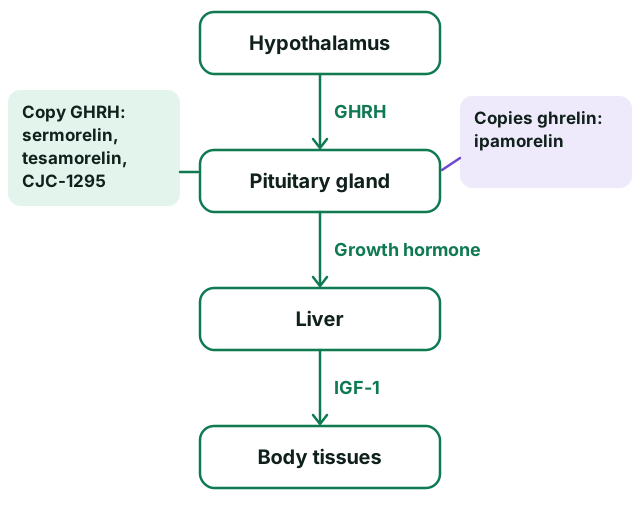
Notice what the diagram implies about the whole category. Every one of these compounds asks the pituitary to release more of its own growth hormone. That makes them weaker levers than growth hormone itself, and growth hormone itself did not improve strength in fit adults.
What people hope for, and what the trials delivered
The hope, as the marketing frames it, is a body that responds like a younger one: more muscle for the same training, faster recovery, less fat, deeper sleep. Set that against the measurements.
- More muscle. Delivered as about 1 kg of lean mass a year in older adults, or 1.2 to 1.3 kg over 26 weeks in people being treated for HIV lipodystrophy. For scale, a kilogram of lean mass is roughly what a committed beginner adds in a couple of months of lifting.
- More strength. Not delivered in any trial that measured it.
- Faster recovery. No controlled human trial has tested recovery from training for any of these compounds.
- Less fat. The year-long MK-677 trial found no change in visceral or total fat, and limb fat rose. Tesamorelin does reduce visceral fat, in the one patient group it is approved for, and its label states it has a weight-neutral effect.
- Keeping the gains. In the tesamorelin trials, people switched to placebo lost 1.8 kg and 1.7 kg of lean mass over the following 26 weeks, which is more than they had gained. Whatever these drugs do, they do it only while you keep taking them.
Lean mass is not the same as muscle strength
Lean body mass includes body water, not just muscle. GH-raising drugs cause fluid retention: the tesamorelin label lists swelling, joint pain and carpal tunnel syndrome, and the growth hormone review found more soft tissue swelling in treated athletes. Some of a lean-mass gain may therefore be water rather than contractile muscle. In the MK-677 trial, total body weight rose 2.7 kg against 0.8 kg on placebo, more than twice the fat-free mass gain.
The best direct look at muscle tissue comes from tesamorelin. A secondary analysis of its phase 3 trials, limited to patients whose belly fat responded, found small increases in the area and density of trunk muscles on CT scans. Whether that changes anything in daily life was not tested; a trial combining tesamorelin with exercise in older adults with HIV is under way.
IGF-1: the number these drugs move
IGF-1 (insulin-like growth factor 1) is the hormone the liver releases in response to GH, and it carries much of GH’s effect on tissue. Tesamorelin raised IGF-1 by 81% in its NEJM trial. CJC-1295 raised it 1.5 to 3 fold after a single injection. MK-677 raised it 60% to 73% in the Alzheimer’s trial. That is the mechanism sellers point to, and a clinic can show you a lab result that moved.
It is also the main concern. The tesamorelin label says “the effects of prolonged elevations in IGF-1 levels are unknown,” tells prescribers to monitor it, and requires any cancer to be inactive and treated before starting. A higher IGF-1 is not a result. It is evidence that the drug did something, plus a reason to watch.
What is actually approved for muscle
Nothing is approved for building muscle in a healthy person. Three approved treatments touch the territory, each tied to a diagnosis:
| Drug | Labeled use | What the label says about muscle |
|---|---|---|
| Somatropin (growth hormone), e.g. Serostim | Adults with HIV and wasting or cachexia | Indicated “to increase lean body mass and body weight, and improve physical endurance.” Contraindicated in active cancer, acute critical illness and diabetic retinopathy |
| Somatropin for growth hormone deficiency | Diagnosed GH deficiency in adults and children | Approved on growth and body-composition outcomes in people who lack the hormone, not on performance in people who do not |
| Testosterone, e.g. Testim gel | Men with primary or hypogonadotropic hypogonadism | The label states that safety and efficacy “in men with ‘age-related hypogonadism’ have not been established,” warns that testosterone can raise blood pressure, and notes it has been subject to abuse |
The pattern is consistent: when a hormone is genuinely missing, replacing it helps, and the approvals are written around that. None of these is a performance drug, and every one of them has a label precisely because somebody had to prove what it does and disclose what it costs you.
Banned in sport
WADA’s Prohibited List bans all of these at all times, in and out of competition, under class S2, and the 2027 list that takes effect January 1, 2027 keeps them there. CJC-1295, sermorelin and tesamorelin are named as GHRH analogues. Ipamorelin and ibutamoren (MK-677) are named as GH secretagogues. Growth hormone fragments such as AOD-9604 and TB-500 sit in the same class, and BPC-157 is named under class S0, for substances with no approval for human use anywhere. The 2027 list also names “peptides” in general under S0, so an unlisted name is no protection.
Risks reported in the trials
- Heart failure. The hip-fracture trial of MK-677 was stopped early over a congestive heart failure signal, and its authors concluded the drug had “an unfavorable safety profile in this patient population.” FDA cites that risk as the reason ibutamoren stays in category 2.
- Blood sugar. MK-677 raised fasting glucose by about 5 mg/dL and lowered insulin sensitivity over a year. The tesamorelin label warns that glucose intolerance or diabetes may develop.
- Fluid and joints. Swelling, joint pain, muscle pain and carpal tunnel symptoms appear in the tesamorelin label and the MK-677 trial.
- Cancer history. GH and IGF-1 are growth factors. Tesamorelin is contraindicated in active malignancy, and somatropin labels list an increased risk of neoplasm among their warnings.
- Pregnancy. Tesamorelin is contraindicated in pregnancy.
- Unknowns for the unapproved ones. CJC-1295 and ipamorelin were placed in FDA’s category 2 (significant safety risks) in September 2023. Their nominations were later withdrawn, which left them with no compounding route at all. There is no long-term human safety data for either, and FDA found no safety data at all for ipamorelin given under the skin.
- What is in the vial. Research-market products carry no verified identity, purity or sterility, and FDA has found mismatched sequences and CAS numbers in supplier listings.
Legal status in plain terms
Tesamorelin is a prescription drug approved for one indication. Sermorelin is compounded by pharmacies on the basis that it was once part of an approved drug. CJC-1295, ipamorelin and MK-677 have no approval and no compounding route; the FDA status tracker has the dates.
One thing did change recently. On October 28, 2026, HHS issued an interim enforcement discretion policy, published in the Federal Register on October 30. As of November 2, 2026, HHS says it does not intend to take enforcement action against a state-licensed pharmacy, federal facility or licensed physician compounding one of six peptides under section 503A, when ten conditions are met, until rulemaking decides whether each belongs on the bulks list. The six are BPC-157, TB-500, MOTS-c, epitalon, KPV and semax, each with its own limits on form and route.
What that does and does not mean for this page:
- None of the six is FDA-approved, none is on the 503A bulks list, and no rule has been proposed. FDA has not reviewed any compounded product for safety, effectiveness or quality.
- Enforcement discretion is a choice not to enforce. The notice says the policy “does not establish any rights for any person and is not binding on HHS or the public,” and comments are open until November 13, 2026.
- The evidence has not changed. BPC-157 still has no published controlled human trial, and TB-500 none for muscle growth.
- Each product must contain a single active ingredient, so multi-peptide blends sold for muscle or recovery fall outside the policy even when every ingredient is on the list.
- The peptides most often sold for muscle, CJC-1295 and ipamorelin, are not on the list. Neither is MK-677, which is not a peptide.
- Research-use-only products gain nothing. Under 21 CFR 312.160 they may be shipped only for laboratory or animal tests, and FDA warning letters in 2026 treated that label as no defense when a product was sold for people. They are not legal to use on a person.
States can also be stricter than the federal policy. The peptide safety guide covers the wider picture.
What to do instead
This is the unglamorous part of the answer, and it is the part with the strongest evidence behind it.
- Train against resistance at least twice a week. CDC guidelines call for muscle-strengthening activity on “at least 2 days” a week, working all the major muscle groups: legs, hips, back, abdomen, chest, shoulders and arms.
- Eat enough protein. A meta-analysis of 49 randomized trials in 1,863 people found that protein supplementation during resistance training added 0.30 kg of fat-free mass and 2.49 kg to one-repetition-maximum strength. Total intakes above about 1.62 g per kg of body weight a day produced no further gains, so there is a ceiling worth knowing about.
- Consider creatine monohydrate. The International Society of Sports Nutrition’s position stand concludes that creatine improves high-intensity exercise performance and supports training adaptations, and that short-term and long-term use, up to 30 g a day for 5 years, is “safe and well-tolerated in healthy individuals.”
- Get the real cause checked. If you have lost muscle without trying, or you are exhausted and weak, that deserves a diagnosis. Low testosterone, thyroid disease, poorly controlled diabetes, kidney disease and cancer all cause muscle loss, and three of those have approved treatments that work.
Against those numbers, the peptide trials offered about 1 kg of lean mass, no measurable strength, a cost in blood sugar and fluid, and a loss of the gain on stopping. That comparison is the clearest argument this page can make.
Compare
- PeptidesNot FDA approvedIpamorelinIpamorelin triggers a growth hormone pulse, but no benefit is proven in people.
- PeptidesNot FDA approvedMK-677 (ibutamoren)MK-677 is an oral drug, not a peptide.
- LearnFDA status trackerWhich peptides are FDA-approved, which HHS tolerates under conditions, and which are not legal to use.
Peptide news, sorted. Plus the printable dose chart.
Sorted, every Tuesday: the week's peptide and GLP-1 news in five minutes: FDA moves, new studies explained, and price changes. Subscribe and the one-page dose and injection-site chart arrives first.
Questions people ask
Which peptide has the best evidence for building muscle?
Do growth hormone secretagogues make you stronger?
Is MK-677 a peptide?
Does BPC-157 build muscle?
Are CJC-1295, ipamorelin and sermorelin banned in sport?
What actually works for muscle growth?
Sources
Primary sources first: FDA labels and documents, peer-reviewed trials, registries.
- 1Egrifta WR (tesamorelin) prescribing information, revised March 2025, via FDAaccessdata.fda.gov
- 2Falutz J et al. Metabolic effects of a growth hormone-releasing factor in patients with HIV. N Engl J Med 2007pubmed.ncbi.nlm.nih.gov
- 3Ditta AM et al. Efficacy and safety of tesamorelin in people living with HIV with lipodystrophy: systematic review and meta-analysis. J Int Assoc Provid AIDS Care 2026pubmed.ncbi.nlm.nih.gov
- 4Adrian S et al. Tesamorelin decreases muscle fat and increases muscle area in adults with HIV. J Frailty Aging 2019pubmed.ncbi.nlm.nih.gov
- 5Liu H et al. Systematic review: the effects of growth hormone on athletic performance. Ann Intern Med 2008pubmed.ncbi.nlm.nih.gov
- 6Nass R et al. Effects of an oral ghrelin mimetic (MK-677) on body composition and clinical outcomes in healthy older adults. Ann Intern Med 2008pubmed.ncbi.nlm.nih.gov
- 7Adunsky A et al. MK-0677 (ibutamoren mesylate) for the treatment of patients recovering from hip fracture: a phase IIb study. Arch Gerontol Geriatr 2011pubmed.ncbi.nlm.nih.gov
- 8Teichman SL et al. Prolonged stimulation of GH and IGF-I secretion by CJC-1295 in healthy adults. J Clin Endocrinol Metab 2006pubmed.ncbi.nlm.nih.gov
- 9Beck DE et al. Randomized, controlled, proof-of-concept study of ipamorelin for postoperative ileus. Int J Colorectal Dis 2014pubmed.ncbi.nlm.nih.gov
- 10Vittone J et al. Effects of single nightly injections of GHRH 1-29 in healthy elderly men. Metabolism 1997pubmed.ncbi.nlm.nih.gov
- 11Khorram O et al. Endocrine and metabolic effects of long-term administration of [Nle27]GHRH-(1-29)-NH2 in age-advanced men and women. J Clin Endocrinol Metab 1997pubmed.ncbi.nlm.nih.gov
- 12Erlandson KM et al. Tesamorelin as an adjunct to exercise for improving physical function in HIV (TRIUMPH): trial protocol. BMJ Open 2026pubmed.ncbi.nlm.nih.gov
- 13Morton RW et al. Systematic review, meta-analysis and meta-regression of protein supplementation and resistance training-induced gains in muscle mass and strength. Br J Sports Med 2018pubmed.ncbi.nlm.nih.gov
- 14Kreider RB et al. International Society of Sports Nutrition position stand: safety and efficacy of creatine supplementation. J Int Soc Sports Nutr 2017pubmed.ncbi.nlm.nih.gov
- 15CDC. Adult activity: an overview (Physical Activity Guidelines for Americans)cdc.gov
- 16SEROSTIM (somatropin) prescribing information, via DailyMeddailymed.nlm.nih.gov
- 17TESTIM (testosterone gel) prescribing information, 2025, via FDAaccessdata.fda.gov
- 18Federal Register. Determination that Geref (sermorelin acetate) injection was not withdrawn from sale for reasons of safety or effectiveness, March 4, 2013federalregister.gov
- 19FDA. Bulk drug substances nominated for use in compounding under section 503A, category list (updated May 14, 2026)fda.gov
- 20FDA. Certain bulk drug substances for use in compounding may present significant safety risksfda.gov
- 21HHS. Enforcement Discretion Policy Regarding 503A Compounding Using Certain Peptide Bulk Drug Substances, with Appendices A and B, October 2026hhs.gov
- 22Federal Register. Notice of availability, FR Doc. 2026-22192, Docket HHS-OASH-2026-0496, RIN 0910-ZD94, published October 30, 2026public-inspection.federalregister.gov
- 23WADA. 2027 Prohibited List, in effect January 1, 2027wada-ama.org
- 24WADA. The Prohibited List (current)wada-ama.org
- 2521 CFR 312.160, drugs for investigational use in laboratory research animals or in vitro testslaw.cornell.edu
- 26FDA warning letter to Gram Peptides, March 31, 2026fda.gov
More in Goals
- Glow blendGlow is an injectable blend of GHK-Cu, BPC-157 and TB-500, never tested in people and outside the HHS policy. See what each ingredient really shows.Read
- Hair growthNo peptide is FDA-approved for hair loss. See what the small peptide studies measured, who paid for them, and how minoxidil and finasteride compare.Read
- Klow blendKlow is Glow plus KPV: four unapproved peptides in one vial, never tested in people and outside the HHS policy for three reasons. See what KPV adds.Read
- SkinA few skin peptides beat a control in small, mostly company-run trials. None is FDA-approved. See the evidence by type and what has stronger proof.Read
- SleepNo peptide is FDA-approved for sleep. DSIP's 1980s trials were mixed, epitalon and selank have no sleep trials, and proven insomnia treatments exist.Read
- Weight lossSemaglutide and tirzepatide are the FDA-approved peptides with strong weight-loss trials. AOD-9604 and MOTS-c are not. See the evidence, group by group.Read
PeptideSorted Editorial Team
Editorial review
The PeptideSorted editors check every guide against its cited sources before publication: each number against its FDA label, trial or registry, the FDA status against current FDA and HHS documents, and the wording against our describe-never-prescribe rule. Licensed clinicians who join the review panel are listed by name on the editorial team page.
This page was checked against its cited sources by the PeptideSorted editorial team. Licensed clinicians on our review panel are listed on the editorial team page. Every health page cites primary sources and shows its review date. Read the editorial policy and how medical review works, or report an error via corrections. Educational only; not medical advice.