Short answer
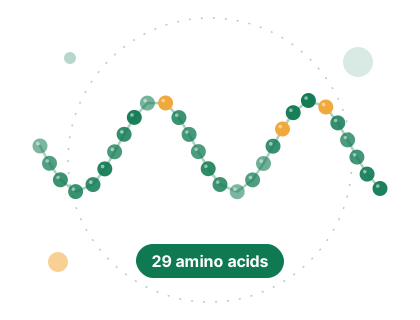
Sermorelin is a lab-made copy of the first 29 amino acids of growth hormone-releasing hormone, the signal that tells the pituitary to release growth hormone. FDA approved it as Geref for children, but Geref was discontinued in 2008. No approved product exists today. US sermorelin is compounded by pharmacies, and it was never approved for adults or anti-aging.
- What it is
- A synthetic 29-amino-acid fragment of human growth hormone-releasing hormone that prompts the pituitary to release growth hormone.
- FDA status
- Compounded (Rx)
Geref (sermorelin acetate) was approved December 28, 1990 and September 26, 1997, discontinued in 2008, and its approvals withdrawn June 18, 2009; FDA found in 2013 this was not for safety or effectiveness. FDA lists sermorelin acetate as a component of an approved drug on its 503B list; no approved product is marketed.
- Evidence level
Early human studies
Small or uncontrolled human studies only.
Sermorelin is an injected peptide that prompts your own pituitary gland to release more growth hormone. It is also a rare case of a peptide FDA once approved: it was sold as Geref for children who did not make enough growth hormone. Geref left the market in 2008 and nothing replaced it. The sermorelin prescribed in 2026 comes from compounding pharmacies, mostly for adults, for uses it was never approved for. So the accurate description has two halves: a pharmacy can compound it with a prescription, and it is not a currently approved product.
| Your question | Short answer |
|---|---|
| What is it? | A synthetic copy of the first 29 amino acids of growth hormone-releasing hormone (GHRH) |
| Is it FDA-approved now? | No approved product is on the market. A licensed pharmacy may compound it for a named patient |
| What was it approved for? | Testing pituitary function (1990) and treating idiopathic growth hormone deficiency in children (1997) |
| Was it approved for adults? | Never as a treatment |
| How strong is the evidence? | One open-label trial of 110 children, plus adult studies of 19 people or fewer lasting 16 weeks at most |
| How is it given? | Injected under the skin. The Geref regimen was once daily at bedtime |
| Most common side effect | An injection site reaction, in about 1 patient in 6 in the reproduced Geref text |
| Allowed in sport? | No. Prohibited at all times under the WADA list |
What is sermorelin?
Sermorelin is a shortened, synthetic version of a natural brain hormone. Growth hormone-releasing hormone (GHRH) is a 44-amino-acid peptide made in the hypothalamus, the part of the brain that controls the pituitary gland. Sermorelin keeps the first 29 of those amino acids, written GHRH(1-29)NH2. A 1999 review in BioDrugs describes it as the shortest synthetic fragment with the full biological activity of natural GHRH.
It is a peptide, not a steroid, and it is not growth hormone. People mix these up constantly, and the difference matters: growth hormone replaces what is missing, while sermorelin asks the body to make more.
How does sermorelin work?
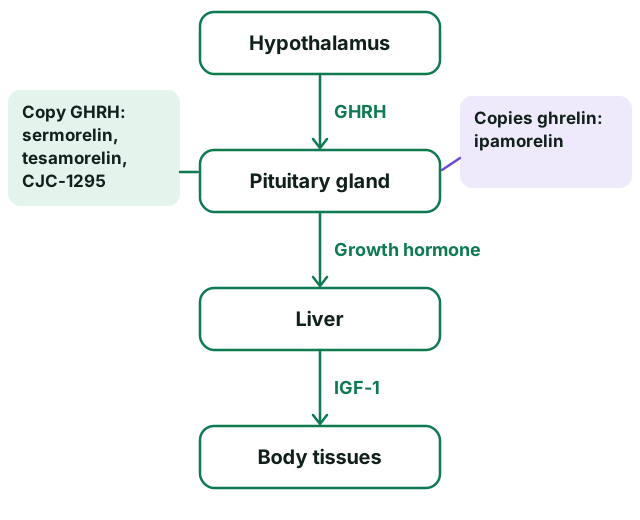
Sermorelin works by copying the signal that tells the pituitary to release growth hormone. Growth hormone then raises IGF-1 (insulin-like growth factor 1), the hormone that carries many of its effects to tissues and is made in the liver and elsewhere in the body.
The drug itself does not stay around long. In the reproduced Geref text, blood levels peaked 5 to 20 minutes after an injection under the skin in 12 volunteers, about 6% of the dose reached the bloodstream, and the half-life was 11 to 12 minutes.
Because sermorelin needs a working pituitary, it has a built-in limit. FDA’s 2024 briefing on a related peptide put it directly: patients with complete growth hormone deficiency will not respond to growth hormone secretagogues, a group that includes GHRH and its analogues.
What are the benefits of sermorelin?
The best-supported benefit of sermorelin is faster growth in children with growth hormone deficiency. The adult benefits promoted online rest on far less, and several of them failed when someone measured them.
| Claimed benefit | What human studies found | How far that goes |
|---|---|---|
| Growth in GH-deficient children | Height velocity rose from 4.1 to 8.0 cm a year at 6 months | The basis for approval, though gains were smaller than with growth hormone |
| Higher GH and IGF-1 in older adults | 1 mg twice daily raised both. 2 mg once nightly raised GH but not IGF-1 | Depends on the regimen, and short term only |
| More muscle | No DEXA change in Vittone. Lean mass rose in men only in Khorram | Weak and inconsistent |
| Strength | 2 of 6 strength measures and one endurance test improved in Vittone | Small study with no placebo group |
| Fat loss or weight loss | No change in weight or body fat in Vittone, and no weight change in Khorram | Not shown, and never tested as a main goal |
| Better sleep | Sleep quality unchanged in Khorram. No improvement in 2 men in Murck | Not shown. Neither study used sermorelin itself |
| Well-being and libido | Improved in men but not women in Khorram | One study of a close analogue |
| Thicker skin | Rose in both sexes in Khorram | One study of a close analogue |
Anti-aging has no row because no study here measured it. A hormone level moving toward a younger range is a change on a lab report, and none of these trials looked at whether it adds up to longer life or lower disease risk.
What the human studies showed
Sermorelin has real human data, which most peptides sold online do not. Almost all of it is from the 1990s, and most of it is small.
| Study | Who | What was given | What was found |
|---|---|---|---|
| Thorner et al. 1996, Geref International Study Group | 110 previously untreated prepubertal children with GH deficiency (86 analysed) | 30 mcg/kg under the skin once daily at bedtime, up to 1 year, open label | Height velocity rose from 4.1 cm/yr to 8.0 cm/yr at 6 months and 7.2 cm/yr at 12 months. No excess IGF-1, no change in fasting glucose. |
| Ogilvy-Stuart et al. 1997 | 9 children with GH deficiency after cranial radiation | 15 mcg/kg twice daily for 1 year | Height velocity rose from 3.3 to 6.0 cm/yr; the following year on growth hormone it was 7.5 cm/yr. |
| Corpas et al. 1992 | 10 healthy men aged about 68, compared with 9 young men | 0.5 mg or 1 mg twice daily for 14 days each | The 1 mg dose raised 24-hour GH and IGF-1 into the young men’s range; 0.5 mg did not reach significance. |
| Vittone et al. 1997 | 11 healthy men aged 64 to 76 | 2 mg once nightly for 6 weeks | Nightly GH rose, but IGF-1 did not change, and neither did body composition by DEXA scan. Two of six strength measures improved. |
| Khorram et al. 1997 | 19 adults aged 55 to 71 | A close analogue, [Nle27]GHRH(1-29), 10 mcg/kg nightly for 16 weeks after 4 weeks of placebo | IGF-1 rose for 12 weeks then drifted back toward baseline. Lean mass rose in men only. Sleep quality did not change. |
Two patterns stand out. In children with growth hormone deficiency it works, but less than growth hormone itself: the BioDrugs review notes height gains were smaller than with daily somatropin, and a 2001 follow-up described 27 children who left a Geref trial, 25 of them for inadequate growth, and then grew well on growth hormone. In older adults the hormone numbers move, especially with twice-daily dosing, but the changes in body composition were small, inconsistent or absent. The sermorelin before and after guide goes through what each study did and did not measure.
Who is sermorelin for?
No group has a current approved use of sermorelin, because there is no approved product to carry one. The only treatment approval covered children with idiopathic growth hormone deficiency, meaning a deficiency with no identified cause, who were failing to grow.
Adults who get sermorelin today are receiving a compounded product off-label, usually for reasons grouped under aging or wellness. FDA has written that Geref was approved only for short stature in children with growth hormone deficiency. Prescribers may still write for it, but no trial tells them which adults benefit, at what dose, or for how long.
Some people are unlikely to be helped at all. Anyone whose pituitary has been removed or badly damaged has nothing to signal. The Geref text also says children whose deficiency came from a lesion inside the skull were not studied, and it did not recommend treating them.
How long does sermorelin take to work?
Sermorelin changes blood tests within about two weeks, while visible change in adults has never been shown on any timescale. In children, faster growth was clear by the six-month mark.
| Time on treatment | What was measured | Source |
|---|---|---|
| 5 to 20 minutes | Peak blood level of sermorelin after one injection | Geref text |
| 2 weeks | 24-hour GH and IGF-1 up in older men on 1 mg twice daily. IGF-1 up on a close analogue | Corpas, Khorram |
| 6 weeks | Night-time GH up on 2 mg nightly, with no change in IGF-1 or DEXA body composition | Vittone |
| 16 weeks | IGF-1 back toward baseline despite continued dosing of the analogue | Khorram |
| 6 months | Children’s height velocity at 8.0 cm a year, up from 4.1 | Thorner |
| 12 months | Children’s height velocity at 7.2 cm a year | Thorner |
No published study listed here followed adults past 16 weeks. As for stopping, the only data come from short children without growth hormone deficiency: after a year of twice-daily treatment, their growth fell to 3.89 cm a year over the next three months, a pattern the authors called catch-down growth.
What are the side effects of sermorelin?
The most common side effect of sermorelin is an injection site reaction, with pain, swelling or redness in about 1 patient in 6, according to the reproduced Geref text. Three of 350 patients in the clinical trials stopped because of it. Headache, flushing, dizziness, trouble swallowing, hyperactivity, sleepiness and hives each occurred in fewer than 1%.
Two less obvious items matter more for monitoring. Hypothyroidism appeared in 6.5% of patients during clinical studies, and the text calls for thyroid tests before and during treatment. Antibodies against the drug were common, though they did not appear to affect growth. Glucose results differed by study: Thorner 1996 found no change in fasting glucose in children with GH deficiency, while a 1994 study of 18 short children without GH deficiency, given 20 mcg/kg twice daily for a year, found fasting glucose and insulin rose during treatment. Khorram reported transient high blood lipids as its only side effect.
These were small, short studies, so rare or long-term effects would not have been detected. The sermorelin side effects guide has the full table, the red flags and when to call.
How does sermorelin compare with similar drugs?
Sermorelin is an older option with thin adult data, and only one of its relatives has a current approval for adults.
| Drug | What it does | FDA status | Best human evidence |
|---|---|---|---|
| Sermorelin | Copies GHRH, using the first 29 amino acids | No approved product; compounded | Children with GH deficiency; small adult studies |
| Tesamorelin | Copies GHRH, using all 44 amino acids plus a stabilizing group | FDA-approved for excess abdominal fat in adults with HIV and lipodystrophy | Two phase 3 trials of 412 and 404 patients |
| Ipamorelin | Copies ghrelin, a different signal at the pituitary | Not FDA-approved | Covered in the ipamorelin guide |
| Growth hormone | Replaces the hormone itself | Prescription drug | Larger height gains than sermorelin in children, across separate studies |
The sermorelin vs tesamorelin comparison goes further, including why the two are not interchangeable. Compounded sermorelin is often sold blended with other peptides such as ipamorelin, which FDA placed in category 2 in 2023, so a vial labeled with one name may not contain one drug.
Why was Geref discontinued?
The public record does not say why Geref was discontinued, only that the reason was not safety or effectiveness.
| Date | What happened |
|---|---|
| December 28, 1990 | FDA approved Geref 0.05 mg ampules (NDA 19-863) for testing whether the pituitary can secrete growth hormone. |
| September 26, 1997 | FDA approved Geref 0.5 mg and 1.0 mg vials (NDA 20-443) for treating idiopathic growth hormone deficiency in children with growth failure. |
| July and December 2008 | EMD Serono told FDA the products were being discontinued and asked FDA to withdraw the applications. The notice gives no reason. |
| June 18, 2009 | FDA’s withdrawal of both approvals took effect. |
| March 4, 2013 | Responding to a citizen petition, FDA determined that Geref was not withdrawn for reasons of safety or effectiveness. That finding allows FDA to approve a generic version if someone applies. None has been approved. |
The 2013 finding matters for two reasons. It means the drug did not leave the market because it was found unsafe. And it is the reason sermorelin is treated differently from peptides such as BPC-157 that were never approved at all.
Is sermorelin legal and FDA-approved?
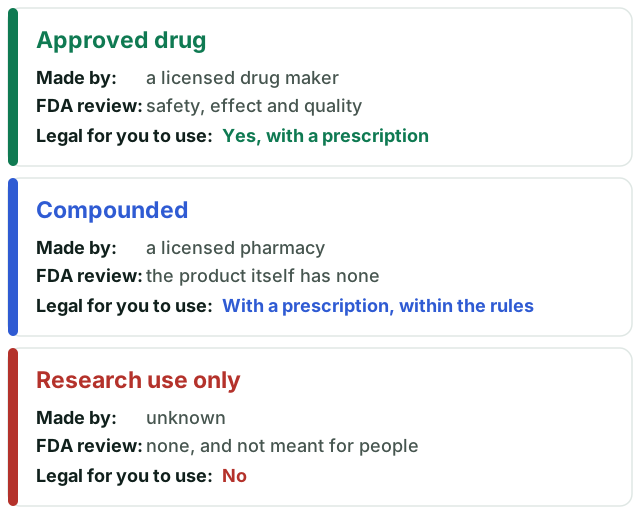
Sermorelin is not an FDA-approved drug today, but a licensed pharmacy can compound it with a prescription. That middle position is easy to misread in either direction, so here are the pieces.
- No approved product. No sermorelin product has been marketed in the United States since Geref was discontinued, and FDA has approved no generic.
- Compounding. Section 503A lets a licensed pharmacy compound for an individual patient using a bulk substance that has a USP monograph, is a component of an FDA-approved drug, or is on the 503A bulks list. Sermorelin is not on the 503A bulks list and appears in no 503A category as of the May 14, 2026 list. FDA’s separate list for outsourcing facilities (503B), updated March 21, 2025, puts sermorelin acetate in category 1 and marks it as a component of an FDA-approved drug. Pharmacies compound it on that basis. We found no FDA statement addressing sermorelin under 503A specifically.
- Not part of the recent peptide actions. Sermorelin was not among the peptides FDA placed in category 2 in September 2023, and it was not reviewed at the July 2026 advisory committee meeting. As of November 2, 2026, it is also not on the interim HHS policy announced October 28, 2026, in which HHS says it does not intend to take enforcement action against 503A compounding of six other peptides (BPC-157, TB-500, MOTS-c, KPV, epitalon and semax) when ten conditions are met. None of those six is FDA-approved or on the 503A bulks list, the policy creates no rights, and it does not change sermorelin’s status.
- Never approved for adults. FDA’s 2024 ipamorelin briefing states that Geref was approved only for short stature in children with growth hormone deficiency, and that no growth hormone secretagogue has been approved for growth hormone deficiency in adults. Adult “anti-aging” use is off-label use of a compounded product.
- Research-only vials are not legal. Sermorelin sold online labeled for research use only falls under 21 CFR 312.160, which allows shipment only for laboratory animal or test-tube work. It is not legal to use on a person, whatever the seller’s disclaimer says.
The FDA status tracker carries the same entry alongside every other peptide on the site.
What does sermorelin cost, and how do people get it?
We do not publish a sermorelin price, because every figure we could find came from a clinic or a seller. With no approved product there is no list price to anchor it, and the cost depends on the pharmacy, the vial and the prescription.
The legitimate route is a prescription written for you by name and filled by a licensed pharmacy. HHS describes compounded drugs plainly: FDA does not review their safety, effectiveness or quality before they are marketed. If you are in this position, it helps to confirm a few things before paying:
- The prescription is for you personally, after a real clinical assessment.
- The pharmacy is licensed in your state.
- The label names every active ingredient and the amount in the vial.
- You know the concentration after mixing, so you can find the volume on a syringe with the reconstitution calculator.
- Someone has explained storage. The Geref vials were kept refrigerated, but your pharmacy’s label governs a compounded product.
Questions to ask a prescriber
Sermorelin has no current label to fall back on, so the conversation has to do more of the work.
- What are you treating, and what evidence says sermorelin helps adults like me?
- Have my IGF-1 and thyroid levels been checked, and how often will they be rechecked?
- What result would tell us it is working, and when will we decide to stop if it is not?
- Do my blood sugar, cancer history or pregnancy plans change the answer?
- Is the vial sermorelin alone, or a blend?
- Which dose did you choose, and why? The sermorelin dosage guide lists what each study used.
Is sermorelin banned in sport?
Yes. The 2026 World Anti-Doping Agency Prohibited List, in force from January 1, 2026, names sermorelin, along with tesamorelin and CJC-1295, as examples of GHRH and its analogues in class S2. These are prohibited at all times, in and out of competition.
Who should be cautious
Every growth hormone-raising drug carries the same family of concerns, and they apply here even though no current label spells them out.
- Allergy. The Geref text lists one contraindication: known sensitivity to sermorelin or any ingredient in the product.
- Cancer. Raising growth hormone and IGF-1 is a reason for caution in anyone with active cancer or a history of it.
- Pregnancy. The Geref text says use only if the potential benefit justifies the risk to the fetus, and advises caution in nursing because passage into breast milk is unknown.
- Diabetes or prediabetes. Growth hormone works against insulin.
- Thyroid problems. Untreated hypothyroidism can jeopardize the response.
- Glucocorticoid treatment. Steroids such as prednisone may blunt the response, according to the Geref text.
- A damaged or removed pituitary. Sermorelin cannot work without one.
Anyone considering a compounded product should also know that it has no FDA-reviewed label listing warnings, because there is no current approved product.
Compare
- PeptidesCompounded (Rx)DosageThe only approved sermorelin dose was 30 mcg/kg nightly in children.
- PeptidesCompounded (Rx)Side effectsThe most common sermorelin side effect is an injection site reaction, in about 1 in 6 patients.
- PeptidesCompounded (Rx)Vs tesamorelinTesamorelin has FDA approval and two large trials, for HIV-related belly fat only.
Peptide news, sorted. Plus the printable dose chart.
Sorted, every Tuesday: the week's peptide and GLP-1 news in five minutes: FDA moves, new studies explained, and price changes. Subscribe and the one-page dose and injection-site chart arrives first.
Questions people ask
Is sermorelin FDA-approved?
Why was Geref discontinued?
Is compounded sermorelin legal?
Was sermorelin ever approved for adults or anti-aging?
Is sermorelin the same as growth hormone?
Does sermorelin help with weight loss?
Sources
Primary sources first: FDA labels and documents, peer-reviewed trials, registries.
- 1Federal Register. Determination that Geref (sermorelin acetate) injection was not withdrawn from sale for reasons of safety or effectiveness. 78 FR 14095, March 4, 2013govinfo.gov
- 2Sermorelin acetate prescribing text, FDA revision date October 2, 2001, as reproduced by RxListrxlist.com
- 3Prakash A, Goa KL. Sermorelin: a review of its use in the diagnosis and treatment of children with idiopathic growth hormone deficiency. BioDrugs 1999pubmed.ncbi.nlm.nih.gov
- 4Thorner M et al. Once daily subcutaneous GHRH therapy accelerates growth in GH-deficient children during the first year of therapy. Geref International Study Group. J Clin Endocrinol Metab 1996pubmed.ncbi.nlm.nih.gov
- 5Saenger P et al. Outcome of GH therapy in children with GH deficiency showing an inadequate response to GHRH. Endocrine 2001pubmed.ncbi.nlm.nih.gov
- 6Ogilvy-Stuart AL et al. Treatment of radiation-induced growth hormone deficiency with GHRH. Clin Endocrinol 1997pubmed.ncbi.nlm.nih.gov
- 7Kirk JM et al. Treatment with GHRH(1-29)NH2 in children with idiopathic short stature induces a sustained increase in growth velocity. Clin Endocrinol 1994pubmed.ncbi.nlm.nih.gov
- 8FDA. 503A categories update, September 29, 2023 (copy hosted by the Alliance for Pharmacy Compounding)join.a4pc.org
- 9Corpas E et al. GHRH(1-29) twice daily reverses the decreased GH and IGF-I levels in old men. J Clin Endocrinol Metab 1992pubmed.ncbi.nlm.nih.gov
- 10Vittone J et al. Effects of single nightly injections of GHRH (GHRH 1-29) in healthy elderly men. Metabolism 1997pubmed.ncbi.nlm.nih.gov
- 11Khorram O et al. Endocrine and metabolic effects of long-term administration of [Nle27]GHRH-(1-29)-NH2 in age-advanced men and women. J Clin Endocrinol Metab 1997pubmed.ncbi.nlm.nih.gov
- 12Murck H et al. Longtime administration of GHRH does not restore the reduced efficiency of GHRH on sleep endocrine activity in 2 old-aged subjects. Pharmacopsychiatry 1997pubmed.ncbi.nlm.nih.gov
- 13Egrifta WR (tesamorelin) for injection, 11.6 mg/vial, prescribing information, Theratechnologies, revised 3/2025, via FDAaccessdata.fda.gov
- 14FDA. Bulk drug substances nominated for use in compounding under section 503B (updated March 21, 2025)fda.gov
- 15FDA. Bulk drug substances nominated for use in compounding under section 503A, category list (updated May 14, 2026)fda.gov
- 16FDA. Briefing document on ipamorelin-related bulk drug substances, Pharmacy Compounding Advisory Committee, October 29, 2024fda.gov
- 17FDA. Briefing document introduction, Pharmacy Compounding Advisory Committee, July 23-24, 2026 (section 503A bulk substance criteria)fda.gov
- 18HHS. Enforcement Discretion Policy Regarding 503A Compounding Using Certain Peptide Bulk Drug Substances, with Appendices A and B, October 2026hhs.gov
- 19Federal Register. Notice of availability, FR Doc. 2026-22192, Docket HHS-OASH-2026-0496, RIN 0910-ZD94, published October 30, 2026public-inspection.federalregister.gov
- 20Council of Europe Anti-Doping Convention. 2026 Prohibited List, in force January 1, 2026 (Tractatenblad 2026, 25)zoek.officielebekendmakingen.nl
- 2121 CFR 312.160, drugs for investigational use in laboratory research animals or in vitro testslaw.cornell.edu
Go deeper on Sermorelin
- Before and afterReal sermorelin results: children grew faster, but adult studies of 19 people or fewer found little change in fat or sleep. Why photos are not evidence.Read
- DosageThe only approved sermorelin dose was 30 mcg/kg nightly in children. No adult dose was ever approved. What each study used, plus the syringe arithmetic.Read
- Side effectsThe most common sermorelin side effect is an injection site reaction, in about 1 in 6 patients. Rates from the Geref text, thyroid risks and red flags.Read
- Vs tesamorelinTesamorelin has FDA approval and two large trials, for HIV-related belly fat only. Sermorelin has no approved product. Evidence, doses and risks compared.Read
PeptideSorted Editorial Team
Editorial review
The PeptideSorted editors check every guide against its cited sources before publication: each number against its FDA label, trial or registry, the FDA status against current FDA and HHS documents, and the wording against our describe-never-prescribe rule. Licensed clinicians who join the review panel are listed by name on the editorial team page.
This page was checked against its cited sources by the PeptideSorted editorial team. Licensed clinicians on our review panel are listed on the editorial team page. Every health page cites primary sources and shows its review date. Read the editorial policy and how medical review works, or report an error via corrections. Educational only; not medical advice.