
Short answer
The only approved sermorelin dose was for children: 30 mcg per kg of body weight, injected under the skin once daily at bedtime. Adult studies used 0.5 mg or 1 mg twice daily for two weeks, or 2 mg nightly for six weeks. No adult dose was ever approved or established, and compounded doses are set by the prescriber.
- What it is
- A synthetic 29-amino-acid fragment of human growth hormone-releasing hormone that prompts the pituitary to release growth hormone.
- FDA status
- Compounded (Rx)
Geref was approved for children in 1997 and its approvals withdrawn June 18, 2009, not for safety or effectiveness. No approved product is marketed; pharmacies compound sermorelin as a component of a formerly approved drug.
- Evidence level
Early human studies
Small or uncontrolled human studies only.
The only sermorelin dose FDA ever approved was a pediatric one. Sermorelin, sold as Geref until 2008, was given to children with growth hormone deficiency at 30 mcg per kilogram of body weight, once a day at bedtime. Adults were never part of the label, and no adult dose has been established by any trial. No sermorelin product is FDA-approved today, so a compounded dose is whatever the prescriber writes. The figures below describe what happened in studies, and nothing here is a recommendation.
Doses in the label and the studies
| Source | Who | Dose | Route and timing | Length |
|---|---|---|---|---|
| Geref, treatment (per 1999 BioDrugs review) | Prepubertal children with idiopathic GH deficiency | 30 mcg/kg | Under the skin, once daily at bedtime | Long term |
| Geref, diagnostic test (per 1999 BioDrugs review) | Children being tested for GH deficiency | 1 mcg/kg | Intravenous, single dose | Once |
| Thorner et al. 1996 | 110 children with GH deficiency | 30 mcg/kg | Under the skin, once daily at bedtime | Up to 1 year |
| Ogilvy-Stuart et al. 1997 | 9 children with GH deficiency after radiation | 15 mcg/kg | Under the skin, twice daily | 1 year |
| Kirk et al. 1994 | 18 short children without GH deficiency | 20 mcg/kg | Under the skin, twice daily | 1 year |
| Corpas et al. 1992 | 10 healthy older men | 0.5 mg or 1 mg | Under the skin, twice daily | 14 days each dose |
| Vittone et al. 1997 | 11 healthy men aged 64 to 76 | 2 mg | Under the skin, once nightly | 6 weeks |
| Khorram et al. 1997 | 19 adults aged 55 to 71 | 10 mcg/kg of a close analogue, [Nle27]GHRH(1-29) | Under the skin, nightly at 9 pm | 16 weeks |
The Geref product came as 0.5 mg and 1.0 mg vials for treatment and a 0.05 mg ampule for the diagnostic test, according to FDA’s 2013 Federal Register notice. The full Geref label is not available on FDA’s website, so the label dose above is as reported by the 1999 BioDrugs review, which calls 30 mcg/kg once daily the recommended dosage.
Reconstitution calculator
U-100 syringeWhy you may see “0.2 to 0.3 mg” quoted online
That figure traces to a prescribing text reproduced on RxList, and we do not treat it as the label dose. The same page gives it as 0.2 to 0.3 mg in one place and 0.2 to 0.3 mcg in another, a thousandfold difference. It also lists 0.5 mg and 3.0 mg vials, which do not match the 0.5 mg and 1.0 mg vials in FDA’s record of Geref. A dose line with those problems should not be read as an established adult dose. If a website quotes it as “the FDA dose,” ask where it came from.
What the dose comparisons showed
Twice daily moved the numbers more than once nightly. In Corpas 1992, 1 mg twice daily raised 24-hour growth hormone and IGF-1 in older men to levels seen in young men, but 0.5 mg twice daily did not reach significance. In Vittone 1997, 2 mg once nightly raised night-time growth hormone but did not change IGF-1, and the authors concluded that single nightly doses are less effective than multiple daily doses.
Sermorelin was weaker than growth hormone in children. The BioDrugs review notes that height gains on sermorelin were smaller than with daily somatropin (growth hormone), even at 30 mcg/kg a day given as an infusion or in three divided doses.
Effects faded. In Khorram 1997, IGF-1 rose within two weeks but drifted back toward baseline by week 16 despite continued dosing.
What happens at each dose step
Sermorelin has no dose ladder. The studies above each used fixed amounts, so there is no published titration schedule. Corpas compared two fixed doses in the same men, with a 14-day break between them, which is the nearest thing to a dose comparison in adults. A clinic’s “starter” or “maintenance” schedule is that clinic’s own design, not something a trial tested.
No cycling pattern has been tested either. The 14-day gap in Corpas separated two doses for comparison, and no study here compared taking breaks with continuous use.
When is sermorelin injected?
Bedtime is the regimen the Geref treatment dose used, and two adult studies dosed at night as well: Vittone had men self-inject nightly at home, and Khorram used 9 pm. The twice-daily studies, which produced the stronger IGF-1 result in older men, were not bedtime-only regimens. No trial compared morning with evening injections, so timing advice beyond that is opinion.
What if a dose is missed?
The reproduced Geref text gives no missed-dose instruction, and compounded sermorelin has no FDA label to supply one. Your prescriber or pharmacist is the right call. The text does say the recommended dosage should not be exceeded, so nothing in it supports doubling the next dose.
What a weight-based dose works out to
The pediatric dose is per kilogram, so the total depends on weight. Arithmetic only:
- 30 mcg/kg for a 20 kg child is 600 mcg.
- 30 mcg/kg for a 30 kg child is 900 mcg.
- 10 mcg/kg, as in the Khorram analogue study, for a 70 kg adult is 700 mcg.
Adult studies that used a fixed dose (0.5, 1 or 2 mg) did not adjust for weight. None of these doses has been tested for safety over months or years in adults, and none was approved for adults.
The syringe arithmetic
Compounded sermorelin usually comes as a freeze-dried powder that is mixed with bacteriostatic water (see how to reconstitute and bacteriostatic water). The units on an insulin syringe measure volume, not drug, so the concentration decides how many units a dose is.
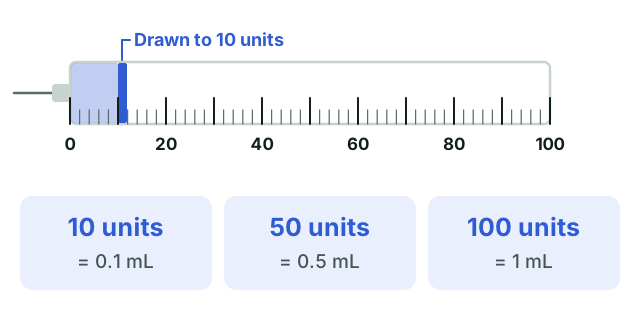
A worked example with a vial containing 3 mg of sermorelin:
- 3 mg = 3,000 mcg.
- Add 3 mL of water: 3,000 mcg divided by 3 mL = 1,000 mcg per mL (1 mg/mL).
- A U-100 insulin syringe holds 100 units per mL, so 1 unit = 0.01 mL.
- 1,000 mcg per mL divided by 100 = 10 mcg per unit.
| Water added to a 3 mg vial | Concentration | Per unit (U-100) | 100 mcg | 300 mcg | 500 mcg |
|---|---|---|---|---|---|
| 1.5 mL | 2 mg/mL | 20 mcg | 5 units | 15 units | 25 units |
| 3 mL | 1 mg/mL | 10 mcg | 10 units | 30 units | 50 units |
| 6 mL | 0.5 mg/mL | 5 mcg | 20 units | 60 units | 100 units |
The amounts in those columns are round numbers for showing the arithmetic, not doses anyone has shown to work. Vial sizes differ between pharmacies, and FDA’s 2024 ipamorelin briefing found compounded vials that combine sermorelin with ipamorelin, so check what is actually in the vial. If your pharmacy sent a different vial, the same math applies.
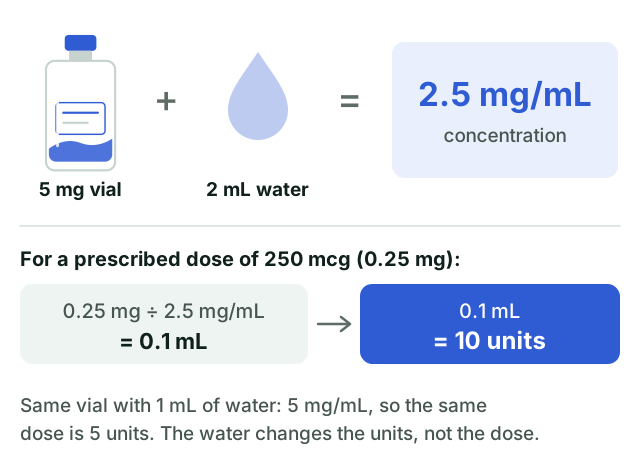
The reconstitution calculator above does the math for any vial and volume, and the mg/mL to units converter works the other way.
Mixing and storing
The Geref text says to inject the liquid against the glass wall of the vial and swirl gently until dissolved, and not to use a solution that is cloudy or has visible particles. Unmixed Geref vials were kept refrigerated at 2 to 8 °C. Geref was mixed with the Sodium Chloride Injection supplied with it, while compounded products are usually mixed with bacteriostatic water. Those instructions came from a different product, so the storage and discard dates on your pharmacy’s label are the ones that apply.
Common mistakes
- Mixing up mg and mcg. 1 mg is 1,000 mcg. A 2 mg study dose is 2,000 mcg, not 200.
- Reading a per-kilogram dose as a total. 30 mcg/kg is not 30 mcg.
- Assuming a blend is single-ingredient. In a combined vial, every unit carries both peptides.
- Borrowing a dose from a forum. Someone else’s number was written for their vial, at their concentration.
- Treating units as a dose. “20 units” means nothing until you know the concentration.
- Using a children’s per-kilogram figure for an adult. That dose was approved only for children with growth failure.
Not approved, and research vials are not legal
No sermorelin product is FDA-approved in 2026. Geref’s approvals were withdrawn in 2009; FDA found in 2013 that this was not for safety or effectiveness. FDA wrote in 2024 that no growth hormone secretagogue has been approved for growth hormone deficiency in adults. A pharmacy may compound sermorelin for a named patient with a prescription, but the result has no FDA label and no approved dose. Sermorelin sold online for research use only may legally be shipped only for laboratory animal or test-tube work under 21 CFR 312.160, and it is not legal to use on a person. The FDA status tracker has the current position, and sermorelin side effects covers what to watch for.
Compare
- PeptidesCompounded (Rx)SermorelinSermorelin signals the pituitary to release growth hormone.
- PeptidesCompounded (Rx)Side effectsThe most common sermorelin side effect is an injection site reaction, in about 1 in 6 patients.
- LearnHow to reconstituteHow a prescribed freeze-dried vial is mixed with bacteriostatic water, the mg/mL and units math worked through, storage, and mistakes that waste a vial.
Peptide news, sorted. Plus the printable dose chart.
Sorted, every Tuesday: the week's peptide and GLP-1 news in five minutes: FDA moves, new studies explained, and price changes. Subscribe and the one-page dose and injection-site chart arrives first.
Questions people ask
What was the approved dose of sermorelin?
What doses did adult studies use?
How many units is 300 mcg of sermorelin?
Why is sermorelin dosed at bedtime?
What if I miss a dose of sermorelin?
How long do people stay on sermorelin?
Sources
Primary sources first: FDA labels and documents, peer-reviewed trials, registries.
- 1Prakash A, Goa KL. Sermorelin: a review of its use in the diagnosis and treatment of children with idiopathic growth hormone deficiency. BioDrugs 1999pubmed.ncbi.nlm.nih.gov
- 2Federal Register. Determination that Geref (sermorelin acetate) injection was not withdrawn from sale for reasons of safety or effectiveness. 78 FR 14095, March 4, 2013govinfo.gov
- 3Sermorelin acetate prescribing text, FDA revision date October 2, 2001, as reproduced by RxListrxlist.com
- 4Thorner M et al. Once daily subcutaneous GHRH therapy accelerates growth in GH-deficient children during the first year of therapy. J Clin Endocrinol Metab 1996pubmed.ncbi.nlm.nih.gov
- 5Ogilvy-Stuart AL et al. Treatment of radiation-induced growth hormone deficiency with GHRH. Clin Endocrinol 1997pubmed.ncbi.nlm.nih.gov
- 6Kirk JM et al. Treatment with GHRH(1-29)NH2 in children with idiopathic short stature. Clin Endocrinol 1994pubmed.ncbi.nlm.nih.gov
- 7Corpas E et al. GHRH(1-29) twice daily reverses the decreased GH and IGF-I levels in old men. J Clin Endocrinol Metab 1992pubmed.ncbi.nlm.nih.gov
- 8Vittone J et al. Effects of single nightly injections of GHRH (GHRH 1-29) in healthy elderly men. Metabolism 1997pubmed.ncbi.nlm.nih.gov
- 9Khorram O et al. Endocrine and metabolic effects of long-term administration of [Nle27]GHRH-(1-29)-NH2 in age-advanced men and women. J Clin Endocrinol Metab 1997pubmed.ncbi.nlm.nih.gov
- 10FDA. Briefing document on ipamorelin-related bulk drug substances, Pharmacy Compounding Advisory Committee, October 29, 2024fda.gov
- 1121 CFR 312.160, drugs for investigational use in laboratory research animals or in vitro testslaw.cornell.edu
More on Sermorelin
- OverviewSermorelinSermorelin signals the pituitary to release growth hormone. Geref was FDA-approved for children; today it is compounded only. Benefits, risks and evidence.
- Before and afterReal sermorelin results: children grew faster, but adult studies of 19 people or fewer found little change in fat or sleep. Why photos are not evidence.Read
- Side effectsThe most common sermorelin side effect is an injection site reaction, in about 1 in 6 patients. Rates from the Geref text, thyroid risks and red flags.Read
- Vs tesamorelinTesamorelin has FDA approval and two large trials, for HIV-related belly fat only. Sermorelin has no approved product. Evidence, doses and risks compared.Read
PeptideSorted Editorial Team
Editorial review
The PeptideSorted editors check every guide against its cited sources before publication: each number against its FDA label, trial or registry, the FDA status against current FDA and HHS documents, and the wording against our describe-never-prescribe rule. Licensed clinicians who join the review panel are listed by name on the editorial team page.
This page was checked against its cited sources by the PeptideSorted editorial team. Licensed clinicians on our review panel are listed on the editorial team page. Every health page cites primary sources and shows its review date. Read the editorial policy and how medical review works, or report an error via corrections. Educational only; not medical advice.