
Short answer
Bacteriostatic water is sterile water with 0.9% benzyl alcohol added as a preservative, so one vial can be punctured repeatedly for up to 28 days. It is an FDA-approved, prescription-labeled diluent for dissolving injectable drugs, never an injection on its own, and it must never be used in newborns, in whom benzyl alcohol has caused deaths.
- What it is
- A multi-dose diluent used to dissolve or dilute injectable drugs; the benzyl alcohol slows bacterial growth between punctures.
- FDA status
- FDA approved
Bacteriostatic Water for Injection, USP is an approved prescription drug product (Hospira, NDA 018802), labeled only for diluting or dissolving drugs for injection.
- Evidence level
FDA label
Dosing comes from the FDA-approved prescribing information.
Bacteriostatic water is sterile water for injection with 0.9% benzyl alcohol, or 9 mg per mL, added as a preservative. That one ingredient is the whole point. Benzyl alcohol slows the growth of bacteria that can enter a vial on a needle, so one vial can be punctured again and again over weeks instead of being thrown away after a single draw. It turns up in every set of peptide basics because it is the liquid most freeze-dried vials are mixed with. It is also an FDA-approved prescription drug product in its own right, with one absolute rule: never in newborns.
| Question | Short answer |
|---|---|
| What it is | Sterile water with 0.9% benzyl alcohol |
| What it is for | Dissolving or diluting injectable drugs, and nothing else |
| How long a punctured vial lasts | 28 days, unless the manufacturer states another date |
| How the unopened vial is stored | Room temperature, 20 to 25°C (68 to 77°F) |
| Who must not receive it | Newborns; it is also barred from epidural and spinal procedures and from fluid replacement |
| FDA status | Approved, marked Rx only |
What is bacteriostatic water used for?
It is used to carry another drug into the body, and that is its only labeled use. The Hospira product, the version most US pharmacies stock, is described on its label as “a sterile, nonpyrogenic preparation of water for injection containing 0.9% (9 mg/mL) of benzyl alcohol added as a bacteriostatic preservative.” The label adds that it is “designed solely for parenteral use only after addition of drugs that require dilution or must be dissolved in an aqueous vehicle prior to injection.”
In plain terms, a drug that has been freeze-dried into a powder needs a liquid before it can be drawn into a syringe, and this is one of the liquids used. An approved example is Egrifta WR, a form of tesamorelin. Its carton holds four powder vials and a 30 mL multiple-dose bottle of bacteriostatic water, and each powder vial is mixed with 1.3 mL. The step-by-step reconstitution guide walks through the technique for a prescribed vial.
What is in the vial, and can it be injected on its own?
No, it is not meant to be injected on its own. The Hospira label lists two presentations, a 30 mL multiple-dose plastic vial and a 20 mL fill in a 30 mL glass vial, both with a pH around 5.7. Two details on that label explain how it should and should not be used.
First, it is not isotonic, meaning it does not match the salt balance of blood. The label says it “must be made approximately isotonic prior to use” and warns that giving it intravenously without a dissolved drug can cause hemolysis, the rupture of red blood cells. Dissolving a drug in it is what makes the small volume safe. Second, it is labeled for intravenous, intramuscular or subcutaneous use once a drug is dissolved, but never for epidural or spinal procedures and never as a fluid replacement.
Why the benzyl alcohol matters
Bacteriostatic means it stops bacteria multiplying; it does not sterilize. The CDC notes that multi-dose vials typically contain a preservative to help limit bacterial growth, and that it “does not have an effect on viruses nor does it provide complete protection against bacterial contamination.” Think of it as buying time between punctures, which is what a vial drawn from over several weeks needs. It does not make a dirty needle safe, and it does nothing to endotoxin, the fragment of bacterial wall that lab tests of unregulated peptides keep finding.
Bacteriostatic water vs sterile water vs saline
The difference that matters is the preservative: bacteriostatic products have one and can be reused for a limited time, and plain products do not and are treated as single use.
| Product | What is in it | Preservative | Tonicity | Container on the label | Labeled use |
|---|---|---|---|---|---|
| Bacteriostatic Water for Injection | Water, 0.9% benzyl alcohol | Yes | Hypotonic | Multiple-dose vial | Diluting or dissolving drugs for injection; not for neonates |
| Sterile Water for Injection | Water only | None | Hypotonic | Single-dose containers | Diluting or dissolving drugs; the preservative-free choice the bacteriostatic water label specifies for neonates |
| 0.9% Sodium Chloride Injection | 9 mg/mL sodium chloride in water | None | Isotonic | Single-dose vials and bags | Intravenous fluid and diluent, per the manufacturer of the drug |
| Bacteriostatic 0.9% Sodium Chloride | 9 mg/mL sodium chloride, 0.9% benzyl alcohol | Yes | Isotonic | 30 mL multiple-dose vial | Diluting or dissolving drugs; same neonate contraindication |
Which one a given drug needs is the manufacturer’s or pharmacy’s call, not the patient’s. The two forms of tesamorelin make the point. Egrifta SV is mixed with sterile water and used right away, with leftovers thrown out. Egrifta WR is mixed with bacteriostatic water and used for up to 7 days. Same molecule, different diluent, because the product was designed that way. The bacteriostatic water label also warns that some drugs “may be incompatible in a given vehicle” containing benzyl alcohol and says to consult a pharmacist.
Is reconstitution solution the same as bacteriostatic water?
Not always. “Reconstitution solution” is a general term for whatever liquid a powder is mixed with, and that may be bacteriostatic water, sterile water or saline. If a pharmacy kit or a prescription sheet uses the phrase, read the small print on the vial for the actual contents. If it does not say, ask before mixing, since the answer decides how long the vial can be kept.
How long does bacteriostatic water last?
An opened vial lasts up to 28 days. USP General Chapter 797, the standard for sterile compounding, is summarized by the CDC this way: an unopened multi-dose vial is good until the manufacturer’s expiry, but once it has been punctured “the vial should be dated and discarded within 28 days unless the manufacturer states another date for that opened vial.” The beyond-use date should never run past the original expiration date.
Three practical points follow from that sentence:
- It does expire. An unopened vial goes by the printed date, and a vial past it should be discarded.
- The clock starts at the first puncture. Write that date on the vial, since no one remembers it three weeks later.
- The 28 days describe the opened container. They are no promise about the stability of whatever is dissolved in it. A compounding pharmacy prints its own beyond-use date for the finished product, and that date governs. The two can differ widely: Egrifta WR is discarded 7 days after mixing.
Use it only if the solution is clear and the seal was intact, with a fresh alcohol swab on the stopper before every entry. The CDC also warns against leaving a needle in the stopper for repeat draws, because that “creates a direct route for microorganisms to enter the vial.”
How can you tell if bacteriostatic water has gone bad?
You often cannot, which is why the dates matter more than the look of the liquid. The label says to use it only if the solution is clear and the seal was intact, so cloudiness, floating particles, a color change or a broken seal are all reasons to discard the vial. Clear liquid is no guarantee, though. A vial past its printed expiry, or more than 28 days past its first puncture, is discarded however it looks.
Does bacteriostatic water need to be refrigerated?
No. The label says to store the vial at 20 to 25°C (68 to 77°F), which is controlled room temperature. Once it has been mixed with a drug, the rule changes, because the storage instruction now comes from that drug. The bacteriostatic water label says to use reconstituted drugs promptly and not to store them “unless otherwise directed by the manufacturer of the solute.” A compounded vial carries the pharmacy’s own storage line, which often means the refrigerator. Egrifta WR shows why nobody should assume: its label says to keep the mixed vial at room temperature and not to freeze or refrigerate it.
Can bacteriostatic water be used with compounded semaglutide or tirzepatide?
Only if the pharmacy’s instructions say so. “BAC water,” as it is often shortened online, is a diluent for dissolving powders, and whether a particular vial needs it depends on how that product was made. The compounded tirzepatide guide covers what to check on the label. If your vial arrived with a stated concentration, it may need nothing added at all, and adding water to it would change every dose you draw.
How much bacteriostatic water do you add?
There is no universal amount, because the volume sets the concentration and the right concentration depends on the drug. The label leaves it to the manufacturer: the volume “is dependent on the vehicle concentration, dose and route of administration as recommended by the manufacturer.” For a compounded peptide that means the pharmacy instruction sheet, and for an approved product it means the label, such as the 1.3 mL that Egrifta WR specifies.
The arithmetic is the same for any vial. A 5 mg vial with 2 mL of bacteriostatic water becomes 2.5 mg/mL, which is 25 mcg per unit on a U-100 insulin syringe, so a 250 mcg dose is 10 units. Add 1 mL instead and every dose is half as many units.
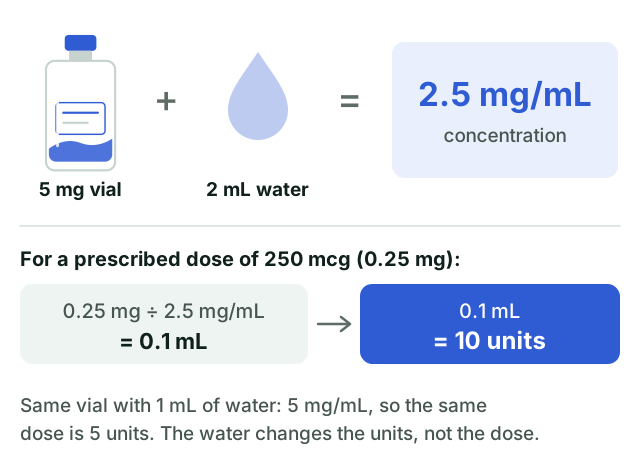
People often search for the amount to add to a specific vial, such as 5 mg of semaglutide or 10 mg of tirzepatide. The table below is arithmetic only. It shows what each combination produces, and it is not a recommendation for any drug.
| Vial | Water added | Concentration | Each unit on a U-100 syringe holds |
|---|---|---|---|
| 5 mg | 1 mL | 5 mg/mL | 50 mcg |
| 5 mg | 2 mL | 2.5 mg/mL | 25 mcg |
| 5 mg | 3 mL | 1.67 mg/mL | 16.7 mcg |
| 10 mg | 1 mL | 10 mg/mL | 100 mcg |
| 10 mg | 2 mL | 5 mg/mL | 50 mcg |
| 10 mg | 3 mL | 3.33 mg/mL | 33.3 mcg |
The reconstitution calculator runs these numbers for any vial, and the tirzepatide units calculator handles that drug’s strengths. If a vial arrived already mixed as a liquid, no water is added at all and the mg/mL to units converter is the one to use.
Who must never receive benzyl alcohol?
Newborns must not receive it. In 1982 the CDC reported sixteen deaths in pre-term infants at two hospitals whose intravascular catheters had been flushed with bacteriostatic saline containing 9 mg/mL benzyl alcohol. The babies developed metabolic acidosis, then respiratory distress with gasping breaths, and in many cases seizures, bleeding in the brain and cardiovascular collapse. The pattern became known as gasping syndrome.
Estimated daily intakes ranged from 99 to 405 mg/kg, far beyond what an adult receives from a few tenths of a milliliter, but premature livers cannot clear benzyl alcohol the way adult livers do. The FDA responded by recommending that flush solutions and diluents containing benzyl alcohol not be used for newborns, and every bacteriostatic product label since has carried a contraindication in neonates. The Hospira vial prints “NOT FOR USE IN NEONATES” on the label itself. For neonatal preparations, the label specifies preservative-free Sterile Water for Injection.
For pregnancy, the label says no animal reproduction studies have been done and that the product with additives “should be given to a pregnant woman only if clearly needed.” It also says safety and effectiveness have not been established in children, so a prescriber makes those calls.
Is bacteriostatic water safe for adults?
For adults the picture is very different. The same label says adverse reactions to subcutaneous, intramuscular or intravenous injection of 0.9% benzyl alcohol “are not known to occur in man,” and cites animal studies estimating that up to 30 mL intravenously could be given to an adult without toxic effects. A reconstituted peptide dose is typically 0.1 to 0.5 mL.
The label does list problems that can follow any injection of this kind: fever, local tenderness, abscess, tissue death or infection at the injection site, vein inflammation, and leakage of fluid into surrounding tissue. Spreading redness, warmth, pus or a fever after an injection is a reason to call the prescriber, and the injection sites guide lists the other signs to watch for.
Is bacteriostatic water in short supply?
FDA’s shortage data lists Hospira’s 30 mL vial as available, in an entry revised October 29, 2026. The product has been on FDA’s shortage list since December 2021, and the entry is still open, so “available” does not mean every wholesaler has it. An ASHP bulletin dated July 2025 described limited supply, with manufacturing delays at Pfizer, Hospira’s parent company. A shortage is no reason to swap in a different liquid without asking, because the diluent is part of the drug’s instructions.
Do you need a prescription for bacteriostatic water?
The Hospira label is marked Rx only, and in practice it usually comes from the pharmacy dispensing the injectable drug it is meant to dilute. Medical and veterinary suppliers also stock it, and whether a given supplier requires a prescription depends on state pharmacy law and the supplier’s policy. Bacteriostatic water is a regulated sterile drug product, not a commodity.
What matters more than the storefront is what sits beside it. In a March 2026 warning letter, the FDA told a peptide vendor that offering bacteriostatic water alongside “research use only” peptides showed the water was intended for injecting those peptides, which made it an unapproved new drug too. Research-use peptides are not legal to use on people, and a vial that arrives in a kit with them is part of the same problem, whatever the water’s own label says. The route that holds up is the one that starts with a prescription and ends at a licensed pharmacy, which is also where injection technique should be taught.
Compare
- LearnHow to reconstituteHow a prescribed freeze-dried vial is mixed with bacteriostatic water, the mg/mL and units math worked through, storage, and mistakes that waste a vial.
- LearnInjection sitesMost peptide drugs go under the skin of the abdomen or thigh, and some labels add the upper arm.
- GLP-1sFDA approvedCompounded tirzepatideCompounded tirzepatide is legal only in narrow cases since the shortage ended.
Peptide news, sorted. Plus the printable dose chart.
Sorted, every Tuesday: the week's peptide and GLP-1 news in five minutes: FDA moves, new studies explained, and price changes. Subscribe and the one-page dose and injection-site chart arrives first.
Questions people ask
Is bacteriostatic water the same as sterile water?
How long is bacteriostatic water good for after opening?
Does bacteriostatic water need to be refrigerated?
Do you need a prescription for bacteriostatic water?
Is the benzyl alcohol harmful to adults?
Can bacteriostatic water be used for any injectable powder?
Sources
Primary sources first: FDA labels and documents, peer-reviewed trials, registries.
- 1Bacteriostatic Water for Injection, USP prescribing information (Hospira, NDA 018802), repackaged vial, DailyMeddailymed.nlm.nih.gov
- 2Bacteriostatic Water for Injection, USP prescribing information, Hospira, DailyMeddailymed.nlm.nih.gov
- 3Sterile Water for Injection, USP prescribing information, DailyMeddailymed.nlm.nih.gov
- 40.9% Sodium Chloride Injection, USP prescribing information, DailyMeddailymed.nlm.nih.gov
- 5Bacteriostatic 0.9% Sodium Chloride Injection, USP prescribing information, DailyMeddailymed.nlm.nih.gov
- 6Egrifta WR (tesamorelin) prescribing information, revised March 2025, via FDAaccessdata.fda.gov
- 7Egrifta SV (tesamorelin) for injection prescribing information, DailyMeddailymed.nlm.nih.gov
- 8CDC. Preventing Unsafe Injection Practices: multi-dose vials and the USP 797 28-day beyond-use date. Reviewed March 2024cdc.gov
- 9USP General Chapter 797, Pharmaceutical Compounding: Sterile Preparationsusp.org
- 10CDC. Neonatal Deaths Associated With Use of Benzyl Alcohol, United States. MMWR 1982;31(22):290-1cdc.gov
- 11FDA Warning Letter to Gram Peptides, March 31 2026: bacteriostatic water sold alongside research-use-only peptides is an unapproved new drugfda.gov
- 12openFDA. FDA drug shortages data, Hospira Bacteriostatic Water for Injection, NDC 0409-3977-03, updated October 29, 2026api.fda.gov
- 13ASHP. Drug shortage detail: Bacteriostatic Water for Injection, bulletin dated July 15, 2025ashp.org
More in Learn
- Are peptides safe?Approved peptide drugs have measured risks. Compounded ones skip FDA review. Research-use vials have no safety review. What is known about each kind.Read
- FDA status trackerWhich peptides are FDA-approved, which HHS tolerates under conditions, and which are not legal to use. One row per peptide, with sources and check dates.Read
- How to read a COAWhat each line on a peptide COA means: HPLC purity, mass spec identity, net content, endotoxin and sterility, plus red flags and what a COA cannot prove.Read
- How to reconstituteHow a prescribed freeze-dried vial is mixed with bacteriostatic water, the mg/mL and units math worked through, storage, and mistakes that waste a vial.Read
- Injection sitesMost peptide drugs go under the skin of the abdomen or thigh, and some labels add the upper arm. Which sites each label names, plus rotation and technique.Read
- Peptide therapyPeptide therapy is a clinic term, not a medical one. It mixes FDA-approved, compounded and unapproved peptides. How to tell which you are being offered.Read
PeptideSorted Editorial Team
Editorial review
The PeptideSorted editors check every guide against its cited sources before publication: each number against its FDA label, trial or registry, the FDA status against current FDA and HHS documents, and the wording against our describe-never-prescribe rule. Licensed clinicians who join the review panel are listed by name on the editorial team page.
This page was checked against its cited sources by the PeptideSorted editorial team. Licensed clinicians on our review panel are listed on the editorial team page. Every health page cites primary sources and shows its review date. Read the editorial policy and how medical review works, or report an error via corrections. Educational only; not medical advice.