
Short answer
Some peptides are legal and many are not, depending on the drug and how it reaches you. FDA-approved peptides such as semaglutide and tirzepatide are legal with a prescription. As of November 2, 2026, HHS tolerates pharmacy compounding of six unapproved peptides under strict conditions. Research use only products are not legal to use on people.
- FDA status
- Not a drug
- Evidence level
n/a
Whether a peptide is legal depends on two things: which molecule it is, and how it reached you. An FDA-approved drug prescribed by a licensed prescriber is legal. A pharmacy may compound a few substances, and as of November 2, 2026 an interim HHS policy tolerates six more under strict conditions. Anything else sold as a peptide is an unapproved new drug. This table is the reference page for our peptide basics and for every profile on the site. Each row gives the status, the basis for it and the date we last checked. Every row was checked on November 2, 2026 against FDA’s 503A category list (updated May 14, 2026), its 503B list (updated March 21, 2025), its safety page for bulk substances (April 22, 2026) and the HHS notice published October 30, 2026.
The five categories this site uses
| Category | What it means | Example |
|---|---|---|
| FDA approved | The drug has a New Drug Application or Biologics License Application and an FDA label. Legal with a prescription, dispensed by a licensed pharmacy. | Semaglutide, tirzepatide |
| Compoundable with a prescription | Not an approved product, but a state-licensed pharmacy may compound it for a named patient under section 503A because it is a component of an approved drug, has a USP monograph, or is on the 503A bulks list. | Sermorelin |
| Not approved, interim HHS policy | Not approved and not on the bulks list. HHS says it does not intend to take enforcement action against 503A compounding of the peptide when ten conditions are met. The route and salt form are limited. | BPC-157, TB-500, semax |
| Investigational | In registered clinical trials under an FDA Investigational New Drug application. Legal inside the trial. Outside one, access is limited to narrow pre-approval arrangements where the sponsor offers them. | Retatrutide, cagrilintide |
| Not approved, research only | No approval, no compounding route. Sold with a research label. Not legal to use on people. | CJC-1295, ipamorelin, selank |
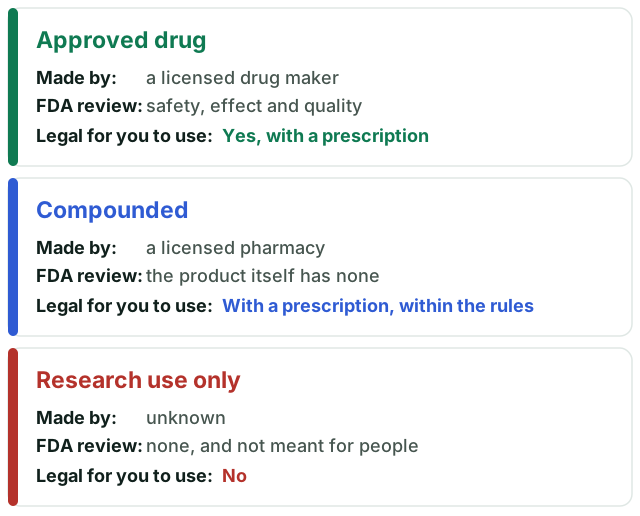
Status table
| Peptide | Status | Basis | Last checked |
|---|---|---|---|
| Semaglutide | FDA approved | Ozempic (type 2 diabetes) approved December 5, 2017; Rybelsus tablets (type 2 diabetes) September 20, 2019, with Ozempic-branded semaglutide tablets (1.5, 4 and 9 mg) now listed under the same application; Wegovy (weight management) June 4, 2021, with cardiovascular risk reduction added March 8, 2024; Ozempic kidney-disease indication January 28, 2025; Wegovy for noncirrhotic MASH with moderate to advanced fibrosis August 15, 2025 (accelerated approval); Wegovy pill (oral semaglutide 25 mg) December 22, 2025; Wegovy HD 7.2 mg injection March 19, 2026 | Nov 2, 2026 |
| Tirzepatide | FDA approved | Mounjaro approved May 2022, with a new indication announced August 28, 2026 to lower the risk of major cardiovascular events in adults with type 2 diabetes at high risk for them; Zepbound approved November 2023, with sleep apnea added December 2024 | Nov 2, 2026 |
| Retatrutide | Investigational | Lilly’s TRIUMPH phase 3 program; positive topline results from TRIUMPH-2 and TRIUMPH-3 announced July 23, 2026. Lilly targets a submission in the first quarter of 2027 and wants to file a BLA. FDA has classified retatrutide as a drug rather than a biologic, and that dispute is in court. No approval. On August 3, 2026 Lilly confirmed that a narrow group of patients can apply for access before approval, through their physicians; published descriptions of who qualifies differ. FDA says retatrutide “cannot be used in compounding under federal law.” | Nov 2, 2026 |
| Cagrilintide | Investigational | Novo Nordisk filed an NDA for CagriSema (cagrilintide 2.4 mg plus semaglutide 2.4 mg) on December 18, 2025. No FDA decision found as of the check date. FDA says cagrilintide “cannot be used in compounding under federal law.” | Nov 2, 2026 |
| Orforglipron (not a peptide) | FDA approved | A small-molecule GLP-1 pill, listed here because it is sold alongside peptide GLP-1s. Foundayo approved April 1, 2026 for chronic weight management, under FDA’s national priority voucher program. Carries the same thyroid C-cell tumor boxed warning as the injectable GLP-1s. | Nov 2, 2026 |
| Liraglutide | FDA approved | Victoza approved January 25, 2010; Saxenda approved December 23, 2014; first generic of Victoza approved December 23, 2024 | Nov 2, 2026 |
| Sermorelin | Compoundable with a prescription | Geref (sermorelin acetate) was approved in 1990 and 1997 for short stature in children with growth hormone deficiency; the maker discontinued it in 2008 and the approvals were withdrawn June 18, 2009. In March 2013 FDA determined it was not withdrawn for safety or effectiveness. FDA’s 503B bulks list (updated March 21, 2025) places sermorelin acetate in category 1 and marks it as a component of FDA-approved drugs. It appears in no 503A category as of the May 14, 2026 list; 503A pharmacies compound it on the component-of-an-approved-drug basis, and FDA has published no 503A statement specific to sermorelin that we could find. | Nov 2, 2026 |
| Tesamorelin | FDA approved | Egrifta approved November 10, 2010 for excess abdominal fat in HIV-associated lipodystrophy | Nov 2, 2026 |
| BPC-157 | Not approved, interim HHS policy | In 503A category 2 from September 2023 until April 22, 2026, when nominators withdrew. PCAC voted 8 to 6 with one abstention on July 23, 2026 to recommend it for the bulks list, against FDA staff advice. No rule proposed. The HHS policy covers BPC-157 acetate for subcutaneous, intramuscular, oral and topical forms. | Nov 2, 2026 |
| SS-31 (elamipretide) | FDA approved | Forzinity approved September 19, 2025 under accelerated approval (NDA 215244) to improve muscle strength in Barth syndrome, in patients weighing at least 30 kg; a confirmatory trial is required. Elamipretide sold for research use is not the approved product. | Nov 2, 2026 |
| TB-500 (thymosin beta-4 fragment) | Not approved, interim HHS policy | Listed as “Thymosin Beta-4, Fragment (LKKTETQ)” in category 2 from September 29, 2023 until April 22, 2026; nomination withdrawn. PCAC recommended it July 23, 2026. No rule proposed. The HHS policy covers TB-500 acetate for subcutaneous or intramuscular injection. Full-length thymosin beta-4 was not on the list. | Nov 2, 2026 |
| GHK-Cu | Not approved (injectable); under evaluation (non-injectable) | Injectable GHK-Cu placed in category 2 September 29, 2023, nomination withdrawn April 22, 2026. Non-injectable GHK-Cu restored to category 1 (under evaluation) May 2026. FDA says it intends to consult PCAC before the end of February 2027. Not in the HHS policy. Topical cosmetics containing GHK-Cu are regulated as cosmetics, not drugs, as long as no drug claims are made. | Nov 2, 2026 |
| CJC-1295 | Not approved | Category 2 September 29, 2023. PCAC reviewed all five CJC-1295 forms for growth hormone deficiency on December 4, 2024 and voted against adding any (0 yes, 13 no for four forms; 1 yes, 12 no for the acetate). Nomination since withdrawn; not on the bulks list; not in the HHS policy | Nov 2, 2026 |
| Ipamorelin | Not approved | Ipamorelin acetate placed in category 2 for both 503A and 503B on September 29, 2023. PCAC voted against it (0 yes, 12 no, 1 abstain on each form) for growth hormone deficiency and postoperative ileus on October 29, 2024. 503A nomination since withdrawn, 503B category 2 entry still listed; not on the bulks list; not in the HHS policy | Nov 2, 2026 |
| KPV | Not approved, interim HHS policy | In category 2 from September 2023 until April 22, 2026; nomination withdrawn. PCAC recommended it July 23, 2026 for wound healing and inflammatory conditions. No rule proposed. The HHS policy covers KPV acetate in topical and oral forms only. Injected KPV is not covered. | Nov 2, 2026 |
| AOD-9604 | Not approved | Category 2 September 29, 2023. PCAC voted against it (0 yes, 12 no) on December 4, 2024. Nomination since withdrawn; not on the bulks list; not in the HHS policy | Nov 2, 2026 |
| MOTS-c | Not approved, interim HHS policy | In category 2 from September 29, 2023 until April 22, 2026; nomination withdrawn. PCAC recommended it July 23, 2026 for obesity and osteoporosis. No rule proposed. The HHS policy covers MOTS-c acetate for subcutaneous or intramuscular injection. | Nov 2, 2026 |
| PT-141 (bremelanotide) | FDA approved | Vyleesi approved June 21, 2019 for acquired, generalized hypoactive sexual desire disorder in premenopausal women | Nov 2, 2026 |
| Selank | Not approved | Selank acetate placed in category 2 September 29, 2023; nomination since withdrawn; not on the bulks list; not in the HHS policy | Nov 2, 2026 |
| Epitalon | Not approved, interim HHS policy | In category 2 from September 29, 2023 until April 22, 2026; nomination withdrawn. PCAC recommended it July 24, 2026 for insomnia. No rule proposed. The HHS policy covers epitalon acetate for subcutaneous or intramuscular injection, dispensed in intermittent courses. | Nov 2, 2026 |
| Semax | Not approved, interim HHS policy | In category 2 from September 29, 2023 until April 22, 2026; nomination withdrawn. PCAC recommended it July 24, 2026. No rule proposed. FDA’s safety page says it has “no, or limited, safety-related information for proposed routes of administration.” The HHS policy covers semax free base for intranasal use only. Injected semax is not covered. | Nov 2, 2026 |
| Thymosin alpha-1 | Not approved | We found no approved application in FDA’s data for thymalfasin or Zadaxin. A former 503A category 2 substance whose nomination was withdrawn; listed in 503B category 3 (nominated without adequate support). FDA says it “may pose significant risk for immunogenicity for certain routes of administration” and that the safety information is inadequate. Not on the bulks list; not in the HHS policy | Nov 2, 2026 |
| MK-677 (ibutamoren) (not a peptide) | Not approved | An orally active nonpeptide growth hormone secretagogue, listed here because it is sold alongside peptides. We found no approved application in FDA’s data. Ibutamoren mesylate is in category 2 on both lists (503A since September 29, 2023; 503B since December 29, 2022). FDA says it “poses significant safety risks due to the potential for congestive heart failure in certain patients.” Not in the HHS policy | Nov 2, 2026 |
| Emideltide (DSIP) | Not approved | Former category 2 substance; nomination withdrawn. PCAC rejected it July 24, 2026, the only one of the seven peptides reviewed that it did not recommend. Not on the bulks list; not in the HHS policy | Nov 2, 2026 |
| Blends, such as the Wolverine stack, Glow and Klow | Outside the HHS policy | The policy requires a single active ingredient from its list, so a multi-peptide product falls outside it even when every ingredient is on the list. | Nov 2, 2026 |
| NAD+ (not a peptide) | Compoundable under FDA’s interim policy, pending evaluation | NAD+ is a coenzyme, not a peptide, but it is sold alongside peptides. Nicotinamide adenine dinucleotide is in 503A category 1 (under evaluation) on the May 14, 2026 list. FDA’s interim policy says it does not intend to act against compounding with category 1 substances while evaluation continues, if the other 503A conditions are met. | Nov 2, 2026 |
| The September 2023 category 2 list | Largely dissolved | Of the 19 substances added September 29, 2023, the May 14, 2026 list keeps only ibutamoren mesylate and kisspeptin-10 in category 2 (with cesium chloride, domperidone, germanium sesquioxide and intrauterine quinacrine from earlier years). The peptide entries were removed when nominators withdrew, which left them in no category at all. | Nov 2, 2026 |
| The July 2026 PCAC review | Advisory votes only, no rule | PCAC met July 23-24, 2026 on seven peptides. It recommended BPC-157, KPV, TB-500, MOTS-c, epitalon and semax and rejected emideltide (DSIP). FDA staff had proposed against all seven. No proposed rule has appeared in the Federal Register as of the check date. FDA has not posted minutes: its meeting page, last changed August 6, 2026, lists the briefing documents, presentations, questions and roster. | Nov 2, 2026 |
| The October 2026 HHS policy | Published, comments open | Reached the White House budget office October 14, 2026 as the “Interim Access Policy for Compounding Using Certain Peptides” (RIN 0910-ZD94). HHS announced it October 28 and published it October 30, 2026 as the “Enforcement Discretion Policy Regarding 503A Compounding Using Certain Peptide Bulk Drug Substances.” Written comments run until November 13, 2026. | Nov 2, 2026 |
What the October 2026 HHS policy does and does not do
The policy is a statement that HHS, through the Secretary’s office rather than FDA, does not intend to take enforcement action against a state-licensed pharmacy, federal facility or licensed physician compounding one of six peptides, when all ten conditions are met, until a final rule says whether each peptide goes on the 503A bulks list. The exact form and route matter, because the cover stops where the appendix stops.
| Peptide | Form covered | Routes covered |
|---|---|---|
| BPC-157 | Acetate | Subcutaneous, intramuscular, oral, topical |
| TB-500 | Acetate | Subcutaneous or intramuscular |
| MOTS-c | Acetate | Subcutaneous or intramuscular |
| Epitalon | Acetate | Subcutaneous or intramuscular, dispensed in intermittent courses |
| KPV | Acetate | Topical and oral only |
| Semax | Free base | Intranasal only |
All ten conditions have to be present:
- The peptide is on the policy’s Appendix A list.
- It has the identity and route limits in Appendix B.
- The bulk substance comes from an FDA-registered facility with a valid certificate of analysis.
- The original manufacturer is FDA-registered and compliant with current good manufacturing practice, with its location on the certificate.
- The compounder reports serious adverse events and quality problems to FDA MedWatch and to the states involved.
- The label reads: “This is a compounded drug product. Not for resale.”
- The product contains a single active ingredient from the list, so blends are outside the policy.
- For an oral product, the compounder keeps documentation that the formulation reaches adequate oral bioavailability in humans.
- The only device packaged with it is an FDA 510(k)-cleared syringe.
- It meets all other requirements of the Food, Drug, and Cosmetic Act, including a valid patient-specific prescription and no insanitary conditions.
Those conditions are narrow, and the limits matter as much as the list:
- It is not an approval. None of the six is FDA-approved and none is on the 503A bulks list. No rule has been proposed, and FDA has not reviewed any compounded product for safety, effectiveness or quality.
- It is a choice not to enforce. The notice says the policy “does not establish any rights for any person and is not binding on HHS or the public.” It calls the policy a draft in places and takes written comments until November 13, 2026.
- It can change. HHS may revisit it if a safety signal or product quality problem appears.
- It covers 503A compounding only. Outsourcing facilities under section 503B are not covered.
- States can be stricter. State boards of pharmacy license these pharmacies and keep their own rules, and states may not follow the federal approach.
- The evidence is unchanged. FDA’s drug center recommended against listing all six, and a decision about enforcement says nothing about whether a peptide works or is safe.
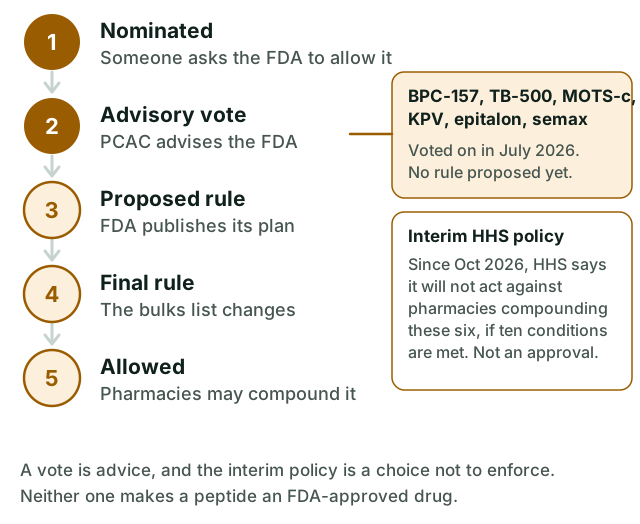
How 503A bulk substance categories work
Section 503A of the Food, Drug, and Cosmetic Act lets a licensed pharmacist in a state-licensed pharmacy, or a licensed physician, compound a drug for an individual patient without the approval, labeling and manufacturing rules that apply to drug companies. One condition is the source material. A bulk drug substance may be used only if it has a United States Pharmacopeia or National Formulary monograph, is a component of an FDA-approved drug, or appears on the 503A bulks list that FDA writes by regulation.
While it evaluates the substances nominated for that list, FDA sorts them into three categories under an interim policy:
- Category 1: nominated with enough information to evaluate; FDA does not intend to take enforcement action against compounding with these while the evaluation runs.
- Category 2: FDA has identified significant safety risks; compounding is not covered by the interim policy.
- Category 3: nominated without enough information to evaluate; not covered either.
FDA’s criteria for the list itself, set by a 2019 final rule, are physical and chemical characterization, safety, evidence of effectiveness or lack of it, and historical use in compounding, balanced substance by substance.
What is the PCAC?
The Pharmacy Compounding Advisory Committee is a panel of outside clinicians, pharmacists and scientists that FDA consults before deciding whether to add a substance to the bulks list. FDA presents its evaluation, the committee votes, and the vote is a recommendation. FDA’s July 2026 briefing document says the agency “does not intend to issue a final determination” until it has considered the committee’s input and finalized its reviews. It is free to disagree, and in July 2026 its staff already had.
A second meeting is expected before the end of February 2027. FDA’s May 2026 category list names GHK-Cu for it, and Holland & Knight reports LL-37, dihexa, melanotan II and PEG-MGF as the others. We found no announced date as of November 2, 2026.
What changes when a substance moves
Moving from category 2 to category 1 restores FDA’s interim enforcement policy, so compounding can resume while evaluation continues. Being removed from category 2 because a nominator withdrew, which is what happened to BPC-157 and most of the 2023 peptide batch in April 2026, is different. In the words of the HHS policy, “neither the placement nor the removal changed” the status of those substances under section 503A. The HHS policy then added a separate layer for six of them, and the rest stayed where they were.
Reaching the bulks list itself, through a proposed rule, public comment and a final rule, is the step that would bring a substance within section 503A. Even then it is not an approved drug: there is no label, no approved dose, and no manufacturer responsible for safety data.
Do state laws matter?
Yes, because federal law sets the floor. State boards of pharmacy license the pharmacies that compound under 503A and can impose stricter rules on what they compound, how prescriptions are written and whether out-of-state pharmacies may ship in. State medical boards separately decide whether prescribing an unapproved peptide falls within the standard of care. Rules vary enough that a prescriber or pharmacy should check their own state, but no state can make an unapproved peptide legal for human use when federal law says otherwise.
The practical test
Three questions settle almost every case. Is there a prescription from a licensed prescriber, written for you? Is it dispensed by a licensed pharmacy? Is the substance FDA-approved, one a pharmacy may lawfully compound, or within the exact form and route of the HHS policy? If any answer is no, the product is outside every route on this page.
A “research use only” label fails the test by definition. 21 CFR 312.160 permits such products to be shipped only for tests in laboratory animals or in vitro, with the words “Not for use in humans” on the label. FDA warning letters to peptide sellers in 2024 and 2026 have found that the disclaimer does not protect a seller whose marketing shows the product is meant for people, and it does not protect the person who injects it either. The HHS policy gives these products nothing. It says its aim is to “discourage the continued, widespread use of certain research-use-only peptides.”
For the most searched example, read the BPC-157 guide. Compounded versions of approved drugs have their own rules, covered in the compounded tirzepatide guide. If you are starting from scratch, begin with what peptides are, and read whether peptides are safe before weighing any of this as a green light.
Compare
Recent news on this
Peptide news, sorted. Plus the printable dose chart.
Sorted, every Tuesday: the week's peptide and GLP-1 news in five minutes: FDA moves, new studies explained, and price changes. Subscribe and the one-page dose and injection-site chart arrives first.
Questions people ask
Are peptides legal in the United States?
What peptides are FDA approved?
Did the FDA approve BPC-157 in 2026?
What does research use only mean legally?
Is compounded semaglutide or tirzepatide legal?
Which peptides are banned in sport?
Sources
Primary sources first: FDA labels and documents, peer-reviewed trials, registries.
- 1FDA. Pharmacy Compounding Advisory Committee, December 4, 2024: final meeting minutes (CJC-1295, AOD-9604)fda.gov
- 2FDA. Pharmacy Compounding Advisory Committee, October 29, 2024: final meeting minutes (ipamorelin)fda.gov
- 3FDA. Bulk drug substances nominated for use in compounding under section 503B, category list (updated March 21, 2025)fda.gov
- 4FDA. Bulk drug substances nominated for use in compounding under section 503A, category list (updated May 14, 2026)fda.gov
- 5FDA. Certain bulk drug substances for use in compounding may present significant safety risksfda.gov
- 6FDA. 503A categories update, September 29, 2023 (copy hosted by the Alliance for Pharmacy Compounding)join.a4pc.org
- 7FDA. July 23-24, 2026 meeting of the Pharmacy Compounding Advisory Committeefda.gov
- 8FDA. Briefing document, Pharmacy Compounding Advisory Committee meeting, July 23-24, 2026fda.gov
- 9RAPS. FDA advisory committee backs two controversial peptides, July 23, 2026raps.org
- 10NCPA. FDA advisory committee nominates six peptides for pharmacies to compound, July 31, 2026ncpa.org
- 11Frier Levitt. FDA PCAC peptide vote: what the 503A recommendations mean, September 17, 2026frierlevitt.com
- 12Holt Law. BPC-157 after the July 2026 PCAC vote: still not legal to compounddjholtlaw.com
- 13Drugs@FDA. Ozempic (semaglutide), NDA 209637, approved December 5, 2017accessdata.fda.gov
- 14Drugs@FDA. Wegovy (semaglutide), NDA 215256, approved June 4, 2021accessdata.fda.gov
- 15Zepbound (tirzepatide) prescribing information, Eli Lilly, via FDAaccessdata.fda.gov
- 16Mounjaro (tirzepatide) prescribing information, Eli Lilly, via FDAaccessdata.fda.gov
- 17Drugs@FDA. Victoza (liraglutide), NDA 022341, approved January 25, 2010accessdata.fda.gov
- 18Drugs@FDA. Saxenda (liraglutide), NDA 206321, approved December 23, 2014accessdata.fda.gov
- 19FDA press release. FDA approves first generic of once-daily GLP-1 injection, December 23, 2024fda.gov
- 20Drugs@FDA. Egrifta (tesamorelin), BLA 022505, approved November 10, 2010accessdata.fda.gov
- 21Drugs@FDA. Vyleesi (bremelanotide), NDA 210557, approved June 21, 2019accessdata.fda.gov
- 22Federal Register. Determination that Geref (sermorelin acetate) injection was not withdrawn from sale for reasons of safety or effectiveness, March 4, 2013public-inspection.federalregister.gov
- 23Eli Lilly press release. Retatrutide successful in two additional phase 3 obesity trials (TRIUMPH-2, TRIUMPH-3), July 23, 2026 (via BioSpace)biospace.com
- 24Drugs@FDA. Rybelsus (semaglutide) tablets, NDA 213051accessdata.fda.gov
- 25Novo Nordisk US. Wegovy approved by FDA for noncirrhotic MASH with moderate to advanced liver fibrosis, August 15, 2025novonordisk-us.com
- 26Novo Nordisk Form 6-K. Wegovy pill approved in the US as first oral GLP-1 for weight management, December 22, 2025sec.gov
- 27HCPLive. FDA approves higher-dose semaglutide (Wegovy HD) injection 7.2 mg for obesity, March 19, 2026hcplive.com
- 28FDA press release. FDA approves first new molecular entity under national priority voucher program (Foundayo, orforglipron), April 1, 2026fda.gov
- 29FDA. Forzinity (elamipretide) accelerated approval letter, NDA 215244, September 19, 2025accessdata.fda.gov
- 30FDA press release. FDA proposes to exclude semaglutide, tirzepatide and liraglutide from the 503B bulks list, April 30, 2026fda.gov
- 31AP via STAT. Trump administration advances plan for peptide drugs favored by RFK Jr., October 15, 2026statnews.com
- 32Holland & Knight. Peptides at a crossroads: what wellness providers need to know, October 16, 2026hklaw.com
- 33Novo Nordisk. Novo Nordisk files for FDA approval of CagriSema, December 18, 2025novonordisk.com
- 34WADA. The Prohibited List (current)wada-ama.org
- 3521 CFR 312.160, drugs for investigational use in laboratory research animals or in vitro testslaw.cornell.edu
- 36FDA warning letter to Gram Peptides, March 31, 2026fda.gov
- 37FDA warning letter to Summit Research Peptides, December 10, 2024fda.gov
- 38HHS. Enforcement Discretion Policy Regarding 503A Compounding Using Certain Peptide Bulk Drug Substances, with Appendices A and B, October 2026hhs.gov
- 39Federal Register. Notice of availability, FR Doc. 2026-22192, Docket HHS-OASH-2026-0496, RIN 0910-ZD94, published October 30, 2026public-inspection.federalregister.gov
- 40FDA. Bulk drug substances used in compounding under section 503A of the FD&C Act (content current as of May 14, 2026)fda.gov
- 41FDA. FDA's concerns with unapproved GLP-1 drugs used for weight loss (content current as of October 1, 2026)fda.gov
- 42Eli Lilly press release. FDA approves Lilly's Mounjaro (tirzepatide) to reduce cardiovascular risk in adults with type 2 diabetes, August 28, 2026investor.lilly.com
- 43AJMC. 5 things to know about HHS's interim peptide compounding policy, October 29, 2026ajmc.com
- 44AJMC. Lilly expands retatrutide access amid doctor pushback, August 5, 2026ajmc.com
- 45BioSpace. Lilly, FDA retatrutide biologic dispute comes to a head as submission nears, August 5, 2026biospace.com
- 46Codner E et al. Effects of oral administration of ibutamoren mesylate, a nonpeptide growth hormone secretagogue. Clin Pharmacol Ther 2001;70(1):91-8pubmed.ncbi.nlm.nih.gov
- 47openFDA. Drugs@FDA data on approved applications, searched November 2, 2026api.fda.gov
- 48openFDA. Drugs@FDA search for thymalfasin, thymosin, Zadaxin and ibutamoren, no application found, November 2, 2026api.fda.gov
More in Learn
- Are peptides safe?Approved peptide drugs have measured risks. Compounded ones skip FDA review. Research-use vials have no safety review. What is known about each kind.Read
- Bacteriostatic waterSterile water with 0.9% benzyl alcohol, so one vial can be used for up to 28 days. How it differs from sterile water, storage, and who must avoid it.Read
- How to read a COAWhat each line on a peptide COA means: HPLC purity, mass spec identity, net content, endotoxin and sterility, plus red flags and what a COA cannot prove.Read
- How to reconstituteHow a prescribed freeze-dried vial is mixed with bacteriostatic water, the mg/mL and units math worked through, storage, and mistakes that waste a vial.Read
- Injection sitesMost peptide drugs go under the skin of the abdomen or thigh, and some labels add the upper arm. Which sites each label names, plus rotation and technique.Read
- Peptide therapyPeptide therapy is a clinic term, not a medical one. It mixes FDA-approved, compounded and unapproved peptides. How to tell which you are being offered.Read
PeptideSorted Editorial Team
Editorial review
The PeptideSorted editors check every guide against its cited sources before publication: each number against its FDA label, trial or registry, the FDA status against current FDA and HHS documents, and the wording against our describe-never-prescribe rule. Licensed clinicians who join the review panel are listed by name on the editorial team page.
This page was checked against its cited sources by the PeptideSorted editorial team. Licensed clinicians on our review panel are listed on the editorial team page. Every health page cites primary sources and shows its review date. Read the editorial policy and how medical review works, or report an error via corrections. Educational only; not medical advice.