Short answer
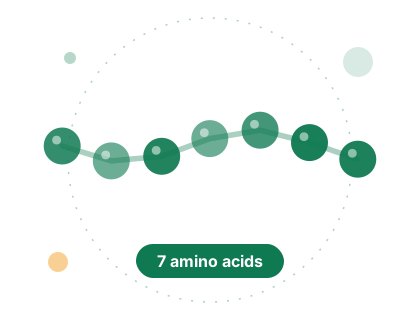
TB-500 is a synthetic seven-amino-acid fragment of thymosin beta-4, and it is not the same substance as that protein. FDA found no human data on it by any route and no animal toxicity studies. It is not FDA-approved. As of November 2, 2026, HHS says it does not intend to act against compounding that meets ten conditions.
- What it is
- A synthetic, acetylated seven-amino-acid fragment (amino acids 17 to 23, LKKTETQ) of thymosin beta-4, first used in veterinary and doping settings.
- FDA status
- Not FDA approved
Not FDA-approved. FDA staff proposed against listing it, and an advisory committee recommended it in July 2026. As of November 2, 2026 no rule has been proposed, but an interim HHS policy says HHS does not intend to take enforcement action against compounding of TB-500 acetate for injection under ten conditions.
- Evidence level
Animal studies only
No controlled human trials. Everything below is animal or lab data.
TB-500 is a tiny synthetic fragment of a natural human protein, and as far as FDA could find, it has never been studied in a person. It came out of the veterinary and doping world, and it is sold today as a healing peptide on the strength of research into a much larger molecule. It is not FDA-approved. Before anything else, understand that TB-500 and thymosin beta-4 are different things. Most of what you will read about it blurs them. It is usually paired with BPC-157, a peptide with its own thin evidence.
| Your question | The short answer, as of November 2, 2026 |
|---|---|
| Is it FDA-approved? | No, for no use |
| Has it been tested in people? | FDA found no human data by any route |
| Is it thymosin beta-4? | No. It is a 7-amino-acid fragment of that 43-amino-acid protein |
| Can a pharmacy compound it? | Tolerated under an interim HHS policy, with ten conditions. TB-500 acetate only, by injection under the skin or into muscle. It is not on the 503A bulks list and no rule has been proposed |
| Is there a human dose? | No |
| Are its risks known? | No. FDA found no toxicity studies at all |
| Is it allowed in sport? | No. WADA bans it at all times |
What is TB-500?
TB-500 is a seven-amino-acid peptide with an acetyl group added to one end. Its sequence is Ac-Leu-Lys-Lys-Thr-Glu-Thr-Gln, or LKKTETQ, which matches positions 17 to 23 of thymosin beta-4. FDA’s July 2026 review describes it as “understood today to be” that fragment, and the hedge is deliberate. TB-500 is a common name, not an official drug name, and FDA has “encountered multiple salts, and derivatives, including different active moieties, sold commercially under the same common name.”
Its history explains a lot. FDA traces the fragment to a 2003 laboratory study, and a veterinary preparation appeared in 2011, marketed to boost performance in horse and greyhound racing. A 2012 anti-doping paper developed a test for it in racehorses. FDA found discussion of it on doping forums rising after 2010. At the time of its review, FDA could not find a pharmacy that marketed compounded TB-500, or any published study of a compounded product.
TB-500 vs thymosin beta-4
Thymosin beta-4 has real human trial data, and TB-500 does not. Results from one do not carry over to the other.
| Thymosin beta-4 | TB-500 | |
|---|---|---|
| Size | 43 amino acids | 7 amino acids, acetylated |
| Origin | Natural. Found in many cell types and in blood, saliva, tears and wound fluid | Synthetic |
| Human trials | Yes: eye drops, skin gels and intravenous infusions | FDA found none |
| Toxicity studies | Not covered in FDA’s TB-500 review | FDA found none |
| FDA-approved? | No | No |
| On the HHS interim list? | No, the list names TB-500 only | Yes, the acetate |
FDA states plainly that “thymosin beta-4 and TB-500 are not the same substance,” although many websites use the names interchangeably. Even a tiny chemical change matters: FDA notes that acetylation alters a peptide’s charge, size and binding, so results for the unacetylated fragment cannot be assumed to apply to TB-500 either.
How is TB-500 supposed to work?
The theory is borrowed from its parent protein. Thymosin beta-4 binds actin, a building block of the cell’s internal skeleton, and it has been linked to cell migration, new blood vessel growth and wound repair. The LKKTETQ stretch contains the actin-binding region, so the idea is that a small piece might do the same work. FDA says it remains to be determined whether actin binding explains the fragment’s reported effects, and it is unknown whether TB-500 needs to be broken down into something else to act at all.
What are the benefits of TB-500?
No benefit of TB-500 has been shown in people. FDA found that sellers market it for a remarkable range of things. Set against the evidence, the list looks like this.
| What sellers claim | What is known about TB-500 itself |
|---|---|
| Faster wound healing | FDA found no animal study of TB-500 for wounds. The unacetylated fragment helped mouse skin wounds in a 2003 study, applied to the skin. In a cell study, TB-500 did not close a scratch wound; one of its breakdown products had a small effect |
| Tendon repair | One 2026 rat study: tendon strength rose over controls, by injection into the abdomen, with 8 rats per group |
| Muscle growth, stamina, performance | No study in people. WADA bans it |
| Better heart health | No study of TB-500 in people |
| Hair growth, more collagen, flexibility, immune support | No study of TB-500 in people found by FDA |
FDA concluded that nonclinical evidence “is currently lacking” to support TB-500 for wound healing, and that there is “a lack of evidence to evaluate the effectiveness” in people. We cannot tell you what results to expect or how long they would take, because nobody has measured them.
The human trials people cite
The trials quoted for TB-500 tested full-length thymosin beta-4, mostly as eye drops (a product called RGN-259) and topical gels. Some used intravenous infusion. None used TB-500.
| Trial | Product and route | Who | Result |
|---|---|---|---|
| Ruff et al. 2010, phase 1 | Synthetic thymosin beta-4, intravenous | 40 healthy volunteers | Adverse events uncommon and mild to moderate; no dose-limiting toxicity |
| Guarnera et al. 2010, phase 2 | Gel on the wound | 73 patients with venous leg ulcers | Safety comparable to placebo; authors suggest the 0.03% dose “may have the potential” to speed healing |
| Sosne and Ousler 2015, phase 2 | 0.1% eye drops | 72 adults with dry eye | Missed both primary endpoints; some secondary measures improved |
| SEER-1, phase 3 (Sosne 2022) | 0.1% eye drops | 18 patients with neurotrophic keratopathy, a nerve-damage disease of the cornea | Complete healing at 4 weeks in 6 of 10 on drug vs 1 of 8 on placebo (p = 0.066, not significant) |
| ARISE-3 (NCT03937882), phase 3 | 0.1% eye drops | 700 adults with dry eye | Completed 2020 |
| SEER-2 (NCT05555589), phase 3 | 0.1% eye drops | Planned 70 patients with neurotrophic keratopathy | Listed as recruiting |
| NL005 (NCT05984134), phase 2b | Recombinant thymosin beta-4 by injection | 90 people after a heart attack, in China | Listed as completed |
A 2025 Cochrane review rated the RGN-259 evidence in neurotrophic keratopathy as low certainty, and a 2025 laboratory paper notes that FDA approval of the eye drops is “still pending.” No thymosin beta-4 product is approved in the United States.
One registry entry deserves a warning. NCT07487363 lists a phase 1/2 study of TB-500 in heart disease, but the record’s own summary calls it “this fictional study” and an “example” record. We do not count it, and you should be wary of anyone who cites it as a human trial.
Is TB-500 safe?
Nobody knows, and FDA was unusually direct: “potential safety risks associated with the use of TB-500 in humans are unknown.”
- No toxicity studies. FDA found no acute, repeat-dose, genetic, reproductive or cancer studies of TB-500.
- No human exposure data. FDA found no clinical studies and no published case reports.
- Adverse event reports. FDA’s drug database held none through March 2025, and its food and supplement database held two reports about a TB-500 and BPC-157 blend with no safety assessment. Reporting is voluntary, so silence means little.
- Immune reactions. As an injected peptide, FDA says, TB-500 “may pose a significant risk for immunogenicity,” meaning the body could mount an immune response against it. Clumping (aggregation) and peptide impurities could make that worse.
- A reaction to a blend. One FDA report describes a woman who developed skin and gum darkening on a BPC-157 and TB-500 research product, repeating when she used it again. FDA could not say which peptide was responsible. The BPC-157 side effects guide gives the details.
The theoretical cancer question
A published concern exists, and it is indirect. In a 2003 mouse study in the Journal of the National Cancer Institute, melanoma cells engineered to make extra thymosin beta-4 formed more lung metastases and more tumor blood vessels. That experiment changed the tumor cells themselves. Nobody gave a drug, it did not involve TB-500, and it does not show that TB-500 causes cancer. But marketing TB-500 for “promoting angiogenesis” sits uneasily beside it, and with no carcinogenicity study there is no data to settle the question.
Quality problems
A 2023 laboratory analysis of products sold online as TB500 and TB1000 found their content was “not systematically consistent” with their descriptions. FDA found TB-500 is not well characterized, with public data missing on impurities, aggregates, microbial quality and endotoxin. Products labeled for research use only are not legal to use on people, and FDA warning letters have treated that label as no defense when the marketing points to human use, under the rule in 21 CFR 312.160.
Is there a TB-500 dose?
No human dose has been established, and no study supports any amount. FDA found that websites sell vials in several sizes for reconstitution, but vial size is packaging, and it should not be read as a dose. The doses in the rat and horse studies do not translate to people, for the reasons on the BPC-157 dosage page. Here the case is even weaker, because there is no toxicology at all to work from. We do not list online protocols.
FDA status and the October 2026 HHS policy
TB-500 has never had a New Drug Application.
| Date | What happened |
|---|---|
| September 29, 2023 | FDA placed it in 503A category 2 as “Thymosin Beta-4, Fragment (LKKTETQ).” FDA says it has “not identified any human exposure data” on such products |
| April 22, 2026 | It left category 2 after the nomination was withdrawn. HHS says this did not change its status under 503A |
| July 23, 2026 | FDA staff proposed against listing it for wound healing, citing no human data, no toxicity studies and approved wound treatments. The advisory committee recommended it |
| October 28 to 30, 2026 | HHS announced an interim enforcement discretion policy covering TB-500 and five other peptides |
| November 13, 2026 | Written comments on the policy close |
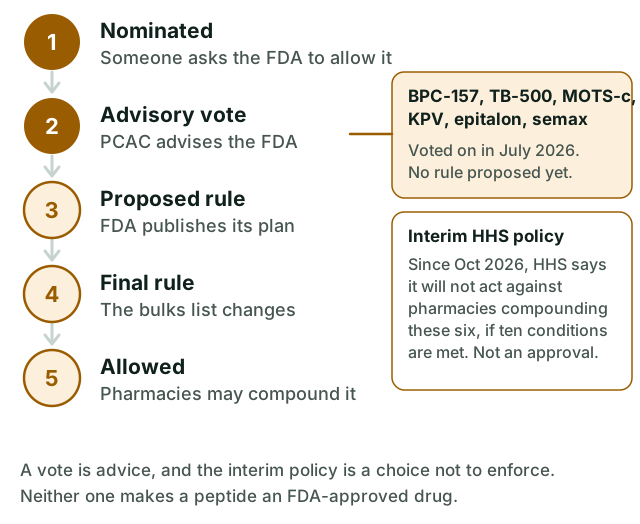
As of November 2, 2026, HHS says it does not intend to take enforcement action against a state-licensed pharmacy, federal facility or licensed physician compounding TB-500 acetate by injection under the skin or into muscle, when all ten conditions are met, until a final rule decides whether it goes on the 503A bulks list. Those conditions include a single active ingredient, an FDA-registered and CGMP-compliant manufacturer, a valid certificate of analysis, a patient-specific prescription and reporting of serious adverse events. A BPC-157 and TB-500 blend falls outside the policy.
The limits matter as much as the policy. TB-500 stays unapproved and off the bulks list, no rule has been proposed, and FDA has not reviewed any compounded product. The notice says it is “not binding on HHS or the public,” and HHS may revisit it if a safety signal or quality problem appears. It covers 503A compounding only, and states can be stricter.
HHS and FDA staff disagree about the science. HHS’s appendix calls FDA’s safety concerns “inferential rather than observed,” and it leans on the record of the parent protein and on rapid breakdown of the fragment in human serum. FDA’s reviewers wrote that they were “particularly concerned about the absence of human data.” Both describe the same fact: nobody has measured what TB-500 does in people. The policy is a decision about enforcement, and it adds nothing to the evidence.
How does TB-500 compare with BPC-157?
Neither is proven, but TB-500 has less behind it. BPC-157 has five small human studies, and TB-500 has none. BPC-157 has a published toxicology paper, and TB-500 has none. In the one rat study testing both, TB-500 improved tendon strength over controls while BPC-157 did not reach significance, and the combination added nothing. That is one small rat experiment, and it should not be stretched further. The BPC-157 and TB-500 guide covers that study, and the Wolverine stack page covers the pairing as it is marketed.
Is TB-500 banned in sport?
Yes. The 2026 WADA Prohibited List puts “Thymosin-β4 and its derivatives e.g. TB-500” in class S2.3, growth factors and growth factor modulators, prohibited at all times. The anti-doping interest is why reliable tests for it exist.
Questions to ask a prescriber
If a clinician brings up TB-500, it is reasonable to ask:
- What is it meant to do for me, given that FDA found no human data?
- Is the product TB-500 acetate as a single ingredient, compounded for me by a state-licensed pharmacy?
- Does our state permit this?
- Can the pharmacy name the original manufacturer and show the certificate of analysis?
- What approved or better-studied options should we try instead?
- Who do I call if I react, and how will it be reported to FDA?
Pregnancy, cancer history, autoimmune disease and competitive sport are the situations where these unknowns weigh most. There is no label to say so, which is the point: with no toxicity data, no one can tell you who is at risk.
Compare
- PeptidesNot FDA approvedBPC-157 and TB-500No controlled human study has tested BPC-157 and TB-500 together.
- GoalsNot FDA approvedWolverine stackThe Wolverine stack is BPC-157 plus TB-500 for injury healing.
- LearnFDA status trackerWhich peptides are FDA-approved, which HHS tolerates under conditions, and which are not legal to use.
Recent news on this
Peptide news, sorted. Plus the printable dose chart.
Sorted, every Tuesday: the week's peptide and GLP-1 news in five minutes: FDA moves, new studies explained, and price changes. Subscribe and the one-page dose and injection-site chart arrives first.
Questions people ask
What does TB-500 do?
Is TB-500 the same as thymosin beta-4?
Is TB-500 safe?
Is TB-500 legal?
Is TB-500 banned in sport?
Sources
Primary sources first: FDA labels and documents, peer-reviewed trials, registries.
- 1FDA. Briefing document for TB-500-related bulk drug substances, Pharmacy Compounding Advisory Committee, July 23-24, 2026fda.gov
- 2HHS. Enforcement Discretion Policy Regarding 503A Compounding Using Certain Peptide Bulk Drug Substances, with Appendices A and B, October 2026hhs.gov
- 3Federal Register. Notice of availability, FR Doc. 2026-22192, Docket HHS-OASH-2026-0496, RIN 0910-ZD94, published October 30, 2026public-inspection.federalregister.gov
- 4Fox Rothschild. HHS moves to pull peptides out of the research-use-only market and into pharmacies, October 2026foxrothschild.com
- 5Ho EN et al. Doping control analysis of TB-500, a synthetic version of an active region of thymosin beta-4, in equine urine and plasma. J Chromatogr A 2012pubmed.ncbi.nlm.nih.gov
- 6Delcourt V et al. TB500/TB1000 and SGF1000: a scientific approach for a better understanding of misbranded and adulterated drugs. Drug Test Anal 2023pubmed.ncbi.nlm.nih.gov
- 7Biçer O et al. Effects of BPC-157 and TB-500 on Achilles tendon healing in rats: a histopathological and biomechanical study. Jt Dis Relat Surg 2026pubmed.ncbi.nlm.nih.gov
- 8Cha HJ et al. Role of thymosin beta4 in tumor metastasis and angiogenesis. J Natl Cancer Inst 2003pubmed.ncbi.nlm.nih.gov
- 9Ruff D et al. A randomized, placebo-controlled, single and multiple dose study of intravenous thymosin beta4 in healthy volunteers. Ann N Y Acad Sci 2010pubmed.ncbi.nlm.nih.gov
- 10Guarnera G et al. The effect of thymosin treatment of venous ulcers. Ann N Y Acad Sci 2010pubmed.ncbi.nlm.nih.gov
- 11Sosne G, Ousler GW. Thymosin beta 4 ophthalmic solution for dry eye: a randomized, placebo-controlled, phase II trial. Clin Ophthalmol 2015pubmed.ncbi.nlm.nih.gov
- 12Sosne G et al. 0.1% RGN-259 (thymosin beta-4) ophthalmic solution in neurotrophic keratopathy: a randomized, placebo-controlled, double-masked phase III trial. Int J Mol Sci 2022pubmed.ncbi.nlm.nih.gov
- 13Kruoch Z et al. Medical and surgical interventions for neurotrophic keratopathy. Cochrane Database Syst Rev 2025pubmed.ncbi.nlm.nih.gov
- 14Nguyen J et al. Engineered tandem thymosin peptide promotes corneal wound healing. Invest Ophthalmol Vis Sci 2025pubmed.ncbi.nlm.nih.gov
- 15ClinicalTrials.gov. ARISE-3: RGN-259 ophthalmic solution for dry eye (NCT03937882)clinicaltrials.gov
- 16ClinicalTrials.gov. SEER-2: 0.1% RGN-259 for neurotrophic keratopathy (NCT05555589)clinicaltrials.gov
- 17ClinicalTrials.gov. Phase 2b study of recombinant human thymosin beta-4 (NL005) in acute myocardial infarction (NCT05984134)clinicaltrials.gov
- 18FDA. Certain bulk drug substances for use in compounding may present significant safety risksfda.gov
- 19FDA. 503A categories update, September 29, 2023 (copy hosted by the Alliance for Pharmacy Compounding)join.a4pc.org
- 20RAPS. FDA advisory committee backs two controversial peptides, July 23, 2026raps.org
- 21Council of Europe Anti-Doping Convention. 2026 Prohibited List, in force January 1, 2026 (Tractatenblad 2026, 25)zoek.officielebekendmakingen.nl
- 2221 CFR 312.160, drugs for investigational use in laboratory research animals or in vitro testslaw.cornell.edu
- 23FDA warning letter to Gram Peptides, March 31, 2026fda.gov
PeptideSorted Editorial Team
Editorial review
The PeptideSorted editors check every guide against its cited sources before publication: each number against its FDA label, trial or registry, the FDA status against current FDA and HHS documents, and the wording against our describe-never-prescribe rule. Licensed clinicians who join the review panel are listed by name on the editorial team page.
This page was checked against its cited sources by the PeptideSorted editorial team. Licensed clinicians on our review panel are listed on the editorial team page. Every health page cites primary sources and shows its review date. Read the editorial policy and how medical review works, or report an error via corrections. Educational only; not medical advice.