
Short answer
Nobody knows the true side effects of BPC-157, because no large human study has measured them. Small studies reported no serious adverse events. FDA's database holds reports of injection-site reactions, shortness of breath and skin darkening, with cause unproven. FDA's main concern with injections is an immune reaction, and unregulated vials add contamination and dosing risks.
- What it is
- A synthetic 15-amino-acid fragment of a protein found in human gastric juice, studied for tissue healing in animals.
- FDA status
- Not FDA approved
Not FDA-approved, so there is no label listing side effects. An interim HHS policy from October 2026 says HHS may revisit its enforcement stance if a safety signal or product quality issue arises.
- Evidence level
Early human studies
Small or uncontrolled human studies only.
Nobody knows the true side effect profile of BPC-157, and that is the honest headline. Drug labels list side effects because large trials counted them against placebo. BPC-157 has no such trial, so there are no rates to report. FDA concluded in 2026 that there is “insufficient clinical safety information to characterize the safety profile.” A clean-looking record here mostly reflects how little anyone has looked, and “no reports” should not be read as “no risk.”
What has been reported
Here is every human source we could find, with what each can and cannot tell you. Clinical trials would give you percentages. These do not.
| Source | Who | What was reported | The catch |
|---|---|---|---|
| Enema studies, 2002 and 2003 (abstracts) | 24 healthy people on BPC-157 | Headache and flatulence, with no obvious difference from placebo | Abstracts only, one week of dosing |
| Colitis enema trial, 2005 (abstract) | 53 randomized, BPC-157 or placebo | No difference in adverse events, per the authors. Withdrawals were mainly worsening colitis | Limited safety detail, two weeks |
| Knee injection chart review, 2021 | 16 patients | “No adverse events noted” | Looked back by phone, with no structured screening described |
| Bladder injection study, 2024 | 12 women | No adverse events reported | No comparison group |
| Intravenous pilot, 2025 | 2 adults | No side effects, no measured change in blood tests | Two people, three days |
| FDA drug adverse event database, through December 4, 2025 | 3 reports | Redness and swelling at the injection site for 9 days; shortness of breath leading to an emergency visit; skin and gum darkening | Other products were involved in two, and detail was missing in the third |
| FDA food and supplement database, through December 3, 2025 | 3 reports | Not interpretable | Multi-ingredient supplements, missing detail |
| Clinical notes preprint, 2026, reported by AJMC | 1,039 confirmed users | People stopped after clinician advice or adverse events, including neuropsychiatric, skin and gut symptoms | Not peer reviewed, no comparison group |
| Anecdotes summarized by Healthline, 2026 | People using BPC-157 with TB-500 | Injection-site irritation, stomach upset, lethargy and headaches | Unverified reports |
AJMC also reported that FDA’s database has logged 10 serious adverse event reports tied to BPC-157 since 2021, 8 of them in 2026, though such reports do not establish cause. FDA notes that 503A compounders generally do not report adverse events to it, so any count is a floor. The interim HHS policy makes serious-event reporting one of its conditions for tolerated compounding, which may change the numbers.
The skin and gum darkening case
One FDA report stands out, because the reaction repeated. A 40-year-old woman injected a BPC-157 and TB-500 product labeled for research purposes, twice a day. After about a week she developed widespread darkening of her skin and gums. Two weeks later she used it again and the same thing happened, and it stopped when she quit. FDA said the product was the likely cause, but with two peptides in the vial it could not say which one. That is exactly the problem HHS gave for limiting tolerated compounding to single-ingredient products.
When do side effects start, and do they fade?
Nobody can say for BPC-157 in general, because no study has tracked this. In the handful of reports, the injection-site reaction lasted 9 days and the skin darkening began within a week. Safety has not been measured systematically beyond a few weeks in people, so late effects are an open question.
What animal studies flagged
A single published toxicology paper (Xu et al. 2020) gave BPC-157 by injection into muscle to rats and dogs for 28 days. Its authors called the changes they found incidental. FDA was more cautious and said some appeared to be “clinically relevant safety signals.”
| What changed | In which animals | Why FDA cared |
|---|---|---|
| Clotting time (aPTT) | Shorter in male rats, longer in male dogs | Altered clotting can raise the risk of clots or bleeding |
| Liver signals: higher ALT, glucose and triglycerides, heavier liver | Female rats, after treatment stopped | FDA said these could not definitively be called incidental |
| Higher triglycerides | Female rats and female dogs at every dose | Seen in two species |
| Lower creatinine | Male and female dogs | FDA questioned the authors’ explanation |
These findings have not been tested in people. On the reassuring side, the same paper found no sign that BPC-157 damages DNA and no birth defects in a rat study, though no one has studied a full reproductive cycle. FDA found no toxicology at all for the oral, under-the-skin or nasal routes.
Concerns that are still theoretical
Everything in this section is a published concern. None has been observed as harm in people.
Immune reactions. This is FDA’s main worry for injected BPC-157. The body can make antibodies against a peptide, and peptides can clump together (aggregate), which makes that more likely. FDA says outcomes range from nothing noticeable to “life-threatening and catastrophic reactions,” and that they are hard to predict. No study has formally tested this for BPC-157. FDA rated the inherent immune risk of oral BPC-157 as likely low.
Cancer. FDA found no carcinogenicity studies, so the question has simply not been tested. The concern is indirect. BPC-157 is proposed to encourage new blood vessels, and a 2025 narrative review noted that abnormal blood vessel growth is involved in tumor growth. The same review cited preclinical work pointing the other way, and BPC-157’s long-time researchers reject the concern. Neither side has human data.
Other proposed effects. That 2025 review also raised possible problems from strong stimulation of nitric oxide and from a breakdown product, proline. It framed these as hypotheses drawn from other research. It concluded that BPC-157 should not be recommended for clinical use in musculoskeletal medicine until well-designed trials exist.
The risks of unregulated injections
Many real-world risks come from the product and the needle, whatever the peptide does.
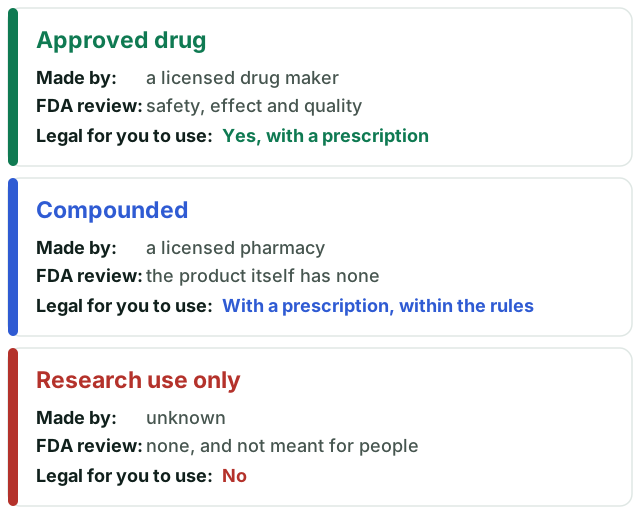
- Unknown contents. Vials sold for “research use only” are not legal to use on people. HHS itself says such peptides from foreign manufacturers “pose a safety risk to US patients,” and it names endotoxins, heavy metals, microbial contamination and impurities as the contaminants its testing conditions are meant to catch.
- Label versus contents. After emergency visits linked to peptides surged in New South Wales, Australia, to 1,180 between July 2025 and September 2026, the Chief Health Officer warned that a purity claim “is not proof of what is inside the product.” Clinicians there reported kidney damage and liver injury. In the underlying report, 71% of those visits mentioned retatrutide only, so they say little that is specific to BPC-157.
- Dosing mistakes. Mixing a powder and reading a syringe leaves room for large errors. The BPC-157 dosage page lists the common ones.
- Infection. Any injection can introduce bacteria into the skin.
- Compounded products are not risk-free. FDA does not review them, and it warned that formulation, concentration and storage can create impurities and aggregates.
What helps if you get a reaction?
There is no tested remedy for a BPC-157 reaction, because no one has studied one. In the case above the reaction stopped when the woman quit. If you do see a clinician, bring the vial or label, since knowing exactly what you took and how much is the first thing they will need. The are peptides safe guide covers the wider picture.
Red flags: when to get help
No BPC-157 label exists to give specific warnings, so these come from general medical guidance on allergic reactions and skin infections, which apply to any injection.
| What you notice | What it may mean | What to do |
|---|---|---|
| Trouble breathing, wheezing, swelling of the face, eyes or tongue, trouble swallowing, chest tightness, slurred speech, fainting | Anaphylaxis, a severe allergic reaction that often starts within seconds or minutes | Call 911 |
| Redness that grows, warmth, tight glossy skin, pain at the injection site, fever with chills | Cellulitis, a skin infection that can spread to the blood | Contact a clinician right away. Seek emergency care if you are confused, faint or very unwell |
| Spreading red streaks, blistering, drowsiness or a fever that persists during treatment | A worsening infection | Contact a clinician right away |
| New skin or gum darkening | The reaction described above | Tell a clinician and report it |
| Any other new or unexplained symptom after a peptide | Unknown | Get medical advice, and say exactly what you used |
How to report a problem
FDA’s MedWatch program takes reports from consumers and clinicians online. Reporting matters more than usual here: with no trials, these reports are close to the only human safety data that exist, and HHS says it may revisit its policy if a safety signal appears. A 2026 systematic review put it plainly, rating the certainty of human evidence very low and saying BPC-157 should not be used clinically outside regulated trials.
Compare
Recent news on this
Peptide news, sorted. Plus the printable dose chart.
Sorted, every Tuesday: the week's peptide and GLP-1 news in five minutes: FDA moves, new studies explained, and price changes. Subscribe and the one-page dose and injection-site chart arrives first.
Questions people ask
What are the side effects of BPC-157?
Does BPC-157 cause cancer?
Is BPC-157 safe to inject?
Does BPC-157 affect the liver or blood clotting?
Are capsules safer than injections?
Sources
Primary sources first: FDA labels and documents, peer-reviewed trials, registries.
- 1FDA. Briefing document for BPC-157-related bulk drug substances, Pharmacy Compounding Advisory Committee, July 23-24, 2026fda.gov
- 2HHS. Enforcement Discretion Policy Regarding 503A Compounding Using Certain Peptide Bulk Drug Substances, with Appendices A and B, October 2026hhs.gov
- 3AJMC. BPC-157 'Wolverine peptide' use rose 33-fold despite scant evidence, October 29, 2026ajmc.com
- 4Poolton JT et al. Human evidence for BPC-157 in orthopaedic and regenerative medicine: a systematic review of efficacy and safety. Acta Orthop Belg 2026pubmed.ncbi.nlm.nih.gov
- 5McGuire FP et al. Regeneration or risk? A narrative review of BPC-157 for musculoskeletal healing. Curr Rev Musculoskelet Med 2025pmc.ncbi.nlm.nih.gov
- 6Lee E, Burgess K. Safety of intravenous infusion of BPC157 in humans: a pilot study. Altern Ther Health Med 2025pubmed.ncbi.nlm.nih.gov
- 7Lee E, Padgett B. Intra-articular injection of BPC 157 for multiple types of knee pain. Altern Ther Health Med 2021pubmed.ncbi.nlm.nih.gov
- 8NSW Health. NSW Health warns of surge in hospital presentations linked to peptide use, October 19, 2026health.nsw.gov.au
- 9NSW Health. Emergency department presentations mentioning unapproved peptide use, NSW, July 2025 to September 2026 (published October 17, 2026)health.nsw.gov.au
- 10Healthline. What to know about Wolverine peptides (BPC-157 and TB-500), medically reviewed, updated October 14, 2026healthline.com
- 11MedlinePlus. Anaphylaxismedlineplus.gov
- 12MedlinePlus. Cellulitismedlineplus.gov
- 13FDA. MedWatch: the FDA safety information and adverse event reporting programfda.gov
- 1421 CFR 312.160, drugs for investigational use in laboratory research animals or in vitro testslaw.cornell.edu
More on BPC-157
- OverviewBPC-157BPC-157 is unapproved and has no proven benefit in people. An interim HHS policy now tolerates some compounding. See the studies, the risks and the limits.
- BPC-157 and TB-500No controlled human study has tested BPC-157 and TB-500 together. One rat study found no added benefit, and a blended vial falls outside the HHS policy.Read
- CapsulesNo human study shows BPC-157 capsules are absorbed or work. See the rat data, the stomach-acid claim, the supplement question and what HHS now requires.Read
- DosageThere is no established BPC-157 dose for people. See what rat and human studies used, why rat doses do not convert, and how syringe units really work.Read
PeptideSorted Editorial Team
Editorial review
The PeptideSorted editors check every guide against its cited sources before publication: each number against its FDA label, trial or registry, the FDA status against current FDA and HHS documents, and the wording against our describe-never-prescribe rule. Licensed clinicians who join the review panel are listed by name on the editorial team page.
This page was checked against its cited sources by the PeptideSorted editorial team. Licensed clinicians on our review panel are listed on the editorial team page. Every health page cites primary sources and shows its review date. Read the editorial policy and how medical review works, or report an error via corrections. Educational only; not medical advice.