
Short answer
There is no established BPC-157 dose for people, because no trial has tested a dose for any condition. Rat studies used microgram or nanogram amounts per kilogram, injected into the abdomen. Small human studies used enemas and knee, bladder or intravenous routes. The amounts posted online have no clinical evidence behind them, and no prescription changes that.
- What it is
- A synthetic 15-amino-acid fragment of a protein found in human gastric juice, studied for tissue healing in animals.
- FDA status
- Not FDA approved
Not FDA-approved, so there is no label dose. An interim HHS policy from October 2026 says HHS does not intend to take enforcement action against compounding of BPC-157 acetate that meets ten conditions. It sets forms and routes, not a dose.
- Evidence level
Early human studies
Small or uncontrolled human studies only.
Nobody has established a dose of BPC-157 for a human being. Every other dosage page on this site reports what an FDA label or a phase 3 trial used. BPC-157 has neither, so all we can show you are the amounts used in rat experiments and in a handful of small human studies, and why neither set tells you what to take. Nothing here is a recommendation, and we do not repeat the schedules posted on forums and seller pages.
What the studies used
The table covers what researchers gave, by species and route. It describes experiments. None of these is a treatment dose, and none was tested by injection under the skin or as a capsule in people.
| Study | Who | Dose studied | Route | Schedule |
|---|---|---|---|---|
| Staresinic et al. 2003 (tendon) | Rats | 10 mcg/kg, 10 ng/kg or 10 pg/kg | Injected into the abdominal cavity | Once daily, first dose 30 minutes after injury, up to 14 days |
| Pevec et al. 2010 (muscle) | Rats | Not stated in the abstract | Into the abdominal cavity, or a cream on the injury | Once, or once daily up to 14 days |
| Seiwerth et al. 2018 (review) | Rats | “Same regimens” as the gut studies | Abdominal, oral (often in drinking water) or local | Mostly once daily |
| Veljaca 2002 and 2003 (abstracts) | 24 healthy people | 0.25 to 2 mg/kg | Enema | One dose, then 7 daily doses after a washout |
| Ruenzi 2005 (abstract) | People with ulcerative colitis | 80 mg | Enema | Daily for 2 weeks |
| Lee and Padgett 2021 | 16 people with knee pain | 2 to 4 mg | Injected into the knee | 1 or 2 injections |
| Lee et al. 2024 | 12 women with interstitial cystitis | 10 mg in total | Injected into the bladder wall | Single procedure |
| Lee and Burgess 2025 | 2 adults | 10 mg, then 20 mg | Intravenous infusion | Two consecutive days |
Three things stand out. The rat doses are tiny and span a huge range, with effects claimed even at nanograms per kilogram, which is why FDA noted that dose-response relationships have not been established. The rat route is a standard laboratory one that is not used in people. And the human studies are so small, and so varied in route, that no pattern can be read from them. A 2026 systematic review graded the certainty of the human evidence as very low.
Why a rat dose does not become a human dose
Multiplying a rat dose by your body weight is the tempting arithmetic, and it is wrong. So is the slightly cleverer version that adjusts for body size. We are not going to run either calculation here, because any number it produced would look like a dose and would mean nothing, for three reasons.
Species handle drugs differently. Metabolic rate, blood flow and drug clearance do not scale with weight. FDA’s 2005 guidance has a method for adjusting animal doses, and it exists to pick a cautious starting point for a monitored first-in-human trial, followed by a further safety margin. It is a tool for designing trials, and it was never meant to produce a treatment dose.
The safety data needed for that method are missing. The method starts from formal toxicology. FDA found published toxicology for BPC-157 only by injection into muscle, and said it could not be used to estimate safe levels for oral, skin-injected or nasal use, because nobody knows how much reaches the body by those routes. FDA also questioned whether the highest doses in those studies were truly free of effects, given liver and blood-fat changes in the animals.
Routes are not interchangeable. The FDA guidance itself cautions against surface-area scaling for local routes. Rat studies mostly used injection into the abdomen, and an injection under a person’s skin or a capsule does not reproduce that exposure. In animals, the half-life after intravenous dosing was 5.3 minutes in dogs and 15.2 minutes in rats, and FDA found no human pharmacokinetic data for any route people commonly use.
What about the doses online?
Forum posts, clinic menus and seller pages publish specific amounts and schedules, and they tend to agree with one another, which makes them look established. They are not. No clinical study has compared one amount with another, once-daily with twice-daily, injecting near an injury with injecting elsewhere, or a capsule with an injection. A 2026 review in the American Journal of Sports Medicine said that information on indications, dosing, frequency and duration “remains unknown.” Agreement between websites shows that people copy each other.
Is there a best time to take it, or a cycle?
Nobody knows, and any answer you read is a guess. No human study has looked at time of day, food, cycling, breaks or tapering. The same goes for a missed dose: there is no label instruction to follow, because there is no label. The longest human exposure FDA identified was two weeks of daily enemas. FDA said there is not enough information to support long-term safety, and that longer repeat-dose toxicity studies were unavailable.
Does the HHS policy set a dose?
No. The October 2026 HHS policy says that, as of November 2, 2026, HHS does not intend to take enforcement action against compounding of BPC-157 acetate when ten conditions are met, including a valid patient-specific prescription. It lists forms and routes and gives no amount, schedule or length of treatment. BPC-157 remains unapproved, FDA has not reviewed any compounded product, and the policy can be revisited. A prescriber who writes a dose is using judgment without trial data behind it, which is a fair thing to ask about directly.
The University of Arkansas pilot study planned for 2027 (NCT07803250) lists daily injections under the skin for 90 days after shoulder surgery, and its public record gives no dose. Results from studies like that are what could one day answer this question.
How syringe units work
The markings on an insulin syringe measure liquid, and they tell you nothing about peptide until you know the concentration. On a U-100 syringe, 100 units is 1 mL, so one unit is 0.01 mL.
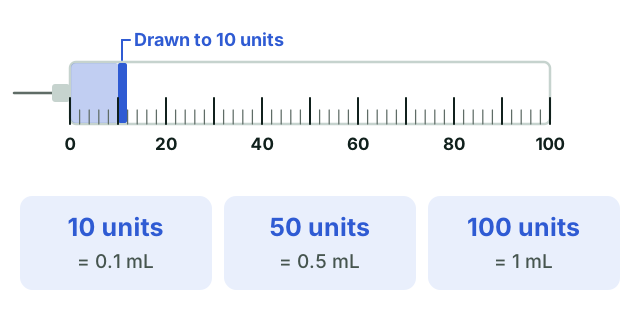
Concentration comes from two numbers: how much peptide is in the vial and how much liquid is added. This table shows how the same 5 mg of powder changes with the volume of water. The reconstitution guide covers the steps, and bacteriostatic water explains the diluent.
| Water added to a 5 mg vial | Concentration | Peptide in 1 unit (U-100 syringe) |
|---|---|---|
| 1 mL | 5 mg/mL | 50 mcg |
| 2 mL | 2.5 mg/mL | 25 mcg |
| 3 mL | 1.67 mg/mL | 16.7 mcg |
This is arithmetic only, and it says nothing about what amount is appropriate. The reconstitution calculator below repeats the math for any vial and volume, and the mg/mL to units converter works the other way round.
Reconstitution calculator
U-100 syringeCommon mistakes
- Confusing mg and mcg. 1 mg is 1,000 mcg. Misreading one for the other is a thousandfold error.
- Treating units as micrograms. A unit is a hundredth of a milliliter. It contains whatever the concentration says it contains.
- Assuming a 5 mg vial holds 5 mL. It holds 5 mg of powder and no liquid until water is added.
- Copying someone else’s numbers. A figure worked out for a vial mixed with 1 mL is wrong for a vial mixed with 2 mL.
- Trusting the printed strength. Arithmetic is only as good as the label. Perfect math on a mislabeled vial still gives a wrong answer.
- Mistaking the free base for the acetate. They are different substances to FDA, and only the acetate is named in the HHS policy.
The legal position on vials
BPC-157 is not an FDA-approved drug and has no label, so any dose anyone gives you is unsupported by one. Vials sold for “research use only” are not legal to use on people, and the HHS policy gives them no cover: 21 CFR 312.160 allows shipment only for tests in laboratory animals or test tubes, and a March 2026 FDA warning letter treated that disclaimer as no defense for a seller whose marketing pointed to people. For the current position, see the FDA status tracker. The risks of getting a dose wrong, or of the product itself, are on the BPC-157 side effects page.
Compare
Recent news on this
Peptide news, sorted. Plus the printable dose chart.
Sorted, every Tuesday: the week's peptide and GLP-1 news in five minutes: FDA moves, new studies explained, and price changes. Subscribe and the one-page dose and injection-site chart arrives first.
Questions people ask
What is the standard BPC-157 dose?
Can I convert the rat dose to my body weight?
How long should BPC-157 be taken?
Does a prescription mean a BPC-157 dose has been established?
How do units work on an insulin syringe?
Sources
Primary sources first: FDA labels and documents, peer-reviewed trials, registries.
- 1FDA. Briefing document for BPC-157-related bulk drug substances, Pharmacy Compounding Advisory Committee, July 23-24, 2026fda.gov
- 2HHS. Enforcement Discretion Policy Regarding 503A Compounding Using Certain Peptide Bulk Drug Substances, with Appendices A and B, October 2026hhs.gov
- 3Federal Register. Notice of availability, FR Doc. 2026-22192, Docket HHS-OASH-2026-0496, RIN 0910-ZD94, published October 30, 2026public-inspection.federalregister.gov
- 4Staresinic M et al. Gastric pentadecapeptide BPC 157 accelerates healing of transected rat Achilles tendon. J Orthop Res 2003pubmed.ncbi.nlm.nih.gov
- 5Pevec D et al. Impact of pentadecapeptide BPC 157 on muscle healing impaired by systemic corticosteroid application. Med Sci Monit 2010pubmed.ncbi.nlm.nih.gov
- 6Seiwerth S et al. BPC 157 and standard angiogenic growth factors. Curr Pharm Des 2018pubmed.ncbi.nlm.nih.gov
- 7Mayfield CK et al. Injectable peptide therapy: a primer for orthopaedic and sports medicine physicians. Am J Sports Med 2026pubmed.ncbi.nlm.nih.gov
- 8Poolton JT et al. Human evidence for BPC-157 in orthopaedic and regenerative medicine: a systematic review of efficacy and safety. Acta Orthop Belg 2026pubmed.ncbi.nlm.nih.gov
- 9ClinicalTrials.gov. Impact of BPC-157 on recovery from rotator cuff repair surgery (NCT07803250)clinicaltrials.gov
- 10FDA. Guidance for industry: estimating the maximum safe starting dose in initial clinical trials for therapeutics in adult healthy volunteers, July 2005fda.gov
- 1121 CFR 312.160, drugs for investigational use in laboratory research animals or in vitro testslaw.cornell.edu
- 12FDA warning letter to Gram Peptides, March 31, 2026fda.gov
More on BPC-157
- OverviewBPC-157BPC-157 is unapproved and has no proven benefit in people. An interim HHS policy now tolerates some compounding. See the studies, the risks and the limits.
- BPC-157 and TB-500No controlled human study has tested BPC-157 and TB-500 together. One rat study found no added benefit, and a blended vial falls outside the HHS policy.Read
- CapsulesNo human study shows BPC-157 capsules are absorbed or work. See the rat data, the stomach-acid claim, the supplement question and what HHS now requires.Read
- Side effectsNobody has measured BPC-157 side effect rates. See what small studies and FDA reports show, the animal warning signs, injection risks and when to get help.Read
PeptideSorted Editorial Team
Editorial review
The PeptideSorted editors check every guide against its cited sources before publication: each number against its FDA label, trial or registry, the FDA status against current FDA and HHS documents, and the wording against our describe-never-prescribe rule. Licensed clinicians who join the review panel are listed by name on the editorial team page.
This page was checked against its cited sources by the PeptideSorted editorial team. Licensed clinicians on our review panel are listed on the editorial team page. Every health page cites primary sources and shows its review date. Read the editorial policy and how medical review works, or report an error via corrections. Educational only; not medical advice.