Short answer
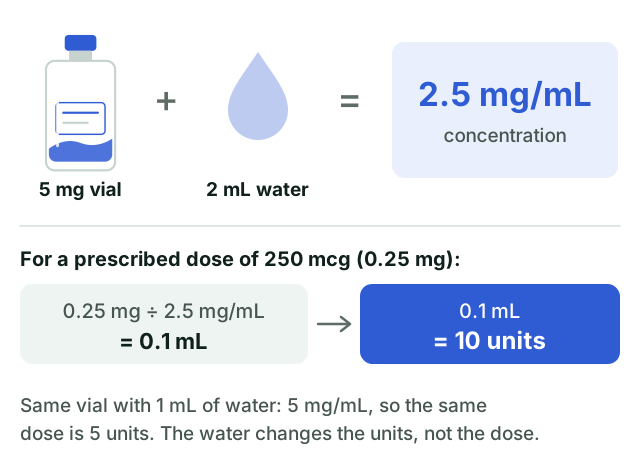
To reconstitute a peptide, swab the stoppers, run the diluent slowly down the inside of the vial, swirl without shaking, check that the liquid is clear, then label it. A 5 mg vial mixed with 2 mL of water is 2.5 mg/mL, or 25 mcg per unit on a U-100 insulin syringe, so a 250 mcg dose is 10 units.
- What it is
- Reconstitution is adding a measured amount of sterile liquid to a freeze-dried (lyophilized) powder so it can be drawn into a syringe and injected.
- FDA status
- Not a drug
- Evidence level
n/a
Reconstitution is the step between a vial of freeze-dried powder and a syringe you can use. You add a measured amount of sterile liquid, let the powder dissolve, and the vial becomes a solution at a known concentration. This guide, part of our peptide basics, describes that technique for prescribed, pharmacy-dispensed products. Peptides sold “for research use only” are not legal to use on people, and the FDA has sent warning letters to sellers of those kits, including over the bacteriostatic water bundled with them. A vial from a pharmacy comes with a label, a concentration or an instruction sheet, and a beyond-use date. Those instructions override anything on this page.
What is reconstitution?
Many peptides do not stay stable in water for long, so manufacturers and compounding pharmacies ship them as a lyophilized (freeze-dried) powder, usually a small white cake at the bottom of a glass vial. Reconstitution means adding a diluent, very often bacteriostatic water, and letting the cake dissolve. The amount of liquid added sets the concentration, and the concentration sets how many units are drawn for each dose. The dose itself does not change; only the volume of liquid that carries it.
Not everything needs mixing. Forzinity, for example, comes as a ready-to-use solution. If your vial is already liquid, skip to the mg/mL to units converter.
What you need
| Item | Why it matters |
|---|---|
| The peptide vial | Check the name, the milligrams printed on the label and the expiry date before opening anything. |
| The diluent your label names | Often bacteriostatic water, sterile water with 0.9% benzyl alcohol as a preservative, supplied in a multi-dose vial so it can be punctured repeatedly. |
| Alcohol swabs | One fresh swab for each rubber stopper, every time it is punctured. |
| A larger syringe for the water | A 3 mL syringe with a needle is the easiest way to measure 1 to 3 mL. |
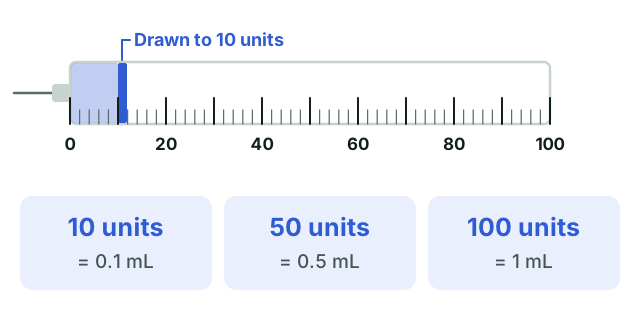
| U-100 insulin syringes for dosing | Marked in units; 100 units equals 1 mL. |
| A marker and a sharps container | To label the vial and to dispose of every needle after one use. |
How to reconstitute a peptide, step by step
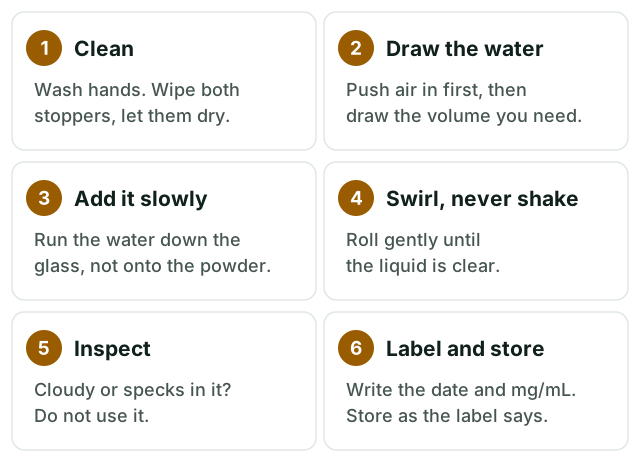
Wash your hands and work on a clean, dry surface first. Then there are six steps.
- Clean the stoppers. Pop the plastic caps off both vials. Wipe each rubber stopper with a fresh alcohol swab and let it air dry.
- Draw the water. Pull the plunger of the larger syringe back to the volume on your instructions, push that air into the diluent vial, turn the vial upside down and draw the same volume of water. Pushing air in first keeps a vacuum from forming. Tap any bubbles to the top, push them back into the vial and check the volume again.
- Add it slowly, down the glass. Tilt the peptide vial and angle the needle so the stream runs down the inside wall rather than hitting the powder directly. A slow stream and a gentle landing mean less foam.
- Swirl, never shake. Move the vial gently until the solution is clear. Labels differ slightly on how: Egrifta SV says to roll the vial gently in your hands for 30 seconds, Egrifta WR says to move it in a circle, and both say do not shake. Some powders take a minute or two to dissolve fully.
- Inspect it. The liquid should be clear. Cloudiness, visible particles or a color change mean do not use it.
- Label and store it. Write today’s date and the concentration you just made, for example 2.5 mg/mL, on the vial. Add the number of units per dose once you have worked it out. Then store it as the pharmacy label says.
Reconstitution calculator
U-100 syringeThe arithmetic, worked through
Three numbers matter: the milligrams in the vial, the milliliters of water added, and the dose on your prescription. From those:
- Concentration in mg/mL = milligrams in the vial divided by milliliters of water.
- Micrograms per unit = concentration in mg/mL multiplied by 1,000, then divided by 100, because a U-100 insulin syringe holds 100 units per mL.
- Units to draw = dose in micrograms divided by micrograms per unit.
| Step | Worked example |
|---|---|
| Vial | 5 mg of peptide |
| Water added | 2 mL |
| Concentration | 5 divided by 2 = 2.5 mg/mL |
| Per unit on a U-100 syringe | 2.5 mg/mL is 2,500 mcg/mL; divided by 100 units = 25 mcg per unit |
| Prescribed dose | 250 mcg |
| Units to draw | 250 divided by 25 = 10 units |
Units on an insulin syringe measure liquid, not drug. That catches people out, because the number on the barrel means nothing until you know the concentration in the vial. The Humulin R label puts the standard plainly: U-100 contains 100 units per mL.
How much water do you add?
Add the volume on your pharmacy label or prescription sheet, because the right amount depends on the product. Egrifta WR specifies exactly 1.3 mL per vial, for example. When a sheet gives you a concentration instead, divide the milligrams in the vial by that concentration to find the volume.
Changing the water changes everything downstream. The same 5 mg vial with 1 mL of water is 5 mg/mL, or 50 mcg per unit, and a 250 mcg dose becomes 5 units. With 3 mL it is about 1.67 mg/mL, or roughly 16.7 mcg per unit, and the dose becomes 15 units. More water gives more units per dose, which is easier to read on the syringe; less water means the vial holds more doses per milliliter. The reconstitution calculator runs this for any vial, and the bacteriostatic water guide has a table of common combinations.
One practical limit: insulin syringes come in 0.3 mL, 0.5 mL and 1 mL sizes, which hold 30, 50 and 100 units. If a dose works out to more units than your syringe holds, call the pharmacy before splitting it. The answer may be a different syringe or a different concentration, and that is their call.
How do you store a reconstituted vial?
Follow the storage line on the vial, because reconstituted products differ more than people expect.
| What the label says | Example | What that means |
|---|---|---|
| Refrigerate after mixing | Many compounded peptide vials | Keep it cold and follow the beyond-use date on the pharmacy label |
| Do not refrigerate after mixing | Egrifta WR | Room temperature, 20 to 25°C (68 to 77°F); do not freeze; discard 7 days after mixing |
| Use immediately | Egrifta SV | One dose right after mixing; throw away the rest |
Some rules hold across products:
- Date it and respect the 28 days. The USP 797 standard, as summarized by the CDC, says an opened multi-dose vial should be dated and discarded within 28 days unless the manufacturer states another date, and never past the original expiry. That applies to the bacteriostatic water vial as well as the peptide. A beyond-use date printed by the pharmacy overrides it.
- Discard if it changes. Cloudiness, particles or color are reasons to throw the vial away, whatever the date says.
- Never leave a needle in the stopper. The CDC warns that a needle left in a vial septum is a direct route for microorganisms into the liquid.
The diluent itself is stored at room temperature before it is opened.
Common mistakes
- Shaking. It foams the solution, and foam makes volumes hard to read.
- Spraying water straight onto the powder. It foams the same way; aim for the glass wall.
- Not labeling. A week later you will not remember whether 1 mL or 2 mL went in, and the difference is a double or half dose.
- Mixing up mg and mcg. The conversion factor is 1,000. Write both on the label.
- Using a syringe that is not marked U-100. The Humulin R label says a syringe marked for anything else gives the wrong dose.
- Reusing needles. The CDC rule is one needle, one syringe, only one time; a reused needle dulls and carries bacteria into the vial.
- Assuming every vial goes in the fridge. Egrifta WR must not be refrigerated after mixing. Read your own label.
- Trusting a seller’s mixing chart. The milligrams a chart assumes may not be the milligrams inside. The guide to reading a COA explains why a printed strength is only a claim until someone has tested it.
Before you mix anything
A legitimate vial reaches you from a licensed pharmacy with a prescription behind it, a label that names the drug and the strength, and someone you can phone. If a product arrived with no pharmacy label, this guide is not written for it, and the FDA status tracker explains why. Once the vial is mixed and labeled, the next question is where and how to inject, which the injection sites guide covers.
Compare
- LearnFDA approvedBacteriostatic waterSterile water with 0.9% benzyl alcohol, so one vial can be used for up to 28 days.
- LearnInjection sitesMost peptide drugs go under the skin of the abdomen or thigh, and some labels add the upper arm.
- GLP-1sFDA approvedCompounded tirzepatideCompounded tirzepatide is legal only in narrow cases since the shortage ended.
Peptide news, sorted. Plus the printable dose chart.
Sorted, every Tuesday: the week's peptide and GLP-1 news in five minutes: FDA moves, new studies explained, and price changes. Subscribe and the one-page dose and injection-site chart arrives first.
Questions people ask
Can sterile water be used instead of bacteriostatic water?
How long does a reconstituted vial last?
What if the wrong amount of water went in?
Why does everyone say not to shake the vial?
The liquid looks cloudy. Is it safe?
Sources
Primary sources first: FDA labels and documents, peer-reviewed trials, registries.
- 1Bacteriostatic Water for Injection, USP prescribing information (Hospira), DailyMeddailymed.nlm.nih.gov
- 2CDC. Preventing Unsafe Injection Practices: multi-dose vials and the USP 797 28-day beyond-use date. Reviewed March 2024cdc.gov
- 3USP General Chapter 797, Pharmaceutical Compounding: Sterile Preparationsusp.org
- 4MedlinePlus Medical Encyclopedia. Drawing medicine out of a vial. Reviewed January 2026medlineplus.gov
- 5Egrifta SV (tesamorelin) for injection prescribing information, reconstitution instructions, DailyMeddailymed.nlm.nih.gov
- 6Egrifta WR (tesamorelin) prescribing information, revised March 2025, via FDAaccessdata.fda.gov
- 7Forzinity (elamipretide) prescribing information, 2025, via FDAaccessdata.fda.gov
- 8FDA 510(k) summary K233794, Insulin Syringe: U-100 means 100 units of insulin in every mL; syringe sizes and needle lengths. March 2024accessdata.fda.gov
- 9Humulin R U-100 prescribing information: U-100 insulin contains 100 units/mL; use a syringe marked for U-100accessdata.fda.gov
- 10FDA Warning Letter to Gram Peptides, March 31 2026: research-use-only peptides and bundled bacteriostatic water are unapproved new drugsfda.gov
More in Learn
- Are peptides safe?Approved peptide drugs have measured risks. Compounded ones skip FDA review. Research-use vials have no safety review. What is known about each kind.Read
- Bacteriostatic waterSterile water with 0.9% benzyl alcohol, so one vial can be used for up to 28 days. How it differs from sterile water, storage, and who must avoid it.Read
- FDA status trackerWhich peptides are FDA-approved, which HHS tolerates under conditions, and which are not legal to use. One row per peptide, with sources and check dates.Read
- How to read a COAWhat each line on a peptide COA means: HPLC purity, mass spec identity, net content, endotoxin and sterility, plus red flags and what a COA cannot prove.Read
- Injection sitesMost peptide drugs go under the skin of the abdomen or thigh, and some labels add the upper arm. Which sites each label names, plus rotation and technique.Read
- Peptide therapyPeptide therapy is a clinic term, not a medical one. It mixes FDA-approved, compounded and unapproved peptides. How to tell which you are being offered.Read
PeptideSorted Editorial Team
Editorial review
The PeptideSorted editors check every guide against its cited sources before publication: each number against its FDA label, trial or registry, the FDA status against current FDA and HHS documents, and the wording against our describe-never-prescribe rule. Licensed clinicians who join the review panel are listed by name on the editorial team page.
This page was checked against its cited sources by the PeptideSorted editorial team. Licensed clinicians on our review panel are listed on the editorial team page. Every health page cites primary sources and shows its review date. Read the editorial policy and how medical review works, or report an error via corrections. Educational only; not medical advice.