mL and mg to syringe units converter
Every U-100 insulin syringe holds 100 units per milliliter. Convert a volume in either direction, or turn a dose in milligrams into units once you know the concentration on the vial.
- Free, no login
- Math only, never a dose suggestion
- Arithmetic checked Oct 17, 2026
mL and mg to units
100 units = 1 mLWant this on paper? The printable dose chart covers every common vial and water amount.
Print the chartEmail it to meQuick reference: mL to units
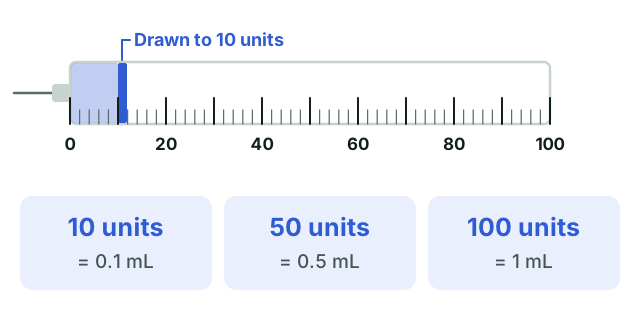
Multiply milliliters by 100 to get units, and divide units by 100 to get milliliters. That holds on every U-100 insulin syringe, whatever its size, so 20 units is 0.2 mL on all of them.
| Milliliters | Units | Fits which syringe |
|---|---|---|
| 0.01 mL | 1 unit | Any |
| 0.05 mL | 5 units | Any |
| 0.1 mL | 10 units | Any |
| 0.2 mL | 20 units | Any |
| 0.25 mL | 25 units | Any |
| 0.3 mL | 30 units | Any (fills a 0.3 mL syringe) |
| 0.5 mL | 50 units | 0.5 mL or 1 mL |
| 0.75 mL | 75 units | 1 mL |
| 1 mL | 100 units | 1 mL (full) |
How many units is a dose in mg?
It depends on the concentration, so a milligram dose has no fixed number of units. Units equal the dose in mg, divided by the concentration in mg/mL, times 100.
- 2.5 mg at 10 mg/mL: 2.5 ÷ 10 = 0.25 mL = 25 units.
- 2.5 mg at 20 mg/mL: 2.5 ÷ 20 = 0.125 mL = 12.5 units.
- 250 mcg (0.25 mg) at 2.5 mg/mL: 0.25 ÷ 2.5 = 0.1 mL = 10 units.
Those are examples of the arithmetic; your dose comes from your prescriber. The first two lines show the pattern to remember: the same dose at twice the concentration takes half the units.
Where do you find the concentration?
On a compounded vial, it is printed on the label as mg/mL. A label showing only a total, such as "30 mg" with no volume, does not tell you the concentration, so ask the pharmacy. If you mix a powder yourself, the concentration is the vial amount divided by the water you added, and the reconstitution calculator starts from there.
How do you turn units back into mg?
Divide the units by 100, then multiply by the concentration. 25 units at 10 mg/mL is 0.25 mL, which is 2.5 mg. The same 25 units at 20 mg/mL is 5 mg. This is a useful check when a pharmacy sheet gives only a number of units: the answer should match the milligram dose on your prescription. If it does not, call the pharmacy before you inject.
The vial errors FDA keeps hearing about
Most reports in FDA's alert on compounded semaglutide involved patients drawing more than the prescribed dose from a multiple-dose vial, and some took five to 20 times the intended amount. Clinicians made errors too, miscalculating when converting milligrams to units or milliliters. FDA names confusion among milliliters, milligrams and units as a possible contributor. Reported problems included nausea, vomiting, abdominal pain, fainting, headache, migraine, dehydration, acute pancreatitis and gallstones.
- Convert through the concentration on the label of the vial you are holding, every time. A new vial may differ.
- Write the draw in units and in mL beside the mg dose, then compare it with your prescription before you inject.
- Ask for a syringe that fits the dose. FDA says some patients were given syringes far larger than the prescribed volume.
- Ask your prescriber or pharmacy to show you how to measure, which is what FDA encourages patients to do.
If you think you injected too much, call your prescriber or Poison Control at 1-800-222-1222, day or night. The compounded tirzepatide guide walks through a vial label line by line.