Short answer
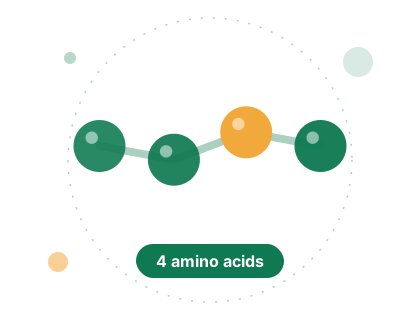
Epitalon is a synthetic four-amino-acid peptide from a Russian lab, and it is not FDA-approved. Its evidence is mostly cell and mouse work, and FDA found no clinical studies of its safety. As of November 2, 2026, HHS says it does not intend to act against compounding it as an injection under ten conditions, which is not an approval.
- What it is
- A synthetic tetrapeptide (alanine, glutamic acid, aspartic acid, glycine) developed in Russia as a 'synthetic analog' of epithalamin, a pineal gland extract.
- FDA status
- Not FDA approved
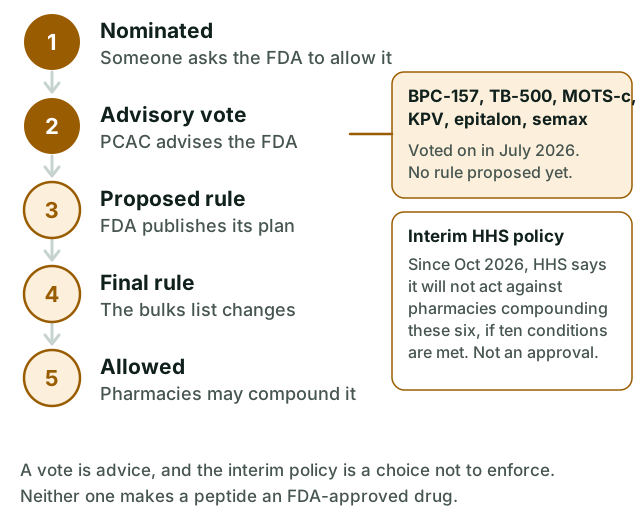
Not FDA-approved. Placed in 503A category 2 on September 29, 2023; nomination later withdrawn. FDA staff advised against adding it to the bulks list; the PCAC recommended it for insomnia on July 24, 2026. HHS's October 2026 enforcement policy covers epitalon acetate by subcutaneous or intramuscular injection in intermittent courses, under ten conditions. No proposed or final rule as of November 2, 2026.
- Evidence level
Early human studies
Small or uncontrolled human studies only.
Epitalon is sold online as an anti-aging, sleep and “telomere” peptide, and it is not FDA-approved. Nearly everything known about it comes from one research school in St Petersburg, Russia, led by gerontologist Vladimir Khavinson, and most of that is cell and mouse work. FDA’s May 2026 review found no clinical studies assessing its safety in people. In our peptide index it is also one of six peptides named in an interim HHS policy from October 2026, which is about enforcement and says nothing new about whether epitalon works.
| Quick answer | Epitalon |
|---|---|
| What it is | Synthetic peptide of four amino acids (Ala-Glu-Asp-Gly) |
| FDA status | Not approved for any use |
| What the evidence is | Cell and mouse studies, plus one small human study of a melatonin marker |
| Human safety studies | None found by FDA |
| Advisory committee | Voted 7 to 5, with one abstention, on July 24, 2026 to recommend it for insomnia, against staff advice |
| HHS policy | Epitalon acetate, injected under the skin or into muscle, in intermittent courses, under ten conditions |
| Established human dose | None |
What is epitalon?
Epitalon, also spelled epithalon and written by its amino acids as AEDG, is four amino acids: alanine, glutamic acid, aspartic acid and glycine (Ala-Glu-Asp-Gly). FDA’s briefing document credits its synthesis to researchers under Khavinson and describes it as the putative active component of epithalamin, a polypeptide extract of cattle pineal glands. The same document gives two different dates for when it was first made (the late 1980s in one section, 1999 in another), so this page does not give one. The pineal gland makes melatonin, the hormone that signals night to the body, which is why epitalon is marketed for sleep.
FDA treats epitalon and epithalamin as different substances. Studies of the extract do not describe the synthetic peptide, and the reverse. FDA also notes that sellers’ information is often unclear about whether a product is the free base or the acetate salt. That detail now matters, because the HHS policy covers only the acetate.
What are the benefits of epitalon?
No benefit has been shown in people. Wellness clinics, some of which call it “the fountain of youth,” claim far more than the research supports.
| Claim | What the research shows |
|---|---|
| Longer telomeres | Reported in human cells in a dish, not in people |
| Longer life | One mouse study: no change in average lifespan; the longest-lived 10% lived 13.3% longer |
| Deeper sleep | No study has measured sleep in animals or people |
| Restored melatonin | A rise in a melatonin marker in 40 women with low levels, in one study |
| Cancer protection | Fewer breast tumors in tumor-prone female mice; FDA says the designs do not settle cancer risk either way |
| Better skin, energy, mood and brain health | FDA did not evaluate these because the nominations lacked enough information |
What the research shows
| Study | Model | What was given | What was reported |
|---|---|---|---|
| Khavinson et al. 2003, Bull Exp Biol Med | Human fetal lung fibroblasts in a dish | Epitalon added to the culture | Switched on telomerase (the enzyme that rebuilds chromosome ends) and lengthened telomeres |
| Khavinson et al. 2004, Bull Exp Biol Med | Ageing human fetal fibroblasts in a dish | Epitalon added to the culture | Cells made 10 extra divisions past their normal limit |
| Anisimov et al. 2003, Biogerontology | 54 female mice per group, from 3 months old until death | About 30 to 40 mcg/kg under the skin, 5 days a month | No change in average lifespan; the longest-lived 10% lived 13.3% longer; leukemia less common; total tumor rate unchanged |
| Anisimov et al. 2002, Int J Cancer | Female mice bred to develop breast tumors | 1 mcg per mouse, 5 days a month | Fewer and smaller tumors than saline |
| Ivko et al. 2020-2021 (as described by FDA) | 75 women aged 40 to 50, mostly night-shift workers | Under-the-tongue spray, 0.5 mg a day for 20 days, or placebo | A melatonin breakdown product in urine rose 1.7-fold in the 40 women with low starting levels; sleep was not measured |
The animal doses above describe what the studies used. They do not translate to a human dose.
How strong is this evidence?
Weaker than the volume of papers suggests. FDA’s 2026 review made several points:
- One group. The studies were “conducted and published by Dr. Khavinson’s research group in Russia,” and several the nominators cited were available only in Russian or could not be found.
- Narrow animal designs. The lifespan and tumor studies used a single fixed dose, female mice only, and short monthly courses, so FDA said they “do not adequately inform the genotoxic or the carcinogenic potential of epitalon.”
- No sleep data. FDA found no animal studies measuring sleep behavior or brain-wave sleep, and the one human melatonin study “did not evaluate sleep outcomes” and did not specify blinding.
- No human safety data. FDA’s search of its adverse event databases through December 2025 found no reports, and it found no clinical studies assessing epitalon’s safety in humans.
FDA also found one study in which epitalon was injected near the eye in people with retinitis pigmentosa, an inherited cause of blindness. Epitalon received a US orphan drug designation for that condition on September 2, 2010; FDA’s briefing says the designation was withdrawn or revoked on January 6, 2016. An orphan designation is an incentive for development, not an approval.
The telomere paradox
The claim that sells epitalon is the same one that worries FDA. Telomerase lets cells keep dividing; that is what Khavinson’s cell studies reported. FDA’s reviewers wrote that, because long telomeres are “generally associated with increased risk for cancer,” reports that epitalon activates telomerase “raise concerns that continuous exposure to epitalon through the lifespan could enable cells to evade senescence and become cancerous.” The mouse studies that found fewer tumors used intermittent dosing for limited periods and do not answer the question for long-term human use. No standard two-year carcinogenicity study has been done.
Does epitalon help sleep?
No study has shown that it does. FDA reviewed epitalon specifically for insomnia and found no publication on its effectiveness in people with insomnia, and no clinical study of the injected route. FDA also noted that low melatonin has not been consistently linked to insomnia in older adults, so raising a melatonin marker would not by itself show better sleep. For the wider picture, see peptides for sleep.
Chronic insomnia is worth treating properly, and options with real data exist. The American College of Physicians recommends cognitive behavioral therapy for insomnia (CBT-I) as the first treatment for adults. FDA lists approved medicines in several classes, including zolpidem, eszopiclone, ramelteon and suvorexant.
Epitalon side effects
Epitalon’s side effects are unknown, because no study has properly looked for them. FDA found no reports in its adverse event databases through December 2025, but compounders generally do not report to FDA and an empty database cannot prove safety. The human study of 20 people who received the spray reported no safety data. One Russian abstract said pineal preparations had “no side effects” in older people, without giving routes, doses or numbers.
| Risk | What is known |
|---|---|
| Cancer | Telomerase activation is a recognized feature of cancer cells. No long-term study has tested the risk |
| Immune reaction | FDA flagged aggregation and peptide-related impurities in injected products as an immunogenicity risk |
| Repeated injections | No published study has measured what they do to a person |
| Reproductive and developmental harm | Not assessed in any study FDA could rely on, so pregnancy and breastfeeding are unstudied |
HHS’s policy reads the same record more kindly. It describes FDA’s safety concerns as mechanistic rather than based on observed harm, and says the limited controlled human exposure reported no side effects. FDA staff’s position was that there are no clinical data to support safety. Both describe the same gap: nobody has done the study.
Epitalon dosage: is there a human dose?
No human dose has been established. The only published human figure in this record is the 0.5 mg a day under-the-tongue spray in the Ivko study, which was not a safety or dose-finding study and did not use injection. The HHS policy mentions “intermittent courses,” but that is a limit on what compounders may dispense under the policy. It is not a schedule, and HHS does not define one. Websites that recommend a cycle are not drawing on human dose-finding data.
Epitalon’s legal status in the US
As of November 2, 2026, epitalon is unapproved, is not on the 503A bulks list, and is the subject of an interim HHS policy of non-enforcement with limits.
| Date | What happened |
|---|---|
| September 29, 2023 | FDA placed epitalon in 503A category 2, substances that raise significant safety risks. FDA’s page says injected epitalon “may pose risk for immunogenicity” and that the agency “lacks sufficient information to know whether the drug would cause harm if administered to humans.” |
| By April 22, 2026 | Both nominations were withdrawn. FDA’s safety-risk page lists epitalon under “nominated but withdrawn,” and FDA chose to evaluate the free base and acetate on its own initiative. |
| May 12, 2026 | FDA staff evaluated epitalon for insomnia, as 10 mg/mL and 3,000 mcg/mL injections under the skin, and concluded that the criteria “weigh against” adding either form to the bulks list. |
| July 24, 2026 | The Pharmacy Compounding Advisory Committee voted 7 to 5, with one abstention, to recommend adding epitalon for insomnia, against the staff recommendation. |
| October 14, 2026 | HHS and FDA sent an interim access policy for certain peptides to the White House for review. |
| October 28, 2026 | HHS announced its enforcement discretion policy for six peptides, published in the Federal Register on October 30. |
| November 2, 2026 | No proposed or final rule. Epitalon is not on the 503A bulks list. Written comments are open until November 13, 2026. |
What the HHS policy does and does not do
HHS says it does not intend to take enforcement action against a state-licensed pharmacy, federal facility or licensed physician compounding epitalon, until a final rule settles whether it goes on the 503A bulks list, when all ten conditions are met.
| Condition | What it means for epitalon |
|---|---|
| Form | Epitalon acetate only |
| Route | Subcutaneous or intramuscular injection only |
| Dispensing | In intermittent courses |
| Ingredients | One active ingredient, so a blend is outside the policy |
| Source | Bulk substance from an FDA-registered, CGMP-compliant maker, with a valid certificate of analysis |
| Prescription | A valid prescription for an individual patient |
| Reporting | Compounder reports serious adverse events and quality problems to FDA MedWatch and the states involved |
| Label | “This is a compounded drug product. Not for resale.” |
| Device | The only device packaged with it may be an FDA 510(k)-cleared syringe |
The limits are the point. FDA has not reviewed any compounded epitalon for safety, effectiveness or quality. The notice says the policy “does not establish any rights for any person and is not binding on HHS or the public,” and calls it a draft in places. HHS may revisit it if a safety signal or quality problem appears. It covers 503A compounding only, so outsourcing facilities are not covered, and states can be stricter.
A policy about enforcement is also not evidence. The insomnia data, the cancer question and the missing safety studies are exactly where they were. Two advocacy groups criticized the policy, including a JAMA viewpoint arguing that it undermines the drug approval process. This section describes a policy and is not a suggestion to seek epitalon out.
Cost and access
There is no FDA-approved epitalon, so no insurance-covered drug exists to compare prices for, and we do not list prices or sources for unapproved peptides. FDA’s briefing described a US Attorney’s press release about a Kentucky compounding pharmacy and its owner who pleaded guilty to unlawful distribution; according to FDA, the pharmacy had compounded and distributed products containing epitalon from October 2018 to April 2020. That case predates the HHS policy, and it shows the older enforcement risk was real.
What research use only means
Vials labeled “research use only” get nothing from the HHS policy, which says it is meant to discourage their use. Under 21 CFR 312.160, that label permits shipment only for laboratory animal or test-tube work, marked “Not for use in humans.” They remain not legal to use on people, and the are peptides safe guide covers what testing of that market has found.
Is epitalon banned in sport?
Epitalon is not named on the 2026 WADA Prohibited List. Class S0 bans, at all times, any pharmacological substance not covered elsewhere and “with no current approval by any governmental regulatory health authority for human therapeutic use.” FDA’s 2026 review found no approved epitalon product in Canada, Australia, the United Kingdom or seven European countries it checked, and none authorized by the European Medicines Agency.
Who should be especially careful
- Anyone with a current or past cancer. The proposed mechanism, telomerase activation, is a recognized feature of cancer cells, and no long-term study has tested it. Raise this with your oncologist before anything else.
- Pregnancy and breastfeeding. No safety data exist.
- Anyone relying on it for sleep. No study has shown that epitalon improves sleep.
PeptideSorted does not link to sellers of epitalon or any other unapproved peptide.
Questions to ask a prescriber
- What problem are we trying to solve, and is there an approved treatment for it?
- Given the telomerase question, does my personal or family cancer history matter here?
- If you are considering compounded epitalon, is it the acetate, and which pharmacy made it?
- How would we know it was helping, and what would make us stop?
The FDA status tracker follows any rule that comes next, and MOTS-c is another “longevity” peptide from the same July meeting.
Compare
- LearnFDA status trackerWhich peptides are FDA-approved, which HHS tolerates under conditions, and which are not legal to use.
- PeptidesNot FDA approvedMOTS-cMOTS-c improved metabolism and running in mice, but no published human trial exists and it is not FDA-approved.
- GoalsSleepNo peptide is FDA-approved for sleep.
Recent news on this
Peptide news, sorted. Plus the printable dose chart.
Sorted, every Tuesday: the week's peptide and GLP-1 news in five minutes: FDA moves, new studies explained, and price changes. Subscribe and the one-page dose and injection-site chart arrives first.
Questions people ask
Is epitalon FDA-approved?
What are the benefits of epitalon?
Does epitalon lengthen telomeres?
Does epitalon extend lifespan?
Is epitalon the same as epithalamin?
Is epitalon banned in sport?
Sources
Primary sources first: FDA labels and documents, peer-reviewed trials, registries.
- 1FDA. Briefing document: evaluation of epitalon-related bulk drug substances (epitalon free base and epitalon acetate), Pharmacy Compounding Advisory Committee, July 23-24, 2026 (memo dated May 12, 2026)fda.gov
- 2HHS. Enforcement Discretion Policy Regarding 503A Compounding Using Certain Peptide Bulk Drug Substances, with Appendices A and B, October 2026hhs.gov
- 3Federal Register. Notice of availability, FR Doc. 2026-22192, Docket HHS-OASH-2026-0496, RIN 0910-ZD94, published October 30, 2026public-inspection.federalregister.gov
- 4RAPS. FDA advisory committee backs two more peptides, rejects one for compounding list, July 24, 2026raps.org
- 5RAPS. HHS will permit compounding of six peptides ahead of formal rulemaking, October 29, 2026raps.org
- 6FDA. July 23-24, 2026 meeting of the Pharmacy Compounding Advisory Committeefda.gov
- 7NCPA. FDA advisory committee nominates six peptides for pharmacies to compound, July 31, 2026ncpa.org
- 8DLA Piper. FDA AdComm recommends adding six peptides to bulks list, July 31, 2026dlapiper.com
- 9Khavinson VKh, Bondarev IE, Butyugov AA. Epithalon peptide induces telomerase activity and telomere elongation in human somatic cells. Bull Exp Biol Med 2003;135(6):590-2doi.org
- 10Khavinson VKh et al. Peptide promotes overcoming of the division limit in human somatic cell. Bull Exp Biol Med 2004;137(5):503-6doi.org
- 11Anisimov VN et al. Effect of Epitalon on biomarkers of aging, life span and spontaneous tumor incidence in female Swiss-derived SHR mice. Biogerontology 2003;4(4):193-202doi.org
- 12Anisimov VN et al. Inhibitory effect of the peptide epitalon on the development of spontaneous mammary tumors in HER-2/neu transgenic mice. Int J Cancer 2002;101(1):7-10doi.org
- 13Ivko OM et al. AEDG peptide regulates human circadian rhythms genes expression during pineal gland accelerated aging. Adv Gerontol 2020;33(3):429-435pubmed.ncbi.nlm.nih.gov
- 14FDA. Certain bulk drug substances for use in compounding may present significant safety risks (content current as of April 22, 2026)fda.gov
- 15FDA. 503A categories update, September 29, 2023 (copy hosted by the Alliance for Pharmacy Compounding)join.a4pc.org
- 16FDA. Bulk drug substances nominated for use in compounding under section 503A, category list (updated May 14, 2026)fda.gov
- 17AP via STAT. Trump administration advances plan for peptide drugs favored by RFK Jr., October 15, 2026statnews.com
- 18Qaseem A et al. Management of chronic insomnia disorder in adults: a clinical practice guideline from the American College of Physicians. Ann Intern Med 2016pubmed.ncbi.nlm.nih.gov
- 19WADA 2026 Prohibited List, official text as reprinted in the Dutch Treaty Series (Trb. 2026, 25)zoek.officielebekendmakingen.nl
- 2021 CFR 312.160, drugs for investigational use in laboratory research animals or in vitro testslaw.cornell.edu
PeptideSorted Editorial Team
Editorial review
The PeptideSorted editors check every guide against its cited sources before publication: each number against its FDA label, trial or registry, the FDA status against current FDA and HHS documents, and the wording against our describe-never-prescribe rule. Licensed clinicians who join the review panel are listed by name on the editorial team page.
This page was checked against its cited sources by the PeptideSorted editorial team. Licensed clinicians on our review panel are listed on the editorial team page. Every health page cites primary sources and shows its review date. Read the editorial policy and how medical review works, or report an error via corrections. Educational only; not medical advice.