Short answer
MOTS-c is a 16-amino-acid peptide encoded in mitochondrial DNA that improved metabolism and exercise capacity in mice. It has no published human drug trial and is not FDA-approved. As of November 2, 2026, an interim HHS policy tolerates compounded MOTS-c acetate injections under ten conditions, which is neither approval nor evidence that it works.
- What it is
- A 16-amino-acid peptide encoded in mitochondrial DNA, studied for metabolism and exercise capacity in mice.
- FDA status
- Not FDA approved
Not FDA-approved and not on the 503A bulks list. Placed in 503A category 2 on September 29, 2023, later dropped after its nomination was withdrawn. The PCAC recommended it on July 23, 2026, against FDA staff advice. An interim HHS policy published October 30, 2026 says HHS does not intend to act against compounding of MOTS-c acetate for subcutaneous or intramuscular use if ten conditions are met.
- Evidence level
Animal studies only
No controlled human trials. Everything below is animal or lab data.
MOTS-c is a peptide your body makes from its own mitochondrial DNA, and in mice it prevented diet-driven weight gain and made old animals run longer. It has not been shown to do either in people. There is no published human trial of MOTS-c as a drug, no human dose, and no human safety data. It is not FDA-approved. In our Peptides A-Z it sits at the animal-studies level, and the gap between that and its popularity is the main thing to understand before anything else.
| Question | Answer as of November 2, 2026 |
|---|---|
| What is it? | A 16-amino-acid peptide coded in mitochondrial DNA |
| Best evidence | Mouse studies, mostly from one laboratory |
| Published human drug trials | None of MOTS-c itself; one small study of a modified version, CB4211 |
| FDA-approved? | No, for any use |
| Compounding | Not on the 503A bulks list. An interim HHS policy tolerates MOTS-c acetate by subcutaneous or intramuscular injection, with ten conditions |
| Established human dose | None |
| Side effects | Unknown for MOTS-c; injection site reactions were common with CB4211 |
| Sport | Banned at all times by WADA |
What is MOTS-c?
MOTS-c stands for mitochondrial open reading frame of the 12S rRNA type-c. A University of Southern California team led by Changhan Lee and Pinchas Cohen described it in 2015. It is a chain of 16 amino acids (Met-Arg-Trp-Gln-Glu-Met-Gly-Tyr-Ile-Phe-Tyr-Pro-Arg-Lys-Leu-Arg) coded inside a mitochondrial gene, which makes it a mitochondrial-derived peptide. Mitochondria are the energy-producing parts of a cell, and having their own peptide signal is why MOTS-c drew so much scientific attention.
Two forms circulate: the free base and the acetate salt. FDA treated both together when its advisory committee reviewed MOTS-c in 2026. FDA’s briefing document also says it “has encountered multiple salts, and derivatives, including different active moieties, sold commercially under the same common name”, meaning a vial labeled MOTS-c may not contain the same molecule as another.
How does MOTS-c work?
In cells, MOTS-c slows the folate cycle and the building of purines (a family of DNA building blocks). That leads to a build-up of a compound called AICAR, which switches on AMPK, an enzyme that acts as a cell’s fuel gauge. The 2015 paper found that skeletal muscle appears to be its main target. FDA’s 2026 review was more cautious, writing that “the molecular targets through which MOTS-c acts remain unknown” and that it is “difficult to predict which organs might be targeted and affected.”
What the mouse studies found
Almost all of the evidence comes from two papers by the same group. Every dose below was injected into the abdominal cavity (intraperitoneal), a laboratory route not used in people.
| Study | Mice | What was given | What was found |
|---|---|---|---|
| Lee et al. 2015, Cell Metab | Normal and high-fat-diet mice | 5 mg/kg a day for 7 days | Better glucose clearance; in high-fat-diet mice, insulin sensitivity rose about 30% in a clamp test |
| Lee et al. 2015, Cell Metab | High-fat-diet mice | 0.5 mg/kg a day for 8 weeks | Prevented diet-induced obesity and high insulin without changing food intake; less fat in the liver |
| Reynolds et al. 2021, Nat Commun | Young mice on a high-fat diet | 5 or 15 mg/kg a day for 10 days | The higher dose improved running capacity |
| Reynolds et al. 2021, Nat Commun | Middle-aged (12 months) and old (22 months) mice | 15 mg/kg a day for 2 weeks | Old mice ran about twice as long on a treadmill |
| Reynolds et al. 2021, Nat Commun | Very old mice, starting at about 23.5 months | 15 mg/kg three times a week for the rest of life | Better grip strength and walking; a trend toward longer lifespan that was not statistically significant |
These are real, published effects in mice. They come mostly from one laboratory, and FDA’s 2026 review noted that the animal studies “have not evaluated the dose-response relationships for the effects of MOTS-c in vivo.” For the osteoporosis use, the bone evidence FDA summarized included cell-culture studies in which MOTS-c pushed bone-marrow cells toward becoming bone cells. The MOTS-c dosage chart lists these amounts in detail and explains why none of them is a human dose.
What is known in humans
The body’s own MOTS-c. In the 2021 study, 10 sedentary young men did a bout of cycling intervals. MOTS-c in their thigh muscle rose about 11.9-fold after exercise, and blood levels rose about 1.5-fold before returning to baseline within 4 hours. A 2026 cross-sectional study of 30 young men found higher serum levels in elite athletes than in sedentary controls. Both findings link natural MOTS-c with exercise. Neither tells you anything about injecting the synthetic peptide, and a one-time comparison cannot show cause.
A genetic clue. A variant called m.1382A>C, found in Northeast Asian populations, changes one amino acid in MOTS-c. In a meta-analysis of three cohorts totaling 27,527 people, men carrying it had a higher prevalence of type 2 diabetes, and women did not. Some researchers have suggested a link to Japanese longevity, and those authors say more research is needed. This is association data about a lifelong genetic difference, and it does not show that adding MOTS-c helps anyone.
CB4211, a modified MOTS-c. The biotech company CohBar developed CB4211, which it called “a novel and improved analog of MOTS-c”. It is a different molecule from the MOTS-c sold online. Its phase 1a/1b trial (NCT03998514) dosed healthy volunteers and then 20 people with obesity and fatty liver who completed 4 weeks of 25 mg under the skin once daily or placebo (11 on drug, 9 on placebo).
- Liver enzymes: ALT fell 21% on CB4211 versus a 4% rise on placebo; AST fell 28% versus 11%. Glucose fell 6% versus no change.
- Weight: a downward trend only. Liver fat fell in both groups, which the company attributed partly to 4 weeks on a controlled diet in a clinical unit.
- Safety: no serious adverse events, but injection site reactions in 79% of CB4211 subjects versus 33% on placebo.
- The trial was paused in November 2018 because of “mild injection site reactions that have been unexpectedly persistent”, described as painless bumps under the skin where some of the dose stayed put. The formulation was changed before dosing resumed.
CohBar never ran a larger CB4211 trial. In November 2023 its planned merger was terminated and the company said it intended to liquidate and dissolve.
A 2026 trial of MOTS-c itself. A phase 2a trial (NCT07505745, sponsor listed as Hudson Biotech, one site in Shenzhen, China) began enrolling in February 2026. It plans to randomize 120 adults with prediabetes and overweight or obesity to 12 weeks of MOTS-c injections under the skin or placebo, with insulin sensitivity and treatment-emergent adverse events as the main outcomes. The registry entry does not state the dose. Its primary completion date is estimated for February 2027, it was recruiting on November 2, 2026, and no results exist.
FDA’s 2026 briefing document summed up the human evidence: FDA “did not identify clinical studies evaluating these uses of MOTS-c”, and “potential safety risks associated with the use of MOTS-c-related BDSs in humans are unknown.”
What are the benefits of MOTS-c?
None has been shown in people. Here is each common claim against what stands behind it.
| Claim | Evidence so far | Human proof? |
|---|---|---|
| Weight loss, fat burning | Prevented diet-induced obesity in mice; a non-significant trend with CB4211 | No |
| Better insulin sensitivity | Mouse clamp test; the MOTS-MET trial is testing this now | No |
| More energy, better endurance | Old mice ran longer; exercise raises natural levels | No |
| Muscle strength in aging | Grip and walking improved in very old mice | No |
| Longer life | A non-significant lifespan trend in mice; a genetic hypothesis in people | No |
| Stronger bones | Cell-culture work summarized by FDA | No |
Those “before and after” stories online have the same weakness as every uncontrolled report. There is no placebo group, no confirmation of what was in the vial, and usually a new diet or training plan at the same time. CB4211’s own trial shows why this matters: liver fat fell in the placebo group too. Nobody can tell you how long MOTS-c takes to work, because no one has shown in a person that it does.
MOTS-c side effects
The side effects of MOTS-c itself are unknown, and the MOTS-c side effects page lays out the evidence. In short, the closest molecule, CB4211, caused injection site reactions in most people who took it. FDA’s reviewers wrote that they “cannot rule out the potential for immunogenicity” from impurities and clumped peptide (aggregates) in injected MOTS-c. MOTS-c lowered blood glucose in mice, and no study has looked at what happens when it is combined with diabetes medicines in people. FDA found no reproductive or developmental studies, and no carcinogenicity studies.
FDA status and the October 2026 HHS policy
MOTS-c has never had a New Drug Application. Like other peptides on this site, the only process it has been through is FDA’s review of bulk substances for compounding under section 503A.
| Date | What happened |
|---|---|
| September 29, 2023 | FDA placed MOTS-c in 503A category 2, substances that raise significant safety risks, alongside BPC-157, CJC-1295, ipamorelin and others. FDA’s safety-risk page lists possible immunogenicity (an immune reaction) with injection, difficulty characterizing peptide impurities, and no human exposure data by any route. |
| By April 2026 | The nomination was withdrawn. FDA’s safety-risk page lists MOTS-c under substances “nominated but withdrawn”, and its May 14, 2026 category list shows MOTS-c in no category. FDA chose to keep evaluating it on its own initiative. |
| Before the July 2026 meeting | FDA’s briefing document proposed “not adding MOTS-c (free base) or MOTS-c acetate to the 503A Bulks List”, citing poor chemical characterization, unknown compounding history, no nonclinical safety data for the proposed uses, and no human safety or effectiveness studies. |
| July 23, 2026 | The Pharmacy Compounding Advisory Committee (PCAC) reviewed MOTS-c for its nominated uses, including obesity and osteoporosis, and voted to recommend adding it to the bulks list. |
| October 28-30, 2026 | HHS announced, then published in the Federal Register, an interim enforcement discretion policy that covers MOTS-c acetate. |
| November 2, 2026 | No proposed or final rule has been published. MOTS-c is not on the 503A bulks list. |
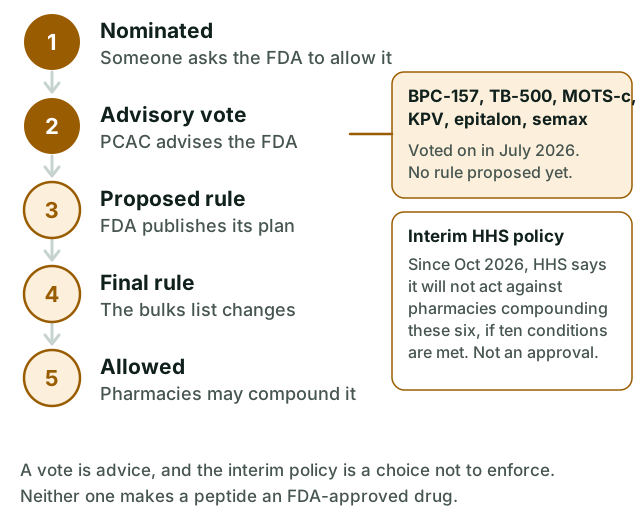
As of November 2, 2026, HHS says it does not intend to take enforcement action against a state-licensed pharmacy, federal facility or licensed physician compounding MOTS-c acetate for subcutaneous or intramuscular injection, when all ten conditions are met, until a final rule says whether MOTS-c belongs on the 503A bulks list. The office of the HHS Secretary issued this, rather than FDA. Enforcement discretion is a choice not to enforce, and the policy sets no dose.
Conditions a patient would notice:
- A valid, patient-specific prescription.
- One active ingredient only, so blends are outside the policy.
- Bulk powder from an FDA-registered, CGMP-compliant original manufacturer, with a valid certificate of analysis. Our guide to reading a certificate of analysis explains those tests.
- The only device packaged with it is an FDA 510(k)-cleared syringe.
- The label reads “This is a compounded drug product. Not for resale.”
- The compounder reports serious adverse events and quality problems to FDA MedWatch and the states involved.
What it leaves unchanged:
- MOTS-c is still not FDA-approved and not on the 503A bulks list. No rule has been proposed.
- FDA has not reviewed any compounded MOTS-c for safety, effectiveness or quality.
- The notice calls the policy a draft in places and says it “does not establish any rights for any person and is not binding on HHS or the public.” Written comments are open until November 13, 2026.
- HHS may revisit the policy if a safety signal or quality problem appears. It covers 503A compounding only, and states can be stricter.
HHS’s stated reasoning is worth reading closely. It cites new certificates from manufacturers, documented use, and a view that the safety evidence “points in one direction”, based on the CB4211 trial and rodent studies. CB4211 is a different molecule, and FDA’s reviewers, facing the same lack of human MOTS-c data, called the risks unknown. The evidence itself has not changed, so this page still says animal studies only.
WADA status
The World Anti-Doping Agency added MOTS-c by name to the 2025 Prohibited List, in class S4 (hormone and metabolic modulators), as an example of an activator of AMPK. The 2026 List keeps it in section S4.4.1 next to AICAR. S4 substances are prohibited at all times, in and out of competition, and a positive test is an anti-doping violation regardless of where the product came from. USADA’s advisory on the change noted that MOTS-c is marketed by wellness clinics and on social media as a weight-loss peptide even though it is not approved for human therapeutic use.
What research use only actually means
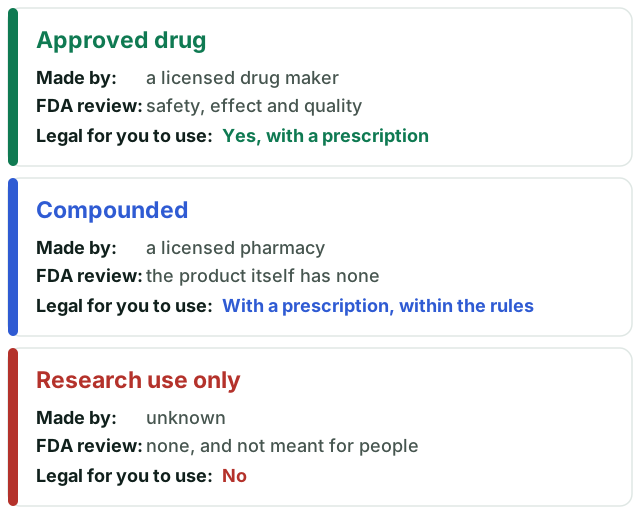
Vials labeled “for research use only” are not legal to use on people, and the HHS policy gives them nothing; HHS says it is meant to discourage their use. The phrase comes from 21 CFR 312.160, which lets a company ship an unapproved drug only for tests in laboratory animals or in test tubes, with a label reading “Not for use in humans.” FDA warning letters to peptide sellers, including one in March 2026, have found that the disclaimer does not protect a seller whose marketing shows the product is meant for people.
What is approved for the same goals
FDA’s review made a point that gets lost online: obesity and osteoporosis are serious conditions with FDA-approved treatments already available. For weight, those drugs have large human trials behind them, and our guide to peptides for weight loss and GLP-1 overview cover what they do, what they cost and how to get them. MOTS-c has nothing comparable. Exercise, which raises natural MOTS-c, needs no prescription.
Access is the other practical point. Compounded drugs generally fall outside standard pharmacy benefits, so anyone prescribed compounded MOTS-c would likely pay out of pocket, and there is no approved product or list price to compare against.
Who should be cautious, and what to ask
These groups have the most specific reasons for concern: people on insulin or other glucose-lowering drugs, anyone pregnant, trying to conceive or breastfeeding, people with a history of allergic reactions to injected drugs, and competitive athletes.
If a clinic offers MOTS-c, reasonable questions include:
- What human data support this for me, given there is no published MOTS-c trial?
- What dose are you proposing, and where did that number come from?
- Is this a single-ingredient compounded product from a state-licensed pharmacy, and can I see the certificate of analysis?
- How will you monitor blood sugar and injection site reactions, and what would make you stop it?
- Which approved option would this delay?
PeptideSorted does not link to sellers of MOTS-c or any other unapproved peptide.
Compare
- PeptidesNot FDA approvedDosage chartThere is no MOTS-c dose for people, because no human trial has published one.
- PeptidesNot FDA approvedSide effectsNo human trial of MOTS-c has reported side effects.
- LearnFDA status trackerWhich peptides are FDA-approved, which HHS tolerates under conditions, and which are not legal to use.
Recent news on this
Peptide news, sorted. Plus the printable dose chart.
Sorted, every Tuesday: the week's peptide and GLP-1 news in five minutes: FDA moves, new studies explained, and price changes. Subscribe and the one-page dose and injection-site chart arrives first.
Questions people ask
Is MOTS-c FDA-approved?
What does MOTS-c do?
Has MOTS-c been tested in humans?
Does MOTS-c cause weight loss?
How long does MOTS-c stay in your system?
Is MOTS-c banned in sport?
Sources
Primary sources first: FDA labels and documents, peer-reviewed trials, registries.
- 1HHS. Enforcement Discretion Policy Regarding 503A Compounding Using Certain Peptide Bulk Drug Substances, with Appendices A and B, October 2026hhs.gov
- 2Federal Register. Notice of availability, FR Doc. 2026-22192, Docket HHS-OASH-2026-0496, RIN 0910-ZD94, published October 30, 2026public-inspection.federalregister.gov
- 3AJMC. 5 things to know about HHS's interim peptide compounding policy, 2026ajmc.com
- 4AJMC. HHS draft policy eases enforcement on 6 compounded peptides, 2026ajmc.com
- 5Lee C et al. The mitochondrial-derived peptide MOTS-c promotes metabolic homeostasis and reduces obesity and insulin resistance. Cell Metab 2015pubmed.ncbi.nlm.nih.gov
- 6Reynolds JC et al. MOTS-c is an exercise-induced mitochondrial-encoded regulator of age-dependent physical decline and muscle homeostasis. Nat Commun 2021pubmed.ncbi.nlm.nih.gov
- 7Zempo H et al. A pro-diabetogenic mtDNA polymorphism in the mitochondrial-derived peptide, MOTS-c. Aging 2021pubmed.ncbi.nlm.nih.gov
- 8Fuku N et al. The mitochondrial-derived peptide MOTS-c: a player in exceptional longevity? Aging Cell 2015pubmed.ncbi.nlm.nih.gov
- 9Associations of serum MOTS-c with exercise capacity and antioxidant markers in young males: a cross-sectional study. Antioxidants 2026pubmed.ncbi.nlm.nih.gov
- 10ClinicalTrials.gov NCT03998514. Phase 1a/1b study of CB4211 in healthy subjects and subjects with nonalcoholic fatty liver disease (CohBar)clinicaltrials.gov
- 11CohBar, Inc. Investor presentation with phase 1a/1b CB4211 topline results, August 10, 2021 (SEC filing, exhibit 99.3)sec.gov
- 12CohBar, Inc. CohBar provides update on CB4211 clinical trial, November 5, 2018 (press release as reproduced by Santelog)santelog.com
- 13CohBar, Inc. Form 8-K: merger termination and intent to liquidate and dissolve, November 2023sec.gov
- 14ClinicalTrials.gov NCT07505745. Phase 2a trial of MOTS-c in adults with prediabetes and overweight or obesity (MOTS-MET)clinicaltrials.gov
- 15FDA. Briefing document for MOTS-c-related bulk drug substances, Pharmacy Compounding Advisory Committee, July 23-24, 2026fda.gov
- 16FDA. July 23-24, 2026 meeting of the Pharmacy Compounding Advisory Committeefda.gov
- 17NCPA. FDA advisory committee nominates six peptides for pharmacies to compound, July 31, 2026ncpa.org
- 18FDA. Bulk drug substances nominated for use in compounding under section 503A, category list (updated May 14, 2026)fda.gov
- 19FDA. Certain bulk drug substances for use in compounding may present significant safety risks (content current as of April 22, 2026)fda.gov
- 20FDA. 503A categories update, September 29, 2023 (copy hosted by the Alliance for Pharmacy Compounding)join.a4pc.org
- 21USADA. Athlete advisory: what's new on the 2025 WADA Prohibited Listusada.org
- 22WADA 2026 Prohibited List, official text as reprinted in the Dutch Treaty Series (Trb. 2026, 25)zoek.officielebekendmakingen.nl
- 23WADA. The Prohibited List (current)wada-ama.org
- 2421 CFR 312.160, drugs for investigational use in laboratory research animals or in vitro testslaw.cornell.edu
- 25FDA warning letter to Gram Peptides, March 31, 2026fda.gov
Go deeper on MOTS-c
- Dosage chartThere is no MOTS-c dose for people, because no human trial has published one. See the mouse doses, why they do not scale, and how syringe math works.Read
- Side effectsNo human trial of MOTS-c has reported side effects. Its relative CB4211 caused injection site reactions in 79% of people. What FDA flagged, and red flags.Read
PeptideSorted Editorial Team
Editorial review
The PeptideSorted editors check every guide against its cited sources before publication: each number against its FDA label, trial or registry, the FDA status against current FDA and HHS documents, and the wording against our describe-never-prescribe rule. Licensed clinicians who join the review panel are listed by name on the editorial team page.
This page was checked against its cited sources by the PeptideSorted editorial team. Licensed clinicians on our review panel are listed on the editorial team page. Every health page cites primary sources and shows its review date. Read the editorial policy and how medical review works, or report an error via corrections. Educational only; not medical advice.