
Short answer
There is no established MOTS-c dose for people. Mouse studies injected 0.5 to 15 mg/kg into the abdomen, daily or three times a week. The only related human trial tested a different molecule, the analogue CB4211. A 2026 phase 2a trial of MOTS-c has not published its dose. MOTS-c is not FDA-approved, and no policy sets a dose.
- What it is
- A 16-amino-acid peptide encoded in mitochondrial DNA, studied for metabolism and exercise capacity in mice.
- FDA status
- Not FDA approved
Not FDA-approved, with no label and no approved dose. Not on the 503A bulks list. An October 2026 HHS enforcement policy tolerates MOTS-c acetate for subcutaneous or intramuscular use under ten conditions and sets no dose.
- Evidence level
Animal studies only
No controlled human trials. Everything below is animal or lab data.
Nobody knows the right dose of MOTS-c for a person, because no human trial of MOTS-c has published one. The only numbers on record for MOTS-c are the doses injected into mice, and they appear below with the dose of a related but different molecule tested in one small human study. This is a chart of what studies used, and it is not a schedule for anyone to follow. MOTS-c is not FDA-approved.
What the mouse studies used
Both key papers come from the University of Southern California group that discovered MOTS-c. The methods of the 2015 paper state that MOTS-c “was injected daily via intraperitoneal injections in all in vivo experiments”, meaning into the abdominal cavity.
| Study | Mice | Dose | Route | Schedule |
|---|---|---|---|---|
| Lee et al. 2015 | Normal-diet mice | 5 mg/kg a day, split into two injections | Intraperitoneal | 4 days |
| Lee et al. 2015 | Normal and high-fat-diet mice | 5 mg/kg a day | Intraperitoneal | 7 days |
| Lee et al. 2015 | High-fat-diet mice | 0.5 mg/kg a day | Intraperitoneal | 3 or 8 weeks |
| Reynolds et al. 2021 | Young mice on normal or high-fat diet | 5 or 15 mg/kg a day | Intraperitoneal | 10 days to 2 weeks |
| Reynolds et al. 2021 | Middle-aged and old mice | 15 mg/kg a day | Intraperitoneal | 2 weeks |
| Reynolds et al. 2021 | Very old mice, from about 23.5 months | 15 mg/kg | Intraperitoneal | Three times a week for the rest of life |
The doses are written as mg/kg, milligrams of peptide per kilogram of mouse body weight. They span a thirtyfold range. One 2021 experiment compared 5 with 15 mg/kg and found only the higher dose improved running, and FDA’s 2026 review concluded that the animal studies “have not evaluated the dose-response relationships for the effects of MOTS-c in vivo.”
The only human dose on record is for a different molecule
| Study | Molecule | Who | Dose | Route | Schedule |
|---|---|---|---|---|---|
| CohBar phase 1b (NCT03998514), results 2021 | CB4211, a modified MOTS-c analogue | Adults with obesity and fatty liver (11 on drug, 9 on placebo) | 25 mg | Under the skin | Once daily for 4 weeks |
| MOTS-MET phase 2a (NCT07505745), recruiting since February 2026 | MOTS-c | 120 adults with prediabetes and overweight or obesity | Not stated in the registry | Under the skin | 12 weeks |
CB4211 is not the MOTS-c sold online. Its dose tells you nothing reliable about MOTS-c, and its phase 1 study had to be interrupted because some of the injected drug stayed deposited under the skin. The phase 2a trial is the first registered test of MOTS-c itself, and it has no results. Until it reports, the dose it used remains unpublished.
Why mouse mg/kg does not become a human dose
It is tempting to do the math on a mouse dose, and any number you get would be meaningless. We do not publish one, for three reasons.
Mice are not small humans. Drug clearance and metabolic rate do not scale with body weight, so multiplying a mouse dose by a person’s weight is wrong from the first step. FDA’s 2005 guidance adjusts for body surface area, and that adjustment is only one early step in a larger process that ends with a heavy safety margin.
The method is for trials, not treatment. FDA’s approach exists to choose a cautious starting dose for a phase 1 trial, which then escalates under monitoring. It assumes the animal dose came from formal toxicology studies that found no harm. FDA’s 2026 briefing document says there is “no available nonclinical data to inform safety considerations” for the uses it reviewed. The method’s starting point is missing.
Routes differ. The mice received injections into the abdominal cavity. People who use MOTS-c inject it under the skin. Nobody has published how much MOTS-c reaches the blood from an injection under the skin, how long it lasts, or whether it reaches active levels. FDA’s reviewers wrote that “it remains to be determined whether exogenous administration of MOTS-c to humans can generate pharmacologically active concentrations of the peptide over time.”
Per day, per week, cycles and missed doses
These are the questions most people arrive with, and each has the same answer.
- Per day or per week: no amount has been tested in a published human study of MOTS-c.
- Time of day and food: never studied in people.
- Cycles and breaks: no study supports any on-and-off pattern. The mouse schedules were chosen for experiments, not to find a human regimen.
- Where to inject: the MOTS-MET trial uses injection under the skin, and the HHS policy names subcutaneous or intramuscular routes. Neither publishes a body site or an amount.
- Missed doses: a missed-dose rule comes from a drug label, and MOTS-c has none.
What online protocols claim
Clinic menus, forums and seller pages describe MOTS-c schedules in milligrams, injected under the skin. No clinical study supports any of them. We mention them only because readers will meet them elsewhere, and we do not reproduce the numbers. None has been tested against placebo, and none was derived from the published mouse data by any validated method. Calling something a “protocol” or printing it as a PDF does not make it one.
What the HHS policy says about dose
Nothing. As of November 2, 2026, HHS says it does not intend to take enforcement action against a state-licensed pharmacy, federal facility or licensed physician compounding MOTS-c acetate for subcutaneous or intramuscular injection, if ten conditions are met, until a final rule addresses it. The conditions cover the ingredient’s identity and testing, a patient-specific prescription, a single active ingredient, labeling and adverse event reporting. HHS’s document mentions a “compounded regimen” in passing and does not state one.
So a compounded prescription would rest on the prescriber’s judgment with no human MOTS-c dose data behind it. MOTS-c is still not on the 503A bulks list, no rule has been proposed, and FDA has reviewed no compounded product for safety, effectiveness or quality. The notice says the policy is not binding, comments run until November 13, 2026, HHS may revisit it if a safety signal or quality problem appears, it covers 503A compounding only, and states can be stricter.
The syringe arithmetic
MOTS-c sold online is a freeze-dried powder that has to be mixed with bacteriostatic water before injection (see how to reconstitute). If a pharmacy has dispensed a compounded vial, its label gives the concentration and the prescriber gives the amount. The unit marks on a U-100 insulin syringe measure volume, not peptide: 100 units is 1 mL, so 1 unit is 0.01 mL. How much peptide sits in each unit depends entirely on how much water went in.
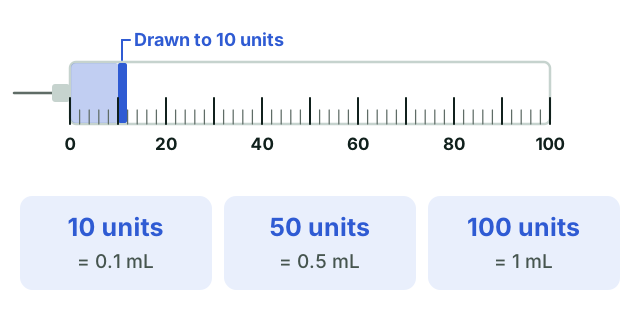
A worked example with a 10 mg vial:
- 10 mg = 10,000 mcg (micrograms). That is the total in the vial no matter how much water is added.
- Add 2 mL of water: 10 mg divided by 2 mL = 5 mg per mL.
- 5 mg per mL divided by 100 units = 0.05 mg, or 50 mcg, per unit.
The same arithmetic at two example vial sizes. These are illustrations, and the water volumes are not recommendations:
| Vial | Water added | Concentration | Peptide per unit |
|---|---|---|---|
| 5 mg | 1 mL | 5 mg/mL | 50 mcg |
| 5 mg | 2 mL | 2.5 mg/mL | 25 mcg |
| 10 mg | 1 mL | 10 mg/mL | 100 mcg |
| 10 mg | 2 mL | 5 mg/mL | 50 mcg |
| 10 mg | 3 mL | 3.33 mg/mL | 33.3 mcg |
We leave out dose columns on purpose, because no MOTS-c dose exists to put in them. The reconstitution calculator below does the same math for any vial and any volume of water, and the mg/mL to units converter works the other way round.
Reconstitution calculator
U-100 syringeWhere the arithmetic goes wrong:
- Mixing up mg and mcg. 1 mg is 1,000 mcg. MOTS-c amounts are usually written in mg, while many other peptides are written in mcg, so copying a table from another peptide can be off by a factor of 1,000.
- Treating units as milligrams. A unit is a hundredth of a milliliter. It holds whatever the concentration says it holds.
- Forgetting that the water changes everything. A table made for a vial mixed with 1 mL is wrong for a vial mixed with 2 mL.
- Overfilling a small syringe. At low concentrations, a few milligrams can exceed the 30 or 50 units a small insulin syringe holds.
- Trusting the label. Research-grade vials carry no FDA-verified content. FDA’s briefing document notes that different salts and even different molecules are sold under the name MOTS-c.
Research vials are a separate matter
Products sold “for research use only” are not legal to use on people, and the HHS policy gives them nothing. Those vials fall under 21 CFR 312.160, which allows shipment only for tests in laboratory animals or in vitro, with a label reading “Not for use in humans.” The MOTS-c side effects page covers what is known about safety, and the FDA status tracker follows the rulemaking.
Compare
- PeptidesNot FDA approvedMOTS-cMOTS-c improved metabolism and running in mice, but no published human trial exists and it is not FDA-approved.
- PeptidesNot FDA approvedSide effectsNo human trial of MOTS-c has reported side effects.
- LearnHow to reconstituteHow a prescribed freeze-dried vial is mixed with bacteriostatic water, the mg/mL and units math worked through, storage, and mistakes that waste a vial.
Recent news on this
Peptide news, sorted. Plus the printable dose chart.
Sorted, every Tuesday: the week's peptide and GLP-1 news in five minutes: FDA moves, new studies explained, and price changes. Subscribe and the one-page dose and injection-site chart arrives first.
Questions people ask
What is the standard MOTS-c dose?
Can I convert the mouse dose to my body weight?
How much MOTS-c per week?
When should MOTS-c be taken?
How do syringe units work with a MOTS-c vial?
Was CB4211 the same as MOTS-c?
Sources
Primary sources first: FDA labels and documents, peer-reviewed trials, registries.
- 1Lee C et al. The mitochondrial-derived peptide MOTS-c promotes metabolic homeostasis and reduces obesity and insulin resistance. Cell Metab 2015pubmed.ncbi.nlm.nih.gov
- 2Reynolds JC et al. MOTS-c is an exercise-induced mitochondrial-encoded regulator of age-dependent physical decline and muscle homeostasis. Nat Commun 2021pubmed.ncbi.nlm.nih.gov
- 3CohBar, Inc. Investor presentation with phase 1a/1b CB4211 topline results, August 10, 2021 (SEC filing, exhibit 99.3)sec.gov
- 4ClinicalTrials.gov NCT03998514. Phase 1a/1b study of CB4211 in healthy subjects and subjects with nonalcoholic fatty liver disease (CohBar)clinicaltrials.gov
- 5ClinicalTrials.gov NCT07505745. Phase 2a trial of MOTS-c in adults with prediabetes and overweight or obesity (MOTS-MET)clinicaltrials.gov
- 6FDA. Guidance for industry: estimating the maximum safe starting dose in initial clinical trials for therapeutics in adult healthy volunteers, July 2005fda.gov
- 7FDA. Briefing document for MOTS-c-related bulk drug substances, Pharmacy Compounding Advisory Committee, July 23-24, 2026fda.gov
- 8FDA. July 23-24, 2026 meeting of the Pharmacy Compounding Advisory Committeefda.gov
- 9HHS. Enforcement Discretion Policy Regarding 503A Compounding Using Certain Peptide Bulk Drug Substances, with Appendices A and B, October 2026hhs.gov
- 10Federal Register. Notice of availability, FR Doc. 2026-22192, Docket HHS-OASH-2026-0496, RIN 0910-ZD94, published October 30, 2026public-inspection.federalregister.gov
- 11AJMC. 5 things to know about HHS's interim peptide compounding policy, 2026ajmc.com
- 1221 CFR 312.160, drugs for investigational use in laboratory research animals or in vitro testslaw.cornell.edu
More on MOTS-c
- OverviewMOTS-cMOTS-c improved metabolism and running in mice, but no published human trial exists and it is not FDA-approved. The evidence, and what HHS did in October.
- Side effectsNo human trial of MOTS-c has reported side effects. Its relative CB4211 caused injection site reactions in 79% of people. What FDA flagged, and red flags.Read
PeptideSorted Editorial Team
Editorial review
The PeptideSorted editors check every guide against its cited sources before publication: each number against its FDA label, trial or registry, the FDA status against current FDA and HHS documents, and the wording against our describe-never-prescribe rule. Licensed clinicians who join the review panel are listed by name on the editorial team page.
This page was checked against its cited sources by the PeptideSorted editorial team. Licensed clinicians on our review panel are listed on the editorial team page. Every health page cites primary sources and shows its review date. Read the editorial policy and how medical review works, or report an error via corrections. Educational only; not medical advice.