
Short answer
The Wolverine peptide stack is BPC-157 and TB-500 used together for injury healing, and nobody has shown that it works in people. No controlled human trial has tested the pair, and neither peptide is FDA-approved. A blended Wolverine vial falls outside the interim HHS compounding policy, which requires a single active ingredient. Both are banned in sport.
- What it is
- A nickname for using two unapproved healing peptides, BPC-157 and TB-500, together.
- FDA status
- Not FDA approved
Neither peptide is FDA-approved. As of November 2, 2026 no rule has been proposed. An interim HHS policy covers each peptide only as a single-ingredient product under ten conditions, so a Wolverine blend is outside it.
- Evidence level
Animal studies only
No controlled human trials. Everything below is animal or lab data.
The Wolverine stack means taking BPC-157 and TB-500 together in the hope of healing an injury faster, and nobody has shown that it works in people. The name is a nickname borrowed from the comic-book character who regenerates. It is not a product, a protocol or a medical term. Neither peptide is FDA-approved, no controlled trial has tested the pair in humans, and the only controlled study of the combination, in rats, found it added nothing.
If you are searching this because you are hurt, the short version is at the end: there are treatments with actual evidence, and they are worth exhausting first.
| BPC-157 | TB-500 | |
|---|---|---|
| What it is | A 15-amino-acid fragment of a protein found in human gastric juice | A synthetic 7-amino-acid fragment of thymosin beta-4, a 43-amino-acid protein the body makes |
| FDA-approved? | No | No |
| Best human evidence | Five small studies; none tested skin injection or capsules | None. FDA found no human data by any route |
| Toxicity studies | One published paper, by muscle injection only | None found by FDA |
| On the interim HHS list? | Yes, acetate, single ingredient only | Yes, acetate, single ingredient only |
| Blended together? | Outside the policy | Outside the policy |
| WADA | Class S0, non-approved substances | Class S2, “thymosin-β4 and its derivatives, e.g. TB-500” |
What people hope the Wolverine stack will do
Most people come to it with a stubborn injury: a tendon that will not settle, a muscle tear, a joint that hurts, or recovery after surgery. The pitch is that two peptides work on healing from different angles, BPC-157 through growth factors and blood vessels, and TB-500 through cell migration. The pitch sounds tidy, but it was built from separate rat and cell studies, much of the TB-500 half from research on the larger thymosin beta-4 protein. FDA says the mechanisms of BPC-157 “remain poorly understood,” and it is unknown whether TB-500 itself promotes wound healing in a living animal.
Interest is climbing fast, which is partly why the name reaches you. A preprint reported by AJMC in October 2026 searched more than 15 million medical records and found new confirmed BPC-157 users rising from 4 in early 2020 to 134 in early 2026, about 33-fold. Users were getting younger and more often male: the mean age fell from 55 to 49, and the male share rose from 57% to 70%. Pain was the most common reason given. Among the 205 users with a documented supply source, 36% used a compounding pharmacy and 35% a gray-market vendor, and TB-500 was among the agents most often taken alongside it. Healthline’s summary adds that fitness influencers promote the pair. The data show that people are using it, and say nothing about whether it helps them.
Does the Wolverine stack work?
Nobody has shown that it does. Here is everything that bears on the question, starting with the strongest study design.
| Evidence | What was done | What it found | What it cannot tell you |
|---|---|---|---|
| Biçer et al. 2026 | 32 rats with repaired Achilles tendons; saline, BPC-157, TB-500 or both, for 4 weeks | TB-500 alone raised tendon strength. “Combined BPC-157 and TB-500 treatment did not confer additional benefits compared to either agent alone” | Anything about people. Eight rats per group, injected into the abdomen |
| Lee and Padgett 2021 | Phone follow-up of 16 knee patients; 4 had BPC-157 with thymosin beta-4 | 3 of those 4 reported improvement | Whether the injections caused it. No control group, and the paper names thymosin beta-4, not TB-500 |
| Clinical notes preprint, 2026 | 1,039 people with documented BPC-157 use | 79% of the 354 with a recorded response reported improvement | Almost everything. No comparison group, no standard product, and about half used something else too |
| Human trials of TB-500 | FDA searched | None found | |
| Human trials of the pair | FDA’s two reviews | No controlled trial |
A flat result in rats does not rule out a benefit in people, and it certainly does not support one. Flynn McGuire of the University of Utah, who studies BPC-157, noted that without a comparison group or a standard dose, the improvement in the clinical notes could not be credited to the peptide. Plenty of injuries get better with time and rehab, which is why controlled trials exist. A 2026 systematic review graded the human evidence for BPC-157 as very low certainty.
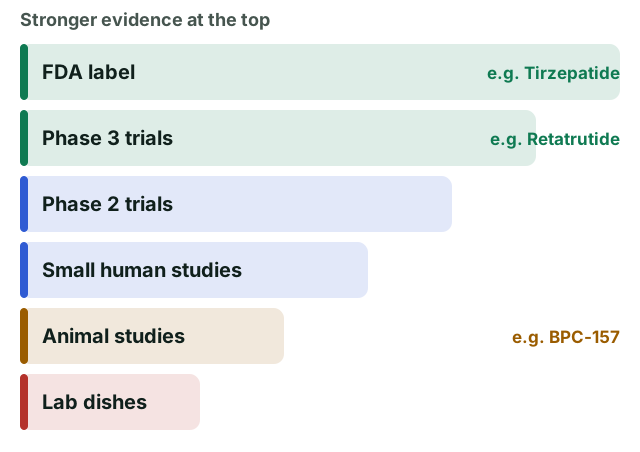
For the stack as a combination, the evidence sits on the animal rung, with a single study. BPC-157 alone reaches small human studies, but for routes unlike the way it is usually used. TB-500 alone has not left the animal rung.
How long does it take to work?
No one can say, since no controlled study has shown it works at all. You will see timelines online. They are anecdotes, and they coincide with how long many injuries take to improve anyway.
Is the Wolverine stack legal?
A premixed Wolverine vial falls outside the interim HHS policy. As of November 2, 2026, HHS says it does not intend to take enforcement action against a state-licensed pharmacy, federal facility or licensed physician compounding BPC-157 or TB-500, when all ten conditions are met. Condition seven requires a single active ingredient, so a blend does not qualify even though each peptide is on the list. HHS’s reason was safety surveillance: with one ingredient, “it will be easier to attribute adverse events or clinical outcomes to a specific substance.”
The policy is silent on someone prescribed two separate single-peptide products, and no study has examined that. Silence is not permission, and nothing here suggests it as a route.
Several limits come with the policy:
- Neither peptide is FDA-approved or on the 503A bulks list, and no rule has been proposed. FDA has not reviewed any compounded product for safety, effectiveness or quality.
- It is enforcement discretion. The notice says it is “not binding on HHS or the public,” and HHS may revisit it if a safety signal or quality problem appears.
- It applies to 503A compounding only, on a patient-specific prescription. States can be stricter, and AJMC reported that peptide advocates expect tension between federal and state regulators.
- FDA’s own reviewers proposed against both peptides. The advisory committee voted 8 to 6 for each in July 2026, and HHS’s policy followed. The petition by the Partnership for Safe Medicines asks FDA to disregard that vote, so the picture may keep moving.
Products labeled “research use only” gain nothing from any of this. Those vials are not legal to use on people, whatever the label implies. The rule in 21 CFR 312.160 allows shipment only for tests in laboratory animals or test tubes, a March 2026 FDA warning letter treated the label as no defense, and HHS says it wants to discourage their use. The FDA status tracker follows each change.
Can a doctor prescribe the Wolverine stack?
A clinician can write a prescription, but that does not bring a blended stack inside the policy or make the combination tested. The single-ingredient condition applies regardless of who prescribes. Fox Rothschild’s analysis tells clinics directly that multi-peptide blends are outside the policy and that stock kept on hand ahead of a prescription is not covered. It also warns that patient-facing materials should not suggest a compounded product has FDA review. If a clinic describes a Wolverine product as approved, FDA-cleared or proven, that claim is false.
Why did HHS act if the evidence is this thin?
HHS framed the policy as harm reduction. It says the policy “will discourage the continued, widespread use of certain research-use-only peptides supplied by foreign manufacturers” and offers “a more controlled alternative.” HHS’s statement stresses that it does not grant FDA approval or establish safety and effectiveness. The argument is about supply, and it makes no claim that these peptides work.
Critics see it differently. Public Citizen urged HHS to rescind the policy. Researchers at the Center for Science in the Public Interest argued in JAMA that this reasoning could be applied to any compound whose illegal sales grew large enough, and that it removes the incentive to run real trials. RAPS reported that eight members were added to the advisory committee before the July vote, many alleged to have ties to peptide prescribing or promotion. Whichever side you find persuasive, none of this is evidence about your tendon.
How to read Wolverine marketing
| What you may see | What it means |
|---|---|
| “Research use only” or “not for human consumption” beside injury claims | The label that FDA warning letters have treated as no defense |
| A premixed vial with both peptides | Outside the HHS policy, whoever sells it |
| “FDA-registered” or “made in an FDA-registered facility” | Registration is one of the policy’s conditions for a manufacturer. It does not mean FDA reviewed the product |
| “Clinically proven” or “doctor recommended” | No controlled human trial of the pair exists |
| A certificate of analysis | One lot tested once, if genuine. See how to read a COA |
| “Wolverine protocol” with a schedule | A forum convention. No human dose of either peptide has been established |
HHS’s conditions give a sense of what tolerated compounding looks like: one active ingredient, a prescription for a named patient, and a label stating, “This is a compounded drug product. Not for resale,” with instructions for reporting adverse events.
What are the risks?
The main risk is that nobody has measured the risks. Here is what is on record.
- A repeat reaction. FDA’s database holds a report of a 40-year-old woman who injected a blended BPC-157 and TB-500 research product and developed widespread darkening of her skin and gums. It returned when she used the product again and stopped when she quit.
- No toxicology for TB-500. FDA found no acute, repeat-dose, genetic, reproductive or cancer studies, and concluded that potential risks in humans “are unknown.”
- Animal signals for BPC-157. FDA flagged changes in clotting times and liver markers in 28-day rat and dog studies.
- Immune reactions. FDA says injected peptides of this kind may pose a significant risk of immunogenicity, with outcomes that range from nothing noticeable to life-threatening.
- A theoretical cancer question. Both peptides are promoted for encouraging blood vessel growth. Neither has a cancer study. In a 2003 mouse experiment, melanoma cells engineered to make more thymosin beta-4 spread more readily, which is suggestive and far from proof, and did not involve TB-500.
- Unknown contents. A 2023 laboratory analysis found products sold as TB500 were “not systematically consistent” with their labels. Premixed vials have no standard ratio.
Two injectables also means twice the unknowns and no way to tell which caused a problem. The BPC-157 side effects guide includes red flags and when to call 911.
Is it banned in sport?
Yes, both halves. WADA names BPC-157 in class S0 and “thymosin-β4 and its derivatives, e.g. TB-500” in class S2, banned at all times. A US compounding policy has no effect on that.
What is approved for injury healing?
Neither peptide in this stack is approved for any injury, and FDA found no approved product containing BPC-157 anywhere in the world.
What to do instead
For most sports and overuse injuries, the route with evidence is unglamorous. NIAMS, part of the National Institutes of Health, describes it this way:
- Many injuries can be treated at home with rest, ice, compression and elevation.
- For more severe injuries, a clinician may recommend physical therapy, and a cast, splint or brace.
- Some cases need surgery.
- Exercise-based rehabilitation is generally advised before returning to the activity that caused the injury.
See a clinician promptly for sudden severe pain or a bone or joint that looks out of place. If an injury has dragged on for months, that is a good reason to get a proper diagnosis, because a tendon problem, a stress injury and arthritis need different plans. The muscle goals guide covers what is known about peptides and recovery more broadly.
If you are already using it
Tell your clinician exactly what you take, including the source and amounts. It changes how they read your symptoms and blood tests, and the preprint above suggests most doctors are not asking. Report any reaction to FDA’s MedWatch program, since these reports are nearly the only human safety data that exist.
Compare
- PeptidesNot FDA approvedTB-500TB-500 is a seven-amino-acid fragment of thymosin beta-4, and FDA found no human use data on it.
- PeptidesNot FDA approvedSide effectsNobody has measured BPC-157 side effect rates.
- LearnFDA status trackerWhich peptides are FDA-approved, which HHS tolerates under conditions, and which are not legal to use.
Peptide news, sorted. Plus the printable dose chart.
Sorted, every Tuesday: the week's peptide and GLP-1 news in five minutes: FDA moves, new studies explained, and price changes. Subscribe and the one-page dose and injection-site chart arrives first.
Questions people ask
What is in the Wolverine stack?
Does the Wolverine stack work?
Is the Wolverine stack legal?
What are the side effects of the Wolverine stack?
Is the Wolverine stack banned in sport?
Sources
Primary sources first: FDA labels and documents, peer-reviewed trials, registries.
- 1HHS. Enforcement Discretion Policy Regarding 503A Compounding Using Certain Peptide Bulk Drug Substances, with Appendices A and B, October 2026hhs.gov
- 2Federal Register. Notice of availability, FR Doc. 2026-22192, Docket HHS-OASH-2026-0496, RIN 0910-ZD94, published October 30, 2026public-inspection.federalregister.gov
- 3Fox Rothschild. HHS moves to pull peptides out of the research-use-only market and into pharmacies, October 2026foxrothschild.com
- 4AJMC. 5 things to know about HHS's interim peptide compounding policy, October 29, 2026ajmc.com
- 5AJMC. BPC-157 'Wolverine peptide' use rose 33-fold despite scant evidence, October 29, 2026ajmc.com
- 6FDA. Briefing document for BPC-157-related bulk drug substances, Pharmacy Compounding Advisory Committee, July 23-24, 2026fda.gov
- 7FDA. Briefing document for TB-500-related bulk drug substances, Pharmacy Compounding Advisory Committee, July 23-24, 2026fda.gov
- 8Healthline. What to know about Wolverine peptides (BPC-157 and TB-500), medically reviewed, updated October 14, 2026healthline.com
- 9Poolton JT et al. Human evidence for BPC-157 in orthopaedic and regenerative medicine: a systematic review of efficacy and safety. Acta Orthop Belg 2026pubmed.ncbi.nlm.nih.gov
- 10Biçer O et al. Effects of BPC-157 and TB-500 on Achilles tendon healing in rats: a histopathological and biomechanical study. Jt Dis Relat Surg 2026pubmed.ncbi.nlm.nih.gov
- 11Lee E, Padgett B. Intra-articular injection of BPC 157 for multiple types of knee pain. Altern Ther Health Med 2021pubmed.ncbi.nlm.nih.gov
- 12RAPS. HHS will permit compounding of six peptides ahead of formal rulemaking, October 29, 2026raps.org
- 13Cha HJ et al. Role of thymosin beta4 in tumor metastasis and angiogenesis. J Natl Cancer Inst 2003pubmed.ncbi.nlm.nih.gov
- 14Delcourt V et al. TB500/TB1000 and SGF1000: a scientific approach for a better understanding of misbranded and adulterated drugs. Drug Test Anal 2023pubmed.ncbi.nlm.nih.gov
- 15NIAMS. Tendinitis and sports injuriesniams.nih.gov
- 16McDermott Will & Schulte. Bulk list bound: PCAC backs majority of peptides in two-day public meeting, July 27, 2026mcdermottlaw.com
- 17Finnish Center for Integrity in Sports (SUEK). Doping agent classes and substances 2026 (WADA List text by class)kamu.suek.fi
- 18WADA. The Prohibited List (current)wada-ama.org
- 1921 CFR 312.160, drugs for investigational use in laboratory research animals or in vitro testslaw.cornell.edu
- 20FDA warning letter to Gram Peptides, March 31, 2026fda.gov
More in Goals
- Glow blendGlow is an injectable blend of GHK-Cu, BPC-157 and TB-500, never tested in people and outside the HHS policy. See what each ingredient really shows.Read
- Hair growthNo peptide is FDA-approved for hair loss. See what the small peptide studies measured, who paid for them, and how minoxidil and finasteride compare.Read
- Klow blendKlow is Glow plus KPV: four unapproved peptides in one vial, never tested in people and outside the HHS policy for three reasons. See what KPV adds.Read
- Muscle growthNo peptide is FDA-approved to build muscle. What tesamorelin, sermorelin, CJC-1295, ipamorelin and MK-677 did to lean mass and strength in human trials.Read
- SkinA few skin peptides beat a control in small, mostly company-run trials. None is FDA-approved. See the evidence by type and what has stronger proof.Read
- SleepNo peptide is FDA-approved for sleep. DSIP's 1980s trials were mixed, epitalon and selank have no sleep trials, and proven insomnia treatments exist.Read
PeptideSorted Editorial Team
Editorial review
The PeptideSorted editors check every guide against its cited sources before publication: each number against its FDA label, trial or registry, the FDA status against current FDA and HHS documents, and the wording against our describe-never-prescribe rule. Licensed clinicians who join the review panel are listed by name on the editorial team page.
This page was checked against its cited sources by the PeptideSorted editorial team. Licensed clinicians on our review panel are listed on the editorial team page. Every health page cites primary sources and shows its review date. Read the editorial policy and how medical review works, or report an error via corrections. Educational only; not medical advice.