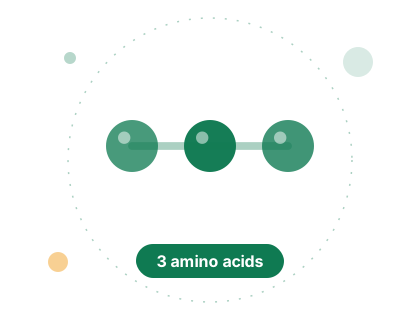
Short answer
KPV is a three-amino-acid peptide cut from the hormone alpha-MSH, studied for gut and skin inflammation in cells and mice. FDA found no human study of it by any route. It is not FDA-approved. As of November 2, 2026, an interim HHS policy tolerates compounded oral and topical KPV under conditions, but not injected KPV.
- What it is
- A three-amino-acid peptide (Lys-Pro-Val), the C-terminal end of alpha-melanocyte-stimulating hormone, studied for anti-inflammatory effects in cells and animals.
- FDA status
- Not FDA approved
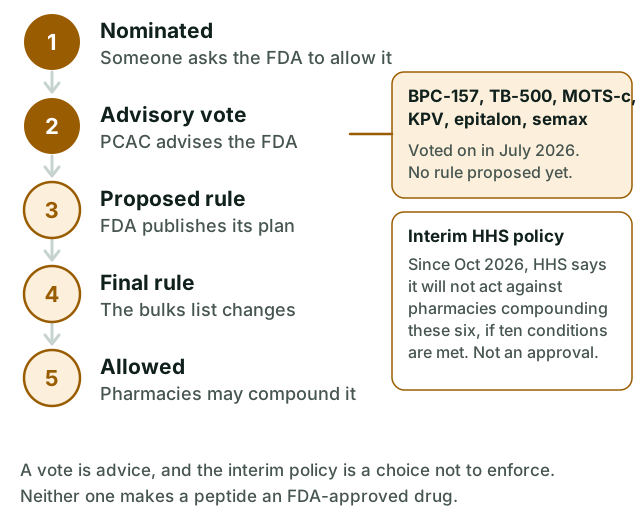
Not approved and not on the 503A bulks list. FDA staff advised against listing it; its advisory committee voted 8 to 6 for it on July 23, 2026. An interim HHS policy published October 30, 2026 says HHS does not intend to act against compounding of KPV acetate in topical and oral forms if ten conditions are met. Injected KPV is not covered.
- Evidence level
Animal studies only
No controlled human trials. Everything below is animal or lab data.
KPV is a three-amino-acid peptide that calms inflammation in lab dishes and in mice with chemically induced colitis. The evidence stops there. FDA’s May 2026 review found no human study of any kind, not a trial and not a case report, and a ClinicalTrials.gov search on November 2, 2026 found none registered. KPV is not FDA-approved. It is one of the unapproved peptides in our Peptides A-Z, and it has become popular online well ahead of its data.
| Question | Answer as of November 2, 2026 |
|---|---|
| What is it? | Lys-Pro-Val, the last three amino acids of the hormone alpha-MSH |
| Best evidence | Mouse colitis studies and human cells in a dish |
| Human studies | None found by FDA, by any route |
| FDA-approved? | No, for any use |
| Compounding | Not on the 503A bulks list. An interim HHS policy tolerates topical and oral KPV acetate, with ten conditions |
| Injected KPV | Not covered by that policy |
| Established human dose | None |
| Side effects | Unknown, because nobody has measured them |
What is KPV peptide?
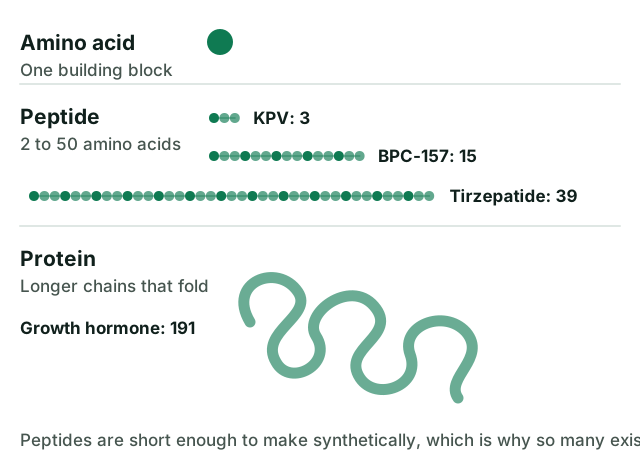
KPV is three amino acids joined in a row: lysine (K), proline (P) and valine (V). It is the C-terminal (tail-end) sequence, positions 11 to 13, of alpha-melanocyte-stimulating hormone (alpha-MSH), a 13-amino-acid hormone made from the same precursor protein as ACTH. Alpha-MSH both darkens skin and dampens inflammation. KPV keeps some of the anti-inflammatory activity without the pigment effect.
FDA’s briefing document lists the free base as C16H30N4O4 with a molecular weight of 342.43 g/mol, and notes an acetate salt form (402.5 g/mol) that shares the same CAS number. “KPV” is a common name, not an official drug name, and FDA found multiple salts and derivatives sold under the same label. Some studies used related molecules, such as N-acetylated KPV or a KPV dimer, which are different substances. That matters for anyone reading a study and then a product label: they may not describe the same chemical.
What does KPV do?
In the lab, KPV lowers inflammatory signals, and the most consistent results are in the colon. How it does that is unsettled. KPV does not bind the main alpha-MSH receptors well in lab tests and does not raise cyclic AMP the way alpha-MSH does. A 2003 mouse study concluded it is unlikely to act through melanocortin receptors and more likely interferes with the inflammatory signal interleukin-1 beta. A 2008 study found that the gut transporter PepT1, which carries small peptides into cells and increases in inflamed colon, pulls KPV into intestinal and immune cells. FDA’s 2026 review summed it up: “the molecular targets underlying the pharmacological effects of KPV-related BDSs remain unknown.”
| Study | Model | What was given | What was found |
|---|---|---|---|
| Dalmasso et al. 2008, Gastroenterology | Human intestinal and immune cells; mice with DSS or TNBS colitis | Nanomolar KPV in cells; 100 µM KPV in drinking water for mice | Blocked NF-kB inflammatory signaling and cytokine release in cells; less colitis and lower inflammatory markers in mice |
| Kannengiesser et al. 2008, Inflamm Bowel Dis | Mice with DSS colitis or T-cell transfer colitis, including mice lacking a working MC1 receptor | KPV treatment | Faster recovery and weight regain, less inflammation; rescued all MC1R-deficient mice from death in DSS colitis |
| Laroui et al. 2010, Gastroenterology | Mice with DSS colitis | KPV inside 400 nm nanoparticles, wrapped in an alginate-chitosan gel, by mouth | Protected against colitis at a KPV concentration 12,000-fold lower than free KPV in solution |
| Xiao et al. 2017, Mol Ther | Mice with DSS colitis | KPV in hyaluronic acid-coated nanoparticles in a gel, 16 µg/kg a day by gavage | Better mucosal healing and lower TNF-alpha than uncoated KPV nanoparticles |
| Cheng et al. 2026, Sci Adv | Mice with colitis or acute lung injury | An engineered KPV conjugate by mouth | 3.8-fold more reached the colon than free KPV, with better results at a 20-fold lower dose |
| Getting et al. 2003, J Pharmacol Exp Ther | Mice with crystal- or IL-1-induced peritonitis | KPV given systemically | Fewer white cells flooding the abdomen, apparently not through melanocortin receptors |
| Cutuli et al. 2000, J Leukoc Biol | Bacteria and yeast in a dish | Alpha-MSH and KPV | Inhibited Staphylococcus aureus and Candida albicans |
Read together, these studies show a consistent anti-inflammatory signal in rodents and in human cells grown in a dish. The nanoparticle and conjugate work is the most active thread, and it carries a warning for anyone comparing it with a plain capsule: the headline results came from engineered delivery systems, built because plain peptides break down in the gut and are poorly absorbed. None of it shows what KPV does in a person.
What is KPV used for?
Officially, nothing. Online, nearly everything. FDA’s review found websites promoting KPV for inflammatory bowel disease, psoriasis, wound healing, immune strength, nerve and stroke protection, tumors, mast cell activation syndrome, histamine intolerance, COVID-19 recovery, Lyme disease, mold toxicity and pain. The proposed compounded product FDA actually evaluated was narrower: a 0.1% cream or gel for “wound healing and inflammatory conditions.” The KPV benefits page sets each claim beside its strongest evidence, and most of the list has no KPV-specific research behind it.
Is KPV safe? What is known about side effects
Nobody can say, and that is the honest answer to the safety question. There is no list of side effects with percentages because no one has measured any in people. FDA’s May 12, 2026 evaluation lists the gaps:
- No human studies. “The nomination did not include, and FDA has not identified, any clinical studies or human exposure data for KPV via any route of administration.”
- No human pharmacokinetics. Nobody has measured how KPV is absorbed, distributed or cleared in people.
- No standard toxicology. FDA found no acute, repeat-dose, genotoxicity, reproductive or carcinogenicity studies.
- No adverse event reports. FDA’s searches of its FAERS database through December 3, 2025 and its food and supplement complaint system found no cases, which reflects the absence of documented use, not proven safety.
- Immunogenicity unknown. FDA said there is insufficient data to conclude KPV does not provoke immune reactions or form aggregates.
- Poor skin penetration. The only study in human tissue, using skin from cadavers, found KPV does not pass well through intact skin, which could limit a cream’s effect. Microneedles or a small electric current (iontophoresis) increased penetration.
- Unclear identity. Because “KPV” is not a standardized name, a vial labeled KPV may be the free base, the acetate, or something else.
Without pregnancy, drug-interaction or long-term data, there is no group for whom KPV has been shown to be safe. Anyone who is pregnant, breastfeeding, immunosuppressed or on treatment for bowel disease is working with no information at all, and that is worth raising with the clinician managing the condition.
Oral, topical or injected: what each route has behind it
Route is where the October 2026 policy draws its firmest line, and it does not line up neatly with the studies.
| Route | What the research used | Where it stands under the HHS policy |
|---|---|---|
| Oral | Plain KPV in mouse drinking water; engineered nanoparticles and conjugates in mice. No human absorption data | Covered for KPV acetate, if the compounder documents adequate oral bioavailability in humans |
| Topical | Mouse and rabbit work; cadaver skin showed poor penetration. FDA reviewed a proposed 0.1% cream or gel | Covered for KPV acetate |
| Injected | Mouse studies by systemic injection. No human study | Not covered |
No route has an established human dose, and the KPV dosage page shows the animal figures and why they do not carry over. How long KPV takes to work is also unknown. The mouse colitis experiments ran for days to about a week, in an artificial disease, so they say nothing about a timeline for a person.
Is KPV legal? Its FDA status in detail
KPV has no new drug application, no FDA approval, no USP monograph and no authorization from the European Medicines Agency. The only process it has been through is the review of bulk substances that compounding pharmacies may use under section 503A.
| Date | What happened |
|---|---|
| September 29, 2023 | FDA placed KPV in 503A category 2, “bulk drug substances that raise significant safety risks,” alongside BPC-157, TB-500 and others. FDA’s stated concern was that it had found no human exposure data by any route. |
| By April 22, 2026 | The only nomination, from a compounding pharmacy, was withdrawn. FDA’s safety-risks page now lists KPV under “nominated but withdrawn,” and FDA chose to evaluate KPV free base and KPV acetate on its own initiative. |
| May 12, 2026 | FDA staff completed their evaluation for topical 0.1% cream and gel for “wound healing and inflammatory conditions” and proposed not adding either form to the bulks list. |
| July 23, 2026 | FDA’s Pharmacy Compounding Advisory Committee voted 8 to 6, with one abstention, to recommend adding KPV anyway. |
| October 28-30, 2026 | HHS announced, then published in the Federal Register, an interim enforcement discretion policy covering KPV acetate in topical and oral forms. |
| November 2, 2026 | No proposed or final rule has been published. KPV is not on the 503A bulks list. |
What the October 2026 HHS policy changed
The office of the HHS Secretary, rather than FDA, issued this policy. As of November 2, 2026, HHS says it does not intend to take enforcement action against a state-licensed pharmacy, federal facility or licensed physician compounding KPV acetate in topical or oral dosage forms, when all ten conditions are met, until a final rule says whether KPV belongs on the 503A bulks list. Enforcement discretion is a choice not to enforce. It does not change what KPV is or what is known about it.
The conditions that matter most to a patient:
- The prescription must be valid and patient-specific.
- The product may contain one active ingredient only, so a blend with KPV in it falls outside the policy. That includes the KLOW blend, even though BPC-157 and TB-500 are also on the HHS list.
- The bulk powder must come from an FDA-registered manufacturer that follows good manufacturing practice, with a valid certificate of analysis. Our guide to reading a certificate of analysis explains what those tests cover.
- An oral product requires documentation that the specific formulation reaches adequate oral bioavailability in humans. FDA’s review found no human absorption data for KPV, so it is unclear what could meet this today.
- The label must read “This is a compounded drug product. Not for resale.”
- The compounder must report serious adverse events and quality problems to FDA’s MedWatch program and to the states involved.
What the policy leaves untouched:
- KPV is still not FDA-approved and still not on the 503A bulks list. No rule has been proposed.
- FDA has not reviewed any compounded KPV product for safety, effectiveness or quality. Injected KPV and KPV free base are outside the policy.
- The notice calls the policy a draft in places and says it “does not establish any rights for any person and is not binding on HHS or the public.” Written comments are open until November 13, 2026.
- HHS may revisit the policy if a safety signal or quality problem appears. It covers 503A compounding only, not outsourcing facilities, and states can be stricter.
HHS justified including KPV partly on the view that FDA’s safety conclusion “reflects an absence of information rather than an observed signal.” That is an accurate description of the data, and also the problem: no reported harm from a substance nobody has studied in people is a long way from evidence of safety. The evidence has not changed, which is why this page still says animal studies only. A 2019 review by Markus Böhm and Thomas Luger, dermatologists at the University of Münster, called KPV and related peptides promising candidates for treating skin wounds, and FDA’s review notes that researchers have said clinical studies are needed. Those studies still have not been done.
What research use only means
Vials labeled “for research use only” remain not legal to use on people, and the HHS policy gives them nothing; HHS says it is meant to discourage their use. Under 21 CFR 312.160, that label allows shipment solely for tests in laboratory animals or in test tubes, and it must read “Not for use in humans.” FDA’s 2026 review found websites promoting KPV as injections, oral capsules, topical products and nasal sprays, and in multi-peptide blends. None of these products has FDA-verified identity, purity, sterility or dose.
How KPV compares with BPC-157
BPC-157 is the peptide KPV is most often sold beside, and both are promoted for the gut. They are different molecules: KPV has 3 amino acids and BPC-157 has 15. Both are on the HHS list, with different limits. BPC-157 acetate is covered for subcutaneous, intramuscular, oral and topical use, while KPV acetate is covered for topical and oral use only. HHS cites human studies of BPC-157 in its justification; for KPV there are none to cite. Combining them in one product puts it outside the policy.
Access, cost and what to ask instead
KPV has no approved product, so no list price and no insurance route to compare. Compounded drugs generally fall outside standard pharmacy benefits, so anyone prescribed one would likely pay out of pocket.
Many people searching for KPV have a real problem, such as ulcerative colitis, Crohn’s disease or a stubborn skin condition. Crohn’s and ulcerative colitis both have approved treatments, tested in the human trials KPV lacks. If KPV has come up in a clinic or a forum, these are fair questions for a prescriber:
- What human evidence supports this for my condition, and what would you expect to see, by when?
- Is this one active ingredient, and is it in a form the HHS policy covers?
- Who made the bulk powder, and can I see the certificate of analysis?
- How does this interact with what I already take, given that no one has studied it?
- Which approved option would I be delaying, and what happens if my condition flares meanwhile?
Compare
- PeptidesNot FDA approvedBenefitsKPV is promoted for gut, skin, wounds and infections.
- PeptidesNot FDA approvedDosageThere is no KPV dose for people, because no human study exists.
- LearnFDA status trackerWhich peptides are FDA-approved, which HHS tolerates under conditions, and which are not legal to use.
Recent news on this
Peptide news, sorted. Plus the printable dose chart.
Sorted, every Tuesday: the week's peptide and GLP-1 news in five minutes: FDA moves, new studies explained, and price changes. Subscribe and the one-page dose and injection-site chart arrives first.
Questions people ask
Is KPV FDA-approved?
What does KPV peptide do?
Has KPV been tested in people?
What are the side effects of KPV?
Where do you inject KPV?
Is KPV the same as alpha-MSH?
Sources
Primary sources first: FDA labels and documents, peer-reviewed trials, registries.
- 1HHS. Enforcement Discretion Policy Regarding 503A Compounding Using Certain Peptide Bulk Drug Substances, with Appendices A and B, October 2026hhs.gov
- 2Federal Register. Notice of availability, FR Doc. 2026-22192, Docket HHS-OASH-2026-0496, RIN 0910-ZD94, published October 30, 2026public-inspection.federalregister.gov
- 3AJMC. 5 things to know about HHS's interim peptide compounding policy, 2026ajmc.com
- 4AJMC. HHS draft policy eases enforcement on 6 compounded peptides, 2026ajmc.com
- 5FDA. Briefing document: evaluation of KPV-related bulk drug substances (KPV free base and KPV acetate), Pharmacy Compounding Advisory Committee, July 23-24, 2026 (memo dated May 12, 2026)fda.gov
- 6FDA. July 23-24, 2026 meeting of the Pharmacy Compounding Advisory Committeefda.gov
- 7DLA Piper. FDA AdComm recommends adding six peptides to bulks list, July 31, 2026dlapiper.com
- 8FDA. Certain bulk drug substances for use in compounding may present significant safety risks (content current as of April 22, 2026)fda.gov
- 9FDA. Bulk drug substances nominated for use in compounding under section 503A, category list (updated May 14, 2026)fda.gov
- 10FDA. 503A categories update, September 29, 2023 (copy hosted by the Alliance for Pharmacy Compounding)join.a4pc.org
- 11ClinicalTrials.gov. Search for KPV, Lys-Pro-Val and lysine-proline-valine, run November 2, 2026 (no trials found)clinicaltrials.gov
- 12Dalmasso G et al. PepT1-mediated tripeptide KPV uptake reduces intestinal inflammation. Gastroenterology 2008pubmed.ncbi.nlm.nih.gov
- 13Kannengiesser K et al. Melanocortin-derived tripeptide KPV has anti-inflammatory potential in murine models of inflammatory bowel disease. Inflamm Bowel Dis 2008pubmed.ncbi.nlm.nih.gov
- 14Laroui H et al. Drug-loaded nanoparticles targeted to the colon with polysaccharide hydrogel reduce colitis in a mouse model. Gastroenterology 2010pubmed.ncbi.nlm.nih.gov
- 15Xiao B et al. Orally targeted delivery of tripeptide KPV via hyaluronic acid-functionalized nanoparticles efficiently alleviates ulcerative colitis. Mol Ther 2017pubmed.ncbi.nlm.nih.gov
- 16Cheng J et al. Inflammation-triggered self-immolative conjugates enable oral peptide delivery by overcoming gastrointestinal barriers. Sci Adv 2026pubmed.ncbi.nlm.nih.gov
- 17Getting SJ et al. Dissection of the anti-inflammatory effect of the core and C-terminal (KPV) alpha-melanocyte-stimulating hormone peptides. J Pharmacol Exp Ther 2003pubmed.ncbi.nlm.nih.gov
- 18Cutuli M et al. Antimicrobial effects of alpha-MSH peptides. J Leukoc Biol 2000pubmed.ncbi.nlm.nih.gov
- 19Pawar K et al. Transdermal iontophoretic delivery of lysine-proline-valine (KPV) peptide across microporated human skin. J Pharm Sci 2017pubmed.ncbi.nlm.nih.gov
- 20Böhm M, Luger T. Are melanocortin peptides future therapeutics for cutaneous wound healing? Exp Dermatol 2019pubmed.ncbi.nlm.nih.gov
- 2121 CFR 312.160, drugs for investigational use in laboratory research animals or in vitro testslaw.cornell.edu
Go deeper on KPV
- BenefitsKPV is promoted for gut, skin, wounds and infections. Every claim rests on cell or animal work, and FDA found no human study. See each claim checked.Read
- DosageThere is no KPV dose for people, because no human study exists. See the mouse, rat and rabbit doses, why they do not translate, and the unit math.Read
PeptideSorted Editorial Team
Editorial review
The PeptideSorted editors check every guide against its cited sources before publication: each number against its FDA label, trial or registry, the FDA status against current FDA and HHS documents, and the wording against our describe-never-prescribe rule. Licensed clinicians who join the review panel are listed by name on the editorial team page.
This page was checked against its cited sources by the PeptideSorted editorial team. Licensed clinicians on our review panel are listed on the editorial team page. Every health page cites primary sources and shows its review date. Read the editorial policy and how medical review works, or report an error via corrections. Educational only; not medical advice.