
Short answer
No benefit of KPV has been shown in people, because FDA found no human study. The strongest evidence is for gut inflammation, from mouse colitis studies. Skin, wound and antimicrobial claims rest on a few animal and test-tube studies. Claims about immunity, nerves, histamine or cancer have little or no KPV-specific research. KPV is not FDA-approved.
- What it is
- A three-amino-acid peptide (Lys-Pro-Val), the C-terminal end of alpha-melanocyte-stimulating hormone, studied for anti-inflammatory effects in cells and animals.
- FDA status
- Not FDA approved
Not approved and not on the 503A bulks list. FDA staff advised against listing KPV, citing no human data by any route; its advisory committee voted 8 to 6 for it on July 23, 2026. An October 2026 HHS enforcement policy tolerates topical and oral KPV acetate under conditions, which is not evidence of benefit.
- Evidence level
Animal studies only
No controlled human trials. Everything below is animal or lab data.
No benefit of KPV has been demonstrated in a human being. KPV is marketed for gut inflammation, eczema and psoriasis, wounds, infections, immunity, histamine and mast cell disorders, nerve damage and more, and FDA’s 2026 review found website claims for all of these and a human study for none. Below is the strongest evidence behind each claim. KPV is not FDA-approved, and products sold “for research use only” are not legal to use on people.
Claims and evidence
“Evidence level” uses the same scale as the rest of the site. Every row tops out at animal studies; none has reached a human trial.
| Claimed benefit | Strongest evidence | Model | Human evidence | Evidence level |
|---|---|---|---|---|
| Gut inflammation (colitis, IBD, Crohn’s) | Less colitis and lower inflammatory markers with KPV in drinking water; nanoparticle KPV by mouth worked at 12,000-fold lower concentration; a rectal KPV gel helped in rats | Mice (DSS, TNBS, T-cell transfer colitis), rats (TNBS), human gut cells in culture | None | Animal studies only |
| Skin inflammation (eczema, psoriasis) | Less ear and paw inflammation in mice given KPV by injection into the abdomen; KPV changes calcium signaling in human skin cells in a dish | Mice; human keratinocytes in culture; human cadaver skin | None; cadaver skin shows poor penetration | Animal studies only |
| Wound healing | Faster healing of scraped rabbit corneas with KPV eye drops; better healing of chemotherapy mouth sores in rats with a KPV gel | Rabbits, rats | None | Animal studies only |
| Antimicrobial | Inhibited S. aureus and C. albicans growth; a KPV gel that also contained green tea extract reduced MRSA wound infection in rats | Test tube; rats | None | Lab and animal studies only |
| General anti-inflammatory (whole body) | Fewer white cells in the inflamed abdominal lining of mice; reduced NF-kB inflammatory signaling in human airway cells | Mice; human bronchial cells in culture | None | Animal studies only |
| Fat and liver metabolism | Less fat build-up in liver and fat cells in a dish; less weight gain in mice on a high-fat diet given KPV by mouth | Human liver cell line, mouse fat cells, mice | None | Animal studies only |
| Immune strengthening, nerve and stroke protection, histamine or mast cell disorders, cancer, Lyme disease, mold illness, COVID-19 recovery | We found no KPV-specific study for these claims; FDA lists them as website claims, and its table of animal work includes one mouse study of brain inflammatory signaling | Not applicable | None | No direct evidence found |
Does KPV help gut inflammation?
It does in mice, and this is the best-studied use. A 2008 Emory University study found that the gut transporter PepT1, which increases in inflamed colon, carries KPV into intestinal and immune cells, where nanomolar amounts blocked NF-kB, a master switch for inflammatory genes. Mice given 100 µM KPV in their drinking water developed milder colitis from two different chemicals. A German study the same year found faster recovery in two mouse colitis models, including one driven by immune cells, and the effect was at least partly independent of the MC1 receptor that alpha-MSH uses.
Later work focused on delivery, which tells you something on its own. In 2010 the Emory group packed KPV into nanoparticles coated in a gel designed to break open in the colon, and reported similar protection at a concentration 12,000 times lower than free KPV. A 2017 study added a hyaluronic acid coating that targets colon cells and immune cells, and found better mucosal healing than plain nanoparticles. A 2022 rat study delivered KPV in a gel that sticks to inflamed colon lining, given rectally. In 2026 a group reported an engineered KPV conjugate taken by mouth that reached the colon at 3.8 times the level of free KPV and worked at a 20-fold lower dose. Researchers keep building these carriers because oral peptides break down in the gut and absorb poorly.
The gap is wide. The colitis in these studies is caused by chemicals or by transferring immune cells, over days to weeks. Human inflammatory bowel disease is chronic, varied and treated with approved drugs that set a high bar. No study has given KPV to a person with any bowel disease.
If you have Crohn’s or ulcerative colitis, approved treatments exist and KPV has not been compared with any of them. Changing or pausing treatment is a decision to make with your gastroenterologist.
Does KPV help skin, eczema or wounds?
The skin evidence is thinner than the gut evidence. FDA’s 2026 review lists mouse studies in which KPV, injected into the abdominal cavity, reduced ear inflammation and paw swelling caused by irritant chemicals. In human keratinocytes (skin surface cells) grown in a dish, KPV triggered calcium signals but not the cyclic AMP response alpha-MSH produces. The only study in human tissue, published in 2017 using cadaver skin, found KPV crosses intact skin poorly, though microneedles and a mild electric current improved penetration. FDA noted that this could limit both the side effects and the usefulness of a cream.
For wounds, a 2006 study found that KPV eye drops at 1 to 10 mg/mL, given to rabbits after their corneal surface was scraped off, sped healing; the authors reported complete regrowth of the surface in all treated corneas by 60 hours, against none in the placebo group. A 2021 rat study of chemotherapy-induced mouth sores reported faster healing with a KPV gel. A 2019 review by two University of Münster dermatologists argued that KPV and related peptides are promising for skin wounds; FDA’s review notes the call for clinical studies. The proposed compounded product FDA reviewed in 2026 was a 0.1% KPV cream or gel for “wound healing and inflammatory conditions.” FDA staff concluded “there is a lack of evidence to evaluate the effectiveness” for those uses.
We found no published KPV study in acne, eczema or psoriasis in people. The psoriasis claim comes from websites FDA reviewed.
Is KPV antimicrobial?
Only in limited lab and rat work so far. A 2000 study from Milan found that alpha-MSH and KPV inhibited the growth of Staphylococcus aureus and the yeast Candida albicans in a dish, across a wide range of concentrations. The 2021 mouth-sore study reported that its KPV gel inhibited MRSA in rats, but that gel also contained EGCG, a green tea compound with its own antibacterial activity, so the KPV share of the effect is unclear. We found no animal infection study of KPV on its own, and there is none in a person. An infection needs a diagnosis and a treatment that has been shown to work, and a test-tube result cannot stand in for either.
Histamine, mast cells, immunity and the rest
These claims have the least behind them. FDA’s review lists websites promoting KPV for immune strengthening, protection against nerve damage and stroke, tumor growth, mast cell activation syndrome, histamine intolerance, COVID-19 recovery, Lyme disease, mold toxicity and pain syndromes. PeptideSorted found no published KPV study testing any of these.
Weight and fat are a newer thread. Three 2026 papers from one Korean group report that KPV reduced fat accumulation in liver cells and fat cells in a dish, reduced weight gain in mice on a high-fat diet, and reduced fat build-up and inflammatory signals in mouse immune cells exposed to oxidized LDL cholesterol. These are early laboratory findings from a single group, and none of them involves a person.
Why animal results are not benefits
A benefit, in medicine, means a measured improvement in people compared with a control group. KPV has no such measurement. FDA’s 2026 review also found no studies of how KPV is absorbed or cleared in humans, no standard toxicology, and no data on whether it triggers immune reactions. Until human trials exist, every benefit on this page is a hypothesis.
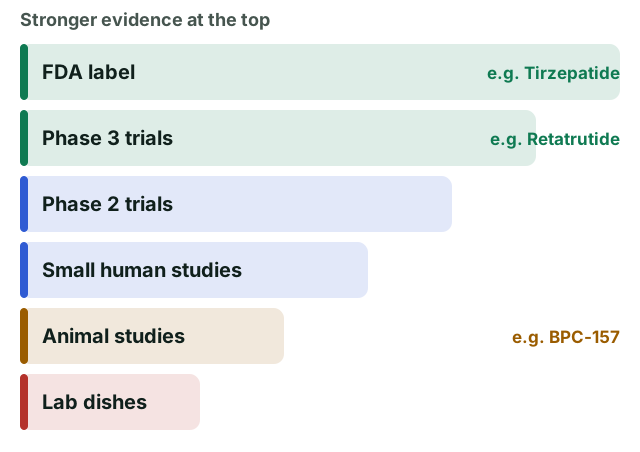
KPV sits on the second rung. Plenty of compounds that look good in mice never make it further, and the basics of how peptides work explain why a short chain of amino acids can behave very differently once it has to survive a human gut or bloodstream.
Does the October 2026 HHS policy mean KPV works?
No. FDA staff proposed against making KPV available for compounding, and FDA’s advisory committee voted 8 to 6 to recommend it anyway on July 23, 2026. Then, on October 28, 2026, HHS announced an interim policy: as of November 2, 2026, it says it does not intend to take enforcement action against state-licensed pharmacies, federal facilities or licensed physicians compounding KPV acetate in topical or oral forms, if ten conditions are met, until a final rule addresses KPV. A patient-specific prescription and a single active ingredient are among those conditions, so blends fall outside it.
That is a decision about enforcement. It rests on what HHS calls patient choice and access, and on better chemical documentation, and it adds no clinical data. KPV is still not FDA-approved and not on the 503A bulks list, no rule has been proposed, and FDA has reviewed no compounded product for safety, effectiveness or quality. The notice says the policy is not binding, written comments run until November 13, 2026, HHS may revisit it if a safety signal or quality problem appears, it covers 503A compounding only, and states can be stricter. Injected KPV is not covered at all.
The KPV dosage page explains why the animal doses do not tell anyone what a human dose would be, and the FDA status tracker records each regulatory step.
Compare
Recent news on this
Peptide news, sorted. Plus the printable dose chart.
Sorted, every Tuesday: the week's peptide and GLP-1 news in five minutes: FDA moves, new studies explained, and price changes. Subscribe and the one-page dose and injection-site chart arrives first.
Questions people ask
What is KPV peptide good for?
Does KPV help with IBD, Crohn's or ulcerative colitis?
Does KPV cream work on skin?
Does KPV help with weight loss?
Does KPV help with acne?
Is KPV antibacterial?
Sources
Primary sources first: FDA labels and documents, peer-reviewed trials, registries.
- 1FDA. Briefing document: evaluation of KPV-related bulk drug substances, Pharmacy Compounding Advisory Committee, July 23-24, 2026 (memo dated May 12, 2026)fda.gov
- 2HHS. Enforcement Discretion Policy Regarding 503A Compounding Using Certain Peptide Bulk Drug Substances, with Appendices A and B, October 2026hhs.gov
- 3Federal Register. Notice of availability, FR Doc. 2026-22192, Docket HHS-OASH-2026-0496, RIN 0910-ZD94, published October 30, 2026public-inspection.federalregister.gov
- 4AJMC. 5 things to know about HHS's interim peptide compounding policy, 2026ajmc.com
- 5DLA Piper. FDA AdComm recommends adding six peptides to bulks list, July 31, 2026dlapiper.com
- 6Dalmasso G et al. PepT1-mediated tripeptide KPV uptake reduces intestinal inflammation. Gastroenterology 2008pubmed.ncbi.nlm.nih.gov
- 7Kannengiesser K et al. Melanocortin-derived tripeptide KPV has anti-inflammatory potential in murine models of inflammatory bowel disease. Inflamm Bowel Dis 2008pubmed.ncbi.nlm.nih.gov
- 8Laroui H et al. Drug-loaded nanoparticles targeted to the colon with polysaccharide hydrogel reduce colitis in a mouse model. Gastroenterology 2010pubmed.ncbi.nlm.nih.gov
- 9Xiao B et al. Orally targeted delivery of tripeptide KPV via hyaluronic acid-functionalized nanoparticles efficiently alleviates ulcerative colitis. Mol Ther 2017pubmed.ncbi.nlm.nih.gov
- 10Cheng J et al. Inflammation-triggered self-immolative conjugates enable oral peptide delivery by overcoming gastrointestinal barriers. Sci Adv 2026pubmed.ncbi.nlm.nih.gov
- 11Zhao Y et al. A KPV-binding double-network hydrogel restores gut mucosal barrier in an inflamed colon. Acta Biomater 2022pubmed.ncbi.nlm.nih.gov
- 12Getting SJ et al. Dissection of the anti-inflammatory effect of the core and C-terminal (KPV) alpha-melanocyte-stimulating hormone peptides. J Pharmacol Exp Ther 2003pubmed.ncbi.nlm.nih.gov
- 13Elliott RJ et al. Alpha-MSH, MSH 11-13 KPV and ACTH signalling in human keratinocyte cells. J Invest Dermatol 2004pubmed.ncbi.nlm.nih.gov
- 14Pawar K et al. Transdermal iontophoretic delivery of lysine-proline-valine (KPV) peptide across microporated human skin. J Pharm Sci 2017pubmed.ncbi.nlm.nih.gov
- 15Bonfiglio V et al. Effects of the COOH-terminal tripeptide alpha-MSH(11-13) on corneal epithelial wound healing. Exp Eye Res 2006pubmed.ncbi.nlm.nih.gov
- 16Shao W et al. In situ mucoadhesive hydrogel capturing tripeptide KPV: effect on chemotherapy-induced oral mucositis. Biomater Sci 2021pubmed.ncbi.nlm.nih.gov
- 17Böhm M, Luger T. Are melanocortin peptides future therapeutics for cutaneous wound healing? Exp Dermatol 2019pubmed.ncbi.nlm.nih.gov
- 18Cutuli M et al. Antimicrobial effects of alpha-MSH peptides. J Leukoc Biol 2000pubmed.ncbi.nlm.nih.gov
- 19Land SC. Inhibition of cellular and systemic inflammation cues in human bronchial epithelial cells by melanocortin-related peptides: mechanism of KPV action. Int J Physiol Pathophysiol Pharmacol 2012pubmed.ncbi.nlm.nih.gov
- 20Lee JY et al. Lysine-proline-valine peptide attenuates hepatic lipid accumulation in HepG2 cells. Cytotechnology 2026pubmed.ncbi.nlm.nih.gov
- 21An SH et al. KPV attenuates adipogenesis and lipid metabolism through modulation of ROS-mediated AKT/mTORC1/PPARgamma signaling. Tissue Cell 2026pubmed.ncbi.nlm.nih.gov
- 22Bai JS et al. Lysine-Proline-Valine attenuates oxidized low-density lipoprotein-induced foam cell formation and inflammatory responses in RAW264.7 macrophages. Tissue Cell 2026pubmed.ncbi.nlm.nih.gov
More on KPV
- OverviewKPVKPV is an anti-inflammatory tripeptide studied in cells and mice. No human study exists and it is not FDA-approved. What changed with HHS in October 2026.
- DosageThere is no KPV dose for people, because no human study exists. See the mouse, rat and rabbit doses, why they do not translate, and the unit math.Read
PeptideSorted Editorial Team
Editorial review
The PeptideSorted editors check every guide against its cited sources before publication: each number against its FDA label, trial or registry, the FDA status against current FDA and HHS documents, and the wording against our describe-never-prescribe rule. Licensed clinicians who join the review panel are listed by name on the editorial team page.
This page was checked against its cited sources by the PeptideSorted editorial team. Licensed clinicians on our review panel are listed on the editorial team page. Every health page cites primary sources and shows its review date. Read the editorial policy and how medical review works, or report an error via corrections. Educational only; not medical advice.